semrush seo or site audit -moz -ahrefs: Scope
semrush seo or site audit -moz -ahrefs starts as a project crawl. Compare scope and taxonomy before you trust a score.
Author credentials: William Zhu is cofounder of InfiniSynapse (GitHub @allwefantasy · auto-coder). Desk: shipping SEO Health and the /en/tool/ visibility pages. No personal LinkedIn published. About: team / editorial standards.
Publisher credentials: InfiniSynapse has public profiles on GitHub, YouTube, and X. A 2026 WAIC Future Tech OPC excellence award covers the Agentic Data Infra entry (WAIC; third-party recap: Xinhua / Caohejing). That award does not review this page or SEO Health. Method CLI: infinitegrowth on npm. Archive: recognition and scope notes.
On this page
By William Zhu · Cofounder, InfiniSynapse · Published: 2026-09-11 · Last updated: 2026-09-27 · Last verified: 2026-09-14 · Reviewed by the InfiniSynapse Data Team.
Reviewed by: InfiniSynapse Data Team · method review 2026-09-14. First-party desk on this host versus Semrush Knowledge Base documentation; we did not run a Semrush Site Audit project.
Trust / COI: About · Corrections. SEO Health is a commercial product from this team. Semrush KB pages are vendor docs, not a crawl we ran and not a purchasing recommendation.
TL;DR
We did not log into Semrush for this rewrite. A semrush site audit comparison is a scope call: three maps, eight fetches, and one CLI on this host versus a recurring suite crawl we did not execute.
Direct answer: semrush seo or site audit -moz -ahrefs starts as a project crawl. Keep a semrush site audit in its product box. Our 2026-09-14 desk is inventory plus a stratified fetch plus one hub JSON. The suite is a configured project with its own issue taxonomy and history. Those are different jobs. Do not paste a Health Score we never collected.
On 2026-09-14 we used curl with user-agent InfiniSynapse-P2-desk/2026-09-14 and one seo-health check on the hub URL. The sample size is three declared maps, eight public requests, and one CLI document. That sample cannot establish how a Semrush crawler would classify this host, and it does not prove the Knowledge Base still matches a live project. We did not run Semrush. Cite the KB as documentation. Do not cite it as our crawl.
What you will learn
- What this desk measured without a suite login
- Which Semrush KB pages define configuration, issues, and limits
- Why issue labels cannot be compared as percentages
- When suite history is the actual requirement
- Where this semrush site audit page stops and a sibling owns the desktop sample or the export tool
The buyer already knows the brand. This semrush site audit page exists so the brand does not swallow the desk. Write the desk first. Open the KB second. If those two paragraphs agree, you still have two products. Agreement is not identity.
Semrush SEO suite or the Site Audit project
Key definition: A semrush site audit in this article is the vendor’s recurring project workflow as documented in its Knowledge Base, compared against a first-party public desk. It is not a crawl we ran, not a Health Score we copied, and not an official Google grade.
Semrush SEO is the suite: keyword research, competitor research, and the audit project. Site Audit is the project crawler inside that suite. Keyword research is not this desk.
Moz is a different crawler. This desk did not run it, and the query operators leave it out.
Ahrefs is a different crawler. This desk did not run it, and the query operators leave it out.
How Site Audit works is the vendor overview. Configuring Site Audit is the configuration surface. We cite both as documentation. Citation does not mean we configured a project, and it is not a purchasing recommendation.
People open a semrush site audit page when a buyer already knows the suite and wants to know whether a smaller public sample is the same job. It is not.
SEO Health remains the measurement layer for one-URL lights. After those rows exist, a team may send the export into an InfiniSynapse Server API long-task workspace; the API does not create a Semrush project and does not import a suite crawl.
Name the operating job
Decide whether the need is one bounded technical sample, a recurring project with crawl history, or broader competitive and backlink research. Do not blend them. A semrush site audit belongs inside a broader platform. Evaluate that history separately from the first public 200.
Compare crawl source as a requirement
Our desk started from robots Sitemap lines. A suite project starts from a configured crawl. Those sources can disagree. Write the source before you compare issue counts.
What this desk actually ran
User-agent InfiniSynapse-P2-desk/2026-09-14 requested eight public addresses.
| Requested URL | First status | Note |
|---|---|---|
/ | 200 | 91,875 bytes |
/en | 308 | Location / |
/en/tool/seo-website-audit | 200 | 95,445 bytes |
/en/blog/seo-website-audit | 308 | Location /en/tool/seo-website-audit |
/en/tool/seo-audit-tool | 200 | 87,057 bytes |
/en/blog/what-is-a-data-agent | 200 | 93,934 bytes |
invented /en/this-path-…-p2-20260914 | 301 | Then blog 404; homepage title |
/robots.txt | 200 | 938 bytes |
Three maps answered 200: 1,568 + 76 + 94 = 1,738 locs. The main map split 392 / 1,131 / 45. The hub CLI exited 0 with one Image Alt Text warning and about 71 KB of JSON. We did not run audit --pages 50.
That is the entire first-party scope for this semrush site audit comparison. It is not a suite crawl. It is not a Site Audit campaign. It is not a logged-in project history.
Write those three refusals in the method block of every memo that cites this semrush site audit. A later slide will try to title the eight fetches “Semrush vs SEO Health.” The title is already false. We have no Semrush column. We have a desk column and a documentation column. Keep the documentation column labeled as unread-by-crawler, because we did not run Semrush.
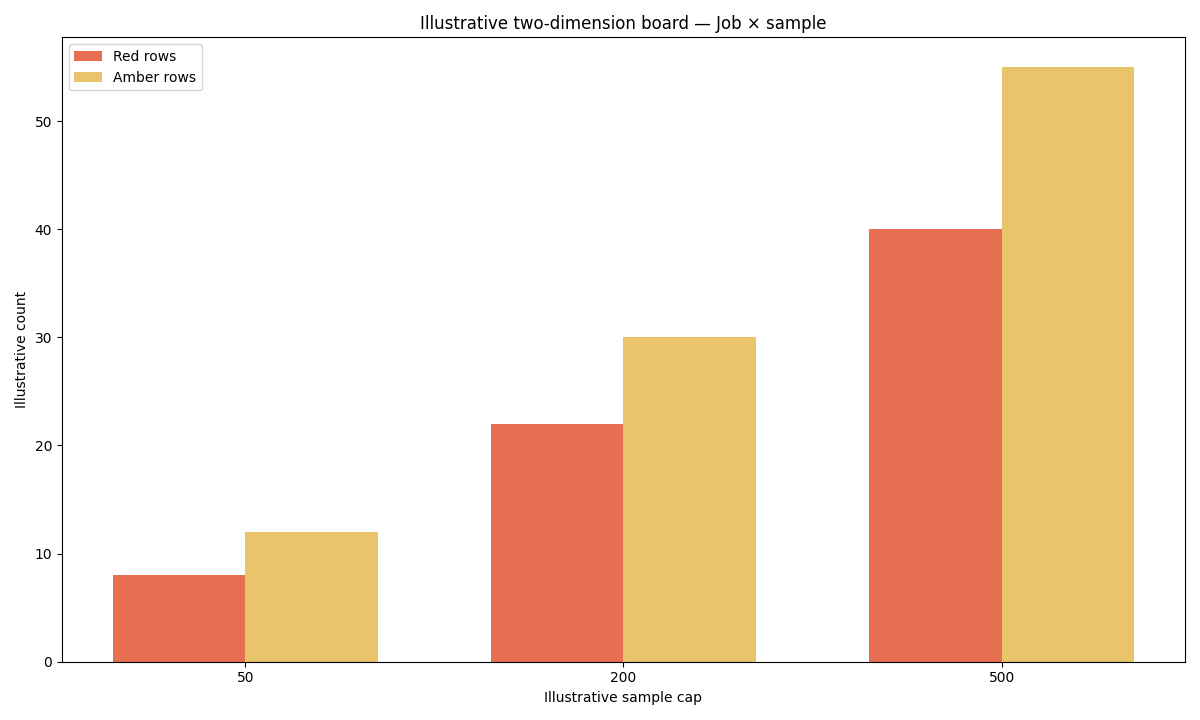
Figure: Two series from the same first-party desk. Loc count is not a suite crawl. Fetch count is not a Health Score.
How we fetched
curl -sS -A 'InfiniSynapse-P2-desk/2026-09-14' \
  https://infinisynapse.com/robots.txt
# three Sitemap: lines · we did not open a Semrush project
Record the user-agent and the date. As of 2026-09-14 those counts matched this desk. A later deploy can change Location. A later Semrush crawl — if someone else runs one — can change issue totals. This file will not invent those totals.
What the CLI still is not
Exit 0 plus a warning is a punch list for one URL. RFC 9110 is why first status and terminal status both get written on the hop rows. It does not translate those rows into a suite taxonomy.
What vendor docs say we did not run
Site Audit issues list documents how the suite groups findings. Vendor docs describe a large check list. This desk’s eight fetches are not that list, and we did not count their checks. Semrush subscription limits documents plan ceilings. We did not execute either surface. A semrush site audit write-up that quotes those pages as if they were our crawl has already crossed the line.
The suite, as documented, is a recurring project: crawl configuration, issue history, and a taxonomy that is not issues[].name from our CLI. Our desk has no crawl history. Skills workflows in this website repo have zero schedule: keys. That is a first-party cadence observation. It is not a Semrush scheduler test.
Google Search Console start remains the property-level search-data contract. Google Analytics documentation is a separate measurement boundary. Neither is a Semrush project, and neither was pulled for this rewrite.
Use those KB URLs as the buyer’s reading list. Do not use them as a substitute for a project we did not open. The SEO audit tool page owns how to choose export fields on our side. This page owns the refusal to pretend the fields match.
A semrush site audit buyer who needs week-over-week issue counts inside that product should read the configuration and limits pages before they read our hop table. The hop table will not grow a history. The limits page will not fetch /en. Those documents answer different questions. Keep them in different folders.
We also did not pull Search Console or Analytics for this rewrite. Google Search Console start and Google Analytics documentation stay in the file as boundary citations. They are not a hidden third crawl and not a semrush site audit we ran.
How to compare without fake parity
Taxonomy alignment
Different products group and weight issues differently. Map raw conditions — first status, Location, missing alt — before comparing severity labels. “Error” in a suite is not “error” in our CLI. A Site Audit score is a vendor metric. This desk did not collect one. A semrush site audit bake-off that starts with Health Score versus speed 79 is already invalid.
History versus a desk
Suite history is a requirement when the buyer needs week-over-week issue counts inside that product. Our semrush site audit desk is a dated snapshot. Eight fetches cannot establish a trend. If history is the job, the suite is the product. If today’s hop table is the job, the desk is enough.
Knowledge-base drift
Saved KB slugs can move. We treat the current URLs as documentation pointers, not as a 2026-09-11 availability probe of six KB paths. This rewrite does not reuse that older fixture. If you cite a KB article, save the final URL and the title you actually saw.
The Screaming Frog alternative page owns desktop-versus-sample scope. Keep that decision out of this suite comparison.
How to read the decision
Write the semrush site audit job in one sentence. If the sentence is “show me 1,738 locs and eight statuses,” you do not need a suite login. If the sentence is “keep a project history inside Semrush and use its issue system,” you do. A semrush site audit is the second sentence.
Use the bounded sample for fast triage. Use the suite when project history and its issue system are requirements. Document any handoff: our JSON fields do not automatically become suite issues.
The SEO website audit hub owns the three-map inventory. Open it when the buyer is actually arguing about population, not about vendor brand.
Limit the claim. This sample cannot establish how the suite would score the invented 404, and it does not prove a paid plan would list the same 1,568 locs. Write that next to the table.
A fair sequence is desk first, suite second, only if the leftover sentence names history or taxonomy. A semrush site audit that starts in the suite and then “validates” our eight URLs is running the products in the wrong order for this host. The invented 404 is already visible without a project. The 308 from /en is already visible without a project. Save the project for the leftover sentence.
If the leftover sentence is empty, stop. You do not owe the suite a demo. You owe the semrush site audit an honest N.
Failure modes that fake a bake-off
Treating Semrush as only a crawler. The documented product is a suite project.
Comparing proprietary health percentages directly. We have no Semrush percent.
Calling absent backlink data a sampler defect. Backlinks were never this desk’s job.
Citing KB pages as if they were our crawl. They are vendor docs.
Running different fixtures in each product. We ran fixtures in one product: this host.
Using a suite subscription as proof every project needs suite scope. A 1,738-loc public host may not.
Inventing a Semrush crawl of infinisynapse.com. We did not run one. A semrush site audit article that pretends otherwise fails the method review.
Translating speed 79 into a Health Score. There is no translation table. Drop the percent.
Calling KB citation a bake-off. Reading How Site Audit works is not running Site Audit. A semrush site audit comparison that treats “we opened the docs” as “we crawled the host” has already failed Trust / COI.
Adjacent guides
This semrush site audit returns to the SEO website audit hub for inventory. Narrower jobs stay on siblings.
| Job you actually have | Guide to open next |
|---|---|
| Desktop sample versus Spider | Screaming Frog alternative |
| Export fields, not a 100 | SEO audit tool |
| Declared maps and strata | SEO website audit |
Write the desk scope before you compare a suite
Save the three maps, the eight fetches, and the CLI JSON. Then open vendor docs as docs, not as your crawl.
Run SEO Health CheckerFrequently Asked Questions
semrush seo or site audit -moz -ahrefs
semrush seo or site audit -moz -ahrefs starts as a project crawl. Site Audit is the crawler inside the Semrush SEO suite. Compare scope and taxonomy before you trust a score. This desk collected no Health Score, and it did not run Moz or Ahrefs.
Is Semrush Site Audit the same as a sitemap sample?
No. A bounded sample answers a narrow public-URL question. A semrush site audit is a recurring suite workflow with its own crawl configuration, issue taxonomy, and history. We did not run that workflow.
Can health scores be compared across products?
Not reliably. Compare matched raw conditions and URLs first. We have speed 79 and one named warning on one URL. We do not have a Semrush Health Score.
When does the suite add value?
When recurring project history, integrated workflows, a broader issue system, and other Semrush datasets are requirements rather than incidental extras. Today’s hop table does not need that box.
Did we run Semrush on this host?
No. The 2026-09-14 record is three maps, eight fetches, and one CLI check. KB URLs are citations. After the desk rows exist, a credited memo may be opened once in the InfiniSynapse web app.
Why verify Knowledge Base URLs separately?
An old slug can land on a different article. Preserve requested URL, final URL, and HTML title before using a KB page as comparison evidence. That check is documentation hygiene. It is not a site audit.
Conclusion
Use a semrush site audit comparison when the job is to keep suite scope separate from a first-party desk. The 2026-09-14 file is 1,738 locs, eight fetches, and one CLI JSON. We did not run Semrush. Close the semrush site audit when the two scopes, the missing Health Score, and the leftover suite requirements are still visible. A scoped desk is more useful than an unsupported vendor bake-off.
If a later week someone does open a project, give that run its own date, UA, and export. Do not splice those rows into this semrush site audit file as if they were part of the 2026-09-14 desk. The method review stopped at documentation plus our own host.
William Zhu · Cofounder, InfiniSynapse · GitHub @allwefantasy
Desk-validated SEO Health methods. Corrections: zhuhl@infinisynapse.com · corrections policy.