Screaming Frog Alternative: When a Sample Is Enough
Evaluate a Screaming Frog alternative by crawl scope, rendering, exports, storage, and repeatability; use a bounded sample only when it fits your job.
Author credentials: William Zhu is cofounder of InfiniSynapse (GitHub @allwefantasy · auto-coder). Desk: shipping SEO Health and the /en/tool/ visibility pages. No personal LinkedIn published. About: team / editorial standards.
Publisher credentials: InfiniSynapse has public profiles on GitHub, YouTube, and X. A 2026 WAIC Future Tech OPC excellence award covers the Agentic Data Infra entry (WAIC; third-party recap: Xinhua / Caohejing). That award does not review this page or SEO Health. Method CLI: infinitegrowth on npm. Archive: recognition and scope notes.
On this page
By William Zhu · Cofounder, InfiniSynapse · Published: 2026-09-11 · Last updated: 2026-09-14 · Last verified: 2026-09-14 · Reviewed by the InfiniSynapse Data Team.
Reviewed by: InfiniSynapse Data Team · method review 2026-09-14. First-party map inventory and eight public fetches on this host; we did not run Screaming Frog SEO Spider.
Trust / COI: About · Corrections. SEO Health is a commercial product from this team. Vendor documentation is cited for stated capabilities, not as a crawl we ran and not as a ranking of the desktop product.
TL;DR
This host declared 1,738 public locs. That volume does not buy a 500,000-URL desktop license. A Screaming Frog alternative is honest only when the remaining job fits a bounded sample, and it is dishonest when the remaining job is JavaScript-heavy private staging.
Direct answer: Use a Screaming Frog alternative when the question is status and repeated templates on a declared public list. Do not use it as a stand-in for graph discovery, authenticated areas, or custom extraction. We did not run Screaming Frog. The comparison below is this host’s desk against documented SEO Spider capabilities.
The 2026-09-14 pass used curl as InfiniSynapse-P2-desk/2026-09-14 on public InfiniSynapse paths. The sample size is three maps, eight public requests, and one hub CLI check. That sample cannot establish orphan URLs the maps omitted, and it does not prove a desktop crawl would agree. We did not launch the SEO Spider. Reproduce the loc counts. Do not invent a Frog project.
What you will learn
- Why 1,568–1,738 public locs are a list, not a 500k crawl
- Which first-party hops a sample already caught
- When documented Spider features still exceed a hosted check
- Why JS-heavy staging is outside this desk
- Where this Screaming Frog alternative page stops and a sibling owns crawler scope or suite comparison
The leftover-job test is the whole Screaming Frog alternative. If you cannot name the leftover job in one sentence, you are not ready to buy a desktop license and you are not ready to claim a substitute. Write the sentence before you open a pricing page.
What the job actually requires
Key definition: A Screaming Frog alternative is a scoped decision: can a bounded public sample answer this job, or does the job still need a desktop graph crawl. It is not a price war, not a feature-table collage, and not a claim that we ran the Spider.
The SEO Spider user guide is the vendor’s own scope document. The SEO Spider FAQ is the second official surface for limits. We cite both to verify stated capabilities. Citation is not a crawl we performed and not an endorsement.
People open a Screaming Frog alternative when a ticket says “we need Frog” and the actual question is whether eight stratified URLs already show the broken template. They do not need a 500k license for a 1,738-loc public host.
SEO Health remains the deterministic evidence foundation for one-URL lights and for a documented audit --pages range. After those rows exist, a team may send the export into an InfiniSynapse Server API long-task workspace; the API does not discover orphans and does not replace the Spider.
Write the requirement first
Specify discovery source, URL volume, JavaScript rendering, authentication, custom extraction, integrations, storage, scheduling, and export needs before naming a substitute. A Screaming Frog alternative that starts with price has already skipped the job.
Honor robots before you praise either tool
This host’s robots.txt answered 200 (938 bytes), allowed /, and disallowed /auth/, /api/, /v1/, /webhooks/, /dashboard, /analyze, and /Volumes/. The desk fetched public HTML only. It did not hit /api/ or /auth/. RFC 9309 is the robots semantics reference we used. A substitute that ignores Disallow is not an alternative. It is a policy violation.
This host’s public estate on 2026-09-14
Three Sitemap lines were present. All three maps answered 200.
| Map named in robots.txt | Bytes on 2026-09-14 | <loc> values |
|---|---|---|
/sitemap.xml | 192,851 | 1,568 |
/sitemap-seo-health.xml | 14,309 | 76 |
/contest/vibe-coding/gallery/sitemap.xml | 22,256 | 94 |
| Three-file total | 1,738 |
The main map split as 392 /en/tool/, 1,131 /en/blog/, and 45 other. No loc used page= or /page/. Last-Modified was Fri, 11 Sep 2026 11:37:28 GMT. The map file carried x-robots-tag: noindex, nofollow. Google’s sitemap overview is why a sitemap remains a hint list, not a discovered graph. 1,568 locs are not a crawl tree.
Eight public fetches were enough to see the hop pattern on this host: / 200, /en 308 to /, hub tool 200, blog twin 308 to the tool URL, blog article 200, invented /en/ path 301 then blog 404 with the homepage title, robots 200.
A 500,000-URL desktop crawl is the wrong instrument for that table. A Screaming Frog alternative that still wants the Spider here must name a leftover requirement the eight rows cannot see: orphans, JS-only routes, or authenticated staging.
1,568 public locs on the main map is smaller than many mid-market desktop projects and far smaller than a 500k ceiling. That comparison is about N, not about brand. If N later grows by an order of magnitude, reopen the Screaming Frog alternative. Until then, size the Screaming Frog alternative to the list you actually declared.
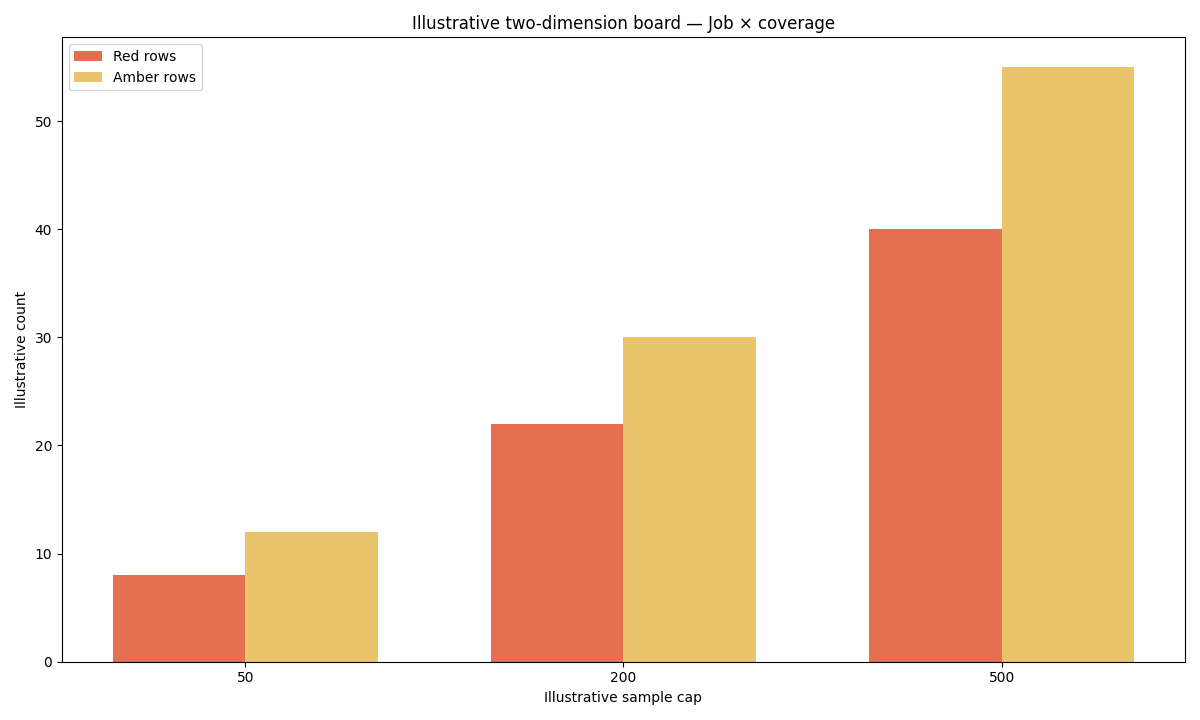
Figure: Two series from the same robots desk. Loc count is not a Spider crawl. HTTP 200 is not feature parity.
How we counted locs
curl -sS -A 'InfiniSynapse-P2-desk/2026-09-14' \
  https://infinisynapse.com/robots.txt
Count <loc> in each map. Record bytes and Last-Modified. As of 2026-09-14 those counts matched this desk. A later deploy can change the list. We still did not run Frog against it.
What the hub CLI added
seo-health check on the hub URL exited 0 with one Image Alt Text warning (2/5). That is a page light, not a site graph, and not a Screaming Frog alternative crawl. We did not run audit --pages 50. A hosted 50–500 sample is still not the SEO Spider.
When a bounded sample is enough
Public keep templates
A bounded sample is enough on this host when the question is: do the keep templates answer 200, do twins 308, and does a miss 404 with an honest title. Eight rows already answered those questions for the paths we fetched. The seo crawler page owns how a crawler must honor the Disallow list. This Screaming Frog alternative owns the substitute decision.
A larger sample that is still not Frog
A Screaming Frog alternative can also be a 50–500 sitemap sample when you need more templates and still do not need link traversal. On 1,568 locs, 50 is about 3.2 percent. That is a sample. It is not a census, and it is not a desktop project we ran.
The canonical audit tutorial and the XML sitemap audit tutorial document how the Spider approaches those jobs. Use them as capability references. Do not paste their screenshots as if they were this desk.
A hosted check that you can rerun after deploy is enough when the defect is a template. The invented 404 title is a template defect. You do not need a 500k graph to see it again next week. You need the same URL, the same UA, and a new date. That loop is a Screaming Frog alternative for this host. It is not a loop we claim for a client’s authenticated app.
When the desktop spider still wins
Choose the SEO Spider when the leftover job is graph discovery beyond the maps, custom extraction, deep configuration, integrations, or a local crawl store. The configuration guide and the integrations guide state those surfaces. We did not exercise them.
JS-heavy staging and auth
JavaScript-heavy private staging is the cleanest reject for a hosted public sample. This desk never authenticated. Robots already disallow /auth/ and /dashboard. A Screaming Frog alternative that claims to replace the Spider on a logged-in Next.js preview is selling a job we did not do.
Custom extraction is the second reject. The configuration guide documents extraction surfaces we did not use. If the leftover sentence is “pull every product SKU from a JS table,” the desktop project still wins. Do not stretch a Screaming Frog alternative across that sentence.
Storage and scheduling also differ. This website repo has no scheduled GitHub Actions in the Skills workflows we inspected (schedule: keys were zero). That is a cadence fact, not a Spider benchmark. A desktop user can still save a project and rerun it locally. A hosted check that you do not schedule is not that project.
The semrush site audit page owns suite-versus-sample scope. Do not blend that vendor crawl into this desktop decision. The operator cut is semrush seo or site audit -moz -ahrefs.
How to read the comparison
Job parity first. A Screaming Frog alternative is credible only for requirements it actually meets. Price cannot substitute for rendering controls or export depth. This Screaming Frog alternative is credible for public status on this host. It is not credible for orphan discovery.
Complement versus replacement. A sample can answer an early template question and still leave a legitimate desktop crawl. That sequence is not feature parity. Write “complement” when the Spider still has work.
Documentation currency. Official pages are the comparison source. We did not re-fetch every tutorial for this rewrite. If a saved vendor URL moves, that is a citation-maintenance fact, not proof the product lost a feature.
The SEO website audit hub owns the three-map inventory. Use it when the substitute debate is actually an inventory debate.
Write the escalate clause in the same memo. “Sample first; Spider if orphans remain” is a sequence. “We replaced Frog” is a slogan. A Screaming Frog alternative memo should keep the sequence and drop the slogan. If nobody on the team has a Spider license, say that. Missing a license is not evidence the leftover job vanished.
Failure modes that fake parity
Calling a sitemap subset a full crawler. 1,738 locs are declared. They are not a discovered graph.
Comparing only price and URL limits. Rendering, auth, and extraction still exist.
Ignoring JavaScript and authentication. Private staging remains a Spider job until proven otherwise.
Claiming orphan discovery without link traversal. This desk did not walk internal links.
Using stale third-party feature tables. Read the current user guide.
Portraying the incumbent as inferior without matched tests. We did not run Frog. A Screaming Frog alternative write-up that grades the Spider from our eight fetches is already invalid.
Treating the hub CLI warning as a site crawl. One URL, one warning.
Adjacent guides
This Screaming Frog alternative returns to the SEO website audit hub for inventory. Narrower jobs stay on siblings.
| Job you actually have | Guide to open next |
|---|---|
| Crawler scope and robots | seo crawler |
| Suite crawl versus this desk | semrush site audit |
| Declared maps and strata | SEO website audit |
Sample the declared maps before you buy a desktop crawl
Count locs, fetch a stratum, and name the leftover job. Escalate only if that leftover job is real.
Run SEO Health CheckerFrequently Asked Questions
Is a bounded sampler a full Screaming Frog alternative?
Only for bounded public-status and repeated-template jobs on a host like this one. It is not equivalent when you need link discovery, custom extraction, rendering configuration, or a local crawl graph. We did not run the Spider to prove otherwise.
When should SEO Spider be used after a sample?
Use it when the sample is clean but the unanswered requirement is graph-wide discovery, orphan analysis, deep extraction, integrations, or a durable desktop export. JS-heavy private staging is the default escalate.
How should features be compared?
Write requirements first, verify current official documentation, then run matched fixtures if you have a license. Do not infer parity from similar issue labels. This page compared documented capabilities to a desk we actually ran.
Did we run Screaming Frog on this host?
No. The 2026-09-14 file is three maps, eight fetches, and one CLI check. A Screaming Frog alternative decision here is a scope call, not a head-to-head crawl. After the loc counts exist, a credited memo may be opened once in the InfiniSynapse web app.
Why report loc counts instead of a 500k limit?
Because this host’s public estate is 1,568–1,738 declared locs. A 500k ceiling answers a different site. Size the tool to N, then name the leftover job.
Conclusion
Use a Screaming Frog alternative when the leftover job fits a bounded public sample on this host. The 2026-09-14 desk shows 1,738 locs, eight hops, and no Spider run. Close the Screaming Frog alternative when the requirement list, the loc counts, and the escalate reasons are still visible. A scoped sample is more useful than an unsupported “we replaced Frog” claim.
If the next host is a JS storefront behind login, start over. This file is about InfiniSynapse public locs. A Screaming Frog alternative that copies these 1,738 counts onto a private catalog is answering the wrong N.
William Zhu · Cofounder, InfiniSynapse · GitHub @allwefantasy
Desk-validated SEO Health methods. Corrections: zhuhl@infinisynapse.com · corrections policy.