Google Algorithm Updates September 2026
Google algorithm updates September 2026: no confirmed ranking incident as of 23 Sep. Latest closed window is the 18–21 Aug spam update.
Author credentials: William Zhu is cofounder of InfiniSynapse (GitHub @allwefantasy · auto-coder). Desk: shipping SEO Health and the /en/tool/ visibility pages. No personal LinkedIn published. About: team / editorial standards.
Publisher credentials: InfiniSynapse has public profiles on GitHub, YouTube, and X. A 2026 WAIC Future Tech OPC excellence award covers the Agentic Data Infra entry (WAIC; third-party recap: Xinhua / Caohejing). That award does not review this page or SEO Health. Method CLI: infinitegrowth on npm. Archive: recognition and scope notes.
On this page
By William Zhu · Cofounder, InfiniSynapse · Published: 2026-09-08 · Last updated: 2026-09-24 · Last verified: 2026-09-23 · Reviewed by the InfiniSynapse Data Team.
Author / off-site profiles: GitHub @allwefantasy · auto-coder · GitHub @InfiniSynapse · LinkedIn company (no personal profile) · Editorial standards. No personal LinkedIn or vendor badge.
Reviewed by: InfiniSynapse Data Team · method review 2026-09-14. First-party method review of a public Google feed.
Trust / COI: About · Corrections. We sell SEO analysis workflows, so product references are a conflict of interest. The nine-row table is the 2026-09-23 fetch of a public JSON feed. The ten-row table is the 2026-09-14 archive. Neither is a customer GSC export or a ranking study.
A google algorithm tracker lists confirmed Search updates with start and end dates. Match a window to Search Console before you blame an update.
TL;DR
A google algorithm tracker is a dated register of named Search Status incidents. It stores the official title, product, start, end, and retrieval time. It records named algorithm updates. It does not forecast the next core update, and it does not name the query that lost clicks on your property.
Direct answer: Google algorithm updates September 2026 are absent from the 2026-09-23 public feed: no confirmed ranking incident opened or closed in September. The newest completed ranking window was the August 2026 spam update, 18–21 August. A google algorithm tracker is the join key between that cited URL and a Search Console window you can reopen. Overlap can prioritize review. Overlap cannot prove that Google caused a loss on one URL.
What a google algorithm tracker shows right now
On 2026-09-23 we fetched incidents.json again: HTTP 200, 11,700 bytes, nine objects. Every object had an end time. No ranking incident in that fetch was still open.
The newest ranking row was the August 2026 spam update, 2026-08-18T16:27:00+00:00 through 2026-08-21T08:49:00+00:00. The nine-row table in the next section is that fetch. The ten-row table later on this page is the 2026-09-14 archive. A later poll of this google algorithm tracker appends a note. It does not silently delete the older retrieval.
The current confirmed list
This google algorithm tracker table is the 2026-09-23 retrieval of incidents.json. It is a first-party desk observation of a public feed, not a customer case and not a ranking study. Class is our label from external_desc, not a Google enum. Hours are (end − begin) in UTC. Updates are the length of the updates array. None of those derived columns measure traffic.
| Official description | Class | Begin (UTC) | End (UTC) | Hours | Updates | Product |
|---|---|---|---|---|---|---|
| August 2026 spam update | spam | 2026-08-18 16:27 | 2026-08-21 08:49 | 64.4 | 2 | Ranking |
| June 2026 spam update | spam | 2026-06-24 16:00 | 2026-06-26 17:00 | 49.0 | 2 | Ranking |
| May 2026 core update | core | 2026-05-21 15:40 | 2026-06-02 12:40 | 285.0 | 2 | Ranking |
| March 2026 core update | core | 2026-03-27 09:00 | 2026-04-08 13:00 | 292.0 | 2 | Ranking |
| March 2026 spam update | spam | 2026-03-24 19:00 | 2026-03-25 14:30 | 19.5 | 2 | Ranking |
| Serving was experiencing an issue | serving | 2026-02-25 03:55 | 2026-02-25 04:10 | 0.2 | 2 | Serving |
| February 2026 Discover update | discover | 2026-02-05 17:00 | 2026-02-27 10:00 | 521.0 | 2 | Ranking |
| December 2025 core update | core | 2025-12-11 17:25 | 2025-12-29 19:00 | 433.6 | 2 | Ranking |
| Serving is experiencing an ongoing issue | serving | 2025-10-03 20:00 | 2025-10-06 20:40 | 72.7 | 3 | Serving |
curl -sS -D - -o incidents-2026-09-23.json \
  https://status.search.google.com/incidents.json
A google algorithm tracker should keep the response status, byte size, object count, and retrieval date beside the table. The May 2026 core update (wdAXJk6LRRihEjpzEeWE) and the March 2026 core update (7eTbAa2jWdToLkraZj5y) are rows a reviewer can reopen. Do not replace them with a blog nickname.
September 2026 on the confirmed feed
Google algorithm updates September 2026 are not a row in that nine-object fetch. No begin or end falls in September 2026. The newest closed ranking window remains the August 2026 spam update, 18–21 August. Core dates stay on the Google core update changelog. A dip that does not overlap a named window is a ranking drop after update question, not a new September incident.
A confirmed row needs the official title, permalink, begin, end, and the retrieval time. Those fields are what the Google Search incidents page copies off one status URL. A heatmap does not supply them.
Search Engine Roundtable reported ranking volatility on 4 September, a possible revert on 13 September, and another heated morning on 15 September. Those posts are not objects in the 2026-09-23 incidents.json. They stay off this confirmed list.
Confirmed rows vs unconfirmed chatter
A row is confirmed when Google names it on the Search Status Dashboard or on a Search Central URL you can reopen. A volatility heatmap, a Slack rumor, and a nickname list that starts before this feed are a different product. This google algorithm tracker does not reconstruct them. Those notes must not inherit an official begin time.
Community chatter about a fluctuation after 21 August 2026 is not a row in the 2026-09-23 fetch. Absence from the feed is a retrieval result. It is not a certificate that ranking was still.
Core, spam, Discover, and serving
The nine-object fetch holds three spam updates, three core updates, one Discover update, and two serving incidents. A google algorithm tracker that only keeps core dates will hide the August 2026 spam window and the February 2026 Discover window. Those omissions matter when someone later asks why a drop line failed to match “the last core.”
Seven of the nine rows are SERVICE_INFORMATION with severity: low. Both serving rows are SERVICE_DISRUPTION with severity: medium. Wikipedia’s note on a web crawler is a reminder that retrieval and ranking are different jobs. The feed already splits Ranking and Serving. A google algorithm tracker that collapses those products will later blame a ranking window for a serving outage.
The 2026-09-14 archive had four spam rows because it still included the August 2025 spam update. That row is not in the current nine.
What this register actually records
Key definition: A google algorithm tracker is a maintained table that admits only named Google incidents and, later, only those Search Console filters that match the same dates. It is not a volatility calendar scraped from social posts.
Google’s own core update guidance explains that a core update is a broad ranking change and that recovery is not a ticket you file. This google algorithm tracker copies that boundary: it records the named window, then leaves site-level cause to evidence you already own.
The Search Status history page is the human-readable twin of the JSON feed. A google algorithm tracker should store both the HTML title you saw and the machine fields you parsed, because later summaries tend to replace Google’s wording with a vendor nickname.
InfiniSynapse can keep a frozen export inside an InfiniSynapse Server API task workspace after you upload it. That API layer preserves filters and timestamps for review. It does not become an update oracle and it does not score recovery.
Official fields versus inferred cause
Each object in the 2026-09-23 feed carried an id, external_desc, begin, end, status_impact, severity, updates[], uri, and affected_products[]. The 2026-09-14 archive used the same fields. Those are observed fields. “This spam update hit our category” is not one of them.
The W3C PROV-O recommendation is a useful independent model for entities, activities, and agents when you design an audit trail. It does not validate a Google event and it does not certify a site-level conclusion. A google algorithm tracker can borrow the idea of provenance without pretending PROV-O reviewed the feed.
The HTML dashboard is easy to screenshot and hard to diff. The JSON feed is the opposite: you can archive the bytes, hash them, and reopen the same id later. That is why this google algorithm tracker starts from incidents.json rather than from a social screenshot.
RFC 3339 is the timestamp profile this google algorithm tracker uses when converting begin and end to UTC hours. Offsets stay on the source fields. Derived hours are a second column, not a replacement.
Google’s SEO Starter Guide remains a separate official reference for what a site owner can control. It does not add hidden ranking factors to the register.
Archive: ten incidents on 2026-09-14
This table is the earlier retrieval, kept because the 2026-09-23 fetch dropped the August 2025 spam update. It is not the working list. A later fetch can add, drop, or rewrite rows. Append a note when that happens.
| Official description | Class | Begin (UTC) | End (UTC) | Hours | Updates | Product |
|---|---|---|---|---|---|---|
| August 2026 spam update | spam | 2026-08-18 16:27 | 2026-08-21 08:49 | 64.4 | 2 | Ranking |
| June 2026 spam update | spam | 2026-06-24 16:00 | 2026-06-26 17:00 | 49.0 | 2 | Ranking |
| May 2026 core update | core | 2026-05-21 15:40 | 2026-06-02 12:40 | 285.0 | 2 | Ranking |
| March 2026 core update | core | 2026-03-27 09:00 | 2026-04-08 13:00 | 292.0 | 2 | Ranking |
| March 2026 spam update | spam | 2026-03-24 19:00 | 2026-03-25 14:30 | 19.5 | 2 | Ranking |
| Serving was experiencing an issue | serving | 2026-02-25 03:55 | 2026-02-25 04:10 | 0.2 | 2 | Serving |
| February 2026 Discover update | discover | 2026-02-05 17:00 | 2026-02-27 10:00 | 521.0 | 2 | Ranking |
| December 2025 core update | core | 2025-12-11 17:25 | 2025-12-29 19:00 | 433.6 | 2 | Ranking |
| Serving is experiencing an ongoing issue | serving | 2025-10-03 20:00 | 2025-10-06 20:40 | 72.7 | 3 | Serving |
| August 2025 spam update | spam | 2025-08-26 16:00 | 2025-09-22 07:00 | 639.0 | 2 | Ranking |
Columns match the current table. Derived hours still do not measure traffic.
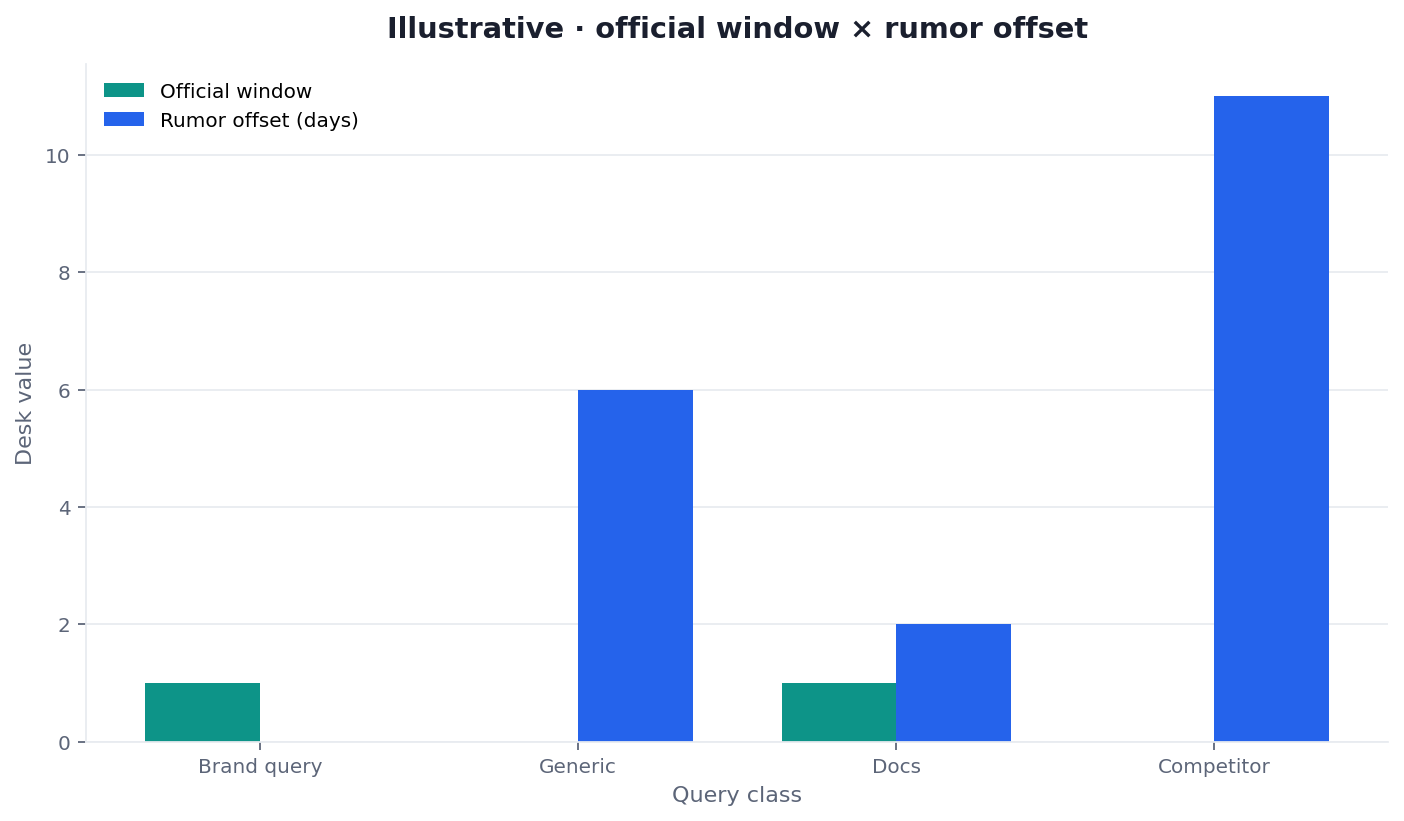
Figure: Two series from the 2026-09-14 archive. Duration is elapsed time. Updates are message count. Neither series is impact, and neither series is the current nine-row list.
curl -sS -D - -o incidents-2026-09-14.json \
  https://status.search.google.com/incidents.json
# HTTP/2 200 · 12961 bytes · 10 objects · retrieved 2026-09-14
Duration is not impact
The longest row in this archive is the August 2025 spam update at 639 hours. The shortest is the 25 February 2026 serving disruption at 0.2 hours. A long window is not a large ranking change. A short window is not a small one. The google algorithm tracker stores both numbers so a later briefing cannot collapse them into “big update” language. The extra spam row versus the current nine is August 2025.
How to admit a row
Admission is a source test, not a taste test. If Google did not name the event on a URL you can reopen, the row stays out of the official lane.
Required source URL
Paste the incident permalink or the feed object id. The google algorithm tracker can keep a non-official note in a side column. That note stays out of the confirmed list above.
Search Console’s performance report is the later overlay, not the admission source. Mixing those jobs is how rumor dates become “Google said.”
Timestamp and timezone
Keep the source offset. Compute UTC hours in a derived column. RFC 3339 exists so a later editor cannot rewrite 2026-05-21T15:40:00+00:00 as “late May.” A google algorithm tracker that rounds to calendar weeks will manufacture overlap that the feed never claimed.
If Google later edits a completion note, append a correction row. Do not overwrite the first retrieval. That append-only habit is what keeps a google algorithm tracker replayable.
Match a window to Search Console
Overlap can prioritize review. Overlap cannot prove that Google caused a loss on one URL. Only after admission do you open a property export. The traffic-drop debugging guide is the official reminder that clicks, impressions, and query mix move for many reasons.
Matching windows only
Freeze the export filters: date, query, page, country, device, and search type. Join those rows to the incident window, not to “the month of the update.” A google algorithm tracker that overlays a 28-day chart on a 19.5-hour spam window is no longer matching.
If the export cannot be reopened with the same filters, stop. A screenshot of a blended line is not a join key for any google algorithm tracker.
Alternative causes stay in a separate column
Deploys, outages, tracking changes, and demand shifts sit beside the Google window. They do not replace it. Google’s Search documentation updates page is a second official surface when you need to know whether a help document changed in the same week. It still does not name your URLs.
A google algorithm tracker that turns the alternative-cause column into a blame calendar has left the method.
Failure modes that invent a story
Rumor admission
The warning sign is a tweet or a rank-tracker spike entering the official lane without a Google URL. The correction is rejection or a non-official label. Keep that label on the google algorithm tracker row so a later summary cannot hide it.
Open-rollout verdict
The warning sign is a team calling winners before Google posts completion. The May 2026 core window in this snapshot ran 285 hours. A briefing written on day two was provisional. A google algorithm tracker should mark open windows as open.
Calendar prophecy
The warning sign is using the gap between March and May 2026 cores to predict the next core Monday. Historical cadence is not a schedule. Remove the forecast. The google algorithm tracker records what Google published.
What this tracker does not measure
Duration hours and status-update counts are not impact scores, and they are not a volatility index. A list of nicknames that begins in 2003 is not this official feed. A google algorithm tracker built from incidents.json starts when that feed starts.
Selective publication
Google does not publish every ranking adjustment. A quiet day in the register means no named event was in the feed we fetched, not that ranking was frozen. Core update guidance already says smaller changes continue. Publish that caveat beside the empty date so the google algorithm tracker cannot be read as a stillness certificate.
Property-specific causality
The feed never lists affected URLs, industries, or queries. Neither the current nine nor the archive can establish why one page lost position. That limit survives even when every hour calculation is correct.
This snapshot is also not a customer result. We have no third-party GSC export attached to these dates. Anyone using this google algorithm tracker on a live property must replace the empty overlay with their own preserved filters.
Where the register hands off
This hub keeps the admission and window jobs. Narrower jobs live on sibling pages:
| Guide | Next job |
|---|---|
| Google Search incidents | Read product, severity, and update notes on one incident page |
| Website Traffic Drop SEO | Order technical and demand checks before you blame a named update |
| Ranking Drop After Update | Compare matching GSC segments inside an admitted window |
| Recover Traffic After a Core Update | Prioritize scoped fixes without promising a rebound |
| Core Update Recovery | Keep recovery claims inside inspected evidence |
| Spam Update SEO | Map policy text before rewriting templates |
| Search Central blog | Track documentation changes as a second official surface |
| Seasonal Traffic vs Penalty | Test demand before you file a penalty story |
| Year Over Year GSC Comparison | Join like-for-like periods without collapsing keys |
| Google Core Update Changelog | Keep a core-only ledger with permalinks |
| Algorithm Change Log for SEO | Preserve typed feed provenance across event classes |
Open a workspace only after the official row exists
Admit the Google URL on the google algorithm tracker first. Then inspect only the Search Console rows that match that window.
Open InfiniSynapseFrequently Asked Questions
Was there a Google ranking update in September 2026?
No confirmed ranking incident, as of the 2026-09-23 public feed. Google algorithm updates September 2026 do not appear as a named row. The newest closed ranking window on that retrieval is the 18–21 August spam update. Community notes about 4, 13, and 15 September are not in that file.
How often should the register refresh?
Poll the JSON feed on a documented cadence and keep the last successful retrieval. Daily is enough for this product. The answer claims no access to unpublished ranking logic. Record the poll time on the google algorithm tracker row you publish that day.
Can a blank day be marked no algorithm change?
No. Mark it no named event found. Google describes continual smaller changes. A blank day on a google algorithm tracker is a retrieval result, not a proof of stillness.
What timestamp belongs in the register?
Preserve the source timestamp and timezone on the google algorithm tracker, then add a derived UTC interval. Do not overwrite the source field. If two retrievals disagree, keep both and label the newer one as a correction.
Does the tracker rank affected sites?
No. A google algorithm tracker organizes official events and, later, a user’s own export. It has no web-wide visibility dataset and it does not rank industries.
Conclusion
Use a google algorithm tracker when the job is to verify a named rollout and to keep your own export from outrunning that citation. The working list is the 2026-09-23 nine-object fetch: three spam, three core, one Discover, two serving, and no open ranking row. The 2026-09-14 ten-object table stays beside it because that retrieval still held the August 2025 spam update. Close the register when the Google fact, the matched filters, and the unresolved alternatives are all still visible.
When researching what Google showed during a bounded period, use a Google before date search before attributing a change to an update.
William Zhu · Cofounder, InfiniSynapse · GitHub @allwefantasy
Desk-validated SEO Health methods. Corrections: zhuhl@infinisynapse.com · corrections policy.