Website Traffic Drop SEO: Diagnose Causes in Order
Run a website traffic drop SEO diagnosis in order: verify measurement, crawl access, indexing, demand, and official update dates before assigning a cause.
Author credentials: William Zhu is cofounder of InfiniSynapse (GitHub @allwefantasy · auto-coder). Desk: shipping SEO Health and the /en/tool/ visibility pages. No personal LinkedIn published. About: team / editorial standards.
Publisher credentials: InfiniSynapse has public profiles on GitHub, YouTube, and X. A 2026 WAIC Future Tech OPC excellence award covers the Agentic Data Infra entry (WAIC; third-party recap: Xinhua / Caohejing). That award does not review this page or SEO Health. Method CLI: infinitegrowth on npm. Archive: recognition and scope notes.
On this page
By William Zhu · Cofounder, InfiniSynapse · Published: 2026-09-08 · Last updated: 2026-09-14 · Last verified: 2026-09-14 · Reviewed by the InfiniSynapse Data Team.
Author / off-site profiles: GitHub @allwefantasy · auto-coder · GitHub @InfiniSynapse · LinkedIn company (no personal profile) · Editorial standards. No personal LinkedIn or vendor badge.
Reviewed by: InfiniSynapse Data Team · method review 2026-09-14. First-party method review of official serving and ranking windows from a public feed.
Trust / COI: About · Corrections. We sell SEO analysis workflows, so product references are a conflict of interest. The order below uses official incident hours, not a customer traffic export and not a paid ranking claim.
Run a website traffic drop SEO diagnosis in order: verify measurement, crawl access, indexing, demand, and official update dates before assigning a cause.
TL;DR
A website traffic drop SEO diagnosis is an order of checks, not a hunt for the loudest update title. Serving disruptions are checked first because they can cut access before any ranking window is relevant. Named ranking events are opened only after measurement, crawl access, and demand still leave a gap.
Direct answer: Run website traffic drop SEO in this sequence: confirm the numbers are real, then rule out serving and eligibility, then test demand, then overlay a named ranking window. Timing overlap can prioritize review. Timing overlap cannot establish that Google caused a loss on one URL.
The 2026-09-14 desk fetch of incidents.json returned HTTP 200, 12,961 bytes, and ten incident objects. This website traffic drop SEO page uses those official hours only. Reproduce the feed with curl and json.loads. We publish no customer click counts. The hours below are observed elapsed time, not impact.
What you will learn
- Why the 0.2-hour and 72.7-hour serving rows jump the queue
- How ranking and Discover windows enter later
- Which eligibility checks belong before any update story
- What this website traffic drop SEO order still cannot prove
Serving disruptions come first
Key definition: website traffic drop SEO is a cause-ordering process. It treats a serving disruption as a different product from a ranking update, and it refuses to open the ranking file until serving and measurement have been checked.
Google’s traffic-drop debugging guide already tells site owners that clicks move for many reasons. A website traffic drop SEO reader who starts with “which core just shipped” is skipping that guidance. Check Google Search incidents for a Serving or Ranking row in the same hours before you open Search Console.
Measurement is the silent first minute of any website traffic drop SEO pass. Confirm that Search Console still returns the property, that analytics tags still fire, and that a filter did not hide the cohort you meant to watch. If the numbers disappeared because a view broke, stop. An update hypothesis is not the next step.
After the serving check and the measurement check, a user can park the matching Search Console export in an InfiniSynapse Server API task workspace. The API foundation keeps filter notes beside the official windows. It does not invent a cause.
The 0.2-hour February 2026 serving row
Object TZF4pLmbzFdoBPP6o3iv in the 2026-09-14 feed is titled “Serving was experiencing an issue.” Product: Serving. Impact: SERVICE_DISRUPTION. Severity: medium. Begin 2026-02-25T03:55:00+00:00. End 2026-02-25T04:10:00+00:00. Derived hours: 0.2. Two notes: “Serving was experiencing an issue,” then “We fixed the issue with serving search results.”
That row is short. It is also the only fifteen-minute medium disruption in the snapshot. A website traffic drop SEO file that ignores it because 0.2 hours “cannot matter” has already confused duration with access. If your property lost reachability in those fifteen minutes, the serving row is the first official object to reopen. If it did not, write that negative check down and move on. The row still does not prove a week-long decline.
The 72.7-hour October 2025 serving row
Object pW6WN7Ymo49q7z8pKk9w ran from 2025-10-03T20:00:00+00:00 to 2025-10-06T20:40:00+00:00. Product: Serving. Impact: SERVICE_DISRUPTION. Severity: medium. Three notes, which is the only three-note object in this snapshot. Google’s first October note described a data-center problem that could affect serving for some pages in some locales. The second said a fix was in progress. The third said the issue had resolved itself.
Seventy-two hours of serving trouble is long enough to appear on a daily Search Console chart. It is still not a ranking update. A website traffic drop SEO diagnosis that files this row under “algorithm” will later write a recovery plan for an outage.
RFC 9110 is the independent HTTP semantics standard to keep beside those serving hours. If your own origin returned 5xx or dropped connections in the same window, write that origin evidence in a separate column. The serving incident does not automatically explain your status codes, and your status codes do not automatically explain Google’s row.
Ranking windows come second
Only after serving is checked do you open ranking-product rows. The get on Google guide is the official reminder that crawl and index eligibility sit in front of any ranking conversation. A website traffic drop SEO overlay that skips that reminder will treat every named core as the default cause.
Eligibility is boring on purpose. Robots rules, canonicals, noindex, and soft 404s remove pages from results without any named update. Write those findings before you open the March or May core rows. A website traffic drop SEO record that never lists a sampled URL is not a diagnosis.
How serving differs from ranking
Eight of the ten 2026-09-14 rows are Ranking / SERVICE_INFORMATION / low. Two are Serving / SERVICE_DISRUPTION / medium. Those are different products. Duration still is not impact: the August 2025 spam window ran 639 hours, and the February 2026 serving window ran 0.2 hours. A website traffic drop SEO briefing that sorts titles by hours will open the spam file first and miss the only two access disruptions.
Discover after serving is cleared
The February 2026 Discover row (mYbNTqV1ytDc2fA8hUz4) is a Ranking product with a 521-hour window. The release note limited the stated launch to English-language users in the United States. Google’s Discover performance report is the official surface for that traffic, not the Web search type. A website traffic drop SEO diagnosis that applies a Discover window to Web clicks has mixed surfaces.
Ten-row snapshot used for the windows
This is a first-party desk observation, not a customer result and not a market study. The sample size is ten official objects. We list serving rows first because that is the diagnosis order, then ranking rows in feed order.
| Official description | Product | Impact | Severity | Hours | Updates |
|---|---|---|---|---|---|
| Serving was experiencing an issue (Feb 2026) | Serving | SERVICE_DISRUPTION | medium | 0.2 | 2 |
| Serving is experiencing an ongoing issue (Oct 2025) | Serving | SERVICE_DISRUPTION | medium | 72.7 | 3 |
| August 2026 spam update | Ranking | SERVICE_INFORMATION | low | 64.4 | 2 |
| June 2026 spam update | Ranking | SERVICE_INFORMATION | low | 49.0 | 2 |
| May 2026 core update | Ranking | SERVICE_INFORMATION | low | 285.0 | 2 |
| March 2026 core update | Ranking | SERVICE_INFORMATION | low | 292.0 | 2 |
| March 2026 spam update | Ranking | SERVICE_INFORMATION | low | 19.5 | 2 |
| February 2026 Discover update | Ranking | SERVICE_INFORMATION | low | 521.0 | 2 |
| December 2025 core update | Ranking | SERVICE_INFORMATION | low | 433.6 | 2 |
| August 2025 spam update | Ranking | SERVICE_INFORMATION | low | 639.0 | 2 |
Hours are (end − begin) in UTC. Class words such as core or spam are our labels from external_desc. None of these numbers are property traffic. A website traffic drop SEO table that invents click deltas beside these hours has left the method.
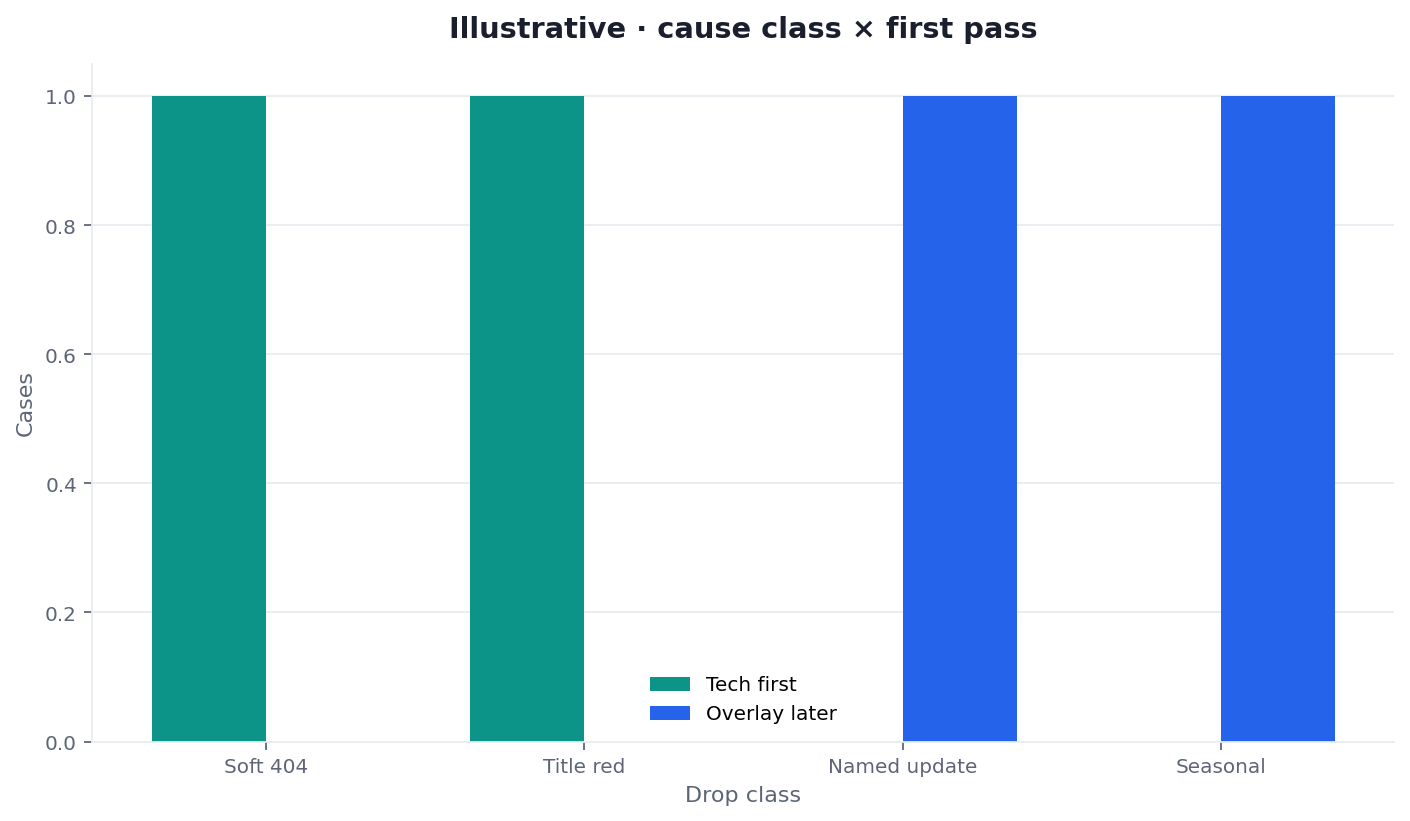
Figure: Two series from the same official feed. Duration is elapsed time. Updates are message count. The near-zero bar is the 0.2-hour serving row; the only taller update bar is the 72.7-hour serving row. Neither series is a traffic loss.
Reproduce the feed used for windows
curl -sS -D - -o incidents-2026-09-14.json \
  https://status.search.google.com/incidents.json
Keep the retrieval date on the website traffic drop SEO record. If a later poll rewrites an end time, append a correction. Do not silently replace the first fetch. The observed begin and end fields are the only official hours this page will overlay.
Checks that belong before a ranking hypothesis
Status codes and crawl access
Sample the affected templates, not only the homepage. URL Inspection is the official per-URL surface for fetched HTML, robots, and index state. Wikipedia’s note on an HTTP 404 response is the independent reminder that a missing page is a different failure from a ranking change. A website traffic drop SEO pass that never opens status codes will later call a 404 directory a core-update victim.
The Search Console overview is the place to confirm that the property still receives data. If the export cannot be reopened with the same filters, stop. A blended screenshot is not a join key.
Demand before penalty language
Google Trends measures relative interest, not your lost-click count. Compare branded and non-branded cohorts, country, and season. Falling interest is not a manual action. A website traffic drop SEO note that jumps from a Trends dip to “penalty” has skipped the demand lane.
Failure modes that skip the queue
Skipping serving because the window was short
The warning sign is discarding the February 2026 row because 0.2 hours looks too small to chart. The corrective action is to check access for those minutes, write the result, and only then open ranking titles. Keep that negative or positive check on the website traffic drop SEO row so a later summary cannot hide it.
Mixing Discover and Web
The warning sign is one blended click line used to judge a Discover-only notice. The corrective action is to filter Search type before comparing dates. Surface mixing is how a US-English Discover window becomes a global Web story.
Opening the loudest core first
The warning sign is starting the file with the longest ranking title in the news. The corrective action is to finish measurement, serving, eligibility, and demand. A website traffic drop SEO diagnosis that begins with “the last core” is no longer an order.
Limits of this diagnosis order
Hidden queries
Search Console anonymization means visible query rows may not sum to chart totals. This limit constrains every website traffic drop SEO overlay even when the official hours are correct. It belongs in the finding, not a footnote.
Demand is relative
Trends cannot establish the property’s exact lost-click count. This snapshot is also not a customer result. We published official windows only. Anyone applying this website traffic drop SEO order to a live property must replace the empty overlay with their own preserved filters. The ten-row sample does not prove a cause on one URL.
Where the triage hands off
The google algorithm tracker is the register that admits the official URL after serving is cleared. Match the dip to that window first; google algorithm updates september 2026 records no confirmed ranking incident for the month. Seasonal traffic vs penalty is the next test when demand is the remaining hypothesis. Year over year GSC comparison is the later join when you need like-for-like periods instead of a single incident overlay.
Open a workspace only after serving and measurement are checked
Write the serving and eligibility results first. Then inspect only the Search Console rows that match a named window.
Open InfiniSynapseFrequently Asked Questions
Why check serving incidents before a named core window?
Because a serving disruption can cut access while ranking systems are unchanged. The 2026-09-14 feed has two medium Serving rows and eight low Ranking rows. A website traffic drop SEO file that opens the core first will mislabel an outage.
What belongs in the first pass after a click decline?
Confirm reporting continuity, status codes, robots rules, indexation on affected templates, and any overlapping serving incident. Reproduce those checks from sources you can reopen. Do not start with a vendor heatmap. That first-hour list is still a website traffic drop SEO order, not a ranking verdict.
Can a 0.2-hour serving row explain a week-long drop?
It can explain a fifteen-minute access gap. It cannot establish a multi-day decline by itself. Write the overlap you actually have, then keep looking.
When does a ranking window become a hypothesis?
After measurement, serving, eligibility, and demand still leave a segmented decline that overlaps a named Ranking product row. Treat that overlap as a reason to inspect, not as a mechanism.
Conclusion
Use website traffic drop SEO when the job is to keep serving, measurement, and demand from being overwritten by the nearest core title. The 2026-09-14 snapshot gives two official serving windows — 0.2 hours and 72.7 hours — and eight ranking windows that wait their turn. Close the diagnosis when the order, the official hours, and the unresolved alternatives are all still visible. A bounded website traffic drop SEO queue is more useful than an unsupported penalty story.
William Zhu · Cofounder, InfiniSynapse · GitHub @allwefantasy
Desk-validated SEO Health methods. Corrections: zhuhl@infinisynapse.com · corrections policy.