Seasonal Traffic vs Penalty: Test Causes Before Acting
Test seasonal traffic vs penalty with matched calendars, demand cohorts, GSC filters, and enforcement evidence before labeling a decline or planning fixes.
Author credentials: William Zhu is cofounder of InfiniSynapse (GitHub @allwefantasy · auto-coder). Desk: shipping SEO Health and the /en/tool/ visibility pages. No personal LinkedIn published. About: team / editorial standards.
Publisher credentials: InfiniSynapse has public profiles on GitHub, YouTube, and X. A 2026 WAIC Future Tech OPC excellence award covers the Agentic Data Infra entry (WAIC; third-party recap: Xinhua / Caohejing). That award does not review this page or SEO Health. Method CLI: infinitegrowth on npm. Archive: recognition and scope notes.
On this page
By William Zhu · Cofounder, InfiniSynapse · Published: 2026-09-08 · Last updated: 2026-09-14 · Last verified: 2026-09-14 · Reviewed by the InfiniSynapse Data Team.
Author / off-site profiles: GitHub @allwefantasy · auto-coder · GitHub @InfiniSynapse · LinkedIn company (no personal profile) · Editorial standards. No personal LinkedIn or vendor badge.
Reviewed by: InfiniSynapse Data Team · method review 2026-09-14. Hands-on read of named-window durations from a public feed. No property export was attached.
Trust / COI: About · Corrections. We sell SEO analysis workflows, so product references are a conflict of interest. The hour counts below are official window lengths. They are not a seasonal diagnosis of any site.
Test seasonal traffic vs penalty with matched calendars, demand cohorts, GSC filters, and enforcement evidence before labeling a decline or planning fixes.
TL;DR
A seasonal traffic vs penalty test is a demand-first check. It aligns calendars, groups queries by occasion, and looks for enforcement notices before anyone uses the word penalty. Official ranking windows enter last, as annotations. They do not open the file.
Direct answer: Run a seasonal traffic vs penalty test on your own matched Search Console windows before you write a penalty story. Named Google events have durations you can measure. Those hours cannot establish that a dip on one property is seasonal, and they do not prove enforcement.
On 2026-09-14 we evaluated incidents.json with curl and json.loads. The response was HTTP 200, 12,961 bytes, and ten objects. The February 2026 Discover window lasted 521.0 hours. The 25 February 2026 serving disruption lasted 0.2 hours. Those two lengths sit in the same snapshot. They are a contrast of named-event duration, not a customer seasonality curve.
We have no GSC export for any property. The sample size is the ten official objects Google returned that morning. Reproduce the fetch. Do not treat derived hours as a verdict on seasonal traffic vs penalty for a live site.
What you will learn
- Why demand evidence is collected before a penalty label
- How official window hours differ across Discover, serving, core, and spam
- Which calendar and cohort checks Google already documents
- How to keep a named event from replacing the demand test
- Where this seasonal traffic vs penalty method stops without a property file
What a seasonal traffic vs penalty test checks
Key definition: A seasonal traffic vs penalty test is a matched-calendar review that compares recurring demand with enforcement evidence before the penalty label is used. It is not a hunt for the nearest Google date.
Google’s own seasonality note inside the traffic-drop guide is the official reminder that clicks move with demand. A seasonal traffic vs penalty test copies that order: demand first, enforcement second, named events last.
The Google Trends getting-started guide is adjacent official context for interest outside your property. Trends is not traffic. A seasonal traffic vs penalty test compares direction, not scale.
The InfiniSynapse API foundation can hold the matched-calendar export you later upload. A task workspace preserves filters and cohort labels. It does not invent a seasonal diagnosis and it does not certify a penalty.
Why official hours are a contrast, not a diagnosis
Wikipedia’s note on seasonality describes recurring calendar structure in a series. A 521-hour Discover incident is not that structure. It is a named event with a start and an end. A seasonal traffic vs penalty notebook that files Discover hours as “the holiday pattern” has left the method.
The US Census Bureau’s X-13ARIMA-SEATS program documents why seasonal adjustment needs explicit modeling choices. It is methodological context for a seasonal traffic vs penalty file. It is not an endorsement of this page and not a diagnosis of any website.
What the test refuses to ask a status row
A status object does not name affected URLs, industries, or queries. The Google Trends data FAQ likewise cannot identify your pages. Where those sources are silent, a seasonal traffic vs penalty record stays silent or labels the line as analysis.
Official window lengths observed on 2026-09-14
This is a first-party duration contrast, not a customer case. The table compares official window lengths across event classes. It is not a proof of seasonality on a site we do not have.
| Official description | Class | Begin (UTC) | End (UTC) | Hours |
|---|---|---|---|---|
| February 2026 Discover update | discover | 2026-02-05 17:00 | 2026-02-27 10:00 | 521.0 |
| December 2025 core update | core | 2025-12-11 17:25 | 2025-12-29 19:00 | 433.6 |
| March 2026 core update | core | 2026-03-27 09:00 | 2026-04-08 13:00 | 292.0 |
| May 2026 core update | core | 2026-05-21 15:40 | 2026-06-02 12:40 | 285.0 |
| Serving issue Oct 2025 | serving | 2025-10-03 20:00 | 2025-10-06 20:40 | 72.7 |
| August 2026 spam update | spam | 2026-08-18 16:27 | 2026-08-21 08:49 | 64.4 |
| Serving issue Feb 2026 | serving | 2026-02-25 03:55 | 2026-02-25 04:10 | 0.2 |
We tagged class from external_desc; that tag is not a Google enum. Hours equal end minus begin in UTC. Length is not impact, and length is not a seasonal coefficient.
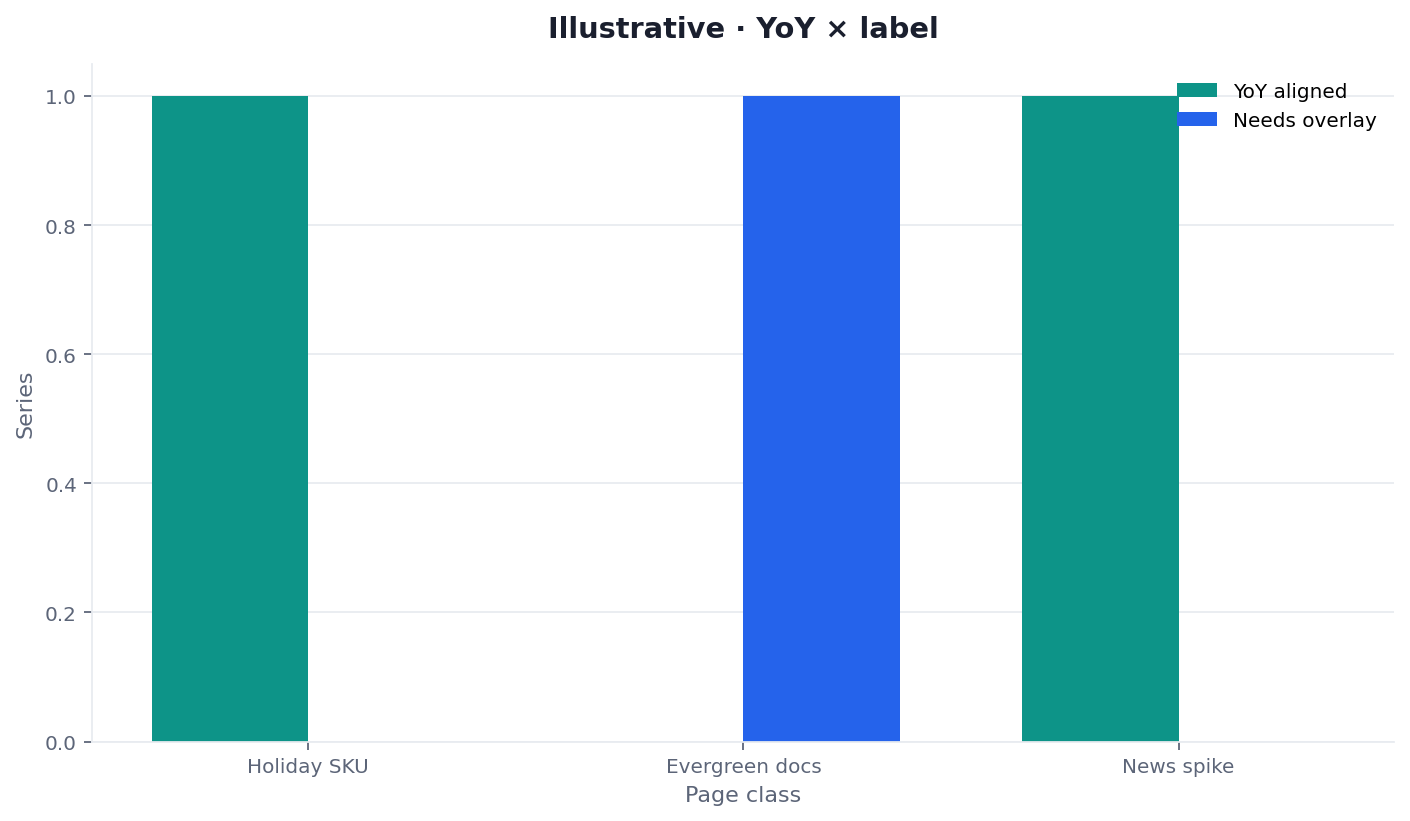
Figure: Official named-window length beside status-update count from the 2026-09-14 snapshot. The chart does not show clicks, and it does not diagnose a customer dip.
Discover versus serving length
curl -sS -D - -o incidents-2026-09-14.json \
  https://status.search.google.com/incidents.json
After json.loads, the Discover row is the longest ranking window in this snapshot. The February serving row is the shortest object. A seasonal traffic vs penalty briefing that calls both “the February season” has mixed a 521-hour ranking notice with a 12-minute serving disruption.
Google’s Discover documentation is the official surface description. Discover interest is not Web Search demand. Keep those products in separate seasonal traffic vs penalty cohorts.
Core and spam windows
Three core windows in this snapshot run 285.0, 292.0, and 433.6 hours. Spam windows in the fuller ten-row feed also include 19.5, 49.0, 64.4, and 639.0 hours. Those lengths tell you how long Google said the named event lasted. They cannot establish a seasonal traffic vs penalty verdict for a November retail site.
The Discover performance report is the later overlay for Discover-only properties. It is still not a penalty notice.
Why hours are not seasonality
Seasonality is a recurring shape you test on your own series. Named-event duration is a one-off official interval. A seasonal traffic vs penalty test that substitutes the Discover hour count for a prior-year click shape has skipped the demand check.
How demand is tested before a penalty label
Only after you can reopen your own export do these checks start. We cannot run them here. The steps stay in the record so a later owner does not jump to enforcement language.
Align the calendar first
Match weekdays, holiday position, and market. Shift for leap days and movable holidays. January weekdays against December weekends are not a pair. A seasonal traffic vs penalty file should keep the aligned dates beside the decision, not only the final label.
Search Console’s performance comparison help is the official UI reminder that two ranges must be declared. Comparison in the UI is not automatic proof of recurrence.
Build demand cohorts
Group queries by product, occasion, and evergreen need. Compare cohorts instead of a single site-wide click total. One holiday category must not define the whole property. A reviewer can audit cohorts in a seasonal traffic vs penalty notebook only when the filter, owner, and timestamp survive handoff.
Read external interest
Use a country-filtered Trends series. Compare direction. Do not subtract a Trends index from GSC clicks. The Trends data FAQ already says the series is normalized. Treat that limit as part of the seasonal traffic vs penalty test, not as a footnote you delete later.
Look for enforcement notices
Open manual actions, security issues, and spam-practice evidence. A seasonal dip is not a notice. A seasonal traffic vs penalty record that writes “penalty” because the technical log looked quiet has used elimination as proof. Elimination is not evidence.
Search Console data retention matters here: if the prior-year window is gone, you cannot complete the matched-calendar step. Stop and say so.
When a named event may be annotated
Named events enter after demand and enforcement checks exist. They do not replace those checks.
Overlay after demand
Annotate an official update window only when its dates overlap a residual you have already described. A seasonal traffic vs penalty test that starts at the nearest core Monday has reversed the order.
The February Discover window is tempting because it is long. Length is not a reason to skip cohorts in a seasonal traffic vs penalty file. The 0.2-hour serving row is tempting because it is sharp. Sharpness is not a penalty.
Mistakes that skip the demand check
Unaligned holidays
The warning sign is a movable event sitting in different weeks across years. The correction is to index around the event or to write the mismatch down. Keep that note on the seasonal traffic vs penalty row so a later summary cannot hide it.
Blended markets
The warning sign is countries with opposite seasons sitting in one total. The correction is a country split. Resolving blended markets in a seasonal traffic vs penalty file requires a documented rerun, not a more confident penalty word.
Penalty by elimination
The warning sign is “no crawl error, therefore enforcement.” The correction is a notice or a mapped policy clause. A second reviewer should reopen Search Console before a seasonal traffic vs penalty finding closes on that path.
The Website Traffic Drop SEO guide is the sibling that orders technical and demand checks before anyone blames a named update.
What duration contrast cannot show
Trends scale
Trends is normalized. You cannot subtract it from clicks. This limit constrains every seasonal traffic vs penalty file even when the official hour table is exact.
Shocks with no prior year
A new product or a news event may have no analogue. The ten-row sample also cannot establish which URL moved. That snapshot is not a customer result. Duration contrast does not prove recurrence, and it does not prove a penalty.
Anyone applying this method must bring their own saved filters. Without that file, stop at “named event observed” and leave the cause unset.
Where this test hands off
This page keeps the demand-before-penalty order. Adjacent jobs live elsewhere.
Annotate the official update window only after the residual is described.
The Website Traffic Drop SEO page is the technical-first pass when the dip might be a fetch or tracking break.
The Year Over Year GSC Comparison is the join you need once two like-for-like exports actually exist.
Open a workspace only after demand evidence is saved
Align the calendar first. Then inspect only the Search Console rows that match those dates and cohorts.
Open InfiniSynapseFrequently Asked Questions
How many years are needed for seasonality?
Two comparable years can show recurrence. More history helps when tracking and the business stay stable. A seasonal traffic vs penalty test still needs your export. Official window hours are not a substitute year of clicks.
What is a movable-holiday adjustment?
Align the weeks relative to the event rather than the same calendar dates when the holiday shifts. Write the adjustment down. Do not hide it inside a blended total.
Does no manual action rule out every penalty?
It rules out a listed manual action. It does not rule out every algorithmic or policy-related possibility. Keep the label no listed notice until other evidence appears.
Can seasonality and an update overlap?
Yes. Estimate recurring demand first. Then describe any residual movement and any official overlap as separate lines. Overlap can prioritize review. Overlap does not prove a single cause.
Conclusion
Use a seasonal traffic vs penalty test when the job is to keep a demand story and a penalty story from collapsing into each other. The 2026-09-14 snapshot gives a 521-hour Discover window and a 0.2-hour serving window in the same feed. That contrast is useful as a warning about named-event length. It is not a customer seasonality study. Close the file when the calendar pair, the enforcement check, and the unresolved alternatives are still visible. If a later export arrives, attach it as a new overlay rather than rewriting the official hours. The method stays useful only while those two evidence classes remain labeled.
William Zhu · Cofounder, InfiniSynapse · GitHub @allwefantasy
Desk-validated SEO Health methods. Corrections: zhuhl@infinisynapse.com · corrections policy.