Search Central Blog: Google's Official URL
The Search Central blog is Google's, at developers.google.com/search/blog. Save each post's URL and both dates before you cite it.
Author credentials: William Zhu is cofounder of InfiniSynapse (GitHub @allwefantasy · auto-coder). Desk: shipping SEO Health and the /en/tool/ visibility pages. No personal LinkedIn published. About: team / editorial standards.
Publisher credentials: InfiniSynapse has public profiles on GitHub, YouTube, and X. A 2026 WAIC Future Tech OPC excellence award covers the Agentic Data Infra entry (WAIC; third-party recap: Xinhua / Caohejing). That award does not review this page or SEO Health. Method CLI: infinitegrowth on npm. Archive: recognition and scope notes.
On this page
By William Zhu · Cofounder, InfiniSynapse · Published: 2026-09-08 · Last updated: 2026-10-02 · Last verified: 2026-09-14 · Reviewed by the InfiniSynapse Data Team.
Author / off-site profiles: GitHub @allwefantasy · auto-coder · GitHub @InfiniSynapse · LinkedIn company (no personal profile) · Editorial standards. No personal LinkedIn or vendor badge.
Reviewed by: InfiniSynapse Data Team · method review 2026-09-14. Hands-on header check of two documentation URLs, plus a desk read of the public incident feed.
Trust / COI: About · Corrections. We sell SEO analysis workflows, so product references are a conflict of interest. The last-modified stamps below are HTTP headers. They are not a customer reading list and not a ranking study.
The Search Central blog is Google's, at developers.google.com/search/blog. Save each post's URL and both dates before you cite it.
TL;DR
The Search Central blog is Google's, at developers.google.com/search/blog. A watch of that blog is a dated file of first-party documentation pages. It stores the URL, the visible title, the publication clock, any later effective date, and the retrieval headers. It does not replace a status incident, and it does not identify which landing page lost clicks.
Direct answer: The Search Central blog is Google's, at developers.google.com/search/blog. Admit a post only when you can reopen that URL. Use the public incident feed as a second official surface, not as a substitute post. Overlap can prioritize reading. Overlap cannot establish that a help article moved your rankings.
On 2026-09-14 we evaluated two live documentation indexes with curl. https://developers.google.com/search/blog returned HTTP 200 and last-modified: Thu, 16 Jul 2026 11:42:35 GMT. https://developers.google.com/search/updates returned HTTP 200 and last-modified: Tue, 08 Sep 2026 11:00:29 GMT. Those stamps are observed headers. Reproduce them; do not invent a fresher blog date from social chatter.
The same morning we also loaded incidents.json and parsed ten objects with json.loads. That feed is not the Google Search Central blog. It is the second official surface this page uses when a reader asks whether a rumor “was announced.”
What you will learn
- Which documentation URLs we actually fetched
- How publication clocks differ from enforcement clocks
- Why the ten-row incident mix is not a set of blog posts
- How to refuse vendor headlines that rewrite Google’s sentence
- Where this Google Search Central blog watch stops and a property export begins
What a Google Search Central blog watch stores
Key definition: A Google Search Central blog watch is a maintained notebook that admits only Google-authored Search documentation. Matching Search Console filters may be attached later. It is not a volatility scrapbook.
The March 2024 core and spam announcement is the kind of post this notebook is built to keep: a dated URL, a published day, and a later May 5 effective date for site reputation abuse. A Google Search Central blog watch copies that split. It does not collapse “posted in March” into “enforced in March.”
Google’s Search Central documentation index is the durable twin of many announcements. After a post ships, the lasting rule often moves there. We maintain the Google Search Central blog notebook so a later editor can see both the announcement URL and the current help URL.
InfiniSynapse can keep a frozen page snapshot inside an InfiniSynapse Server API task workspace after you upload it. That API layer preserves headers and retrieval time. It does not become a changelog oracle and it does not score recovery.
Permalink and page class
Each admitted row needs a URL you can reopen, a page class (announcement, explainer, policy note, or documentation notice), and the retrieval date. “Someone said Google posted” is not a class. A Google Search Central blog watch can keep rumor notes in a side column. Those notes must not inherit an official publication time.
The August 2024 core update post is adjacent official context for how Google writes a named ranking change in prose. It still does not list your URLs.
Why we fetched headers instead of screenshots
A screenshot of an index page is easy to share and hard to diff. Response headers are the opposite: you can archive the status, the last-modified value, and the fetch day. That is why this Google Search Central blog watch starts from curl on the live indexes.
Search Central news is a separate official list. Keep it if a Google Search Central blog watcher needs a second Google surface. Do not treat it as proof that the blog index was quiet.
Observed documentation headers on 2026-09-14
This is a first-party header check plus a feed parse, not a customer case and not a ranking study. The sample size for the documentation lane is two index URLs. The sample size for the second surface is the ten incident objects Google returned that morning. A later fetch can rewrite either set.
| Surface | URL | HTTP | Last-modified (GMT) |
|---|---|---|---|
| Blog index | developers.google.com/search/blog | 200 | Thu, 16 Jul 2026 11:42:35 |
| Documentation updates | developers.google.com/search/updates | 200 | Tue, 08 Sep 2026 11:00:29 |
Those two clocks already disagree. The blog index header is older than the updates index header. A Google Search Central blog watch that only polls the blog will miss documentation edits that never become posts.
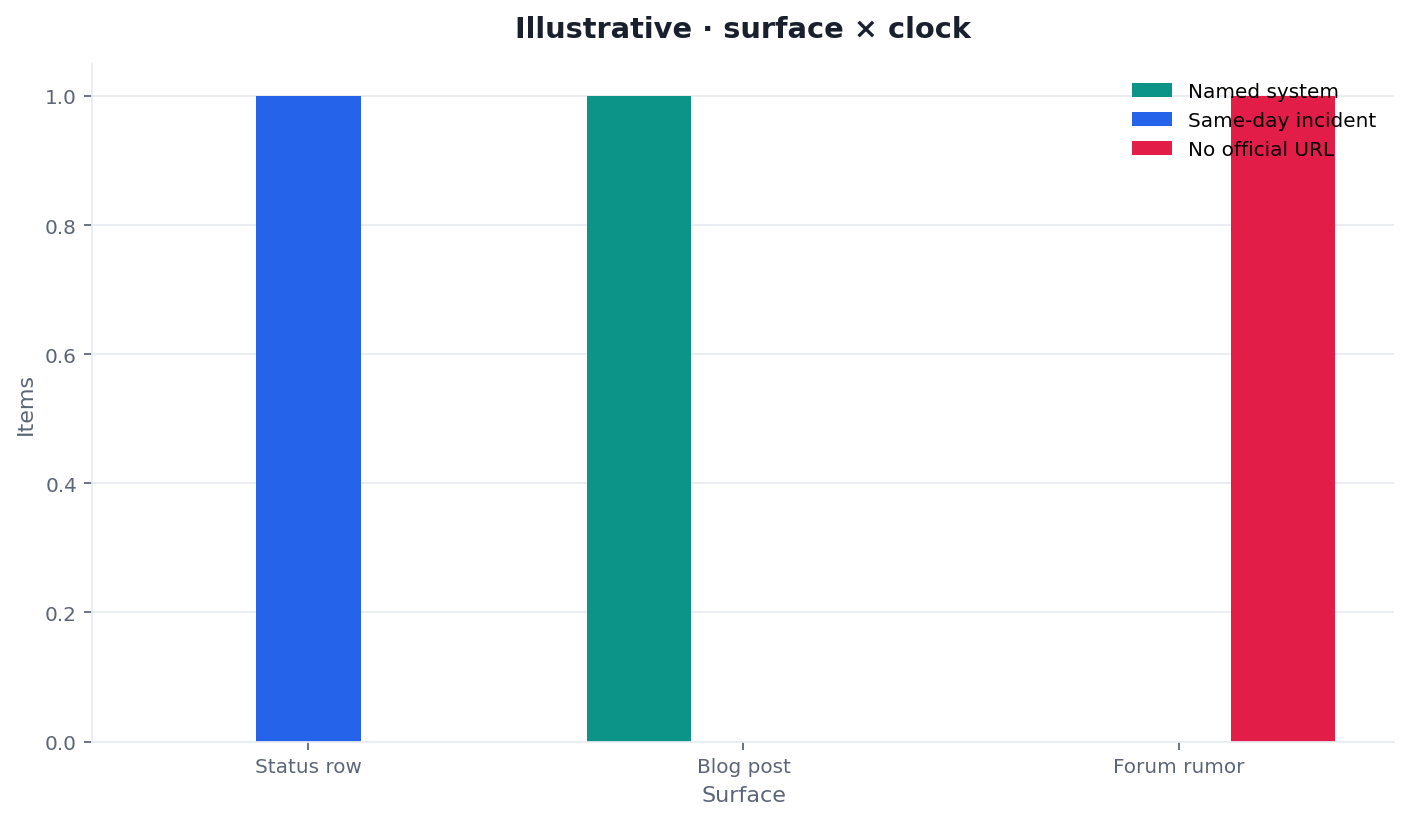
Figure: Class count beside duration hours from the 2026-09-14 incident snapshot, used here only as a second official surface. Neither series is a blog post.
Blog index last-modified
curl -sS -D - -o /dev/null \
  https://developers.google.com/search/blog
A Google Search Central blog watch should store status, header, and retrieval date beside the index URL. If a later poll returns a newer last-modified, append a retrieval note. Do not silently overwrite the July stamp we observed.
The site reputation abuse post remains a useful example of a policy page that later readers still reopen. Header freshness on the index does not retire that URL from a Google Search Central blog file.
Documentation updates last-modified
curl -sS -D - -o /dev/null \
  https://developers.google.com/search/updates
# HTTP/2 200 · last-modified: Tue, 08 Sep 2026 11:00:29 GMT
The documentation updates page is the official change list for Search help articles. On 2026-09-14 its header was newer than the blog index. That gap is the reason a Google Search Central blog watch treats updates as a first-class surface, not as optional extra reading.
The machine-readable twin is the Search documentation RSS feed. Feed handling can be checked independently with the W3C RSS 2.0 validator notes. That reference helps you tell a malformed ingest from a missing publication. It does not make W3C responsible for Google’s dates.
Class mix from the JSON feed
The ten-row mix on 2026-09-14 was four spam, three core, two serving, and one Discover. Those labels are ours, taken from external_desc. They are not blog categories. A Google Search Central blog watch that files the August 2026 spam window as “a Search Central post” has left the method.
For a separate engine’s authored channel, the Bing Webmaster Blog is an independent comparison point. Keep Bing rows in another column. They cannot corroborate what Google published.
How a documentation change is admitted
Admission is a source test. If Google did not publish the sentence on a URL you can reopen, the row stays out of the official documentation lane.
Permalink and retrieval stamp
Paste the post URL or the updates entry. A Slack rumor and a vendor recap are not admission evidence. The Google Search Central blog watch can label those notes non-official. They must not inherit the July or September headers we fetched.
Publication clocks and effective clocks
Keep every clock Google prints: publication day, rollout day, effective day, and later update notes. The March 2024 announcement and the May 5 site-reputation date are the teaching pair. A Google Search Central blog watch that stores only the post day will later tell an editor the policy “already applied” when Google had not said that.
If Google later edits a paragraph, append a correction row with the new retrieval date. Do not overwrite the first wording you saved.
Claims Google actually wrote
Quote the sentence Google published. Mark paraphrase as paraphrase. The documentation index is the place to check whether the durable rule moved. A Google Search Central blog watch that lets a marketing summary replace the quote will later cite a cause Google never wrote.
The incident feed as a second official surface
The JSON feed answers a different question: did Google name a ranking, serving, or Discover incident? It does not publish blog prose. Mix those jobs and you will file a 64.4-hour spam window as if it were an authored explainer.
Why a status object is not a blog post
Each feed object we parsed carried id, external_desc, begin, end, updates[], and affected_products[]. Those are incident fields. A Google Search Central blog post carries a title, authors, and documentation links. Reproduce the split with curl and json.loads; do not merge the schemas.
The google algorithm tracker is the page that keeps the ten-row register. This page only borrows the class mix so a documentation watcher can see why “no new blog post” is not the same as “no named event.”
Hours versus message count
August 2025 spam is the longest object in that snapshot at 639 hours. The 25 February 2026 serving disruption is the shortest at 0.2 hours. Elapsed hours and message count are different columns. Neither column is a documentation edit.
Most ranking objects in that snapshot carry SERVICE_INFORMATION. The two serving objects carry SERVICE_DISRUPTION. Keep that product split beside the blog watch so a later brief cannot call a serving outage “the new Search Central post.”
Mistakes that turn rumor into a citation
Treating the blog as a live dashboard
The warning sign is an editor using a post date as live service status. The correction is to open the status surface. A Google Search Central blog watch that marks “green” because the blog index header is unchanged has invented an all-clear.
The Google Search incidents page is the sibling that reads product, severity, and update notes on one incident page.
Dropping the later enforcement date
The warning sign is a briefing that keeps March 5 and drops May 5. The correction is two fields. In a Google Search Central blog notebook, resolving a missing effective date requires a documented correction, not a louder paraphrase.
Replacing Google's sentence with a vendor headline
The warning sign is a third-party title entering the official lane. The correction is the original URL plus an inference label. A second reviewer should reopen the post before the Google Search Central blog watch closes that row.
What authored pages cannot show
Editorial selection
Google does not turn every documentation edit into a blog post. The September header on the updates index, sitting beside a July header on the blog index, is the observed reminder. A quiet week in the Google Search Central blog cannot establish that help pages were frozen.
Pages that keep changing
A post can gain update notes. A one-time scrape becomes stale. This snapshot is also not a customer result. No property export sits next to these headers. Anyone using a Google Search Central blog watch on a live site must attach their own saved filters.
The ten-row incident sample therefore cannot establish which URL lost position. That limit survives even when every header is correct. A duration hour count does not prove a documentation change caused traffic movement.
Where this watch hands off
This page keeps the documentation-admission job. Narrower jobs live on sibling pages.
The google algorithm tracker stores named incident windows when you need a join key rather than a post.
The Google Search incidents page is the place to read severity and completion notes.
The Google Core Update Changelog keeps a core-only ledger with permalinks when the documentation watch has finished classifying the post.
Open a workspace only after the documentation URL exists
Admit the Google page first. Then inspect only the Search Console rows that match that publication or effective window.
Open InfiniSynapseFrequently Asked Questions
When should the blog be checked instead of the dashboard?
Use the Google Search Central blog for explanations, policy announcements, documentation context, and authored guidance. Use the dashboard for product, severity, and incident clocks. This answer claims no access to unpublished ranking logic.
Which date should a change log store?
Store publication, rollout, effective, and modified dates in separate fields when they differ. The March 2024 post and the May 5 enforcement note are the teaching pair for any Google Search Central blog change log. Do not let one clock overwrite the others.
Are old Search Central posts still authoritative?
They remain historical evidence. Current maintained documentation governs present guidance. Reopen both the post and the live help URL before you act. A Google Search Central blog archive does not freeze later edits.
How should an update note be cited?
Name the note date, keep the page URL, and describe what changed. Do not silently replace the earlier wording. Record the retrieval day so a later editor can reproduce the Google Search Central blog citation.
Conclusion
Use a Google Search Central blog watch when the job is to classify an official documentation change and to keep rumor out of that lane. The 2026-09-14 header pair shows two Google indexes with different last-modified stamps. The ten-row feed sitting beside them is a second official surface, not a set of posts. Close the notebook when the Google URL, the clocks, and the unresolved alternatives are still visible. A bounded citation is more useful than an unsupported cause claim.
Use Google before date search to narrow announcements by period without confusing web results with Search Console reporting windows.
William Zhu · Cofounder, InfiniSynapse · GitHub @allwefantasy
Desk-validated SEO Health methods. Corrections: zhuhl@infinisynapse.com · corrections policy.