Ranking Drop After Update: Compare Matching GSC Evidence
Investigate a ranking drop after update with matched GSC windows, query-page cohorts, and documented alternatives before attributing the change to Google.
Author credentials: William Zhu is cofounder of InfiniSynapse (GitHub @allwefantasy · auto-coder). Desk: shipping SEO Health and the /en/tool/ visibility pages. No personal LinkedIn published. About: team / editorial standards.
Publisher credentials: InfiniSynapse has public profiles on GitHub, YouTube, and X. A 2026 WAIC Future Tech OPC excellence award covers the Agentic Data Infra entry (WAIC; third-party recap: Xinhua / Caohejing). That award does not review this page or SEO Health. Method CLI: infinitegrowth on npm. Archive: recognition and scope notes.
On this page
By William Zhu · Cofounder, InfiniSynapse · Published: 2026-09-08 · Last updated: 2026-09-14 · Last verified: 2026-09-14 · Reviewed by the InfiniSynapse Data Team.
Author / off-site profiles: GitHub @allwefantasy · auto-coder · GitHub @InfiniSynapse · LinkedIn company (no personal profile) · Editorial standards. No personal LinkedIn or vendor badge.
Reviewed by: InfiniSynapse Data Team · method review 2026-09-14. First-party method review of ranking-product rows from a public Google feed.
Trust / COI: About · Corrections. We sell SEO analysis workflows, so product references are a conflict of interest. The overlay below uses official ranking windows only. It includes no invented Search Console clicks and no customer export.
Investigate a ranking drop after update with matched GSC windows, query-page cohorts, and documented alternatives before attributing the change to Google.
TL;DR
A ranking drop after update review is a matched Search Console comparison inside an admitted Ranking-product window. It is not a serving-outage file and it is not a site-total screenshot. Eight of the ten objects fetched on 2026-09-14 are Ranking. Those eight are the only rows this page will overlay.
Direct answer: Treat a ranking drop after update as a join between one cited Ranking incident and Search Console segments you can reopen with the same filters. Overlap can prioritize inspection. Overlap cannot establish that Google demoted a page, and it does not prove a recovery path.
A 2026-09-14 pull of the public the public incidents.json feed answered HTTP 200 with 12,961 bytes and ten objects. This ranking drop after update page drops the two Serving rows and keeps the eight Ranking rows. Reproduce that split with curl and json.loads. We invent no click totals.
What you will learn
- Why serving incidents stay out of this overlay
- How the December 2025 core permalink is worded
- How to freeze matching segments without inventing numbers
- What a ranking drop after update finding still cannot claim
Which incidents are ranking products
Key definition: A ranking drop after update overlay admits only incidents whose affected_products value is Ranking. Serving disruptions are a different product and belong in a traffic-order diagnosis, not in this comparison.
Google’s ranking systems guide is the official vocabulary list for ranking systems. It does not attach those systems to your URLs. A ranking drop after update file that imports a Serving row because “users could not see results” has changed the product Google published.
Once the December 2025 window is admitted, an InfiniSynapse Server API task workspace can hold the query-page export you already filtered. The API layer preserves keys. It does not score recovery.
Serving rows stay out of this job
The 2026-09-14 snapshot includes two Serving / SERVICE_DISRUPTION / medium rows: 0.2 hours on 25 February 2026 and 72.7 hours from 3–6 October 2025. Those rows can explain access symptoms. They are not ranking updates. Leave them out of a ranking drop after update matrix so a later briefing cannot call an outage a core.
Wikipedia’s note on a search engine results page is a reminder that what users see is a composed page, not a single rank number. That composition still does not turn a serving outage into a ranking incident.
December 2025 core as the comparison window
The worked permalink is the December 2025 core update. On 2026-09-14 the feed object DsirqJ1gpPRgVQeccPRv still carried these fields. This is not a customer case. The sample size is one official Ranking object plus the seven other Ranking siblings fetched the same morning.
Permalink fields for December 2025
| Field | Observed value |
|---|---|
external_desc | December 2025 core update |
affected_products | Ranking |
status_impact | SERVICE_INFORMATION |
severity | low |
begin | 2025-12-11T17:25:00+00:00 |
end | 2025-12-29T19:00:00+00:00 |
| Hours (derived) | 433.6 |
updates length | 2 |
json.loads showed two notes:
- 2025-12-11T17:25:48+00:00 — “Released the December 2025 core update. The rollout may take up to 3 weeks to complete.” Status:
SERVICE_INFORMATION. - 2025-12-29T19:05:33+00:00 — “The rollout was complete as of December 29, 2025.” Status:
AVAILABLE.
433.6 hours is elapsed time. It does not prove that any query-page pair moved. A ranking drop after update briefing that treats “three weeks” as a traffic magnitude has left the permalink.
The December window is useful because it is long enough to overlap two full weekly cycles and because Google posted a clear completion sentence. It is still only a join key. Open it after serving and measurement are already checked elsewhere. A ranking drop after update overlay that starts here because the title is familiar has skipped admission.
The Search Console performance report is the later overlay, not the admission source. Mixing those jobs is how rumor dates become “Google said.”
Eight ranking rows from the 2026-09-14 feed
This is a first-party desk observation, not a customer result and not a market study. Serving rows are omitted on purpose.
| Official description | Product | Impact | Severity | Hours | Updates | Begin (UTC) | End (UTC) |
|---|---|---|---|---|---|---|---|
| August 2026 spam update | Ranking | SERVICE_INFORMATION | low | 64.4 | 2 | 2026-08-18 16:27 | 2026-08-21 08:49 |
| June 2026 spam update | Ranking | SERVICE_INFORMATION | low | 49.0 | 2 | 2026-06-24 16:00 | 2026-06-26 17:00 |
| May 2026 core update | Ranking | SERVICE_INFORMATION | low | 285.0 | 2 | 2026-05-21 15:40 | 2026-06-02 12:40 |
| March 2026 core update | Ranking | SERVICE_INFORMATION | low | 292.0 | 2 | 2026-03-27 09:00 | 2026-04-08 13:00 |
| March 2026 spam update | Ranking | SERVICE_INFORMATION | low | 19.5 | 2 | 2026-03-24 19:00 | 2026-03-25 14:30 |
| February 2026 Discover update | Ranking | SERVICE_INFORMATION | low | 521.0 | 2 | 2026-02-05 17:00 | 2026-02-27 10:00 |
| December 2025 core update | Ranking | SERVICE_INFORMATION | low | 433.6 | 2 | 2025-12-11 17:25 | 2025-12-29 19:00 |
| August 2025 spam update | Ranking | SERVICE_INFORMATION | low | 639.0 | 2 | 2025-08-26 16:00 | 2025-09-22 07:00 |
All eight rows share SERVICE_INFORMATION and severity: low. They do not share a class: four spam, three core, one Discover. A ranking drop after update overlay that only keeps core dates will hide the August 2026 spam window and the February 2026 Discover window.
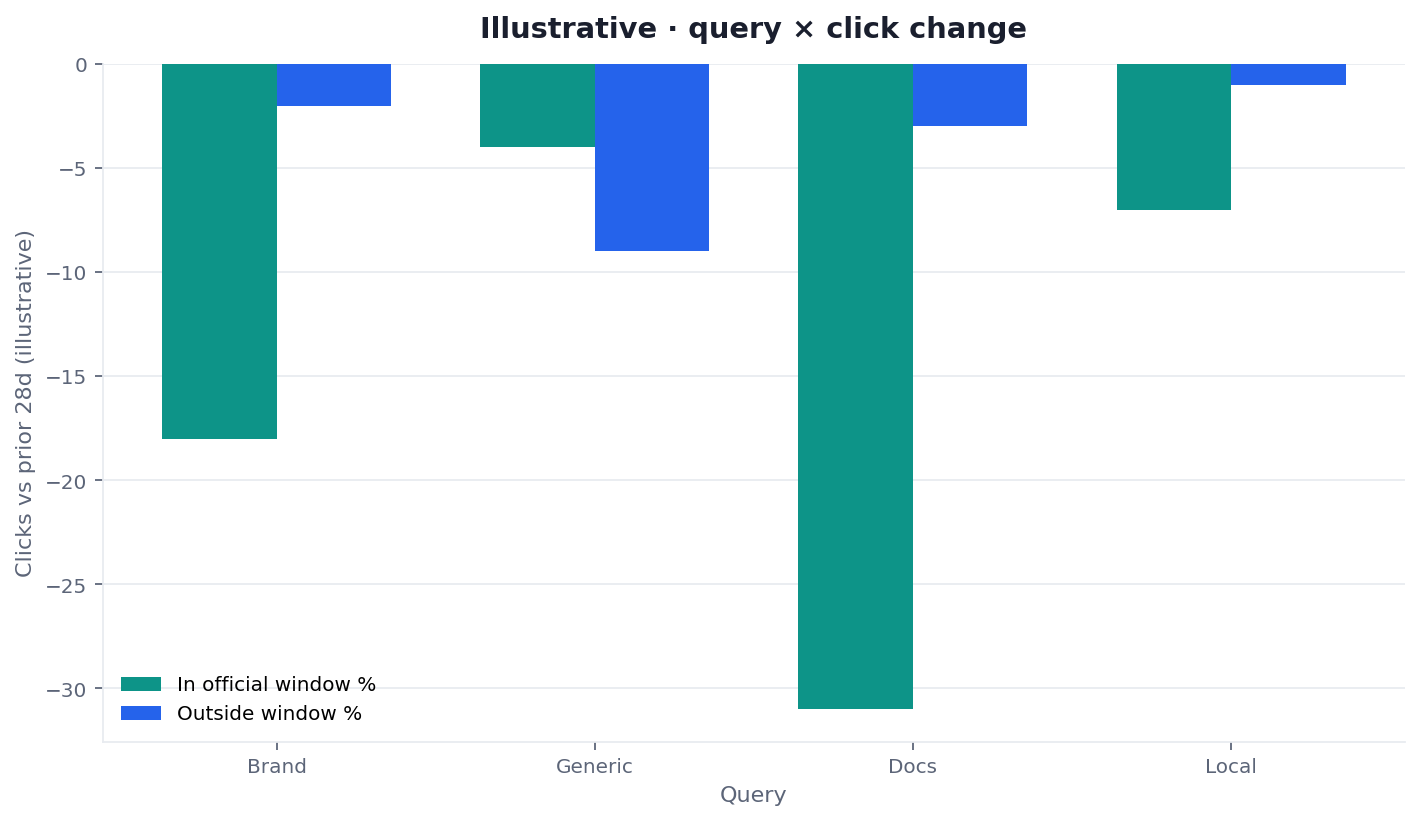
Figure: Two series from the eight Ranking rows only. Duration is elapsed time. Updates are message count. Every row in this snapshot has two notes. Neither series is a click loss.
Core, spam, and Discover still differ
Core, spam, and Discover are our labels from external_desc, not a Google enum. The Discover release note limited the stated launch to English-language users in the United States. A ranking drop after update comparison that applies that window to a Web / all-countries export is no longer matching.
Duration is not a click loss
The longest Ranking row is the August 2025 spam update at 639 hours. The shortest is the March 2026 spam update at 19.5 hours. A long window is not a large ranking change. A short window is not a small one. The ranking drop after update record stores both numbers so a later briefing cannot collapse them into “big update” language.
curl -sS -D - -o incidents-2026-09-14.json \
  https://status.search.google.com/incidents.json
How to compare matching GSC segments
The Search Console API overview and the traffic-drop debugging guide are official reminders that Performance rows move for many reasons. Compare conceptually. Do not invent click totals you do not own.
The W3C Data Quality Vocabulary is an independent way to describe dataset quality and measurement metadata. It can make a ranking drop after update export easier to review. It does not validate a Google event.
Freeze filters before you look
Declare date, query, page, country, device, and search type before you open the chart. Join those rows to the incident window, not to “the month of the update.” A 28-day blended line over a 19.5-hour spam window is not a match. If the export cannot be reopened with the same filters, stop. A ranking drop after update overlay without a reopenable filter set is a screenshot, not a join.
Search appearance filters belong in that freeze list when the SERP feature mix changed. Google’s title-link guidance is the official reminder that titles can move CTR without a comparable position change. That is an alternative cause, not a hidden ranking factor.
Query-page keys, not site totals
Keep query, page, country, and device together before you aggregate. Site averages hide opposing cohorts. A ranking drop after update finding that quotes only the property total cannot say which result combination moved.
We publish no customer numbers here. Write the keys you will compare. Leave the cells empty until a real export exists. A ranking drop after update worksheet with invented clicks is worse than an empty sheet, because later readers will treat the fiction as evidence.
Control windows outside the incident
Inspect an adjacent period that does not overlap the official begin/end. If the same cohort already moved before 2025-12-11, the December core is a weaker hypothesis. If an unaffected template was stable through 433.6 hours, write that too. Control windows do not prove innocence. They stop a ranking drop after update file from treating every post-date wiggle as Google.
If two templates move and a third stays flat through the same 433.6 hours, write all three outcomes. Concentration is a clue for where to inspect. It still cannot establish a mechanism, and it does not prove that the stable template was “rewarded.”
Failure modes that fake a movement
Aggregate-only stories
The warning sign is a site average falling while major cohorts grow. The corrective action is to inspect query-page keys before storytelling. Keep that warning on the affected ranking drop after update row so a summary cannot hide it.
Average position without impressions
The warning sign is a lone average-position chart used as a rank tracker. Average position is impression-weighted. Query mix can move the average without a demotion. Use clicks, impressions, CTR, and position together, or do not publish the number.
Window shopping
The warning sign is dates sliding until the decline looks largest. The corrective action is to declare the official window and the control window before reviewing the result. A second reviewer should reopen the source before a ranking drop after update finding closes.
Limits of a ranking-only overlay
The feed cannot establish your URLs
The eight Ranking rows never list affected URLs, industries, or queries. This snapshot is not a customer result. Anyone using a ranking drop after update overlay on a live property must replace the empty cells with their own preserved filters. Correct hour math does not prove a page was demoted.
SERP composition
Result features can alter CTR without a comparable organic-position change. That boundary still constrains a ranking drop after update comparison when every filter is correct, so it remains explicit in the finding.
Where the comparison hands off
The google algorithm tracker is the register that admits the official Ranking URL before this overlay starts. The same retrieval is the google algorithm updates september 2026 note: no confirmed ranking incident that month. Core update recovery is the later job that keeps fix claims inside inspected evidence. Recover traffic after a core update is the prioritization page that still refuses a rebound promise.
Open a workspace only after the ranking window is admitted
Cite the official Ranking permalink first. Then inspect only the Search Console segments that match that window.
Open InfiniSynapseFrequently Asked Questions
Which incidents belong in a ranking-product overlay?
Only rows whose product is Ranking. The 2026-09-14 feed has eight of those and two Serving disruptions. A ranking drop after update matrix that imports serving hours is no longer a ranking overlay.
How should matching Search Console segments be frozen?
Save date, query, page, country, device, and search type before you look at the line. Reproduce the same filters on the control window. If you cannot reopen them, stop.
Does a longer core window mean a larger ranking change?
No. 433.6 hours is elapsed time on the December 2025 row. Duration cannot establish impact on one property and does not prove that a shorter spam window was milder.
What belongs in the written finding after an overlay?
State the official permalink, the frozen filters, the cohorts that moved or did not, the control window, the alternatives still open, and the uncertainty that remains. Invent no click totals you do not own. That written finding is the whole ranking drop after update deliverable.
Conclusion
Use a ranking drop after update overlay when the job is to compare matching Search Console segments inside an admitted Ranking window. The 2026-09-14 snapshot supplies eight official Ranking objects and a December 2025 core permalink you can reopen. Close the comparison when the cited window, the frozen filters, and the unresolved alternatives are all still visible. A bounded ranking drop after update join is more useful than an unsupported demotion claim.
William Zhu · Cofounder, InfiniSynapse · GitHub @allwefantasy
Desk-validated SEO Health methods. Corrections: zhuhl@infinisynapse.com · corrections policy.