Check Canonical URL: One Address, Eight Lights
Check canonical URL on the address you will ship. Compare the request with the declared tag, then read eight lights on that string only.
Author credentials: William Zhu is cofounder of InfiniSynapse (GitHub @allwefantasy · auto-coder). Desk: shipping SEO Health and the /en/tool/ visibility pages. No personal LinkedIn published. About: team / editorial standards.
Publisher credentials: InfiniSynapse has public profiles on GitHub, YouTube, and X. A 2026 WAIC Future Tech OPC excellence award covers the Agentic Data Infra entry (WAIC; third-party recap: Xinhua / Caohejing). That award does not review this page or SEO Health. Method CLI: infinitegrowth on npm. Archive: recognition and scope notes.
On this page
By William Zhu · Cofounder, InfiniSynapse · Published: 2026-09-08 · Last updated: 2026-09-30 · Last verified: 2026-09-14 · Reviewed by the InfiniSynapse Data Team.
Reviewed by: InfiniSynapse Data Team · method review 2026-09-14. First-party CLI review of the hub page as one public string.
Trust / COI: About · Corrections. SEO Health is a commercial product published by the InfiniSynapse team. The hub-page table below is a desk run of
infinitegrowth@0.1.1, not a customer case and not an official Google score.
TL;DR
Check canonical URL on the address you will ship. Compare the request with the declared tag, then read eight lights on that string only. A one URL SEO health check is that board: title, meta, headings, density, images, links, tech, and speed, in about 30 seconds. A homepage paste does not prove templates.
Direct answer: A check canonical URL on this board records the requested URL and
page.canonicalon one public response. If they match, that resource is the string you pasted. If they disagree, fix that pair before you read the other lights. On 2026-09-14 the hub request and the hub canonical agreed. The other lights — title 43 characters, description 153, 3025 words, missing alt 2/5, speed 64, andblockingScripts5 as error — belong to that string only.
On 2026-09-14 we ran npx --yes -p infinitegrowth@0.1.1 seo-health check URL --format json --lang en against https://infinisynapse.com/en/tool/seo-health-checker. The sample size is one first-party hub URL. That sample does not prove a site-wide pattern and cannot establish a ranking outcome.
We evaluate a one URL SEO health check hands-on as the InfiniSynapse Data Team. For older on-page diagnosis language, use the on-page SEO tool page. The hub-page JSON is the evidence. A later credited write-up is not.
What a check canonical URL returns
A check canonical URL here is one cell on the fetched response: the address you pasted, and the canonical the HTML declared. This page does not follow a chain of tags, does not compare an HTTP Link header with the HTML tag, and does not compare og:url. Those gaps stay on the tag page linked below.
Requested URL versus the declared tag
On 2026-09-14 the hub request https://infinisynapse.com/en/tool/seo-health-checker and page.canonical were the same string. That agreement is why the lights on that run name one resource. Record redirects, the top-level url, and page.canonical. If they disagree, fix that pair before you attribute title, alt, or speed findings to a page you did not mean to check. A cell that matches does not prove the target is still live, indexable, or free of a redirect.
When the tag points somewhere else
If the declared tag points at a different URL, a loop, a missing target, or another host, open the canonical checker. This board does not follow those targets.
What a one URL SEO health check actually covers
Key Definition: A one URL SEO health check is a single fetch of one public address that scores eight deterministic modules with red, amber, or green. It does not crawl the host, it does not infer sibling templates, and it does not invent an official Google health score.
Independent citation: According to [RFC 3986](https://www.rfc-editor.org/rfc/rfc3986), RFC 3986 defines the generic syntax of a URI, including the URL a crawler requests. IETF's RFC 3986 page is the third-party rule this write-up holds to. The hub-page table below is first-party CLI output, not that rule.
People type one URL SEO health check when they changed a hero, a title, or a canonical and want a board. They want the page they are about to ship, not a million-page crawl.
The hub for the product name is the SEO health checker page. This cluster page is the scope rule: one address, one board, one claim. Stay here when someone pastes / and then announces the whole template family is green.
A public URL is the only honest input for a one URL SEO health check, because the checker fetches the address you typed and does not invent sibling paths. A one URL SEO health check stops at that address.
The address you paste is the address you prove
If you paste the homepage, you proved the homepage. If you paste a localized path, you proved that locale. If you paste a preview with a token, you proved a secret you should not have pasted.
A one URL SEO health check will not infer hreflang from /. It will not certify /pricing because / went green. It will not certify a CMS template because one published row looked clean.
For older one-page diagnosis language, continue on the on-page SEO checker. Keep the first run on the canonical you put in the sitemap.
What the fetch can already see
That fetch travels over HTTP, so a blocked response is already a finding before any module light can turn green. A timeout, a 404, or a login wall is the result. Do not call it a failed product.
RFC 3986 is the URI standard that tells you why a trailing slash, a locale prefix, or a query string makes a different resource than the homepage you remembered. A one URL SEO health check respects that difference. Your habit of “just check the home” does not.
Tech looks at robots directives, canonical hints, and HTTPS on that response. Speed is a coarse load signal on that response. Neither row is a site certificate.
The hub page as one public string
This is a first-party desk observation. We used infinitegrowth@0.1.1. The host is InfiniSynapse and is labeled as such. We walked the hub page because a one URL SEO health check has to name the string it proves.
| Signal | Observed 2026-09-14 value |
|---|---|
| Requested URL | https://infinisynapse.com/en/tool/seo-health-checker |
| Title characters | 43 |
| Description characters | 153 |
| Parsed words | 3025 |
| Canonical | https://infinisynapse.com/en/tool/seo-health-checker |
| Issue E/W/G | 0/1/7 |
| Missing alt | 2/5 |
| Speed score | 64 |
| Speed E/W/G | 1/3/3 |
blockingScripts | 5 (error) |
Title length was 43, inside this package’s 40–60 window. Description length was 153, inside the 120–160 window. Word count was 3025. The only page-issue warning was Image Alt Text at 2/5. Speed scored 64 with one error family: blockingScripts 5. A one URL SEO health check that blended those families into one trophy number would hide both the alt warning and the script error.
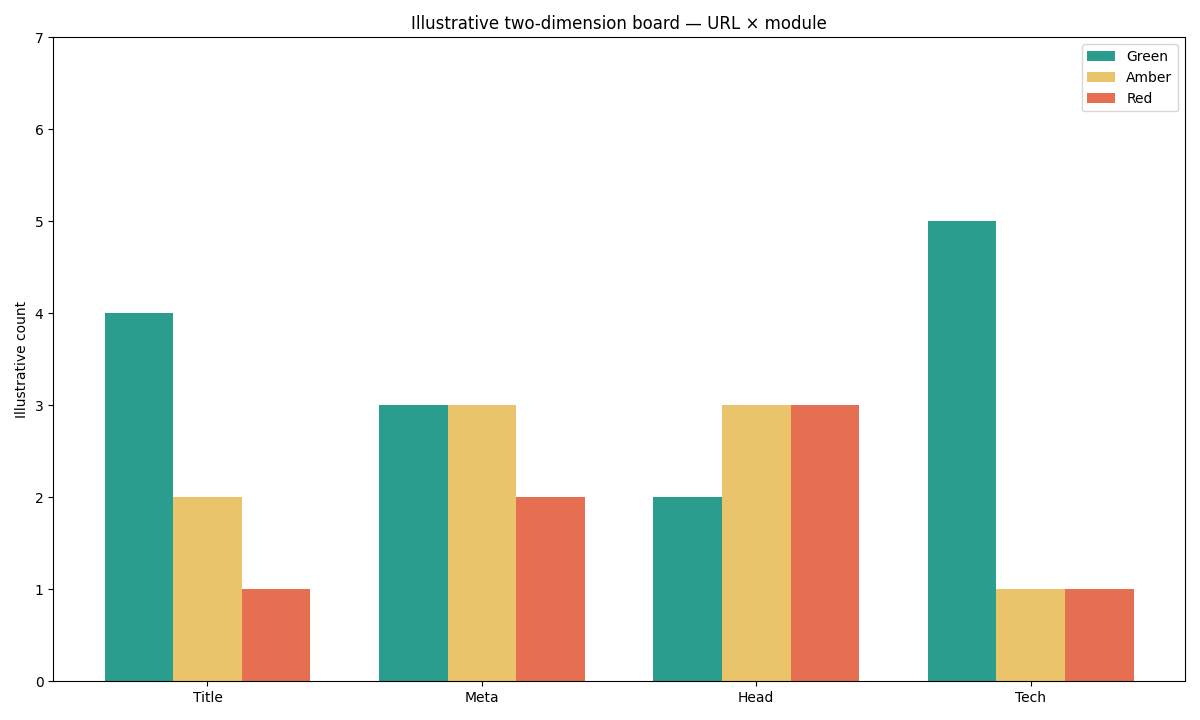
Figure: Two series from the same hub CLI JSON file. Page-issue error, warning, and good sit beside speed error, warning, and good. Both series belong to one requested string.
Title, description, and word count on that string
npx --yes -p infinitegrowth@0.1.1 seo-health check \
  https://infinisynapse.com/en/tool/seo-health-checker \
  --format json --lang en
Parsing rule: the isolation rule compares top-level url with page.canonical and attributes every issue to that pair. No sibling path is inferred from navigation links. Reproduce the parse with json.loads. Exit code 0 is not a clean board.
The returned title was SEO Health Checker: Eight Lights on One URL. The canonical matched the requested path. That match is why this one URL SEO health check can talk about the hub page as one resource. It still cannot talk about /en or /zh from this file.
Images and speed on that string
Two of five images missed alt. Those empty alts are a real checker finding on this document. They do not prove a hero failure on a different route. Speed 64 is a checker score on this response. blockingScripts 5 as error is a delivery row on this response. Caching recorded no.
A green image light on the homepage hero would not prove alt text here. Paste this gallery if this is the page you changed. The one URL SEO health check will not follow you there.
During a one URL SEO health check, SEO Health computes the eight traffic lights for that resource; the free rule engine is not powered by InfiniSynapse. The API-backed foundation is available only after a credited deep EEAT or visibility request, which can start an InfiniSynapse Server API long task with the same one-page evidence, stream SSE progress into a workspace, and add interpretation without rescoring or fetching neighboring URLs.
One paste versus a sitemap sample
A one URL SEO health check answers what is wrong on this page. A sampled site audit answers what is wrong on a slice of the host. Use the single paste when you changed a title and want lights in about 30 seconds. Use a 50–500 sitemap sample when the same template ships across dozens of URLs. The hub board will not find a title warning that exists only on nextjs.org.
If you later want the step list, open how to run an SEO health check. If you later want the release habit, open SEO health check after deploy. A one URL SEO health check after a ship still proves only the URL you pasted.
Why navigation links do not expand scope
The hub HTML contains links to siblings. Those links are not additional fetches. Title 43 and words 3025 describe the hub document. They do not describe the multilingual SEO checker page sitting one click away.
Google's chapter on monitoring distributed systems treats one probe as a sample of one target, not a proof that every replica is healthy — the same humility applies to one paste.
Landscape of single-address checks
Suites sell a site file. A one URL SEO health check that only promises eight lights on one paste is easier to defend because it promises less.
IBM's explainer on a URL describes it as a locator, not as a site map, which is why a homepage paste cannot speak for a template family.
Google Cloud's note on web application architecture reminds you that routes, templates, and environments differ; checking / does not certify /en/tool/seo-health-checker.
Do not paste localhost, signed cloud URLs, or admin paths. Keep every one URL SEO health check on a public address you can stand behind.
Browser, CLI, and Chrome
Three doors, one address rule. The browser form teaches: paste, wait, read. The CLI repeats seo-health check. Chrome stays local unless you start AI EEAT. Do not confuse seo-health check with seo-health audit --pages 50-500. If you are checking a localized page, paste that locale’s URL. A one URL SEO health check does not hop hreflang.
We used RFC 3986 and the WHATWG URL Standard to define address identity. Google's documents on canonicalization and redirects explain preferred resources, while the MDN URL API provides a programmatic parsing reference. None of those documents produced the hub numbers.
Enforce the one-resource contract
The value of a one URL SEO health check is its narrow denominator: one requested address and the response associated with it.
Resolve the final address
The comparison of the request and page.canonical is in Requested URL versus the declared tag. On 2026-09-14 the hub request and the hub canonical agreed, which is why that one URL SEO health check can name one resource.
Bind findings to that document
Title, headings, images, and speed belong to the returned resource. Navigation links do not authorize claims about their destinations. Speed 64 and blockingScripts 5 belong to the hub response. They do not belong to /en.
Independent citation 2: According to [URL](https://en.wikipedia.org/wiki/URL), URL is documented in that encyclopedia article as a public third-party definition. The URL definition establishes address semantics; only the captured hub response establishes its measured state.
Generalization limit
A clean or dirty result for this hub page cannot be promoted to its template, directory, domain, or next deployment. Reproduction means fetching this address again and comparing its own raw object, not substituting another representative page. If someone wants a printed 100, send them to the seo score checker first.
Selection scorecard
Score each row 0–2 when someone asks whether a one URL SEO health check is the right tool today.
| Question | 0 | 1 | 2 |
|---|---|---|---|
| Do you have one public canonical to defend? | No URL, or a secret host | Staging with a public share | Live canonical URL |
| Is this page the one that changed? | You changed a template and pasted / | You think it is the same | You copied the shipped address |
| Do you need lights in about 30 seconds? | Template-level evidence is required | You can wait a few minutes | You need the board now |
| Are eight modules enough to start? | You need backlinks or EEAT scores | You also need a later sample | Title through speed is the job |
| Will you re-run the same address? | Generalize from one clean document | Maybe next sprint | Same URL, same day |
Under 6 means pick another instrument. 8–10 means paste the URL that changed. A one URL SEO health check is for one page and one board.
Failure modes that waste a paste
The first failure is pasting / after you edited a template. The homepage can be green while the article URL is red. A one URL SEO health check will not warn you that you picked the wrong address; it will faithfully score the wrong address.
The second failure is pasting a URL nobody can open. Signed links, basic-auth admin, and localhost are not a public one URL SEO health check input.
The third failure is treating green as a rank promise or a site certificate. Eight lights from a one URL SEO health check are not an indexation guarantee. Title 43 on the hub does not certify /en.
The fourth failure is starting EEAT by accident. The eight lights are free. The fifth failure is reading blockingScripts 5 on the hub and filing it against a different path. A one URL SEO health check keeps delivery rows on the string you fetched.
Cluster guides beside this page
If one address is no longer the correct denominator, move without pretending the original fetch covered more.
| Job you actually have | Guide to open next | What this page will not do |
|---|---|---|
| Need the click-by-click paste | How to run an SEO health check | Repeat every button label |
| Check the page after a release | SEO health check after deploy | Become the CI pillar |
| Want the product name hub | SEO health checker | Re-teach every sibling |
| Sample 50–500 URLs | SEO website audit | Crawl a million pages |
| Someone wants a vanity 100 | SEO score checker | Print an official Google grade |
Paste the address you will actually ship
Run eight lights on one public canonical URL in about 30 seconds. A homepage paste does not prove a template.
Run SEO Health CheckerFrequently Asked Questions
What does a check canonical URL show on this board?
Bottom line: Check canonical URL on this board compares the address you pasted with the declared tag, then reads eight lights on that string only. If the request and page.canonical disagree, fix that pair before you read the other lights. A match is one cell on that string. It is not a site certificate.
Does a homepage paste prove every template?
Bottom line: No. A homepage paste proves the homepage. A one URL SEO health check does not infer sibling paths, shared templates, or other locales from /. The hub page must be pasted as its own string.
How long should the board take to settle?
Bottom line: About 30 seconds for eight modules on one public URL. If a module stays empty, treat the run as failed and re-paste once. A blocked fetch is already a finding.
Can I paste localhost or a signed preview?
Bottom line: No. Paste a public canonical address. Localhost, basic-auth admin, and signed cloud URLs are not a repeatable one URL SEO health check. Do not paste secrets.
Is this an official Google score?
Bottom line: No. A one URL SEO health check is a first-party rule board with eight traffic lights. Google supplies no universal page-health certificate, and a clean result here remains tied to one canonical document.
What did the hub page return on 2026-09-14?
Bottom line: Title 43, description 153, 3025 words, missing alt 2/5, speed 64, and blockingScripts 5 as error. Those rows describe that public string only. They do not describe /en or a template family.
Conclusion
A one URL SEO health check is eight lights on the address you pasted. The 2026-09-14 snapshot shows the hub page as one public string: title 43, description 153, 3025 words, alt 2/5, speed 64, and five blocking scripts in error. Paste the canonical you will ship, fix red, re-run the same URL.
Keep the one URL SEO health check in SEO Health. If interpretation is needed for this exact document, open it once in the InfiniSynapse web app without implying coverage of neighboring guides.
William Zhu · Cofounder, InfiniSynapse · GitHub @allwefantasy
Desk-validated SEO Health methods. Corrections: zhuhl@infinisynapse.com · corrections policy.