Canonical Checker: Read the Tag, Then Keep One
A canonical checker reads rel=canonical, follows the target, and flags loops or twins. See the keep-list desk before you rewrite either URL.
Author credentials: William Zhu is cofounder of InfiniSynapse (GitHub @allwefantasy · auto-coder). Desk: shipping SEO Health and the /en/tool/ visibility pages. No personal LinkedIn published. About: team / editorial standards.
Publisher credentials: InfiniSynapse has public profiles on GitHub, YouTube, and X. A 2026 WAIC Future Tech OPC excellence award covers the Agentic Data Infra entry (WAIC; third-party recap: Xinhua / Caohejing). That award does not review this page or SEO Health. Method CLI: infinitegrowth on npm. Archive: recognition and scope notes.
On this page
By William Zhu · Cofounder, InfiniSynapse · Published: 2026-09-08 · Last updated: 2026-09-24 · Last verified: 2026-09-24 · Reviewed by the InfiniSynapse Data Team.
Reviewed by: InfiniSynapse Data Team · method review 2026-09-24. First-party canonical review of InfiniSynapse public HTML. No customer twin set.
Trust / COI: About · Corrections. SEO Health and InfiniSynapse are commercial products from this team. Declared hrefs below are our own public markup, not a search-engine-selected canonical.
TL;DR
A canonical checker reads the string in rel=canonical, follows that href, and maps twins to one keep list. A canonical tag checker is the same mapping job with the HTML element named. Self-canonical on the winner is a pass. Two live URLs that each claim themselves fail.
Direct answer: Run a canonical checker as a mapping job. Record the requested URL, the terminal status, and the href the terminal emits. On this host the apex declared
https://infinisynapse.com. The tool page declared itself. A UTM query still answered 200 and pointed at the clean tool URL. Fix the tag or 301 the loser before anyone rewrites either title.
What you will learn
- What a canonical checker must report besides “tag present”
- Which first-party documents declared a keep href
- Why a 200 with a UTM query is not a second winner
- When this file should stop and a hop ticket should start
- Which siblings own duplicates, leftover noindex, and eligibility after one URL is chosen
The same desk string InfiniSynapse-P4-desk/2026-09-14 fetched HTML heads, not hop traces. A declared canonical is a hint. A canonical checker does not prove a search engine selected that URL. Build marker: DESK-CTC-20260924A.
What is a canonical checker?
Key definition: A canonical checker fetches a URL, records the declared keep href from HTML rel=canonical (and an optional HTTP Link header), follows that target, and marks whether the requested URL sits on the keep list. A canonical tag checker is the same job. The job names canonical errors. It is not a title rewrite and not an official Google health score.
People search this phrase when two parameter URLs both look live and a writer wants a new H1 on each. The first canonical checker question is which URL is chosen. Copy is later.
Google’s canonical troubleshooting guide is the search-engine rule we used when a declared href disagrees with the requested address. It does not pick a winner for this host.
What a canonical checker should report
A canonical checker that only counts tags can pass a page that points at a missing document. Record these lights on every fetch. The site-wide leftover graph stays on duplicate URL indexation.
| Light | Fail when |
|---|---|
| Missing | No HTML rel=canonical and no HTTP Link |
| Self vs other | Href does not match the keep-list winner |
| Target status | Href is not a live 200 document |
| Loop | A points at B and B points at A |
| Cross-domain | Href leaves the host without a syndication ticket |
| Multiple | Two HTML tags, or theme plus plugin |
| HTTP vs HTML | Link header and the HTML href disagree |
og:url that disagrees is a note, not a third canonical. A raw-curl canonical checker will not see a tag inserted only after JavaScript. If the fetch is 403, write “canonical not observable” and stop. Absence under a refusal is not evidence of a missing tag.
What a keep vote looks like
The keep URL is the string in rel=canonical, not the address bar after a campaign click. A canonical checker groups those strings. Preferred is a vote. RFC 6596 defines the link relation. It is not a fetch.
Apex versus tool
Apex and the tool page are different identities. Apex declared https://infinisynapse.com. The tool page declared https://infinisynapse.com/en/tool/website-indexation. A canonical checker that merges those two hrefs into “the site” will hide a real split later.
Query strings that stay 200
https://infinisynapse.com/en/tool/website-indexation?utm_source=p4-desk answered 200 with zero hops. The HTML still declared the clean tool URL. A canonical checker records that as a keep vote on the loser query. It is not proof the query string will disappear from every log.
WHATWG’s canonical link type treats the href as a document identity, not as a campaign token. Compare the href as a string. Do not pretty-print away utm_source.
SEO Health is the deterministic foundation for status, robots, and declared canonical on every candidate twin. After conflicts are classified, an InfiniSynapse Server API long-task workspace can sequence keep-list queues; the API does not refetch twins or choose a search-engine canonical.
First-party declarations on 2026-09-14
We fetched InfiniSynapse public HTML for this canonical checker desk. The sample is this host. It is not a 40-row fictional twin set.
| Requested URL | First status | Declared keep href |
|---|---|---|
https://infinisynapse.com/ | 200 | https://infinisynapse.com |
/en (followed) | 308 → 200 | https://infinisynapse.com |
/en/tool/website-indexation | 200 | self |
tool URL + utm_source=p4-desk | 200 | clean tool URL |
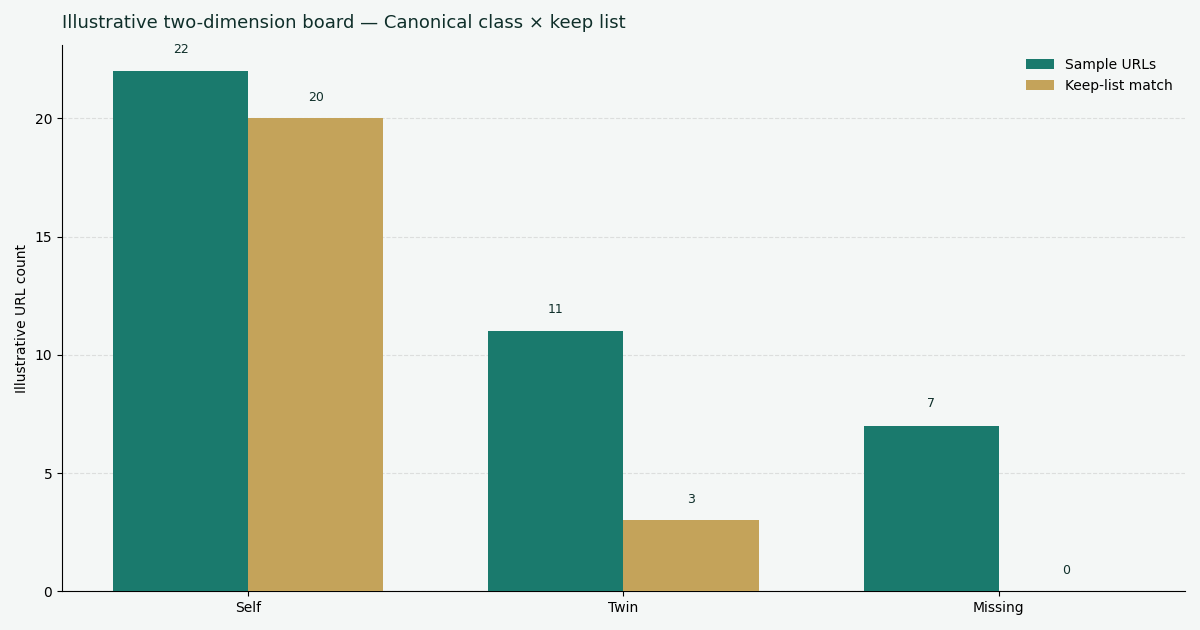
Figure: Two series from the same desk. Request status is not the declared href. Neither series is a Google-selected canonical.
A later deploy can change the tag. A canonical checker file that quotes only a CMS field and skips the live HTML is incomplete.
Homepage keep string
The homepage title was present. The keep href was the apex without a trailing slash. A canonical checker writes that exact string. MDN’s rel attribute reference is the markup reminder that rel=canonical is a link type, not a banner. Write the exact href. Relative guesses fail the ticket.
/en 308’d to / and inherited that same apex href. The hop belongs on redirect chain. The keep string belongs in this file.
Tool self pointer
The live tool document declared a self canonical and robots = index, follow, max-image-preview:large, max-snippet:-1. That is a self vote on a URL we intend to keep. Open the website indexation hub when status and robots must sit beside the href. A canonical checker stays with the href.
UTM twin
The UTM twin stayed on the same request. No 301 cleaned the query. The tag did the vote. Bing’s 2009 note on duplicate content still treats near-copies as a retrieval problem. Do not write two outlines for one identity.
A canonical checker treats a self tag on a leftover parameter as a miss against the keep list, even when the parameter URL returns 200.
How we read the href
A canonical checker record should keep the user-agent, the requested URL, the first status, and the exact canonical href. We used one desk string. A later bot can see a different head. HTTP Link: rel="canonical" is a second vote when the server emits it. Compare it to the HTML string. Do not treat og:url as a third winner.
String compare, not pretty-print
curl -sS -A 'InfiniSynapse-P4-desk/2026-09-14' \
  'https://infinisynapse.com/en/tool/website-indexation?utm_source=p4-desk' \
  | grep -i canonical
If a later replay is refused, write “canonical not observable” and stop. URI strings compare as strings. Trailing slashes, http versus https, and www are different votes. This host’s www path 301’d to apex before HTML existed, so there was no second www canonical to fight. That hop is a different ticket.
Twins that still answer 200
Twins are live URLs that share a document identity: slash variants, parameters, print views, or locale copies that should not both stay. The UTM tool URL is the first-party example on this desk. A canonical checker lists them. It does not merge them for you.
A canonical checker fails when both twins keep a self tag, when the tag points at a redirect, or when the element is missing. Status codes stay deterministic and free. Chrome can finish eight lights locally. A green density light on a twin that should have lost is false comfort.
If two URLs still both return 200 without a 301 after tags are clean, you still have an eligibility leak. Close the loser. The fuller graph lives on duplicate URL indexation.
Drop one twin into SEO Health tools if you only need a keep-href light. Those lights are not a Google 100. The chosen-URL string does not need login.
Keep list versus a rewrite
A rewrite changes words. A tag table changes which URL is allowed to remain the document. Engineering owns the tag and the header. Product owns the keep list. Editorial owns titles after one URL is chosen. Meetings fail when writers own the first hour of a canonical checker. Start with the live href. Then assign copy.
When both pages stay live
Self-canonical on a loser is a canonical error. Self-canonical on a winner is a pass. The keep list decides which is which. The UTM twin already voted for the clean tool URL. That is the intended pattern. If a later template emits self on both, the sample will show it.
One URL is enough when a launch path is new and you need a canonical checker on that address only. Paste it. Confirm a live self tag that matches the keep list. Then write.
One URL is not enough when templates mint parameters. This desk did not sample 50–500 sitemap URLs. The 1,568-loc map is an inventory. Template prevalence still needs a stratified fetch. Homepage-only confidence is how print views hide.
How to close a twin
Run this keep-list framework before you open the copy doc. Skip the outline until twins on the requested set are classified.
Point or 301
Point losers at the winner, or 301 them. Do not retitle both. A canonical checker is a mapping job. The model may not invent a keep URL you did not write down.
If a leftover noindex sits on the winner, the next room is noindex tag. Do not mix those tickets.
Re-fetch after cache
Origin can be fixed while a CDN still serves the old tag. Purge, then re-fetch. A canonical checker that trusts a staging screenshot will lie in production.
Recheck the parameter, slash, and locale twin buckets against the approved keep list. Compare self / twin / missing shares. Only then ask for a ranked punch list. The narrative still quotes the tag table.
Open the InfiniSynapse web app only if you want a credited sequencing narrative after the keep-list table already exists.
Failure modes that leave two winners
Copy first. The most common miss is a new title on both twins. A canonical checker already failed. The keep list never closed.
Self-tag theater. Each URL points at itself. The screenshot looks tidy. Two winners still exist.
Tag to a redirect. The href hops. The chosen URL is not a document. Point at the live winner.
Cache lie. Origin is fixed. CDN still serves the old tag. Purge, then re-fetch.
Query applause. Teams celebrate the 200 on a UTM URL and ignore that the keep href already named the clean path. Record both.
Update fan fiction. A core-update week is not a twin diagnosis. If the keep list is split, fix the tag. Do not invent a recovery percentage.
Nearby guides after the keep list
This page is the chosen-URL cluster for a canonical checker. The older phrase canonical tag checker still names this desk. Nearby guides pick up hops and leftover robots after one href is chosen.
| Job you actually have | Guide to open next |
|---|---|
| Hop count and terminal status | redirect chain |
| Parameter and slash twins at graph scale | duplicate URL indexation |
| Leftover meta or header refusals | noindex tag |
| Eligibility across status and robots | website indexation |
| Nuxt canonical on the public route | Nuxt SEO |
Read the keep href before you retitle either twin
Record the requested URL, the terminal status, and the exact canonical string. Then open a sample only if templates mint copies.
Run SEO Health CheckerFrequently Asked Questions
What is a canonical checker?
A canonical checker reads the declared keep href, follows it, and flags missing tags, loops, dead targets, and twins that still answer 200. A canonical tag checker is the same job. It does not prove a search engine selected that URL.
Does a self tag always pass?
No. Self on a loser is a canonical error. A canonical checker passes only when the self tag sits on the keep-list winner and the target returns 200. Two self tags are a split.
Do chosen-URL strings need a login?
No. A canonical checker reads the href without an account. Chosen-URL fetch status remains a free, deterministic column. Eight-module lights on a pasted URL stay free. Credits enter only when the completed conflict table needs sequencing.
Can a title rewrite merge twins?
No. A title change does not pick a winner. A canonical checker is a tag fix or a 301, then a re-fetch. Copy waits until one URL is chosen.
What does a 200 UTM URL mean if the tag is clean?
It means the query string is still fetchable. The keep vote already named the clean tool URL. A canonical checker does not treat that 200 as a second winner. File the requested URL and the href together.
How wide should a later sitemap sample be?
Use 50–500 stratified URLs when templates mint twins. This desk used a first-party head set, not a loc sample. A homepage-only paste hides parameters, slash variants, and print views. Record the sample ceiling in the ticket so a later replay uses the same twin population.
Conclusion
Use a canonical checker when the job is to verify one chosen URL before anyone opens a copy doc. The 2026-09-14 desk shows apex voting for https://infinisynapse.com, the tool page voting for itself, and a UTM query answering 200 while pointing at the clean tool URL. Close the file when the requested URL, the status, the href, and the unresolved alternatives are still visible. A bounded keep list is more useful than an unsupported consolidation claim.
William Zhu · Cofounder, InfiniSynapse · GitHub @allwefantasy
Desk-validated SEO Health methods. Corrections: zhuhl@infinisynapse.com · corrections policy.