Fix a Redirect Chain by Checking Every Live Public Hop
Fix a redirect chain by recording every Location hop, loop, and terminal response across a bounded URL sample before changing destination copy or metadata.
Author credentials: William Zhu is cofounder of InfiniSynapse (GitHub @allwefantasy · auto-coder). Desk: shipping SEO Health and the /en/tool/ visibility pages. No personal LinkedIn published. About: team / editorial standards.
Publisher credentials: InfiniSynapse has public profiles on GitHub, YouTube, and X. A 2026 WAIC Future Tech OPC excellence award covers the Agentic Data Infra entry (WAIC; third-party recap: Xinhua / Caohejing). That award does not review this page or SEO Health. Method CLI: infinitegrowth on npm. Archive: recognition and scope notes.
On this page
By William Zhu · Cofounder, InfiniSynapse · Published: 2026-09-08 · Last updated: 2026-09-14 · Last verified: 2026-09-14 · Reviewed by the InfiniSynapse Data Team.
Reviewed by: InfiniSynapse Data Team · method review 2026-09-14. First-party hop review of InfiniSynapse public URLs. No customer crawl.
Trust / COI: About · Corrections. SEO Health and InfiniSynapse are commercial products from this team. The hop table is a desk fetch of our own host, not a Google membership report.
TL;DR
A Location header is the only hop proof that belongs in the ticket. Count those headers, then write the terminal status. A redirect chain is that pair: hop count plus the last code. One hop to a live 200 can be healthy. One hop into a blog 404 is still a defect.
Direct answer: Treat a redirect chain as a recorded path, not a pretty first 301. Write every Location, the hop count, and the terminal status. On this host, locale roots, blog-to-tool slugs, www, and http each used one hop. An invented
/en/…path also used one hop, then 404’d. Extra hops, loops, and a 301 that dies on 4xx still fail.
What you will learn
- Which first-party paths on this host used one hop
- Why a 308 to
/is a different ticket from a 301 that lands on 404 - How http 302 and www 301 collapse toward apex
- When a redirect chain file should stop and a 404 ticket should start
- Which siblings own twins, misses, and eligibility after hops are honest
Desk UA InfiniSynapse-P4-desk/2026-09-14 followed each Location on this host. Those codes do not prove Google stored the old path. A redirect chain desk that skips the user-agent cannot be replayed.
What hop count records
Key definition: A redirect chain is the count of hops from the requested URL to a terminal response, plus the final status of that terminal. The job names leftover hops, loops, and a 301 that lands on 4xx, 5xx, or an empty 200. It is not a title rewrite and not an official Google health score.
People open this phrase when Search Console shows a redirect and a writer still wants a new paragraph on the old address. The first question in a redirect chain pass is how many hops remain and what status the last hop returns. Copy waits.
Google’s redirect guidance is the search-engine rule we used when deciding that a 3xx is an intermediate, not a keep. It does not grade this host.
First status is not the terminal
A 308 on /en is the first status. The terminal is / at 200. A redirect chain row that quotes only the 308 is unfinished. Write both codes.
MDN’s redirection guide is the protocol reminder that a client must follow Location before it can claim a document. We followed Location. We did not invent a second hop.
Location is the second column
Location is a string. Compare it as a string. / is not /en. /en/tool/website-indexation is not /en/blog/website-indexation. A redirect chain ticket that paraphrases Location as “the tool page” will hide a wrong host path later.
SEO Health remains the deterministic evidence layer for status, Location, and terminal HTML. Classified hop defects may enter an InfiniSynapse Server API long-task workspace to sequence edge and app queues; the API does not refetch a URL or override the recorded chain.
First-party hops on 2026-09-14
We fetched InfiniSynapse public URLs for this redirect chain desk. The sample is this host. It is not a 50–500 sitemap draw and not a customer outage.
| Requested path | First code | Location | Hops | Terminal |
|---|---|---|---|---|
/en | 308 | / | 1 | / 200 |
/en/blog/website-indexation | 308 | /en/tool/website-indexation | 1 | tool 200 |
/zh/tool/website-indexation | 308 | /en/tool/website-indexation | 1 | tool 200 |
http://infinisynapse.com/ | 302 | https://infinisynapse.com/ | 1 | apex 200 |
https://www.infinisynapse.com/ | 301 | https://infinisynapse.com/ | 1 | apex 200 |
/en/this-path-should-not-exist-p4-20260914 | 301 | /en/blog/this-path-… | 1 | blog 404 |
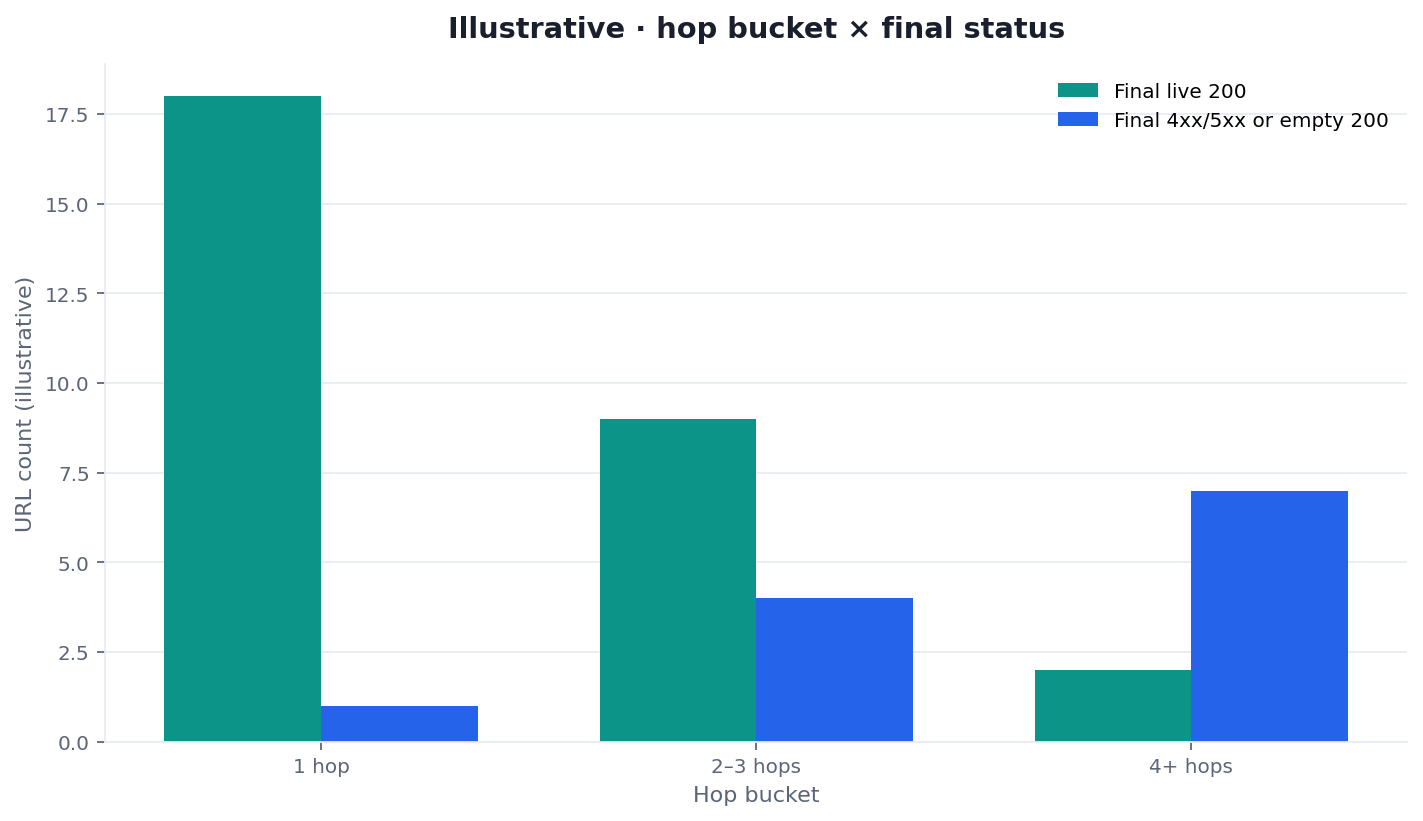
Figure: Two series from the same desk. First status is not hop count. Neither series is an indexed-page count.
A later deploy can change Location. A redirect chain file that quotes only next.config.ts and skips the live status is incomplete.
Locale roots and host twins
/en answered 308 with Location /. Followed, it landed on the apex 200. That locale-root row belongs in the redirect chain table. It is not a language page. RFC 9110 redirection semantics still classify 308 as a permanent redirect. Permanent is not a keep on the old path.
http://infinisynapse.com/ answered 302 to the https apex. https://www.infinisynapse.com/ answered 301 to the same apex. Two schemes, two hosts, one hop each. A redirect chain keep list that still treats www as a live document is already stale.
Blog slug and zh tool consolidation
/en/blog/website-indexation answered 308 with Location /en/tool/website-indexation. Followed, hop count was 1 and the terminal was 200. That is a one-hop redirect chain, not a missing document. The website indexation hub owns eligibility after that hop. This page owns the hop itself.
/zh/tool/website-indexation answered 308 to the same English tool URL. That is consolidation, not a translated twin. A redirect chain row should store the first 308 beside the English terminal. Locale pairing belongs on a hreflang pair.
The invented /en path
The invented missing path /en/this-path-should-not-exist-p4-20260914 did not 404 in place. It 301’d into /en/blog/this-path-should-not-exist-p4-20260914, and that blog URL 404’d. Two statuses. One hop. Then 404. The 404 HTML title was the homepage title, about 17 kB.
That mismatch is a classification finding, not a customer outage. A redirect chain register still stores the 301. The polite 404 body belongs on 404 errors seo.
How we recorded hops
A redirect chain record should keep the user-agent, the first status, the Location, the hop count, and the followed final URL. We used one desk string. A later bot can see a different path.
Replay command
curl -sSI -A 'InfiniSynapse-P4-desk/2026-09-14' \
  https://infinisynapse.com/en/blog/website-indexation
Follow with curl -L when you need the terminal. Do not treat a cached 200 as a new hop. Geo routing, cookies, or a later config can produce another path. If a later replay is refused, write “terminal status unavailable” and stop. Do not convert an edge refusal into a loop claim.
Cloudflare’s URL forwarding docs show how an edge can mint the hop you just recorded. Name the layer. Do not blame the CMS by default.
Why one hop can still fail
One hop is not a pass if the terminal is 404, 410, 5xx, or a 200 whose body is an empty “not found.” The invented /en/ path was one hop and still failed as a document. A redirect chain that celebrates “only one redirect” without the terminal is theater.
A loop is a hop that returns to a URL already seen. This desk did not see a loop. If you see one later, treat it as a hop failure. Do not brief a novelist for a cookie ping-pong.
Paste one address at SEO Health tools if you want a single-URL hop light. Those lights are not a Google 100. A redirect chain status column does not need login.
Rule owners versus vanity hosts
Engineering owns the redirect rule. Editorial owns titles after the URL is one hop and a live 200. Meetings fail when writers own the first hour of a redirect chain. Start with the live Location. Then assign copy.
Apache mod_alias is one application-layer way to mint a hop. Ingress and a load-balancer listener can add another. A redirect chain asks which layer owns the leftover hop, then deletes it. Do not add a hop because a slide asked for a vanity host.
Edge, balancer, and app
Pick one owner. Delete the extra rule. Re-read the hop list after the delete. If hop count did not drop, the owner was wrong. This host’s locale-root and blog-to-tool hops already live in next.config.ts. The 2026-09-14 curl confirmed the live hop. Config without curl is a guess.
When a hop table is enough
One URL is enough when a launch path is new and you need a redirect chain check on that address only. Paste it. Read the first status. Confirm one hop and a live 200. Then write.
One URL is not enough when templates mint chains. Redirect behavior at scale still needs legacy paths and current destinations in the same bounded draw. This desk did not sample 50–500 sitemap URLs. The 1,568-loc map is an inventory. Template prevalence still needs a stratified fetch. Homepage-only confidence is how leftover www and HTTP twins hide.
If hops are clean and two URLs still both return 200, the next room is the canonical tag checker. After hops are clean, run a canonical checker. Come back here when the sample still shows stacked hops or a 301 that lands empty.
How to classify a live hop
Run this hop framework before you open the copy doc. Skip the outline until hops on the requested set are classified.
Record every Location
Write the requested URL and every Location you followed. A redirect chain starts with that list, not with a slogan. If HTTP rows 302 to HTTPS and then 301 again to www, that is already a finding. This host’s http path was one 302. Do not assume every property matches.
Status codes stay deterministic. They do not need a login. Sort 4+ hops with a bad final status to the top. A one-hop 301 to a live 200 can wait. A one-hop 301 to a 404 cannot.
Separate loops from long stacks
Label loops separately from long chains. A loop never ends. A long chain ends badly or late. A redirect chain is one rule, not three polite 301s. Re-sample after the edge rule ships. Compare hop shares and final-status shares. Only then ask for a ranked punch list. The narrative still quotes the hop table. The model may not invent a 301.
When hops are green and the page still looks gone, stay on the 404 sibling. Do not mix those tickets.
Open the InfiniSynapse web app only if you want a credited sequencing narrative after the hop table already exists.
Failure modes that hide a hop
Copy first. The most common miss is a rewrite on a URL that still hops. The redirect chain already failed. The new paragraph never stays on the requested address.
Pretty 301 theater. A 301 looks finished in a screenshot. Hop two still 302s to hop three, which 404s. Record the terminal, not the first 301.
Empty 200 applause. Teams celebrate the 301 and ignore that the terminal body is a “not found” card. That empty 200 is still a hop failure.
Loop as temporary. Cookie or A/B ping-pong never ends. Treat it as a hop failure. Do not wait for a campaign to finish.
Wrong owner. App team deletes a hop. Ingress adds it back. Re-sample across layers.
Update fan fiction. A core-update week is not a hop diagnosis. If tech is red, fix the rule. Do not invent a recovery percentage.
Nearby guides after hops
This page is the hop-count cluster for a redirect chain. Nearby guides pick up chosen-URL fights and miss classes after hops are honest.
| Job you actually have | Guide to open next |
|---|---|
| One chosen URL per twin | canonical tag checker |
| A miss that should 404 in place | 404 errors seo |
| Eligibility across status and robots | website indexation |
| Locale prefix versus a translated pair | hreflang audit |
Trace every hop before you rewrite the destination
Read first status, Location, hop count, and the terminal code. Then open a sample only if templates disagree.
Run SEO Health CheckerFrequently Asked Questions
Is a single 301 enough to pass?
Only if hop count is one and the final status is a live 200. A redirect chain fails on extra hops, loops, and terminals that are 4xx, 5xx, or an empty 200. A screenshot of the first 301 is not the job.
Do hop counts need a login?
No. You can count a redirect chain without an account. Hop status remains a free, deterministic column. Eight-module lights on a pasted URL stay free. Credits enter only when the measured hop table needs a separate InfiniSynapse sequencing task.
Can a title rewrite shorten a chain?
No. A title change does not delete a Location header. A redirect chain is a rule fix, then a re-fetch. Copy waits until hops are honest.
What does a 301 into a 404 mean?
It means two statuses on one path. The first hop moved the URL. The terminal said the document is gone. File both codes. Do not call that path a healthy redirect chain because hop count was one.
How wide should a later sitemap sample be?
Use 50–500 stratified URLs when templates mint chains. This desk used a first-party hop set, not a loc sample. A homepage-only paste hides www, slash, locale, and HTTP leftovers. Write the hop-sample ceiling beside the command before interpreting chain frequency.
Conclusion
Use a redirect chain file when the job is to verify hop count and terminal status before anyone opens a copy doc. The 2026-09-14 desk shows locale roots collapsing to /, blog and zh tool slugs collapsing to /en/tool/, http and www collapsing to apex, and an invented /en/ path walking into a blog 404. Close the file when the first status, the Location, the hop count, and the terminal are still visible. A bounded hop table is more useful than an unsupported index claim.
William Zhu · Cofounder, InfiniSynapse · GitHub @allwefantasy
Desk-validated SEO Health methods. Corrections: zhuhl@infinisynapse.com · corrections policy.