Fix 404 Errors SEO by Classifying Each Missed Live URL
Fix 404 errors SEO by separating hard misses, soft 200 error pages, and stale sitemap entries before restoring content or changing response behavior first.
Author credentials: William Zhu is cofounder of InfiniSynapse (GitHub @allwefantasy · auto-coder). Desk: shipping SEO Health and the /en/tool/ visibility pages. No personal LinkedIn published. About: team / editorial standards.
Publisher credentials: InfiniSynapse has public profiles on GitHub, YouTube, and X. A 2026 WAIC Future Tech OPC excellence award covers the Agentic Data Infra entry (WAIC; third-party recap: Xinhua / Caohejing). That award does not review this page or SEO Health. Method CLI: infinitegrowth on npm. Archive: recognition and scope notes.
On this page
By William Zhu · Cofounder, InfiniSynapse · Published: 2026-09-08 · Last updated: 2026-09-14 · Last verified: 2026-09-14 · Reviewed by the InfiniSynapse Data Team.
Reviewed by: InfiniSynapse Data Team · method review 2026-09-14. First-party curl of an invented InfiniSynapse
/en/path and the matching/en/blog/miss.
Trust / COI: About · Corrections. SEO Health and InfiniSynapse are commercial products from this team. The miss rows below are a desk fetch of our own public host. They are not a customer outage and not proof that Google stored any URL.
TL;DR
404 errors seo classifies gone URLs as a hard miss, a soft 200 that should not be kept, or a leftover sitemap row that still advertises the gone address. Classify those rows. Do not rewrite an error template as if it were a live document.
Direct answer: Treat 404 errors seo as a status-and-body job. On 2026-09-14 the invented path
https://infinisynapse.com/en/this-path-should-not-exist-p4-20260914answered 301 into/en/blog/this-path-should-not-exist-p4-20260914, and that blog URL answered 404. Asking the blog miss directly was a 404 in place. The 404 HTML reused the homepage title and was about 17k bytes. That is a classification finding, not a customer outage.
We used user-agent InfiniSynapse-P4-desk/2026-09-14. Reproduce the hops with curl -sSI and curl -L. Those codes do not prove Google stored the URL.
What you will learn
- Why an invented
/en/path walked into a blog 404 - Why a direct blog miss 404’d in place
- Why a homepage title on a 404 still needs a row
- When 404 errors seo stops and a leftover-robots sibling begins
What a miss class records
Key definition: 404 errors seo is the job of labeling gone URLs as a hard miss (404 or 410), a soft miss (200 that should not index), or a sitemap leftover that still advertises the gone address. The repair is an honest status, a restored document, or a sitemap delete — not a longer apology.
People search this phrase when Search Console lists 404s and a writer wants a new paragraph. 404 errors seo answers “should this URL exist, and did we tell the truth.” A deleted SKU with a friendly 200 is one miss. A true 404 that never left the sitemap is another.
The Google HTTP and network errors guide is the official reminder that 404 and network failures are crawl facts. This page copies that reminder. It does not claim Google indexed any row below.
RFC 9110 status 404 is the protocol definition we used when deciding that a gone document should not answer 200. The RFC does not grade this host.
Paste a public URL at SEO Health when you still need eight lights. That board is not an official Google 100. 404 errors seo work starts in status, body, and leftover rows.
SEO Health stays the deterministic evidence foundation for status, robots, canonical, error-body, and sitemap observations. Once misses are classified, an InfiniSynapse Server API long-task workspace can sequence template and sitemap engineering queues; the API does not refetch missing paths, change a status, or override the observed miss class.
A hard miss can still wear the wrong title
The hard-miss check asks whether the status matches the gone document. A true 404 or 410 with an error template is already honest on the code. 404 errors seo still records the title and byte size. A 404 that reprints the homepage title is a classification finding even when the status is correct.
Soft 200s and leftover rows stay on the same ticket
A soft 404 is a 200 plus “sorry” or an empty card grid. A sitemap leftover is a gone URL that still appears in the XML you publish. 404 errors seo holds both on the same ticket. Removing the leftover row does not flip a polite 200. Flipping the status does not remove the leftover row.
Allow rules still belong on the robots txt check. Allowing the path is required and still incomplete. Misses can still appear after allow: the path is fetchable and the body or sitemap is a lie.
First-party miss chain on 2026-09-14
We invented https://infinisynapse.com/en/this-path-should-not-exist-p4-20260914 so the miss would be identifiable later. The first answer was HTTP/2 301 with Location /en/blog/this-path-should-not-exist-p4-20260914. Following that hop produced 404. Requesting the blog miss directly produced 404 in place, with no extra hop.
| Requested URL | First status | Hops | Final status | Title / size note |
|---|---|---|---|---|
/en/this-path-should-not-exist-p4-20260914 | 301 | 1 | 404 on /en/blog/… | 404 HTML title = homepage title; ~17k bytes |
/en/blog/this-path-should-not-exist-p4-20260914 | 404 | 0 | 404 | same title reuse; 404 in place |
/ | 200 | 0 | 200 | homepage title source |
curl -sSI -A 'InfiniSynapse-P4-desk/2026-09-14' \
  https://infinisynapse.com/en/this-path-should-not-exist-p4-20260914
404 errors seo files the first hop as a locale-prefix rule, not as a restored document. The invented /en/ path did not 404 where it was requested. It became a blog URL first. The final code was honest. The title was not.
The MDN 404 reference is the browser-facing status explainer we used for the hard-miss label. It is not a product endorsement.
Cloudflare custom error pages show how an edge can wrap a miss. Applied here: a custom 404 that reprints the homepage title is still a 404. 404 errors seo records the wrap. It does not treat the wrap as a live document.
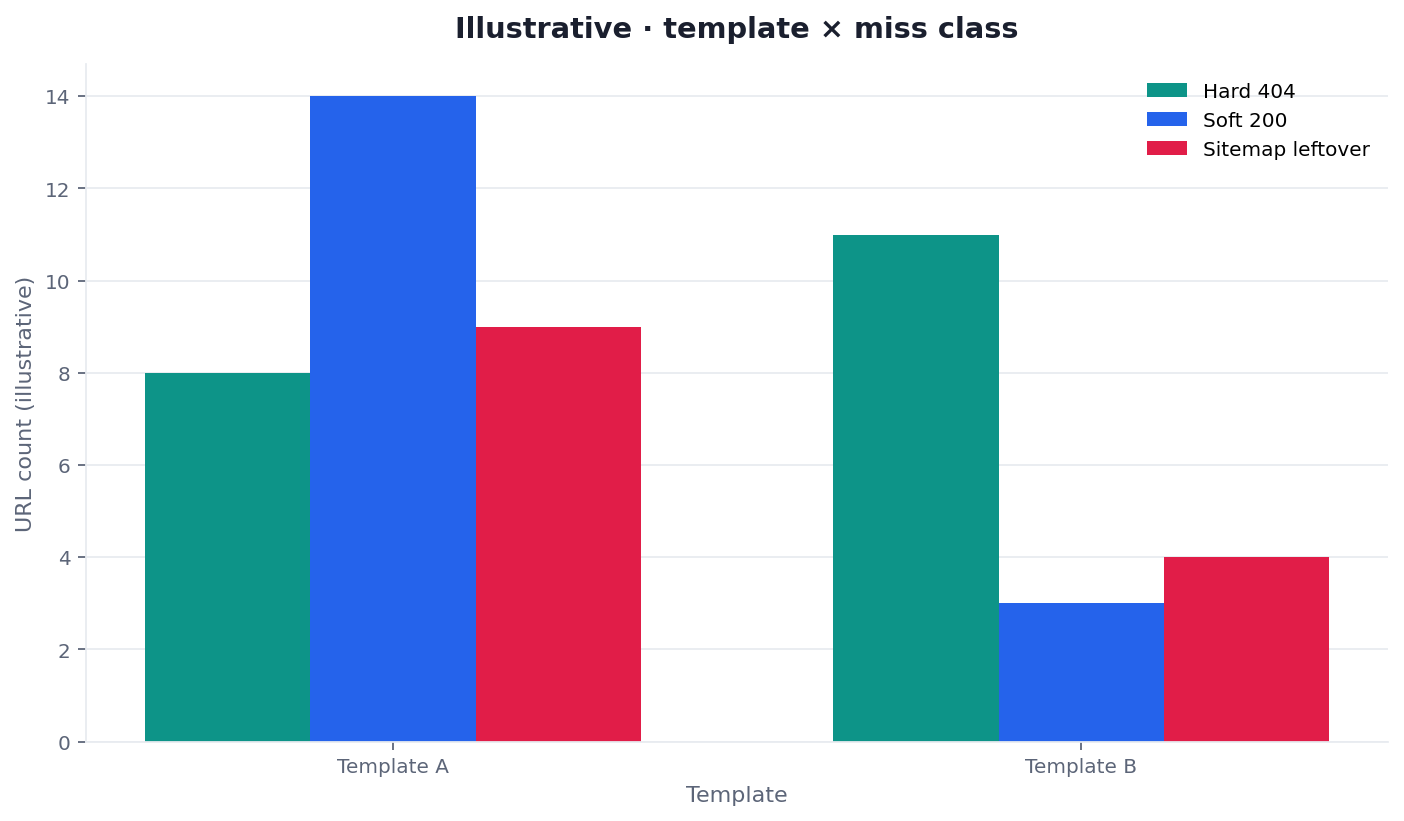
Figure: Two series from the same curl desk. First status is not hop count. Neither series is an indexed-page count.
Why the invented /en/ path hopped
This host already collapses some /en/ addresses toward blog or tool routes. The 2026-09-14 curl confirmed the live hop for this nonce. A later deploy can change Location. A 404 errors seo file that quotes only next.config.ts and skips the live status is incomplete.
The 301 body on the first hop was 47 bytes. That is a Location packet, not a document. The 404 HTML was about 17k bytes and reused the homepage title “InfiniSynapse — AI Data Agent for Enterprise Data Analysis.” Status was honest on the final hop. The title was a homepage twin.
Why the direct blog miss stayed in place
Asking /en/blog/this-path-should-not-exist-p4-20260914 directly answered 404 with zero hops. That is the honest in-place miss. 404 errors seo needs both rows: the hop-then-404 chain and the in-place 404. Teams that only invent /en/ paths will miss the in-place case. Teams that only hit /en/blog/ will miss the prefix hop.
This host’s sitemap.xml answered 200 with 1,568 <loc> values. None of those locs was the invented nonce. The miss is therefore not a leftover sitemap advertisement. 404 errors seo still files a status-and-title finding. Do not invent a leftover row that the map did not list.
A three-class framework
Use this map before you open a copy doc. 404 errors seo is a classification, not a vibe.
| Class | Status | Body / list | This 2026-09-14 desk |
|---|---|---|---|
| Hard 404 | 404 or 410 | Error template | Final hop and in-place blog miss |
| Soft 200 | 200 | Error or empty “not found” | not observed on these two URLs |
| Sitemap leftover | Any | Gone URL still in XML | invented nonce not in the 1,568-loc map |
404 errors seo holds when you can label every failing URL as one of those three. A hard 404 is already honest on the code. A soft 200 is an engineering ticket. A leftover sitemap row is a list ticket. Do not call all three “thin content.”
The Apache ErrorDocument directive is the origin-side reminder that an error template is still an error. 404 errors seo borrows that reminder. It does not treat a custom template as a keep-page.
Body length is evidence, not a grade
A 17k 404 that reprints the homepage title is evidence for a title-mismatch ticket. A 40-word live how-to that you intended to keep is thin content after eligibility. Same “short or long” habit. Different ticket. Do not print a vanity 100 to hide the difference.
Fetch utilities sit on the technical SEO tools page. This page stays on 404 errors seo miss classes.
How a miss compares to a rewrite
A true miss tells the crawler to drop the URL. A polite 200 asks the crawler to keep it. A leftover sitemap row asks the crawler to fetch it again. 404 errors seo exists to catch all three. If you only need a title, wait until the URL is a live 200 with a real body.
Open the website indexation hub when you still need the full eligibility map. This page owns the 404 errors seo slice.
A leftover noindex tag on an error template can hide a polite 200 from an index and still leave a messy sitemap. Remove the leftover only after you decide whether the URL should exist. Existence is decided first.
A redirect chain that lands on a 404 is two defects if you expected a keep-page, and one honest miss if you expected a gone document. Count hops. Then classify the final body. Do not celebrate a 301 that delivers a homepage-titled 404 as a “restore.”
Who owns the status and the template
Engineering owns the status map, the error template, and the sitemap builder. Editorial owns titles after the URL is a live document. 404 errors seo meetings fail when writers own the first hour. Start with the sample. Then assign copy only to thin 200s that should live. A service-case traffic story is not product proof.
When one URL is enough
One URL is enough when a deleted product is already in a ticket and you need miss class on that address only. Paste it. Read status, body, title, and whether the sitemap still lists it. Then stop.
One URL is not enough when category templates mint empty grids. 404 errors seo at template scale needs a wider sample. This desk proved two first-party miss shapes on our host. It did not sample 50–500 sitemap URLs. Soft 200s still cluster on those templates. Homepage-only checks hide them.
Credits are optional. List every miss without a model. Pay for narrative only when a wide sample needs a ranked punch list.
How to classify the live miss
Work the four steps before a writer opens a doc. 404 errors seo work is a fetch, a classify, and only then a sentence.
Step 1 — Request the gone path both ways
If your host rewrites locale prefixes, request the invented /en/ form and the destination form. Record first status, Location, hop count, and final status. This table is the 404 errors seo job.
Step 2 — Read title, bytes, and leftover rows
Fetch the final URL. Record title, H1, whether the body is an error template, and whether the URL still sits in the sitemap. Status codes stay free. The miss table does not need credits to name a hard 404, a soft 200, or a leftover row.
Step 3 — Label hard, soft, or leftover
Mark hard 404, soft 200, or sitemap leftover. 404 errors seo fails when a gone document still returns 200, or when a gone URL still appears in XML. A live document with a short body is a later writing ticket. Return 404 or 410 for gone URLs, restore the product, or delete the leftover row. Re-sample. Then write only on eligible thin 200s.
Step 4 — Optional priority narrative
If the sample is large, ask for a ranked list: which template mints the most soft 200s, and which leftover rows still advertise gone SKUs. The narrative must still quote the miss table. The model may not invent a 404. After the list, fix the template and the sitemap, then retitle.
When an update week coincides with a traffic drop, keep the evidence on the fetch. The miss is the live response. Do not invent a GSC index count for this nonce.
Scorecard for honest misses
Score 404 errors seo, not a vanity 100, before you call the template done.
| Check | Pass | Fail |
|---|---|---|
| Gone docs use 404 or 410 | Honest hard miss | Soft 200 error body |
| Miss 404s in place when it should | Direct blog miss is 404 | Prefix hop hides the miss |
| Title matches the miss | Error title, not homepage title | Homepage title on ~17k 404 HTML |
| Sitemap matches intent | Gone URLs removed or repaired | Sitemap advertises leftovers |
| Eligibility before copy | Status honest, then prose | Rewrite of the empty template |
A pass means 404 errors seo is clear enough to write. A fail keeps the 404 errors seo ticket open. Credits do not flip a 200 into a 404.
Failure modes that keep a polite lie
Copy first. The common miss is a longer apology on a 200. 404 errors seo was already a status ticket. The new paragraph still asks the index to keep a gone URL.
Hop blindness. Treating only the final 404 as the whole story hides a 301 that minted a blog twin. 404 errors seo still records the first Location.
Title reuse. A 404 that reprints the homepage title still needs classification. Status was honest on the final hop here. The title was not.
Soft-only theater. Treating every miss as a polite 200 hides honest hard 404s and leftover sitemap rows. Classify all three.
Sitemap loyalty. Leaving deleted SKUs in the sitemap advertises the lie. Remove the row or restore the product.
Noindex as a bandage. Hiding a polite 200 with a leftover tag does not make the status honest. Fix the code.
Credit superstition. Buying EEAT does not change a 200.
Adjacent jobs in this pillar
This page is the 404 errors seo miss-class cluster. Nearby guides pick up leftover refusals and hop counts after the miss is labeled.
When the hop itself is the defect, open redirect chain. When the keep-page still refuses, open noindex tag. When the stored 200 is missing HSTS, open HTTPS security headers SEO. When the first HTML bytes are the defect, open javascript crawl.
Submit a known missing path to SEO Health tools alongside a live peer so status, body, and template behavior can be compared directly.
Classify the miss before you rewrite it
Store first status, Location, final code, title, and sitemap membership. Then decide restore, 404, or delete.
Run SEO Health CheckerFrequently Asked Questions
Is a friendly error page a live document?
A missing-content template that returns 200 can be classified as a soft 404 by search systems, but a raw fetch cannot prove that classification. 404 errors seo records the mismatched status, body, and sitemap row. Return 404 or 410 for gone URLs, restore the document, or delete the leftover.
Can I fix this by adding more sentences?
No. 404 errors seo fails on status, intent, and leftover rows. Rewriting an error template does not correct a mismatched HTTP status or a homepage title on a 404. Change the response, restore the SKU, or remove the sitemap entry, then verify the result.
Do I need credits to see the 200?
No. Status codes stay free. The miss table does not require a login. Signed-in credits start only if you begin EEAT, visibility, GSC narrative, or a deep report.
Can the homepage alone prove the miss class?
Only for that known URL. 404 errors seo at template scale needs a wider sample. Soft 200s and leftovers cluster. This desk proved a hop-then-404 and an in-place 404 on our host. Homepage checks hide the rest.
Does a 301 into a 404 restore the document?
No. A 301 records a hop we observed. 404 errors seo still requires the final 404, the title, and the leftover-row check. The hop answers fetch. It does not restore a keep-page.
Conclusion
Use 404 errors seo when the job is to classify a gone URL before anyone opens a copy doc. The 2026-09-14 desk showed an invented /en/ path walking into a blog 404, a direct blog miss 404’ing in place, and 404 HTML that reused the homepage title at about 17k bytes. Close the file when the first status, the Location, the final code, and the title mismatch are still visible. A bounded miss table is more useful than an unsupported index claim.
William Zhu · Cofounder, InfiniSynapse · GitHub @allwefantasy
Desk-validated SEO Health methods. Corrections: zhuhl@infinisynapse.com · corrections policy.