Fix HTTPS Security Headers SEO at the Live Host Layer
Fix HTTPS security headers SEO by checking HSTS, CSP, and Referrer-Policy on final live responses, then assigning each missing value to its host owner.
Author credentials: William Zhu is cofounder of InfiniSynapse (GitHub @allwefantasy · auto-coder). Desk: shipping SEO Health and the /en/tool/ visibility pages. No personal LinkedIn published. About: team / editorial standards.
Publisher credentials: InfiniSynapse has public profiles on GitHub, YouTube, and X. A 2026 WAIC Future Tech OPC excellence award covers the Agentic Data Infra entry (WAIC; third-party recap: Xinhua / Caohejing). That award does not review this page or SEO Health. Method CLI: infinitegrowth on npm. Archive: recognition and scope notes.
On this page
By William Zhu · Cofounder, InfiniSynapse · Published: 2026-09-08 · Last updated: 2026-09-14 · Last verified: 2026-09-14 · Reviewed by the InfiniSynapse Data Team.
Reviewed by: InfiniSynapse Data Team · method review 2026-09-14. First-party
curl -sSIof InfiniSynapse apex and the website-indexation tool URL.
Trust / COI: About · Corrections. SEO Health and InfiniSynapse are commercial products from this team. The header rows below are a desk inventory of our own public responses. They are not a customer edge map and not a Search ranking certificate.
TL;DR
HTTPS security headers SEO is a host-layer inventory: did the final public response send HSTS, X-Content-Type-Options, X-Frame-Options, CSP, and Referrer-Policy. Absence is a configuration ticket. It is not a Google 100.
Direct answer: Run HTTPS security headers SEO on the stored 200, not on a slogan. Our 2026-09-14
curl -sSIof/and the tool URL showedx-powered-by: Next.jsand did not show HSTS, XCTO, XFO, CSP, or Referrer-Policy. The http apex took one 302 into https. That hop is transport. It is not a header grade.
On 2026-09-14 we used user-agent InfiniSynapse-P4-desk/2026-09-14 against our own public host. Reproduce the inventory with curl -sSI. Those names do not prove a ranking movement.
What you will learn
- Which five hardening headers were absent on this desk fetch
- Why
x-powered-byis a stack label, not a substitute - How a one-hop http 302 differs from a missing HSTS line
- When HTTPS security headers SEO stops and an eligibility sibling begins
What host headers prove on a live fetch
Key definition: HTTPS security headers SEO is the job of reading the final live response for hardening headers, naming each present or missing value, and assigning the owner. It is not a content grade and not an official Search health score.
People open this phrase when Chrome looks locked and a header scanner still fails. HTTPS security headers SEO answers “did the host emit the line,” not “is the paragraph useful.” A keep-page with perfect HSTS and a leftover noindex is still a refusal that happens to be encrypted.
The OWASP Secure Headers Project is the catalog we used for header names on this pass. It is not a product endorsement and not a ranking table.
The MDN HTTP security guide is the browser-side reminder that these fields are operator controls. HTTPS security headers SEO borrows that reminder. It does not reprint every optional header as a Search factor.
Paste a public URL at SEO Health if you still want eight lights. Those lights are not a Google 100. HTTPS security headers SEO work starts in the response map, not in a title rewrite.
SEO Health remains the deterministic evidence foundation for status, robots, canonical, and header values. Classified host gaps can move into an InfiniSynapse Server API long-task workspace to sequence origin and edge queues; the API does not mint Strict-Transport-Security or override the captured map.
Presence is a configuration fact
The presence check asks whether the stored 200 carried the header. A prose score asks whether the body helps a reader. Mixing them wastes a sprint. If tech is red on headers, stop the outline. If tech is green and the page is thin, write. Do not brief a novelist for a missing Strict-Transport-Security line.
HTTPS security headers SEO stays mechanical. The module reports what the response sent. Credits do not invent a max-age.
What this page will not score
This page’s target is HTTPS security headers SEO. It leaves miss classes, leftover robots bits, empty shells, and hop counts to sibling slugs. Stay here when the ticket is “HSTS, XCTO, XFO, CSP, or Referrer-Policy is missing on the sample.”
A path-allow pass on the robots.txt checker is required and still incomplete. Header lights can still fail after allow: the path is fetchable and the host omitted HSTS.
First-party header inventory on 2026-09-14
We ran curl -sSI against https://infinisynapse.com/ and https://infinisynapse.com/en/tool/website-indexation. Both answers were HTTP/2 200 with zero hops. Both carried x-powered-by: Next.js. Neither carried strict-transport-security, x-content-type-options, x-frame-options, content-security-policy, or referrer-policy in that fetch.
| Requested URL | First status | Hops | x-powered-by | HSTS / XCTO / XFO / CSP / Referrer-Policy |
|---|---|---|---|---|
/ | 200 | 0 | Next.js | all absent in this -I |
/en/tool/website-indexation | 200 | 0 | Next.js | all absent in this -I |
http://infinisynapse.com/ | 302 | 1 | — on the hop | final https 200 still lacked the five |
curl -sSI -A 'InfiniSynapse-P4-desk/2026-09-14' \
  https://infinisynapse.com/en/tool/website-indexation
HTTPS security headers SEO records that map as dated configuration evidence. A later deploy can add the lines. A later briefing cannot promote two first-party 200s into a sitewide header audit.
RFC 6797 is the HSTS standard we used when deciding that a missing Strict-Transport-Security line is a host ticket, not a title ticket. The RFC does not grade this host.
The Mozilla Observatory documentation is a second independent scanner surface. This desk did not treat Observatory as a Search score.
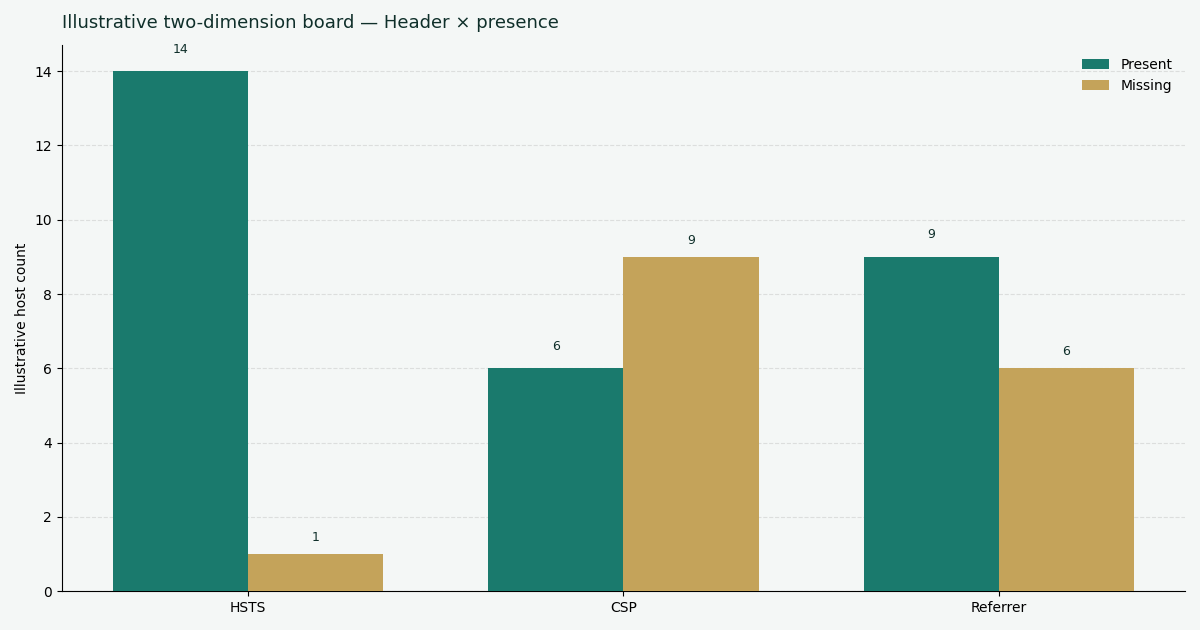
Figure: Two series from the same curl -sSI desk. Presence is not hop count. Neither series is a ranking score.
Apex and tool URL on curl -sSI
The apex body was 91,875 bytes. The tool body was 96,998 bytes. Those sizes describe HTML, not header policy. HTTPS security headers SEO keeps byte count beside the header map so a later slide cannot swap “large page” for “hardened host.”
www 301’d to apex in one hop. That hop is a host-choice vote. It does not mint HSTS on the stored document.
The http hop is one 302
http://infinisynapse.com/ answered 302 to https://infinisynapse.com/ and then 200. One hop. Transport flipped. The five hardening headers were still absent on the final https response in this fetch. HTTPS security headers SEO files the 302 as a hop row and the missing headers as a separate host row. Do not collapse them into one mood.
A 302 that reaches https is not HSTS. HSTS is the browser instruction after a good https response. Engineering sets max-age on the host. This desk did not see that instruction.
A five-header presence map
Use this map before you open a copy doc. HTTPS security headers SEO is five present-or-missing facts, not a vibe.
| Header | What you read | On this 2026-09-14 fetch |
|---|---|---|
| HSTS | Strict-Transport-Security | absent on / and the tool URL |
| XCTO | X-Content-Type-Options | absent |
| XFO | X-Frame-Options | absent |
| CSP | Content-Security-Policy | absent |
| Referrer-Policy | Referrer-Policy | absent |
A present x-powered-by with five missing hardening headers is six facts, not one grade. Do not average them into a 100.
The web.dev security headers article is the public explainer we used for CSP and Referrer-Policy names. HTTPS security headers SEO records whether those names arrived. It does not claim the article ranks this host.
HSTS is a browser instruction
Public language for Strict Transport Security still treats HSTS as a browser instruction to stay on https after the first good response. HTTPS security headers SEO uses that same instruction as a present-or-missing light. The light does not invent includeSubDomains. Engineering sets the directive.
CSP, XCTO, XFO, and Referrer-Policy
CSP constrains scripts, frames, and sources. XCTO asks the browser not to sniff MIME. XFO limits framing. Referrer-Policy limits outbound leakage. HTTPS security headers SEO records whether each constraint arrived. A missing CSP is a fetch-risk ticket. It is not a license to rewrite the hero.
x-powered-by is not a substitute
x-powered-by: Next.js names a stack. It does not stand in for HSTS. It does not stand in for CSP. HTTPS security headers SEO keeps the stack label in the ticket so an owner can find the origin map. It does not treat the label as a hardening pass.
How header lights compare to eligibility
A grade is a single number. HTTPS security headers SEO is five present-or-missing facts on the stored 200. If you only need a title, wait until eligibility is green. If you only need eight lights, stay on the free checker.
Return to the website indexation hub when the job is still status, robots, canonical, hops, and the first HTML bytes. This page owns the header slice only.
A leftover noindex tag can hide a URL that already sends perfect headers. Header presence does not override a refusal. Eligibility before copy still wins.
A redirect chain can drop headers on an intermediate hop. The header row on the final 200 is the one that matters. Count hops, then read the last response. Do not celebrate HSTS on a hop the crawler never stores.
This host’s http 302 was one hop. That is a hop finding for the sibling, and a missing-HSTS finding here. Keep both rows.
Who owns the origin and the edge
Engineering owns TLS, header maps, and the edge. Editorial owns titles after the URL is eligible and the host sends the headers you intended. Header meetings fail when writers own the first hour.
HTTPS security headers SEO follows that duty: the host owns the header. A model does not.
When one URL is enough
One URL is enough when a launch page is new and you need HTTPS security headers SEO on that address only. Fetch it. Confirm 200, indexable, self-canonical, and the five headers. Then write.
One URL is not enough when templates share one origin map. This desk fetched two public 200s plus the http hop. That is enough to file a host ticket on this host. It is not a 50–500 sitemap proof. Homepage-only confidence is how twins hide. Keep that limit next to the header table.
Credits are optional. You can list every missing HSTS without a model. Spend credits only when a wide sample needs a ranked punch list. Do not buy narrative to change a missing header into a present one.
How to record a header ticket
Follow the three steps before anyone opens a copy brief. HTTPS security headers SEO work is a fetch, a classify, and only then a sentence.
Step 1 — Fetch the final 200
Use curl -sSI with a recorded user-agent. Follow hops only after you store the first Location. Read the last 200. This table is the job.
Status codes stay free. Chrome remains local unless you start AI EEAT. Header presence does not need those credits to name a missing HSTS.
Step 2 — Name each missing header
Label each URL: HSTS present or missing, XCTO present or missing, XFO present or missing, CSP present or missing, Referrer-Policy present or missing. HTTPS security headers SEO fails when any intended header is absent. A thin body with all five present is a content ticket. A fat body with missing CSP is still a host ticket.
Step 3 — Assign the owner
Fix the origin or the edge. Re-fetch. Then write. Optional priority narrative can rank which header blocks the most templates. The narrative must still quote the presence table. The model may not invent a Strict-Transport-Security line.
When an update week coincides with a header change, keep the evidence on the fetch. HTTPS security headers SEO is the live response. A Performance CSV is history.
Scorecard for host header presence
Score HTTPS security headers SEO, not a vanity 100, before you call the host done.
| Check | Pass | Fail |
|---|---|---|
| Status is honest | 200 for live docs | Soft 200 error body |
| Five headers named | Each present or missing on the final 200 | “Looks secure in Chrome” |
| Stack label separated | x-powered-by is not treated as HSTS | Stack label used as a pass |
| http hop recorded | 302 counted, then headers read on https | 302 treated as HSTS |
| Eligibility before copy | Indexable, then headers, then prose | Rewrite on a refusal |
A pass means HTTPS security headers SEO is clear enough to write. A fail keeps the host ticket open. Credits do not flip a missing header.
Failure modes that treat headers as copy
Copy first. The common miss is a rewrite on a URL that never sent HSTS. HTTPS security headers SEO was already a host ticket. The new paragraph does not mint the header.
Grade theater. A single 100 hides five different misses. The job needs present-or-missing rows.
Hop confusion. Intermediate redirects can show a header the stored URL never sent. Read the last 200.
302 as HSTS. An http-to-https hop is transport. It is not Strict-Transport-Security.
Edge strip. An origin sends CSP. The load balancer drops it. The public fetch is the truth. Fix the edge.
Credit superstition. Buying EEAT or visibility does not add Strict-Transport-Security, and it does not finish HTTPS security headers SEO for you.
Adjacent jobs in this pillar
This page is the header-presence cluster. Sibling guides stay off miss classes and leftover robots bits.
When the gone URL should 404 in place, open 404 errors seo. When the keep-page still refuses, open noindex tag. When hops are the defect, stay on the redirect sibling. When the first HTML bytes are the defect, open javascript crawling.
Inspect the production response in SEO Health tools and assign each missing security header to the host layer that actually emits it.
Read the live headers before you rewrite the page
Store the first status, then read HSTS, XCTO, XFO, CSP, and Referrer-Policy on the final 200.
Run SEO Health CheckerFrequently Asked Questions
Do missing headers lower an official grade?
No. HTTPS security headers SEO is a tech-module presence check. Missing HSTS, CSP, or Referrer-Policy is a fetch risk, not a Google 100. Read the lights, then fix the host.
Can a title rewrite add HSTS?
No. HTTPS security headers SEO fails on configuration. A title change helps after the URL returns 200, is indexable, and already sends the headers you intended.
Do I need credits to see header lights?
No. Status codes and tech lights stay free. HTTPS security headers SEO does not require a login. Login and credits start only if you begin EEAT, visibility, GSC narrative, or a priority write-up.
Does one launch paste cover every host map?
Only for that one address. HTTPS security headers SEO at template scale needs a wider sample. This desk proved two public 200s plus one http hop on our host. Header misses still cluster on shared origin maps.
Does a 302 to https count as HSTS?
No. A 302 records a hop we observed. HTTPS security headers SEO still needs the Strict-Transport-Security line on the stored https document. The hop answers transport. It does not answer HSTS.
Conclusion
Use HTTPS security headers SEO when the job is to verify hardening headers on the final public 200 before anyone opens a copy doc. The 2026-09-14 desk showed x-powered-by: Next.js on / and the tool URL, a one-hop http 302, and five absent hardening headers in that -I. Close the file when the first status, the Location, and the missing names are still visible. A bounded header table is more useful than an unsupported ranking claim.
William Zhu · Cofounder, InfiniSynapse · GitHub @allwefantasy
Desk-validated SEO Health methods. Corrections: zhuhl@infinisynapse.com · corrections policy.