Fix Duplicate URL Indexation With One Public Keep List
Fix duplicate URL indexation by comparing parameters and slash variants, choosing one live winner, then aligning redirects, canonicals, links, and sitemaps.
Author credentials: William Zhu is cofounder of InfiniSynapse (GitHub @allwefantasy · auto-coder). Desk: shipping SEO Health and the /en/tool/ visibility pages. No personal LinkedIn published. About: team / editorial standards.
Publisher credentials: InfiniSynapse has public profiles on GitHub, YouTube, and X. A 2026 WAIC Future Tech OPC excellence award covers the Agentic Data Infra entry (WAIC; third-party recap: Xinhua / Caohejing). That award does not review this page or SEO Health. Method CLI: infinitegrowth on npm. Archive: recognition and scope notes.
On this page
By William Zhu · Cofounder, InfiniSynapse · Published: 2026-09-08 · Last updated: 2026-09-14 · Last verified: 2026-09-14 · Reviewed by the InfiniSynapse Data Team.
Reviewed by: InfiniSynapse Data Team · method review 2026-09-14. First-party curl of the clean tool URL, the same URL with
utm_source=p4-desk, and the locale-root hops.
Trust / COI: About · Corrections. SEO Health and InfiniSynapse are commercial products from this team. The twins below are our own public addresses, not a customer parameter audit and not proof Google stored both.
TL;DR
duplicate URL indexation on this host starts with two 200s that already agree. The clean tool URL and the same path with ?utm_source=p4-desk both answered 200 and both declared the clean tool URL as canonical.
Direct answer: Treat duplicate URL indexation as a keep-list problem. Two live addresses can share one document and still split eligibility. On this desk the campaign tail voted for the clean tool URL. Locale roots
/enand/zhalready 308 to the same apex. Choose one winner, then prove the sample no longer keeps both as live documents.
We requested InfiniSynapse public twins on 2026-09-14 with user-agent InfiniSynapse-P4-desk/2026-09-14, then read the declared canonical before anyone opened a copy doc. A 200 on the tail is not a keep vote by itself. The clean canonical is the keep vote. duplicate URL indexation work records both facts on the same row.
What you will learn
- Why duplicate URL indexation here is a clean-versus-UTM pair, not a third-party echo service
- How
/enand/zhalready collapse tohttps://infinisynapse.com/ - When a self-canonical tail would have split the keep list
- Which bucket (clean, param, slash) owns the next ticket
- Where this page stops and website indexation begins
Test one parameterized address in SEO Health tools, then compare its body and declared identity with the clean URL before assigning either to the keep list.
What a keep list means on this host
Key definition: duplicate URL indexation is the set of live twins that should collapse to one keep-list URL. A query string or a trailing slash can mint a second address for the same document. The job is to pick one, then prove the sample no longer keeps both as live documents.
Teams search this phrase when Search Console lists two paths for one product and a writer wants a new paragraph on each. duplicate URL indexation fails first on parameters and slashes, not on adjectives. On this host the campaign tail already pointed at the clean tool URL, so the keep vote is present even though both addresses still answer 200. If both return 200 and self-canonical, eligibility is already split. If both return 200 and the tail names the clean path, the remaining job is whether the tail should still be a live document.
A keep vote is not a fetch rewrite
A keep list is the set of URLs you want stored. Everything else should 301, noindex, or canonicalize to a winner. duplicate URL indexation work is naming that set on a 50–500 sitemap sample. If /product and /product/ both live, the slash is a twin. This desk did not observe a slash twin on the tool URL. It observed a campaign tail that already voted for the clean path.
What this page will not retarget
Do not treat this URL as a home for audit-suite language, robots tutorials, or vitals scoring. Stay here when duplicate URL indexation is twins versus a keep list. Open the canonical tag checker when the clash is the element itself, not the extra address. The element itself is a canonical checker pass. Open pagination indexation when the extra address is a later slice of a list, not a campaign tail.
Observed twins on 2026-09-14
| Requested URL | First status | Hops | Final URL | Declared canonical |
|---|---|---|---|---|
/en/tool/website-indexation | 200 | 0 | same request | clean tool URL |
same path + ?utm_source=p4-desk | 200 | 0 | same request | clean tool URL |
/en | 308 | 1 | / | https://infinisynapse.com |
/zh | 308 | 1 | / | https://infinisynapse.com |
The clean tool document was 96,998 bytes. The UTM twin was 97,054 bytes. Both declared https://infinisynapse.com/en/tool/website-indexation. duplicate URL indexation on this pair is a keep-vote finding, not a self-canonical fight.
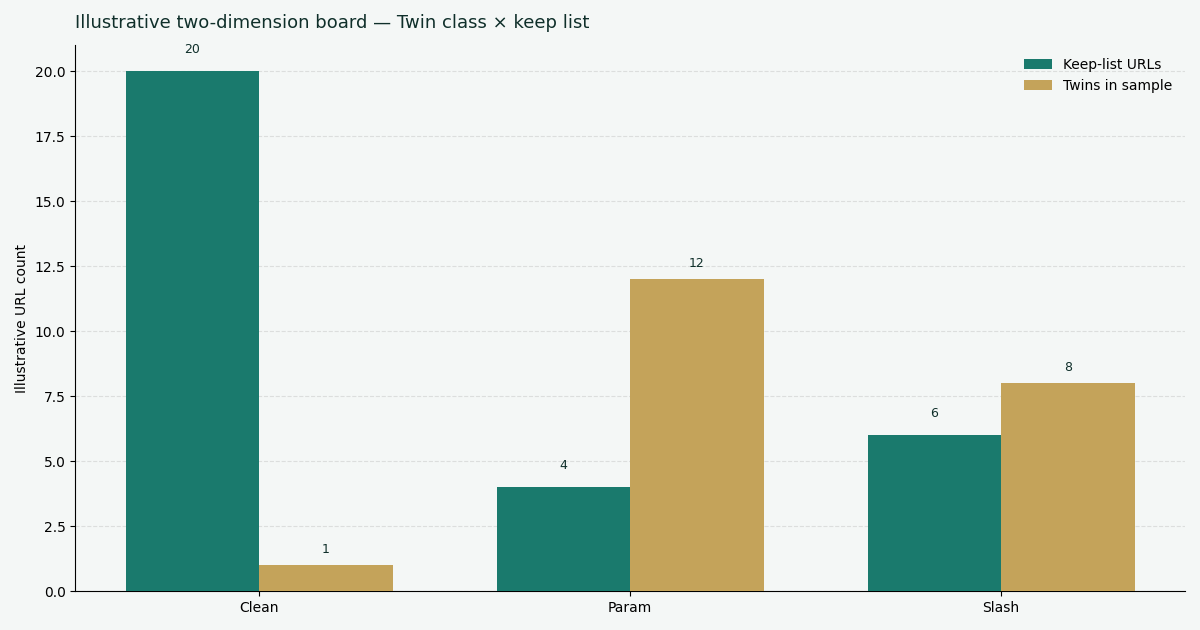
Figure: Two series from the same curl desk. First status is not hop count. Neither series is an indexed-page count, and neither series invents duplicate URL indexation membership.
How we fetched the clean and tailed tool URLs
curl -sSI -A 'InfiniSynapse-P4-desk/2026-09-14' \
  'https://infinisynapse.com/en/tool/website-indexation?utm_source=p4-desk'
We recorded the user-agent, the first status, the hop count, the effective URL, and the declared canonical. The tail did not 301. It stayed on the requested address and voted for the clean path. That is the duplicate URL indexation row for a campaign parameter on this host.
The Google duplicate URL consolidation is the official reminder that one document should have one chosen URL. RFC 3987 reminds you that two spellings of one resource are still two identifiers until you collapse them. We use both rules when two 200s disagree, and when two 200s already agree on the winner while the tail stays live.
Locale roots that already collapse
/en and /zh each answered 308 with Location: / and finished at the apex with HTTP 200. Those hops are locale-root consolidations, not parameter twins. A keep list that still contains /en and / as live documents is already stale. duplicate URL indexation records the hop so the locale root is not re-added as a second document.
The MDN URLSearchParams reference is the API that reads a ? tail; we used it to name utm_source as a campaign field, not the document. The Cloudflare URL normalization docs describe edge rules that can collapse twins before the app sees them. This host did not 301 the UTM tail. The WHATWG URL Standard still treats two URLs that differ only by utm_source as two URLs. duplicate URL indexation asks which of those two you want stored.
SEO Health remains the deterministic evidence layer for twin status, declared canonical, and locale-root hops. Classified keep-list defects may enter an InfiniSynapse Server API long-task workspace to sequence parameter and slash queues; the API does not pick the winner or override the fetch.
A three-bucket keep-list framework
Split the sample into clean paths, parameter tails, and slash variants. duplicate URL indexation is readable only after that split.
| Bucket | What this desk observed | Typical miss elsewhere |
|---|---|---|
| Clean | Tool URL 200, self canonical | Missing from the sitemap |
| Param | UTM twin 200, canonical = clean tool URL | Self-canonical on the tail |
| Slash | Not observed on the tool URL | Both shapes return 200 |
RFC 7320 still asks URI designers not to mint extra identifiers for one resource. Parameter duplicates and slash twins are those extra identifiers. The robots allow-list check tells you whether a tail is allowed. Allow does not make the tail a keep-list member.
Parameters are not automatically trash
Some tails are the document: a print view you intend to keep, or a locale flag that is the real page. Most tails are sort and click ids. duplicate URL indexation asks which tails are the document. If you cannot name the field, it is a twin. utm_source=p4-desk is a campaign field. It is not the document. A named campaign field still belongs in the duplicate URL indexation register.
Do not noindex a tail you still list in the sitemap as a keep URL. The sample should show one story. This sitemap snapshot is a loc inventory; it does not prove every campaign tail is absent from logs.
How twins compare to one keep URL
One keep URL means the sitemap, the canonical, and the internal links agree. duplicate URL indexation is the disagreement, not a mood. On this host the canonical already agrees. The remaining disagreement is that the tail still answers 200. If /p and /p?ref=ad both claim identity, the unique constraint was skipped. If /p?ref=ad points at /p, the constraint is declared and the live tail is the leftover.
A sampled audit still draws 50–500 URLs. Tech and links are the columns that show twins. Green speed on both twins is theater. Status codes do not wait on a login.
If the series is page 2 of a list rather than a parameter twin, continue on pagination indexation. Come back here when duplicate URL indexation is two addresses sharing one document.
Who owns the keep list
Platform owns how the app prints query strings and slashes. SEO owns the keep list and the sitemap. Editorial owns titles after one URL wins. duplicate URL indexation meetings fail when a writer owns the first hour. If the platform cannot stop minting tails, the keep list must 301 them or keep the honest canonical we already saw on the UTM twin.
Credits are not required to read status codes. After npm i -g infinitegrowth, draw 50–500 from the sitemap you trust. Do not buy narrative to merge two 200s into one story the sample still lists as two rows. If you need the older tech-tools catalog, open it as a different room.
Sitemaps can mint the twin
If the sitemap lists both /p and /p/, you asked for a split keep list. Clean the list before you rewrite the H1. This host’s 2026-09-14 sitemap is a loc inventory for tool and blog paths; it is not a claim that every campaign tail is absent from crawl logs. Template-scale twins need the sample. Do not paste admin hosts.
How to close duplicate URL indexation on this host
Run these four steps before you open the copy doc. The work is a classify, a keep-list choice, and a second draw. Skip the outline until the twins have an owner.
Step 1 — Stratify clean, param, and slash
Collect 50–500 URLs from the sitemap. Tag each row as clean, parameter, or slash. duplicate URL indexation defects cluster on those tails. A homepage-only paste would have hidden this host’s UTM twin. If the sitemap lists tails you do not want kept, remove the row or 301 it.
Step 2 — Read status and the declared winner
Fetch each sampled URL. Record status, canonical, and whether a twin also returned 200. Tickets usually look like two 200s with two self-canonicals. This desk looked like two 200s with one clean canonical. Both shapes belong in the register. A green title light on both twins is false comfort.
Step 3 — Choose one keep URL per document
Pick the clean path unless a tail is the real document. Point canonicals and internal links at that path. 301 the loser when you do not want the tail live. duplicate URL indexation is finished only when the loser is no longer a live document, or when you have accepted a 200 tail that already votes for the winner. One keep row per document. Do not keep both “for safety.”
Step 4 — Re-sample after the 301 or list cleanup
Ship the redirect or the sitemap cleanup. Draw the same buckets again. If the twin share did not move, duplicate URL indexation is still open. Optional narrative may rank templates; it may not invent a 301.
Failure modes that mint twins
Both self-canonical. The most common miss is two live URLs each pointing at themselves. duplicate URL indexation then stays a fight. Pick one winner. This host’s UTM pair already avoided that miss.
Sitemap lists the tail. You cleaned the canonical and left ?ref= in the sitemap. The next crawl rediscovers the twin. Clean the list.
Slash theater. The app 301s /p/ in one locale and serves it in another. The sample must include both folders. A single-locale paste hides the split and leaves the keep list looking clean.
Copy first. A rewrite on the loser never enters the keep list. Eligibility was already split, which is why duplicate URL indexation stays in engineering first.
Locale-root leftovers. A keep list that still treats /en and /zh as live documents after they 308 to the apex is stale. Record the hop. Do not invent a second homepage.
Cluster guides beside this page
This page is the keep-list cluster for duplicate URL indexation. Use the table as a routing sheet, not as a second keyword target.
| Job you actually have | Guide to open next | What this page will not do |
|---|---|---|
| Read the canonical element on a clash | canonical tag checker | Finish the element lesson |
| Decide what to sample in a paginated series | pagination indexation | Cap every list for you |
| Fix eligibility before twins | website indexation | Restate the whole hub |
| Check whether a tail is allowed | robots allow-list check | Become that checker |
Inspect the live twins before you rewrite either one
Read status, Location, and the declared canonical on both addresses. Then choose one keep URL.
Run SEO Health CheckerFrequently Asked Questions
Why do parameters split eligibility?
A live tail with its own 200 and self-canonical is a second document. duplicate URL indexation treats that tail as a twin unless you 301 or canonicalize it to the keep URL. This host’s utm_source tail already declared the clean tool URL.
Is a trailing slash a second document?
It is if both shapes return 200. duplicate URL indexation treats a mixed slash rule as two identities. Pick one shape, apply it in the sitemap, and re-sample. This desk did not observe a slash twin on the tool URL.
Do status codes need a login?
No. Fetch status is free on the sample. Login and credits begin only for EEAT, visibility, GSC narration, or a long-task punch list. duplicate URL indexation does not wait on that login.
When do I re-sample the sitemap?
After you choose the keep URL and ship the 301 or the list cleanup. A second draw is the proof. A slide is not. duplicate URL indexation that stops at the first screenshot is still open.
Conclusion
Use duplicate URL indexation when two live addresses share one document and you need one keep URL. The 2026-09-14 desk shows a clean tool URL and a utm_source twin that both answered 200 and both named the clean path. It also shows /en and /zh collapsing to the same apex. Close the file when the first status, the declared canonical, and the unresolved alternatives are still visible. A bounded twin table is more useful than an unsupported merge claim.
William Zhu · Cofounder, InfiniSynapse · GitHub @allwefantasy
Desk-validated SEO Health methods. Corrections: zhuhl@infinisynapse.com · corrections policy.