Control Pagination Indexation with a Capped Sample
Control pagination indexation by sampling page one, a short middle band, and one labeled tail canary; drop noisy repeats before they consume the audit draw.
Author credentials: William Zhu is cofounder of InfiniSynapse (GitHub @allwefantasy · auto-coder). Desk: shipping SEO Health and the /en/tool/ visibility pages. No personal LinkedIn published. About: team / editorial standards.
Publisher credentials: InfiniSynapse has public profiles on GitHub, YouTube, and X. A 2026 WAIC Future Tech OPC excellence award covers the Agentic Data Infra entry (WAIC; third-party recap: Xinhua / Caohejing). That award does not review this page or SEO Health. Method CLI: infinitegrowth on npm. Archive: recognition and scope notes.
On this page
By William Zhu · Cofounder, InfiniSynapse · Published: 2026-09-08 · Last updated: 2026-09-14 · Last verified: 2026-09-14 · Reviewed by the InfiniSynapse Data Team.
Reviewed by: InfiniSynapse Data Team · method review 2026-09-14. First-party fetch of sitemap.xml and a loc inventory for
page=and/page/paths.
Trust / COI: About · Corrections. SEO Health and InfiniSynapse are commercial products from this team. Loc counts below are this host’s map, not a customer category series and not a Search Console index count.
TL;DR
pagination indexation still needs a sample-versus-drop rule when a list series exists. This host’s 2026-09-14 sitemap listed 1,568 locations and none used page= or /page/.
Direct answer: Treat pagination indexation as a draw rule. Page 2 is not always a twin. Cap the draw at 50–500 sitemap URLs. Do not invent a page-2 template from a loc count. This snapshot has zero pagination queries, so the method stays on the shelf until a series appears.
We opened InfiniSynapse sitemap.xml on 2026-09-14 with user-agent InfiniSynapse-P4-desk/2026-09-14, then counted <loc> values before anyone booked a desktop walk of a category list. 1,568 locs is an inventory. It is not a rendered series. pagination indexation still matters on hosts that actually paginate.
What you will learn
- Why pagination indexation on this host starts with a zero-page sitemap, not a trophy crawl
- How 392 tool locs and 1,131 blog locs sit beside zero
page=rows - When page 2 is a real slice instead of a twin
- Which band (page 1, 2–5, 6+) owns the next ticket if a series appears
- Where this page stops and website indexation begins
Sample page one, a middle page, and a tail page with SEO Health tools when a series exists, preserving item IDs and navigation links for each band.
What a series sample means when the map has no page query
Key definition: pagination indexation is the rule for a paginated series: which pages you fetch into a 50–500 sample, and which you drop as noise. Page 1 is usually a keep. Page 2 can be a real document. Page 6 and beyond are often repeats you do not need to crawl. A host with zero `page=` locs still needs that rule written down, because the next template can mint a series tomorrow.
Teams search this phrase when a category list has 80 pages and someone booked a desktop walk of all of them. On this host the 2026-09-14 map did not list that series. pagination indexation still owns the method for the day a list template ships. Later chunks often repeat the same template with a thinner slice of items, which is why the tail is dropped. A loc inventory with no page query does not invent those chunks.
Page 2 is not automatically a twin
A twin is two addresses for one document. Page 2 is often the next slice of the same list, with its own items. pagination indexation keeps a few of those slices so you can see whether the template 404s or noindexes later pages. It does not keep every slice. It also does not invent a page-2 URL when the sitemap has none.
W3C’s page-structure tutorial still asks for a clear main and headings on each view. If page 2 has a main and unique items, it can be a document. If page 2 is an empty “no results” 200, it is a soft miss, not a keep.
What this page will not retarget
Those older tool phrases belong on other pages. Stay here when pagination indexation is sample versus drop on a series. Open the duplicate URL indexation guide when two addresses share one document. Open the hreflang audit when locale folders each have their own series.
Observed sitemap inventory on 2026-09-14
| Inventory field | Count |
|---|---|
sitemap.xml status | 200 |
| Sitemap bytes | 192,851 |
Total <loc> values | 1,568 |
/en/tool/ locs | 392 |
/en/blog/ locs | 1,131 |
locs containing page= | 0 |
locs containing /page/ | 0 |
1,568 locs still do not invent a page-2 template. pagination indexation on this snapshot is a negative finding: the method is ready, the series is not present in the map.
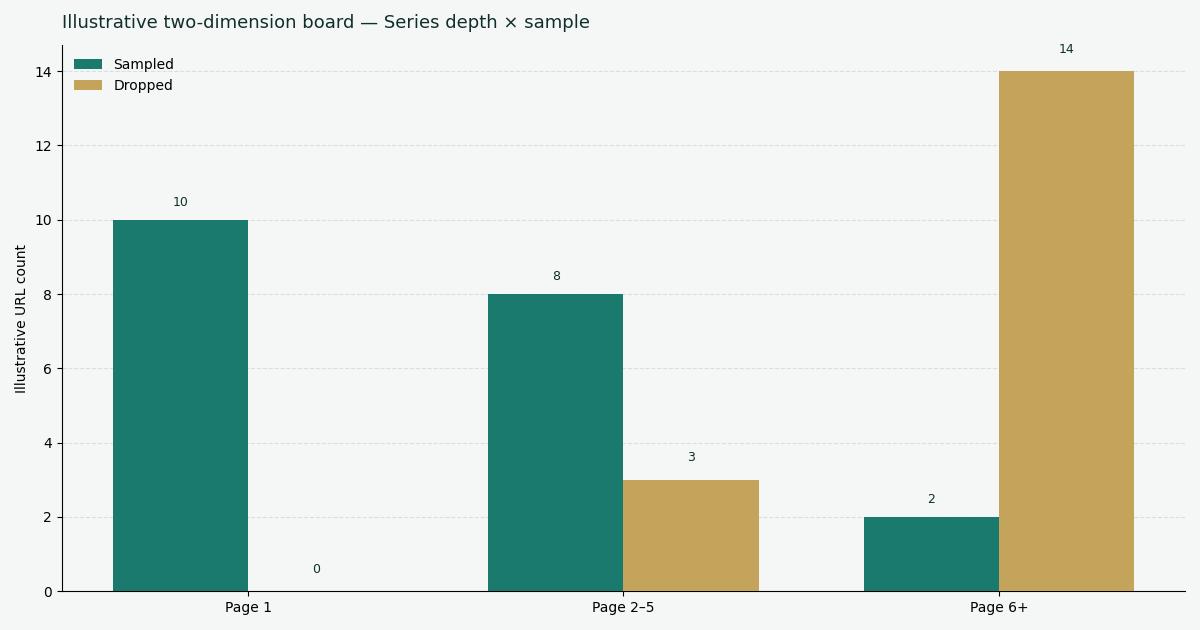
Figure: Two series from the same sitemap desk. Tool loc count is not blog loc count. Neither series is an indexed-page count, and neither series invents pagination indexation membership.
How we counted locs
curl -sS -A 'InfiniSynapse-P4-desk/2026-09-14' \
  https://infinisynapse.com/sitemap.xml | wc -c
We recorded the user-agent, the status, the byte total, the loc count, and two pattern counts. The map answered 200. It listed tool and blog paths. It did not list a pagination query. That absence is the pagination indexation row for this host on this date.
The Google pagination best practices remain the official series rule when a list actually paginates. We keep that rule on the shelf. RFC 8288 defines rel="next" and rel="prev". Those relations matter when a series exists. This sitemap snapshot did not give us a next-link inventory. Do not invent one from 1,568 locs.
Why a zero-page map is still a finding
A missing page query is not proof that no list will ever paginate. It is proof that this map, on this date, did not publish those URLs. pagination indexation records the zero so a later briefing cannot promote 1,568 locs into an 80-page category walk.
The MDN Intersection Observer API sits behind many infinite-scroll loaders. A zero-page map does not prove the UI has no loader. It proves the loc list has no page query. The W3C WCAG reflow guidance is about readable layout, not keep-list membership. Do not treat a responsive grid as a page-2 series. The MDN History API navigation guide explains how a client can push /list?page=2 without a full reload. If that pattern ships later, pagination indexation becomes a fetch job again.
SEO Health remains the deterministic evidence foundation for loc inventory, page-query absence, and sampled series status. Classified list-template defects may enter an InfiniSynapse Server API long-task workspace to sequence sitemap and band queues; the API does not invent page-2 URLs or expand the cap.
A three-band sample-versus-drop framework
Split the series into page 1, pages 2–5, and page 6+. pagination indexation is readable only after that split. On a host with no series, write the split anyway so the next deploy has a rule.
| Band | Default action | Typical miss |
|---|---|---|
| Page 1 | Sample | Missing from the sitemap |
| Pages 2–5 | Sample a few | Treat every page 2 as a twin |
| Page 6+ | Drop most | Crawl the whole tail |
The robots allow-list check tells you whether /page/12 is allowed. Allow does not put page 12 in the draw. This host’s map did not list /page/12. Write the band rule in the ticket. “We crawled the category” is not a draw rule. “The sitemap had zero page queries on 2026-09-14” is a draw rule.
Unique items change the band
If pages 2–5 still introduce new products, sample them. If page 6+ only repeats leftover sort orders, drop them. pagination indexation follows the items, not the page number vanity. Sample versus drop is a draw rule. noindex is an eligibility rule. Do not noindex a page that does not exist in the map.
How a later slice compares to a twin
A twin fights a keep URL. Page 2 continues a series. pagination indexation asks whether the next page is a slice or a copy. If /list and /list?page=2 show the same three products, you have a twin. If they show different products, you have a series. Fetch both before you write the ticket. If neither URL exists in the sitemap, do not invent the fetch from a loc total.
Name the chunk: page 1, a short middle band, and a dropped tail. This host’s file had none of those chunks. Green speed on page 47 is not a reason to keep page 47 in the next draw, and green speed on a URL that is not in the map is not a reason to invent page 47.
If locale folders each have their own series, continue on the hreflang audit. Come back here when pagination indexation is how far down one list to sample.
Who owns the series
Engineering owns how the list prints page numbers and empty tails. SEO owns the draw rule and the sitemap. Editorial owns titles on the pages you actually keep. pagination indexation meetings fail when a writer owns a page-20 ticket on a host with no page-20 URL. A 50–500 sitemap sample is a bounded read. A 1,568-loc inventory with zero page queries already answered the series question for this date.
Credits are not required to read loc counts. After npm i -g infinitegrowth, set --pages and stratify when a series exists. Do not buy narrative to invent page 80. Link out to the tech-tools catalog when you want that catalog. Stay on sample versus drop.
Sitemaps can list the whole tail
If the sitemap lists 80 category pages, you asked the sample to see them. Trim the list to the bands you will defend. pagination indexation includes that trim. This host’s map listed 392 tool locs and 1,131 blog locs. It did not list an 80-page tail. Do not paste admin hosts.
How to apply pagination indexation when a series exists
Run these four steps before you book a desktop walk. The work is a band, a cap, and a drop list. Skip the outline until the series is classified. If the sitemap still has zero page queries, write that finding and stop.
Step 1 — Name the series and the cap
Write the category URL, the page pattern, and the --pages cap. Stay inside 50–500. pagination indexation starts with a number you can replay. “1,568 locs, 0 page queries” is a number. Confirm robots allow the pattern. If page 1 is missing on a host that paginates, that is already a finding. If page 1 does not exist because there is no series, that is a different finding.
Step 2 — Draw page 1 and a short middle band
Fetch page 1 and a few URLs from pages 2–5. Record status, noindex, canonical, and whether items are unique. pagination indexation uses that middle band to see if the template dies after page 1. A 200 with zero items is a soft miss. A missing page-3 loc on this host is not a 404. It is an absence.
Step 3 — Drop the noisy tail
Do not fetch every page 6+. Drop near-empty sort loops and infinite “next” links. pagination indexation earns its keep on the drop, not on a trophy crawl. If you need one deep page as a canary, pick one, label it, and stop. If the map has no tail, do not invent a canary.
Step 4 — Fix the template, then re-sample the bands
Ship the empty-page 404, the canonical to page 1 if that is the rule, or the sitemap trim. Draw the same bands again. If the tail still floods the sitemap, pagination indexation is still open. Optional narrative may rank series; it may not invent a page= loc.
Failure modes that crawl the whole list
Trophy tail. The most common miss is fetching page 80 because it exists. pagination indexation then spends the draw on noise. Cap first. The inverse miss is fetching page 80 because 1,568 locs exist. Loc count is not a series.
Page 2 as automatic twin. The second miss is 301ing page 2 to page 1 when the items differ. The method hid a real slice. Fetch before you collapse. Do not 301 a URL the map never published.
Sitemap lists 80 pages. You capped --pages and the sitemap still flooded the random draw with tails. Trim the list. This host’s 2026-09-14 map did not flood the draw with page queries.
Copy on page 47. A rewrite on a near-empty tail never earns its keep. Eligibility and uniqueness were already gone.
Inventory theater. Treating 392 tool locs as 392 paginated views is a category error. Tool slugs are not page-2 URLs. pagination indexation stays on series URLs.
Cluster guides beside this page
This page is the series-sample cluster for pagination indexation. The table routes the next job; it does not reprint older tool targets.
| Job you actually have | Guide to open next | What this page will not do |
|---|---|---|
| Collapse two addresses for one document | duplicate URL indexation | Finish the twin lesson |
| Check locale pairs on a series | a hreflang audit | Map every language |
| Fix eligibility before the draw | website indexation | Restate the whole hub |
| Check whether a page path is allowed | robots allow-list check | Become that checker |
Inspect the sitemap before you crawl a series
Count locs, then look for page queries. Sample bands only when those URLs exist.
Run SEO Health CheckerFrequently Asked Questions
Is page 2 always a twin?
No. Page 2 is a twin only when it shows the same document as page 1. pagination indexation samples a short middle band to see unique items before anyone 301s the slice. This host’s sitemap had no page-2 loc on 2026-09-14.
Why cap the draw?
A 50–500 sample is enough to see whether the template dies. pagination indexation that crawls every page of the list fills the draw with near-empty tails and hides page 1 defects. A loc inventory with zero page queries does not need a full-list walk.
Do I need credits for status codes?
No. The band counts do not need an account. Credits are for EEAT, visibility, GSC, or a ranked write-up you start on purpose. pagination indexation does not wait on that login.
What should I drop from the series?
Drop most of page 6+ unless you need one labeled canary. Keep page 1. Keep a few pages from 2–5 when items are still unique. That drop list is pagination indexation, not a mood. If the sitemap has no series, drop the trophy crawl and keep the zero-page finding.
Conclusion
Use pagination indexation when a list series exists and you need a sample-versus-drop rule. The 2026-09-14 desk shows 1,568 sitemap locs, 392 tool paths, 1,131 blog paths, and zero page= or /page/ rows. Close the file when the loc inventory, the missing page query, and the band rule are still visible. A bounded sitemap count is more useful than an unsupported series claim.
William Zhu · Cofounder, InfiniSynapse · GitHub @allwefantasy
Desk-validated SEO Health methods. Corrections: zhuhl@infinisynapse.com · corrections policy.