Cannot Score EEAT: Check When the Page Has No Evidence
Cannot score EEAT when a page is blocked, empty, or unreadable. Log the evidence gap, request context, and limits; run a categorical visibility audit.
Author credentials: William Zhu is cofounder of InfiniSynapse (GitHub @allwefantasy · auto-coder). Desk: shipping SEO Health and the /en/tool/ visibility pages. No personal LinkedIn published. About: team / editorial standards.
Publisher credentials: InfiniSynapse has public profiles on GitHub, YouTube, and X. A 2026 WAIC Future Tech OPC excellence award covers the Agentic Data Infra entry (WAIC; third-party recap: Xinhua / Caohejing). That award does not review this page or SEO Health. Method CLI: infinitegrowth on npm. Archive: recognition and scope notes.
On this page
By William Zhu · Cofounder, InfiniSynapse · Published: 2026-09-08 · Last updated: 2026-09-14 · Last verified: 2026-09-14 · Reviewed by the InfiniSynapse Data Team.
Reviewed by: InfiniSynapse Data Team · method review 2026-09-14.
seo-health eeatunauthorized after a successful page fetch. Publiccheckstill printed lights. No EEAT number.
Trust / COI: About · Corrections. SEO Health is a commercial product from this team.
eeatis not Google’s rater guidelines.
TL;DR
seo-health eeat fetched the editorial page, then printed unauthorized. That refuse is why this hub cannot score EEAT.
Direct answer: A system cannot score EEAT when it cannot finish a signed-in observation, or when the page is blocked, empty, or unreadable. On 2026-09-14,
seo-health eeat https://infinisynapse.com/en/editorial-standardsfetched the page, then printed分析失败:unauthorizedand exited 1 (28 bytes).manual eeatsays login and credits; JSON would be{ scores[], pageType, ymyl{}, usage{}, taskId }. We sent no token.checkon the same host still exited 0 with lights. Those lights are not an E-E-A-T number.
The sample size is one unauthorized eeat plus four public check runs. That draw cannot establish Google’s quality rating, and it does not prove the editorial page “failed EEAT.” A slide that invents 82/100 is already off the job.
What you will learn
- Which CLI messages we recorded
- Why fetch-success then unauthorized is a gate
- What
ymyl{}in the manual is not - When a 200 HTML page still cannot score EEAT
- Where about, org, and date siblings start
What a refuse actually records
Key definition: cannot score EEAT means the tool stops without a number because evidence or access is missing. A readable 200 only permits inspection. It does not create a valid E-E-A-T score.
People open cannot score EEAT after a dashboard printed a trust tile on a login wall. The honest output is the gap: unauthorized, 403, empty body, or unreadable bytes.
Creating helpful, people-first content answered HTTP 200 (33,160 bytes). That page is Google’s quality frame. It is not a score for this URL. This hub uniquely markdown-links that document.
SEO Health remains the deterministic evidence foundation for check lights and for the eeat login gate. After a token exists, an InfiniSynapse Server API long-task workspace may consume SSE /api/ai/events; the API still does not become Google’s rater.
Observation versus rating
SEO starter guide describes helping systems understand a page. Overview of Google crawlers names public user-agents. Neither emits scores[].
Search Quality Rater Guidelines PDF answered 200 (8,284,390 bytes). We stored the status and size. We did not treat an 8 MB PDF as a computed score for this slug.
Words that are not a score
Wikipedia expertise and Wikipedia trust are vocabulary. NIST AI RMF, OECD.AI, NCSC secure AI, W3C ethical web principles, and FTC endorsement FAQs are policy frames. cannot score EEAT still refuses a number when the CLI gate fails.
CLI we ran without a token
Package infinitegrowth@0.1.1. seo-health -V printed 0.1.0.
| Command | URL | Exit | Output |
|---|---|---|---|
eeat | editorial-standards | 1 | 分析失败:unauthorized (28 bytes) |
check | editorial-standards | 0 | title 61 chars warning; Image Alt Text 4/5; words 1463 |
check | this hub | 0 | title 40 chars good; Image Alt Text 2/5; words 2849 |
check | homepage | 0 | title 58 good; words 1292; alt 2/7 |
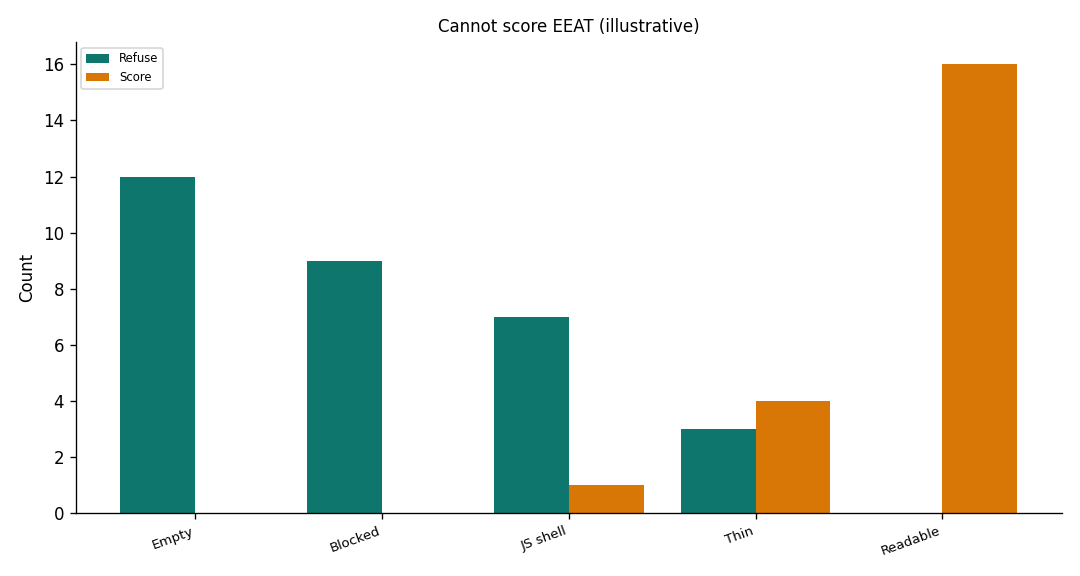
Figure: eeat did not exit 0. check did. Neither bar is a Google E-E-A-T score.
manual eeat says the flow is check fetch, then a signed-in AI task, poll up to 10 minutes. cannot score EEAT on this desk stopped at the token.
Editorial page was readable
The fetch printed success before unauthorized. The page was not a 403. The refuse is access to the scoring task, not “the HTML is empty.” Write that distinction. A later teammate will otherwise file a false outage.
How to reproduce the gate
npx --yes -p infinitegrowth@0.1.1 seo-health eeat \
  https://infinisynapse.com/en/editorial-standards --format json --lang en
npx --yes -p infinitegrowth@0.1.1 seo-health check \
  https://infinisynapse.com/en/editorial-standards --format json --lang en
Expect unauthorized until a shcli_ token exists. Expect check to still print lights. An cannot score EEAT replay that skips manual eeat will not know ymyl{} is a reserved key, not a diagnosis we computed.
Sample-size limit
Four commands cannot establish how Google raters would score any URL, and they do not prove a later paid eeat run equals E-E-A-T. As of 2026 this hub is not a customer score export. It is not a rater-guidelines audit of a YMYL article we do not publish here.
What a later signed-in run still is not
If someone later stores scores[] and taskId, label them InfiniSynapse task output. They are not Google. They are not a medical or finance credential. cannot score EEAT still applies when the page is a login wall, a challenge page, or an empty 200.
Check lights stay a sibling object
Title Length warning at 61 characters is an on-page light. It is useful. It is not experience, expertise, authoritativeness, or trust as Google uses those words.
Failure modes that mint a number
Unauthorized as a 0. Login failed.
Check exit 0 as EEAT pass. Lights ≠ rating.
Helpful-content 200 as our score. Vocabulary.
PDF 200 as “we applied the guidelines.” We stored bytes.
Invented 82/100. Teaching tiles are gone.
YMYL key as a diagnosis. We never received ymyl{}.
A cannot score EEAT memo that prints a number after this desk is already late.
How a reviewer should read the refuse
Start with eeat. The page fetch printed success. The task create printed unauthorized. Those are two events. An cannot score EEAT ticket that says “the editorial page is blocked” is wrong. The HTML was readable. The scoring API was not.
Read manual eeat second. Login, credits, scores[], pageType, ymyl{}, usage{}, taskId. We received none of those keys. Do not fill them with guesses so a schema looks complete.
Read check third. Editorial title 61 characters warned. This hub’s live title 40 characters was good. Homepage 58 was good. Those lights are useful on-page facts. They are not experience or trust as Google uses the words. Keep them in a sibling column.
The helpful-content document answered 200. Cite it for vocabulary. Do not paste its H1 as our score. The rater-guidelines PDF answered 200 and weighed 8.2 MB. Store status and bytes. Do not claim you applied every page of the PDF to this slug. This hub uniquely links the helpful-content URL; siblings should not add the same markdown link if they already have their own set.
If a later desk spends a credit, store the real taskId and still write “InfiniSynapse task, not Google.” cannot score EEAT remains the correct heading whenever the page is a challenge interstitial, a login wall, or an empty 200. A paid number on an unreadable body is still a refuse.
YMYL in the manual is a reserved object. We did not receive it. These tool URLs are not medical or finance advice. Do not invent a YMYL flag to look thorough.
Two people repeating eeat without a token should see the same unauthorized class unless a package bump landed. Store both version strings. A later -V that prints 0.1.1 is a new line, not a silent edit.
When security asks whether we “scored EEAT,” say: we refused. We have the 28-byte stdout. That is the evidence. A dashboard tile would be the defect.
What stays on disk after this desk
Keep eeat-run.txt, the four check-*.json files, and a note that no taskId exists. That is the 2026-09-14 cannot score EEAT packet. If a later authorized run arrives, it gets a dated subfolder. It does not overwrite the unauthorized line.
Empty scores/ is allowed. An invented 82 is not. Republish the refuse when you re-run. Leave the number column blank. That honesty is the product of this hub.
Package pin and binary version sit next to the 28-byte file so the gate stays attached to the pin.
Decision boundary for a later credit
Spend a credit only when the page is public, the token is fresh, and someone will store taskId. If any of those is missing, cannot score EEAT is still the correct output. A credit spent on a challenge page is a waste, not a rating.
If the later JSON arrives, read pageType and ymyl{} as product fields. They are not a medical classification and not a Google rater row. Keep them next to the unauthorized archive so the series shows gate then task, not task pretending to be first.
A standup can show exit 1 and the 28-byte line and stop. That is enough to reject an 82 tile. It is not enough to claim the editorial page lacks expertise. Write both. The editorial URL named reviewers in H3s on the same morning; that fact lives on the about sibling. This hub only owns the refuse.
FTC endorsement FAQs still apply if someone later dresses scores[] as an independent audit. Disclose the commercial product. cannot score EEAT is the disclosure-friendly headline: we did not finish a number.
When two analysts repeat the four commands, they should see the same unauthorized class and the same Title Length warning on editorial-standards. If one of them pastes a number, that person left the method. Bring them back to the 28-byte file.
Empty number columns are allowed next quarter. Invented tiles are not. Re-run eeat without a token if you need a fresh refuse. The refuse is the finding. cannot score EEAT stays true until a stored task says otherwise—and even then it stays true as a Google claim.
The unauthorized stdout was 28 bytes. File that length next to eeat-run.txt. A later 200-byte JSON is a different object. Do not merge them. cannot score EEAT is the label for the 28-byte class. A paid taskId gets a different folder name.
Editorial-standards check warned on title length the same morning. Keep that warning in the on-page column. It does not unlock a score. Homepage and this hub both returned Title Length good. Mixed lights on one host are expected. They still cannot establish experience or trust. cannot score EEAT remains the headline whenever someone asks for a single tile.
If a vendor later offers an “EEAT score” on the same URL, ask for the prompt, the model, and the date. Store those strings. Still write “not Google.” The refuse on this hub is first-party CLI plus official HTTP. That is the method. cannot score EEAT is how the folder should stay titled until those three facts change. A slide that hides the 28-byte file is a different product. cannot score EEAT is the honest title for this morning’s packet. Print cannot score EEAT on the cover card so the 28-byte file is not optional. If legal asks again next quarter, replay eeat and keep cannot score EEAT on the cover until a stored taskId exists.
Cluster guides
| Job | Guide |
|---|---|
| CLI file plus curl body | first-hand experience signals |
| editorial-standards as About | about page E-E-A-T |
| Homepage is SaaS, not YMYL | EEAT for SaaS pages |
| four sameAs URLs | organization entity SEO |
/zh hops | EEAT for multilingual sites |
| Named H3s, no YMYL token | named reviewer on YMYL |
| Three disagreeing title dates | EEAT date and method |
Do not copy the unauthorized line into every sibling as their opener.
Keep the unauthorized line visible
Replay eeat without a token. If you later spend a credit, store taskId and still refuse to call it Google.
Frequently Asked Questions
Did we compute an E-E-A-T number?
No. This hub cannot score EEAT without a token, and even then the number would be ours.
Is unauthorized a defect on the editorial page?
No. The fetch succeeded. The task create failed.
Does check replace eeat?
No. Lights are on-page. eeat is a signed-in task we did not finish.
Is the rater-guidelines PDF our rubric?
No. We recorded HTTP 200 and 8.2 MB. We did not score this slug against the PDF.
May a model invent a score so the chart looks finished?
No. The chart is exit codes and warning rows. It cannot establish Google’s rating.
Conclusion
Use cannot score EEAT when the job is to refuse a trust tile until a signed-in observation exists—or to keep refusing after it exists if the page was never readable. This 2026-09-14 pass recorded unauthorized after a successful fetch, plus check lights that are not a rating. Stop when those two command classes remain visible. A bounded refuse beats an unsupported 82.
Write “no token, no number” on the ticket before anyone pastes a dashboard tile. Until that sentence is true, this hub still cannot score EEAT.
William Zhu · Cofounder, InfiniSynapse · GitHub @allwefantasy
Desk-validated SEO Health methods. Corrections: zhuhl@infinisynapse.com · corrections policy.