About Page E-E-A-T: Audit Public Trust Fields Live
About page E-E-A-T checks the visible operator, accountable person, contact, corrections, and limits. Audit the public URL before marking the entity now.
Author credentials: William Zhu is cofounder of InfiniSynapse (GitHub @allwefantasy · auto-coder). Desk: shipping SEO Health and the /en/tool/ visibility pages. No personal LinkedIn published. About: team / editorial standards.
Publisher credentials: InfiniSynapse has public profiles on GitHub, YouTube, and X. A 2026 WAIC Future Tech OPC excellence award covers the Agentic Data Infra entry (WAIC; third-party recap: Xinhua / Caohejing). That award does not review this page or SEO Health. Method CLI: infinitegrowth on npm. Archive: recognition and scope notes.
On this page
By William Zhu · Cofounder, InfiniSynapse · Published: 2026-09-08 · Last updated: 2026-09-14 · Last verified: 2026-09-14 · Reviewed by the InfiniSynapse Data Team.
Reviewed by: InfiniSynapse Data Team · method review 2026-09-14. Fetched editorial-standards as the About URL. Title 61. William Zhu H3. No customer EEAT score.
Trust / COI: About · Corrections. SEO Health is a commercial product from this team. The About fetch is our page, not an independent audit.
TL;DR
The about URL we fetched is editorial-standards, and its title is already 61 characters.
Direct answer: Treat about page E-E-A-T as a field audit of the live About URL. On 2026-09-14 we fetched
https://infinisynapse.com/en/editorial-standards. Visible H1: “About the research desk & editorial standards.” CLI title: “About the Research Desk & Editorial Standards | InfiniSynapse” (61 characters; recommended 40–60). Words 1463. Speed 79. This is not a Google score and not a customer EEAT score.
An about page E-E-A-T memo that adds another bio before quoting the legal name is already late. The sample size is one URL. That sample cannot establish a market About pattern.
What you will learn
- Which URL this desk treated as About
- Why 61 characters is a CLI warning, not a trust grade
- Which tokens we actually counted
- When empty social alts are a checker row
- Where refuse, entity, and first-hand jobs live
What the about URL actually shows
Key definition: about page E-E-A-T asks whether a visitor can name the operator, find a contact path, and see corrections on the public About URL. A logo wall is not that audit.
People open about page E-E-A-T after a redesign ships “Our story” with no company. Ask for the live URL first.
Schema.org’s AboutPage type still treats About as a page that describes an organization or person. Honest about page E-E-A-T follows that habit: quote the H1, quote the title, then write.
SEO Health is the deterministic evidence foundation for About-field reads. A later InfiniSynapse Server API long-task workspace can review a submitted pack through SSE /api/ai/events; the API does not mint a legal name that the live URL never shows.
Title length is a CLI warning
seo-health check on this URL exited 0 and warned “Title is 61 characters; recommended 40-60.” Exit 0 is not a page pass. About page E-E-A-T that promotes the warning into “Google dinged our trust” is mixing boards.
Wikipedia’s overview of organizational identity still asks who runs the house in public words. The title string is one of those words.
Named people are H3s
The compressed HTML showed one H1, ten H2s, and ten H3s. H3 labels included William Zhu, Research desk contact, Analytics engineering reviewer, Data platform reviewer, LLM security reviewer, and Editor. About page E-E-A-T that collapses those headings into “the team” loses the only named rows we have.
The NIST Privacy Framework is the control map we cite when an About URL collects a form and never names the operator. Replay that habit on this fetch: the operator string is already on the page.
Counts we transcribed
Text counts on the 2026-09-14 HTML: William Zhu 6, Conflict 18, Corrections 21, method 13, YMYL 0. Those are token counts. They are not an authority score.
| Field | Observed 2026-09-14 | Not observed |
|---|---|---|
| About URL | /en/editorial-standards | A separate /about we did not fetch as primary |
| H1 | About the research desk & editorial standards | A legal-entity line in the H1 |
| Title length | 61 (CLI warning) | A Google title-link rewrite we did not see |
| Images | 5; empty alt 4 | Customer photos or award shots as proof |
Google’s Organization structured data page still asks that markup match a real organization. About page E-E-A-T flags a hidden legal name in JSON-LD when the HTML only says “we.”
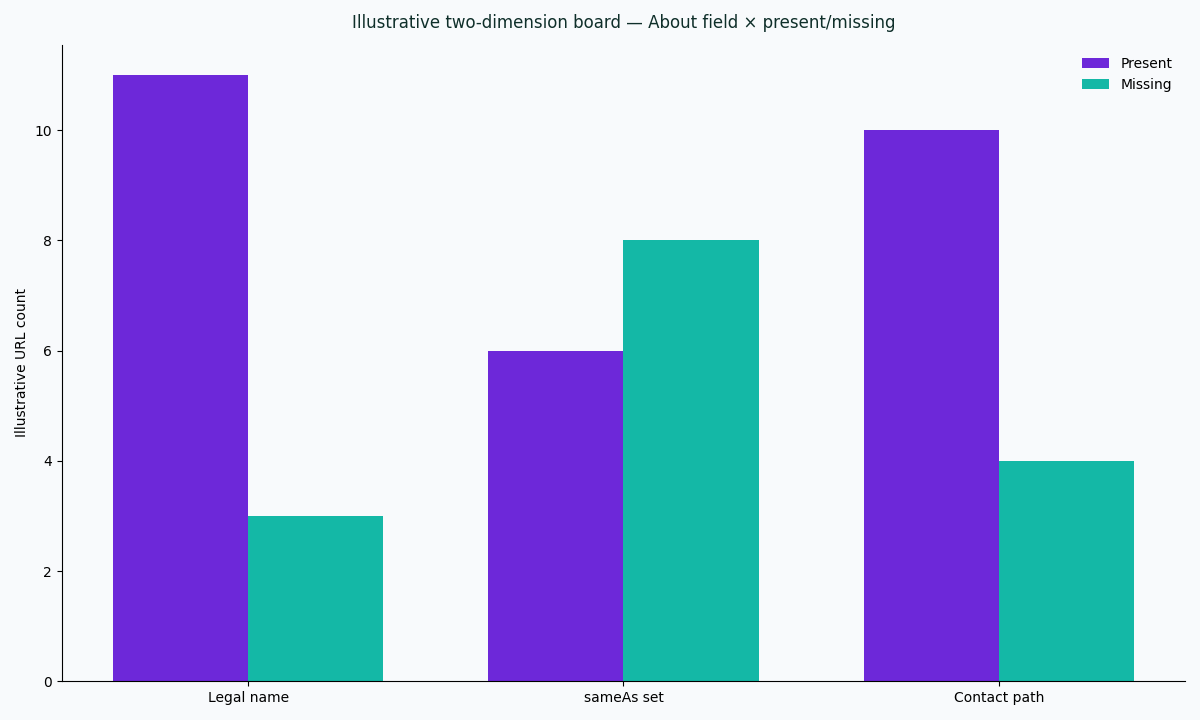
Figure: Present means a visible string. It does not prove authority.
Conflict and Corrections tokens
Conflict appeared 18 times. Corrections appeared 21 times. Those counts show the words are on the page. They do not prove a stranger can finish a correction. About page E-E-A-T still needs the heading a visitor can open.
The W3C Organization Ontology treats an organization as something you can name and relate. A token count is not that name.
Empty social alts
CLI warned “4/5 images are missing the alt attribute.” Empty alt="" on footer social icons is counted as missing by this CLI. That is a checker row. It is not an about page E-E-A-T verdict and not a Google score.
ICANN’s WHOIS primer is why a registry contact is not an About URL. IANA’s about IANA page is the companion: a named operator and a path a visitor can use.
How to reproduce the fetch
curl -sS --compressed -A 'InfiniSynapse-SH67-desk/2026-09-14' \
  -o /tmp/editorial-standards.html \
  -w '%{http_code} %{size_download}\n' \
  https://infinisynapse.com/en/editorial-standards

seo-health check https://infinisynapse.com/en/editorial-standards --format json --lang en
This fetch used --compressed HTML. Expect 200 unless the host moved. Store the H1. Store the title length. Store the four empty-alt warning. Do not paste a customer EEAT row under this chart.
seo-health eeat on the same URL printed unauthorized (exit 1, 28 bytes). That is a login miss. About page E-E-A-T that treats unauthorized as Google’s About grade is inventing a meter.
Compressed HTML note
A later browser UA can receive a different shell. Write the new status beside the 2026-09-14 line. Do not silently replace the counts. About page E-E-A-T that “updates” Conflict from 18 to a round number without a refetch is editing the desk.
As of 2026 this page is not a customer case. The limitation is one first-party URL.
If the About URL is empty, blocked, or unreadable, stop on cannot score EEAT. Do not guess the legal name.
Fields a later About still needs
When someone edits About, keep three inspectable fields: legal name a visitor can quote, a contact path that resolves, and a corrections route. sameAs belongs with the entity sibling, not as a substitute for the visible name.
About page E-E-A-T fails when the page is a collage and the markup is the only place the company appears.
Google’s people-first content page is the third-party rule for who created the content. It does not certify this About.
Legal name before another bio
Quote the operator before you commission another paragraph. A staff story without the company is a person node. If the next job is the join across HTML and schema, open organization entity SEO. Stay here when about page E-E-A-T is still the missing visible name.
Markup must match the visible operator
An organization entity is the same operator in the HTML, the footer, and the markup. A sameAs set that points at a different brand is a miss. About page E-E-A-T is about page trust you can re-fetch, not a private registry row.
If the next job is dating a test file, open first-hand experience signals. Come back here when the live About is still unnamed.
FTC endorsements guidance is why a logo wall of “partners” is not an operator name. It does not score our URL.
Failure modes that invent an About
Shipped a logo wall as the About. A collage is not a legal name. Name the operator or unpublish.
Cited a preview only the author can see. Wait for a public 200.
Called eight green lights an entity win. Wrong layer. The three fields are the cite.
Marked Organization in JSON-LD while the HTML said “we.” Markup must match the visible name.
Treated 61 characters as a trust fail. It is a title-length warning.
Advertised unauthorized as Google’s About score. Stop. About page E-E-A-T does not mint an official meter.
Stamped the same unnamed About on forty locales. Kill the partial. That is a template job, not this fetch.
YMYL counted 0 on this HTML. Do not write medical or finance advice onto this tool URL to “look serious.” This desk gives none.
How a reviewer should read the page
Start with the URL. Confirm it is still editorial-standards unless a later desk fetched a different About. Confirm the H1 still names the research desk. Confirm the title is still 61 characters or write the new length. Confirm William Zhu is still an H3. Confirm Conflict and Corrections are still present as words. Only then edit a bio.
Write empty nodes as empty. If you cannot quote the operator, you are not ready to mark an entity. About page E-E-A-T treats a green title on a logo wall as false comfort.
Two people repeating the compressed curl should see the same class of 200 unless the About host moved. Two people paraphrasing “we have an About” will not. That difference is why the fetch is the desk.
When legal asks whether the About “passes EEAT,” the accurate answer is: we fetched editorial-standards, counted the fields above, and did not run a signed-in score. Anything stronger is a different desk with a token.
Do not upload a customer About to prove you worked. This URL is ours. About page E-E-A-T that publishes a buyer’s legal name to look empirical is leaking identity, not proving a method.
If the only artifact you have is this article’s chart, say so. The chart is field present versus field absent. It is a useful stop rule. It is not a customer series.
YMYL token stayed at zero
YMYL appeared 0 times on the fetched HTML. Keep it that way on this tool slug. About page E-E-A-T is an inspectability audit, not a clinic or brokerage review. This page does not give medical or finance advice.
Store the user-agent InfiniSynapse-SH67-desk/2026-09-14. Package pin infinitegrowth@0.1.1; -V printed 0.1.0. Those strings do not prove the About is complete. They prove which CLI warned on title length.
The decision this page supports is narrow: name the organization on the live URL before you add another bio. This does not prove authority. It cannot establish a ranking change. The illustrative desk below is first-party.
When the next quarter still has a 61-character title, republish the new length if you re-fetched it. Do not invent a shorter title in the ticket to look finished.
A reviewer who needs a punch list can still run seo-health check on editorial-standards. Expect the 61-character warning and the four empty-alt row. Those lights are not about page E-E-A-T. Write Conflict 18 and Corrections 21 only if you re-counted them. Rounding either token to a pretty twenty is editing the desk.
Keep William Zhu as an H3 until a later fetch shows a different label. Do not collapse the reviewer headings into a single “team” line in the ticket. About page E-E-A-T that loses the named rows loses the only accountability strings this HTML gave us. If a later editor adds another bio, quote the live legal organization first. If the legal line is still missing from the H1, write that absence. Absence is a field.
The 2026-09-14 eeat unauthorized line belongs in the same folder as the About fetch. It proves we did not mint a score. About page E-E-A-T that deletes the miss to look cleaner is hiding the limit. This page remains first-party. It is not a customer About and not a market study of other operators. The sample size is one URL until someone fetches a second About and stores that HTML beside this one.
Nearby guides
The cannot score EEAT hub owns the blocked-About refuse. Do not invent a name on a wall.
| Job | Guide |
|---|---|
| Reconcile visible name and schema | organization entity SEO |
| Date the test you cite | first-hand experience signals |
| About in each language that rendered | EEAT for multilingual sites |
About page E-E-A-T stays on the URL a visitor can fetch.
Quote the H1 before another bio
Re-fetch editorial-standards. Write the title-length warning and the named H3s. Do not treat unauthorized as a Google About grade.
Run SEO Health CheckerFrequently Asked Questions
Is editorial-standards the About URL we used?
Yes. That is the URL this desk fetched. About page E-E-A-T on this pass starts there, not on a private CMS preview.
Does a 61-character title fail trust?
No. The CLI warned on length. That warning is not a Google score and not an authority grade.
Do four empty social alts refute the operator name?
No. They are a checker row. Transcribe the visible operator anyway.
Does a complete About prove authority?
No. Completeness is inspectability. Authority needs unaffiliated evidence this first-party page cannot mint.
What if the About URL is empty when I re-check?
Record cannot observe for that request. Do not invent about page E-E-A-T from a prior screenshot.
Conclusion
Use about page E-E-A-T when the job is to quote the live operator, contact path, and corrections before another bio. This 2026-09-14 pass recorded editorial-standards, a 61-character title, named H3s, Conflict 18, Corrections 21, and YMYL 0. Stop when those objects remain visible. A bounded About fetch beats an unsupported trust percentage.
Name the legal organization on that live URL before you add another bio paragraph.
William Zhu · Cofounder, InfiniSynapse · GitHub @allwefantasy
Desk-validated SEO Health methods. Corrections: zhuhl@infinisynapse.com · corrections policy.