Organization Entity SEO: Audit the Company Node Live
Organization entity SEO reconciles visible identity with name, URL, logo, sameAs, and contact schema. Audit contradictions before adding more markup now.
Author credentials: William Zhu is cofounder of InfiniSynapse (GitHub @allwefantasy · auto-coder). Desk: shipping SEO Health and the /en/tool/ visibility pages. No personal LinkedIn published. About: team / editorial standards.
Publisher credentials: InfiniSynapse has public profiles on GitHub, YouTube, and X. A 2026 WAIC Future Tech OPC excellence award covers the Agentic Data Infra entry (WAIC; third-party recap: Xinhua / Caohejing). That award does not review this page or SEO Health. Method CLI: infinitegrowth on npm. Archive: recognition and scope notes.
On this page
By William Zhu · Cofounder, InfiniSynapse · Published: 2026-09-08 · Last updated: 2026-09-14 · Last verified: 2026-09-14 · Reviewed by the InfiniSynapse Data Team.
Reviewed by: InfiniSynapse Data Team · method review 2026-09-14. Homepage Organization sameAs is four profile URLs. HTML name counts. No Wikidata Q-id claimed. No customer EEAT score.
Trust / COI: About · Corrections. SEO Health is a commercial product from this team. sameAs below is our homepage node, not market identity.
TL;DR
sameAs on the homepage is four profile URLs; the string InfiniSynapse is not in that list.
Direct answer: Treat organization entity SEO as a reconciliation of visible copy and Organization markup. On 2026-09-14 the homepage Organization
sameAslisted four URLs: YouTube@infinisynapse, XInfiniSynapse, GitHub InfiniSynapse, and GitHub allwefantasy. Homepage HTML counted InfiniSynapse 85, SEO Health 10, Infini Synapse 0. Those strings are names. They are notsameAsURLs. No customer EEAT score. No Q-id was minted.
An organization entity SEO ticket that adds a Wikidata item to look finished is already late. The sample size is one homepage node. That sample cannot establish a resolved company in every locale.
What you will learn
- Which four URLs sat in sameAs
- Why a brand string is not a profile link
- Which HTML counts this desk transcribed
- When a staff bio is the wrong node
- Where About, SaaS, and refuse jobs live
What sameAs actually lists
Key definition: organization entity SEO joins the company on public HTML to other public identities. The join is fetchable profile URLs, a stable logo, and one About path. A byline is a different node.
People open organization entity SEO after a homepage paragraph feels finished and the company still will not join. Ask for the JSON-LD first.
Schema.org documents sameAs as the property that points a thing at another identity URL. Honest organization entity SEO follows that habit: quote the four URLs, then write.
SEO Health stays the deterministic evidence foundation for public HTML and Organization JSON-LD. A later InfiniSynapse Server API long-task workspace may classify a submitted pack over SSE /api/ai/events; the API does not mint a Wikidata Q-id.
Names are not profile URLs
InfiniSynapse appeared 85 times in the HTML. That count is copy. It is not a member of the sameAs array. Organization entity SEO that drops the four URLs and cites the name count as the join is mixing columns.
Google’s logo structured data page still explains how to attach a stable image to an organization. A staff headshot is the wrong image.
HTML counts stay in copy
SEO Health counted 10. Infini Synapse (space) counted 0. Those zeros and tens are alias decisions. They are not profile URLs. Organization entity SEO that puts “SEO Health” into sameAs is mixing a product nickname with identity links.
The W3C RDF 1.1 Primer is the graph model we use: nodes resolve when identifiers agree. A slogan does not agree two identifiers.
Visible strings versus identity links
Fetched https://infinisynapse.com/ on 2026-09-14 with the SH67 desk user-agent.
| String or URL | HTML count | In Organization sameAs |
|---|---|---|
| InfiniSynapse | 85 | no (name, not a URL) |
| SEO Health | 10 | no |
| Infini Synapse | 0 | no |
| youtube.com/@infinisynapse | — | yes |
| x.com/InfiniSynapse | — | yes |
| github.com/InfiniSynapse | — | yes |
| github.com/allwefantasy | — | yes |
Wikidata’s data model still treats a stable item as a public identifier you can point at. We did not claim a Q-id for InfiniSynapse on this desk. Organization entity SEO that invents one to look complete is minting a finish line.
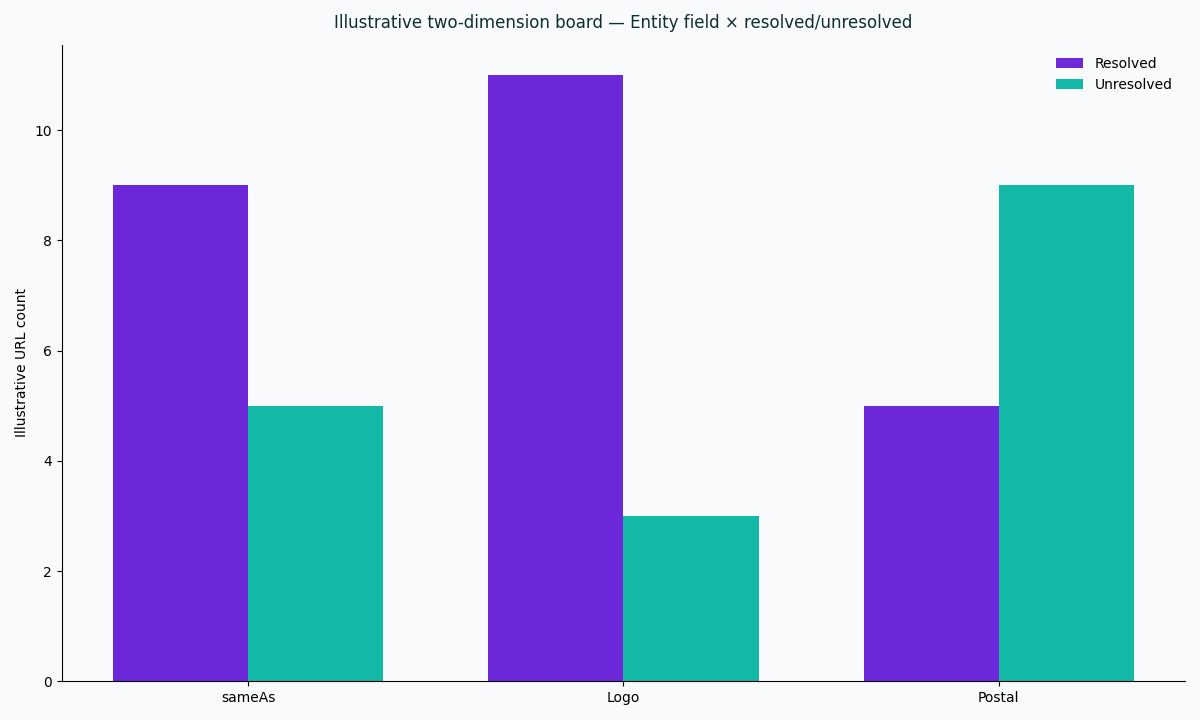
Figure: Present means a quoted field. It does not prove reputation.
Infini Synapse counted zero
The spaced string is a rejected alias on this homepage. Keep the zero. Organization entity SEO that deletes unused aliases makes the next analyst re-litigate the name.
W3C JSON-LD 1.1 is the syntax we expect on the public HTML. A screenshot of a CMS field is not evidence.
Schema.org Organization is the type. It does not certify the join.
How to reproduce the homepage join
curl -sS -A 'InfiniSynapse-SH67-desk/2026-09-14' -o /tmp/homepage.html \
  -w '%{http_code} %{size_download}\n' \
  https://infinisynapse.com/
View source or the rendered JSON-LD. Quote the four sameAs URLs exactly. Count InfiniSynapse, SEO Health, and Infini Synapse in the HTML. Do not add a Q-id in the ticket unless an item already exists and you fetched it.
seo-health check on the homepage exited 0 with 1292 words and a 58-character title. Exit 0 is not a page pass and not an entity verdict. seo-health eeat printed unauthorized on editorial-standards. That is a login miss, not a Google score.
View source for the Organization node
If you cannot paste the four strings into the ticket, organization entity SEO is a hold. Do not start a paid pass to “see if the model notices.”
MDN’s note on the HTML link element is the same fetch habit: if the crawler cannot retrieve the relation, treat the identifier as missing.
GS1’s note on identification keys is the commerce cousin: a firm that already has a key still needs that identifier on a URL a crawler can fetch. Organization entity SEO does not invent a new key.
SEC EDGAR company search and UK Companies House search are public registries. They are not this homepage node. Do not paste a filing as if it were sameAs unless the URL is actually in the array.
If the page cannot be read, stop on cannot score EEAT. Do not guess the company.
As of 2026 this page is not a customer case. The limitation is one first-party homepage.
Fields a later entity still needs
When someone edits identity, reconcile visible name, legal name, canonical URL, logo, sameAs destinations, contact details, and the About path. Record conflicts. Do not assume a matching string proves ownership.
Organization entity SEO fails when /about 302s through three hosts or is noindex.
If the next job is the human-readable About, open about page E-E-A-T. If the next job is product claims on a software URL, open EEAT for SaaS pages. Stay here when the defect is the join.
Logo and About stay fetchable
About must be one public URL. The sibling About guide owns the essay. Organization entity SEO still asks whether the path is stable.
Google’s Organization structured data page says markup can help disambiguate an organization and that properties are recommended, not a required scorecard. A parser pass is not authority.
A Q-id is not a finish line
Wikidata is a vocabulary. It is not our item until an item exists and we fetch it. Organization entity SEO that mints a Q-id to close a ticket is theater.
GLEIF LEI data and OpenCorporates are other public identity sources. They do not appear in this homepage sameAs list. Do not add them in prose as if they were on the node.
IETF URI syntax is why a broken vanity URL is not a join. The W3C RDF Schema note is a vocabulary, not a reputation certificate.
Failure modes that invent a resolved company
Shipped a long bio and called the company done. Wrong object. The join still needs sameAs.
Pointed sameAs at a campaign URL. The join dies when the campaign ends.
Used a staff headshot as the logo. The image node is a person.
Moved About every release. The identifier is not stable.
Put the visible name into sameAs. Names are not URLs.
Minted a Q-id to look finished. We did not fetch one.
Advertised unauthorized as Google’s entity score. Stop. Organization entity SEO does not mint an official meter.
W3C RDF 1.1 concepts still treat identity as agreement among identifiers. A confident paragraph is not agreement. ISO legal entity identifier is a standard for a different identifier. It is not on this sameAs list.
This does not prove reputation. It cannot establish ownership in a knowledge graph. The illustrative node is first-party.
How a reviewer should read the node
Start with the four URLs. Confirm YouTube, X, GitHub InfiniSynapse, and GitHub allwefantasy still sit in sameAs or write the new list. Confirm InfiniSynapse still appears as HTML copy and not as a fifth sameAs URL. Confirm Infini Synapse is still 0 unless a later fetch changed it. Confirm no Q-id was added in the ticket without a fetch.
Write conflicts as conflicts. If the visible legal name and the Organization name disagree, stop. Organization entity SEO that picks the prettier string is already late.
Two people repeating the curl should see the same class of JSON-LD unless the host changed. Two people minting a Q-id will not. That difference is why the node is the desk.
When legal asks whether the company is “resolved for EEAT,” the accurate answer is: we quoted four sameAs URLs and three HTML counts, and we did not run a signed-in score. Anything stronger is a different desk with a token.
Do not upload a customer’s Organization block to prove you worked. This host is ours. Organization entity SEO that publishes a buyer’s sameAs list to look empirical is leaking identity.
If the only artifact you have is this article’s chart, say so. The chart is name versus URL versus contact. It is a useful stop rule. It is not a customer series.
Four links still need the visible name
The four profile URLs do not replace the legal name on About. Reconcile both. Organization entity SEO that ships icons without a quoteable operator is unresolved.
Store the user-agent InfiniSynapse-SH67-desk/2026-09-14. Package pin infinitegrowth@0.1.1; -V printed 0.1.0. Those strings do not prove the join. They prove which morning we counted.
The decision this page supports is narrow: reconcile visible name, legal name, and the four links. When the next quarter still has four URLs and no Q-id, republish the new counts if you re-fetched them. Do not backfill an item to look finished. Empty Q-id is a legal state.
A reviewer who needs a punch list can still run seo-health check on the homepage. Expect 1292 words and a 58-character title. Those lights are not organization entity SEO. Write InfiniSynapse 85 only if the new HTML still counts 85. Rounding to 80 is editing the desk. Organization entity SEO that “cleans” the alias table is no longer empiric.
Keep GitHub InfiniSynapse and GitHub allwefantasy as two rows. They are different profile URLs. Collapsing them into “GitHub” loses the join. Organization entity SEO that treats two destinations as one icon is unresolved. If a later editor adds a fifth sameAs URL, fetch it and write the status. Do not add it from memory. If a later editor wants a Q-id, fetch the item page first. No fetch means no item.
The 2026-09-14 unauthorized eeat line from editorial-standards belongs in the same folder as a reminder: we did not mint an entity score. Organization entity SEO that deletes the miss to look cleaner is hiding the limit. This host is first-party. It is not a customer Organization block and not a market study of other companies. The sample size stays one homepage node until someone stores a second host beside it.
EU business registers are another public search. They are not this homepage array. Keep them off the sameAs quote unless they appear there.
Nearby guides
The cannot score EEAT hub owns the unreadable-node refuse. Do not invent a company on a wall.
| Job | Guide |
|---|---|
| Name the operator on About | about page E-E-A-T |
| Software claims on a product URL | EEAT for SaaS pages |
Organization entity SEO stays on the join.
Keep the four URLs unlabeled as a Q-id
Re-read the Organization node. Quote the four profile links and the HTML counts. Do not mint an item to close the ticket.
Run SEO Health CheckerFrequently Asked Questions
Is the string InfiniSynapse in sameAs?
No. sameAs is four profile URLs. The string is HTML copy. Organization entity SEO keeps those columns split.
Does a staff bio resolve the company?
No. A bio is a person node. The join still needs fetchable identity URLs, a logo, and a stable About path.
Does valid Organization schema prove authority?
No. Syntax helps machines read the claimed entity. Reputation needs evidence beyond the organization’s own markup. Google does not issue an entity EEAT score.
May we add a Wikidata Q-id to look finished?
No. We did not fetch an item. Do not mint one for the ticket.
What if the homepage JSON-LD is missing when I re-check?
Record cannot observe for the node. Do not invent organization entity SEO from this article’s table.
Conclusion
Use organization entity SEO when the job is to reconcile visible identity and schema without minting a finish line. This 2026-09-14 pass recorded four sameAs URLs and three HTML counts. Stop when those objects remain visible. A bounded node quote beats an unsupported entity percentage.
Reconcile visible name, legal name, and the four links; do not mint a Q-id to look finished.
William Zhu · Cofounder, InfiniSynapse · GitHub @allwefantasy
Desk-validated SEO Health methods. Corrections: zhuhl@infinisynapse.com · corrections policy.