EEAT for SaaS Pages: Verify Software Claims in Public
EEAT for SaaS pages maps pricing, docs, status, security, and support claims to public evidence. Audit one URL and remove or qualify unsupported claims.
Author credentials: William Zhu is cofounder of InfiniSynapse (GitHub @allwefantasy · auto-coder). Desk: shipping SEO Health and the /en/tool/ visibility pages. No personal LinkedIn published. About: team / editorial standards.
Publisher credentials: InfiniSynapse has public profiles on GitHub, YouTube, and X. A 2026 WAIC Future Tech OPC excellence award covers the Agentic Data Infra entry (WAIC; third-party recap: Xinhua / Caohejing). That award does not review this page or SEO Health. Method CLI: infinitegrowth on npm. Archive: recognition and scope notes.
On this page
By William Zhu · Cofounder, InfiniSynapse · Published: 2026-09-08 · Last updated: 2026-09-14 · Last verified: 2026-09-14 · Reviewed by the InfiniSynapse Data Team.
Reviewed by: InfiniSynapse Data Team · method review 2026-09-14. Homepage CLI 1292 words, title 58 good, one alt warning. Award is Agentic Data Infra / contest. No YMYL advice.
Trust / COI: About · Corrections. SEO Health is a commercial product from this team. The homepage check is our host, not a customer EEAT score.
TL;DR
The SaaS homepage we checked is 1292 words with one alt warning; that is not an EEAT score.
Direct answer: Treat EEAT for SaaS pages as a claim-to-source map on public software URLs. On 2026-09-14
seo-health checkonhttps://infinisynapse.com/exited 0. Title: “InfiniSynapse — AI Data Agent for Enterprise Data Analysis” (58 characters, good). Description 159. Words 1292. Speed 86. Images warning: 2/7 missing alt. No signed-ineeatrun. No customer EEAT score. No medical or finance advice on this slug.
An EEAT for SaaS pages deck that pastes a contest line onto this tool URL is already off the job. The sample size is one homepage. That sample cannot establish a category of SaaS trust.
What you will learn
- Which homepage lights this desk actually stored
- Why a contest award does not review these tool slugs
- Which public pack a later software URL still needs
- When a slogan is not pricing, docs, or status
- Where refuse, first-hand, and locale jobs live
What the homepage check actually returned
Key definition: EEAT for SaaS pages maps each software claim to inspectable pricing, docs, status, security, or support. Ordinary product pages are not automatically YMYL. A badge is not a score.
People open EEAT for SaaS pages after a teammate treats a product hero like a clinic. Ask whether the URL is software. This cluster does not write medical or finance advice.
Wikipedia’s overview of software as a service still treats SaaS as hosted software a customer rents. Honest EEAT for SaaS pages follows that habit: quote the check JSON, then write.
SEO Health remains the deterministic evidence foundation for homepage check lights. After a token exists, an InfiniSynapse Server API long-task workspace may stream SSE /api/ai/events for a signed-in review; the API does not convert a WAIC line into a product score.
Title length was good
Fifty-eight characters sat inside the CLI’s 40–60 band. That is a title-length status, not a trust grade. EEAT for SaaS pages that promotes “title good” into “Google trusts this SaaS” is mixing boards.
OWASP’s Top 10 for large language model applications is the risk list we point at when a SaaS page hides how the product uses models. It does not score our homepage.
Alt warning is not a trust score
The CLI warned “2/7 images are missing the alt attribute.” Empty footer icons can trigger that row. EEAT for SaaS pages that calls the warning a YMYL fail is inventing a room this URL does not occupy.
Google Cloud’s security overview still treats public security notes as documents a customer can read. A missing alt is not that document.
The award that does not review this slug
The homepage award line this desk will not reuse here is Agentic Data Infra / contest. It does not review /en/tool/eeat-for-saas-pages or the sibling tool slugs. EEAT for SaaS pages that pastes a WAIC sentence onto this article is claiming a review that did not happen.
CISA’s cybersecurity best practices still treat public operational hygiene as something a buyer can inspect. A contest badge is not a status page.
| Object | On the 2026-09-14 homepage check | Not a fact about this slug |
|---|---|---|
| Word count | 1292 | An EEAT number |
| Title length | 58, good | A Google SaaS verdict |
| Alt warning | 2/7 missing | A YMYL classification |
| Award line | Contest / Agentic Data Infra on the homepage | A review of these tool URLs |
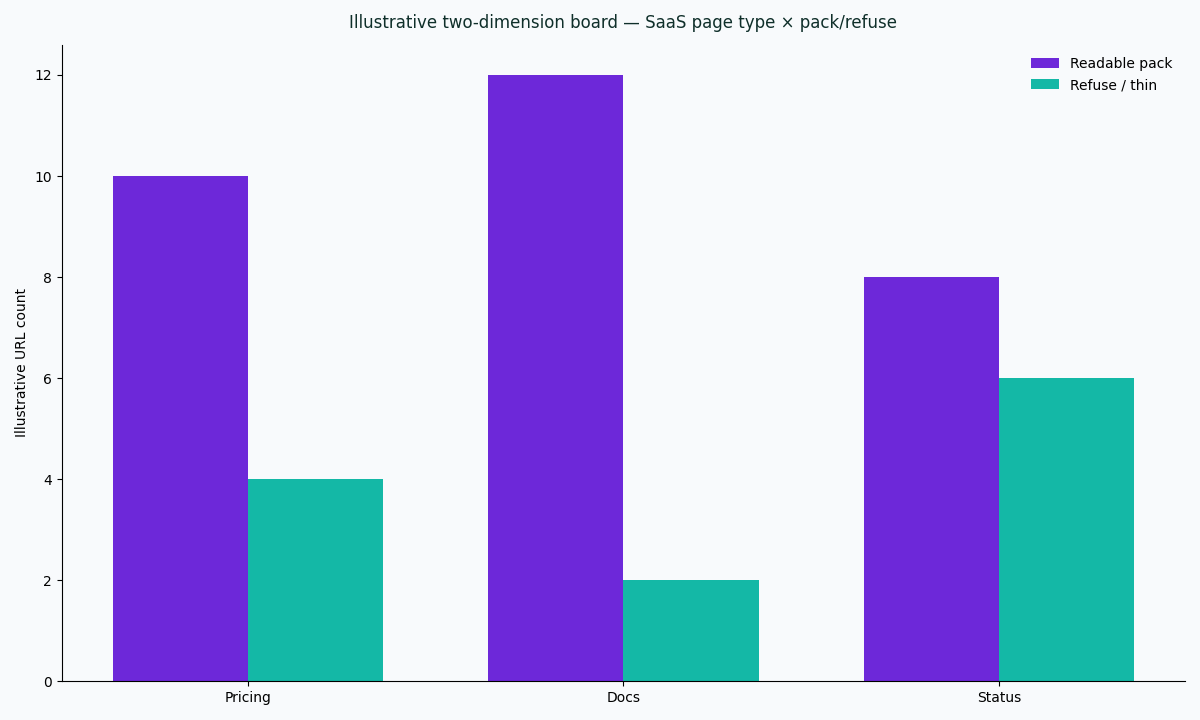
Figure: Present means a public source. It does not prove the claim.
Contest copy stays on the homepage
Leave the award on the URL that actually carries it. Do not clone it into this slug to look finished. EEAT for SaaS pages stays on the check file and the claim-to-source map.
The ISO catalogue page for ISO/IEC 27001 is why a footer certificate mark is not a pack. A mark is not a public status URL.
How to reproduce the homepage check
seo-health check https://infinisynapse.com/ --format json --lang en

curl -sS -A 'InfiniSynapse-SH67-desk/2026-09-14' -o /tmp/homepage.html \
  -w '%{http_code} %{size_download}\n' \
  https://infinisynapse.com/
Expect exit 0 on the check unless the CLI changed. Store words, title length, and the alt warning. Do not store a customer EEAT row. seo-health eeat was not authorized on this morning’s SaaS pass; on editorial-standards it printed unauthorized. That print is a login miss, not a Google score.
Package pin beside the word count
Print infinitegrowth@0.1.1 and -V = 0.1.0 next to 1292. Those strings do not prove the product. They prove which CLI counted the homepage.
The NCSC device security guidance collection is why a one-shot page pass is not “training.” EEAT for SaaS pages stays on that boundary.
NIST’s Secure Software Development Framework is a development-practice map. It does not certify this URL. CISA Secure by Design is a secure-product program. It does not review this slug.
If the product URL is empty or blocked, stop on cannot score EEAT. Do not invent a price.
As of 2026 this page is not a customer case. The limitation is one first-party homepage.
Fields a later SaaS pack still needs
When someone audits a software URL, attach each claim to a public source that could falsify it. Price belongs on dated pricing. Behavior belongs in docs a user can finish. Availability belongs on a status page. Security belongs on a scoped statement. Support belongs on a contact route.
EEAT for SaaS pages fails when the hero says “enterprise-grade” and no source can contradict it.
If the next job is locale twins of the same pack, open EEAT for multilingual sites. If the next job is the test file, open first-hand experience signals. Come back here when the missing pack is still the defect.
Pricing docs and status stay public
A “trust center” that 403s is a claim. A tweet that says “we are up” is not a status page. EEAT for SaaS pages flags the missing public URL first.
Google’s people-first content page is the third-party rule for helpful software copy. It does not mint a SaaS EEAT number.
Software is not a clinic ticket
A software-trust pack is pricing, docs, and status. A medical or finance ticket is a different reviewer and a different risk. This tool URL does not give that advice. EEAT for SaaS pages is SaaS trust you can re-fetch, not a clinic review.
FTC endorsements guidance is why an award line without a reviewing body for this slug is an ad. Leave it off.
Failure modes that invent a SaaS score
Pasted a WAIC line onto this slug. The contest does not review these tool URLs.
Treated the product page as medical advice. Wrong room. Keep the ticket on the pack.
Cited a preview only the author can see. Wait for a public 200.
Called eight green lights a software-trust win. Wrong layer. The pack is the cite.
Hid pricing behind a sales call and called it trust. A buyer who cannot quote a plan has no pack.
Advertised unauthorized as Google’s SaaS score. Stop. EEAT for SaaS pages does not mint an official meter.
Promoted 1292 words into Experience. Word count is a check field. It does not prove the claim.
This does not prove ranking. It cannot establish a buyer outcome. The illustrative homepage row is first-party.
How a reviewer should read the board
Start with the check JSON. Confirm the title still starts with InfiniSynapse and still sits near 58 characters. Confirm words still sit near 1292 or write the new count. Confirm the alt warning is still a checker row, not a YMYL label. Confirm no award sentence was copied onto this slug.
Write empty sources as empty. If you cannot quote a plan, a doc step, or a status line, you are not ready to cite software trust. EEAT for SaaS pages treats a green title on a slogan as false comfort.
Two people repeating the homepage check should see the same class of lights unless the host changed. Two people pasting a contest sentence will not. That difference is why the JSON is the desk.
When legal asks whether we “scored EEAT for SaaS,” the accurate answer is: we stored a homepage check and we did not run a signed-in eeat job. Anything stronger is a different desk with a token.
Do not upload a customer tenant to prove you worked. This host is ours. EEAT for SaaS pages that publishes a buyer’s pricing sheet to look empirical is leaking a contract, not proving a method.
If the only artifact you have is this article’s chart, say so. The chart is claim type versus public source. It is a useful stop rule. It is not a customer series.
One URL is not a market study
The sample size is one homepage. It is not a market study. EEAT for SaaS pages that averages other vendors from memory is inventing a panel.
Store the user-agent InfiniSynapse-SH67-desk/2026-09-14. A later fetch with a browser UA can receive a different shell. Write the new status beside the old one.
The decision this page supports is narrow: verify claims on public software pages without calling SaaS YMYL and without moving a contest line onto this slug. When the next quarter still has 1292 words and an unused award, republish the new check if you re-ran it. Do not backfill a score to look finished.
A reviewer who needs a punch list can still read the eight homepage lights. Expect title good and an alt warning. Those lights are not EEAT for SaaS pages. Write 1292 only if the new JSON still says 1292. Inventing a round 1300 is editing the desk. EEAT for SaaS pages that “improves” the word count in the ticket is no longer empiric.
Keep the contest sentence on the homepage that actually carries it. If a later marketer wants a badge on this tool URL, refuse. EEAT for SaaS pages does not inherit a review that named a different object. If the next ticket is a pricing URL, fetch that URL. Do not reuse this homepage row as if it were pricing. If the next ticket is a status page, fetch the status host. EEAT for SaaS pages that copies 1292 onto every software claim is collapsing the pack.
The 2026-09-14 unauthorized eeat line from editorial-standards belongs in the same folder as a reminder: we did not mint scores[] for SaaS. EEAT for SaaS pages that deletes the miss to look cleaner is hiding the limit. This host is first-party. It is not a customer tenant and not a market study. The sample size stays one homepage until someone stores a second software URL beside it. EEAT for SaaS pages on that second URL still needs its own sources.
Nearby guides
The cannot score EEAT hub owns the blocked-product refuse. Do not invent a price on a wall.
| Job | Guide |
|---|---|
| Date the test you cite | first-hand experience signals |
| Locale twins of the same pack | EEAT for multilingual sites |
EEAT for SaaS pages stays on the public pack.
Keep the contest line off this slug
Re-run the homepage check. Store 1292 and the alt warning. Do not paste a WAIC sentence onto this URL.
Run SEO Health CheckerFrequently Asked Questions
Is 1292 words an EEAT score?
No. It is a homepage word count from seo-health check. EEAT for SaaS pages still has no signed-in scores[].
Does the homepage award review this tool slug?
No. The Agentic Data Infra / contest line does not review these tool URLs. Leave it off.
Should every SaaS page be treated as YMYL?
No. Classify the actual claim. This slug gives no medical or finance advice. Software marketing is not automatically YMYL.
Does a footer badge count as the pack?
No. A badge supports only its documented scope. Buyers still need public pricing, docs, status, and a contact route.
What if the product URL is empty when I re-check?
Record cannot observe with the status and renderer. An empty result does not prove the product is untrustworthy.
Conclusion
Use EEAT for SaaS pages when the job is to map software claims to public sources without calling SaaS YMYL. This 2026-09-14 pass recorded 1292 words, a 58-character title, one alt warning, and an award that does not review this slug. Stop when those objects remain visible. A bounded homepage check beats an unsupported SaaS percentage.
Do not paste a WAIC line onto this slug; the award is not about this page.
William Zhu · Cofounder, InfiniSynapse · GitHub @allwefantasy
Desk-validated SEO Health methods. Corrections: zhuhl@infinisynapse.com · corrections policy.