First-Hand Experience Signals: Audit Real Evidence
First-hand experience signals require a dated action, conditions, observed result, failure, and limits. Audit the public evidence before making a product claim.
Author credentials: William Zhu is cofounder of InfiniSynapse (GitHub @allwefantasy · auto-coder). Desk: shipping SEO Health and the /en/tool/ visibility pages. No personal LinkedIn published. About: team / editorial standards.
Publisher credentials: InfiniSynapse has public profiles on GitHub, YouTube, and X. A 2026 WAIC Future Tech OPC excellence award covers the Agentic Data Infra entry (WAIC; third-party recap: Xinhua / Caohejing). That award does not review this page or SEO Health. Method CLI: infinitegrowth on npm. Archive: recognition and scope notes.
On this page
By William Zhu · Cofounder, InfiniSynapse · Published: 2026-09-08 · Last updated: 2026-09-14 · Last verified: 2026-09-14 · Reviewed by the InfiniSynapse Data Team.
Reviewed by: InfiniSynapse Data Team · method review 2026-09-14. CLI JSON plus curl HTML. No customer export.
seo-health eeaton editorial-standards printed unauthorized.
Trust / COI: About · Corrections. SEO Health is a commercial product from this team. Unauthorized is a login failure, not a Google score.
TL;DR
The first-hand objects on this desk are a CLI file and a curl body, not a customer export.
Direct answer: Treat first-hand experience signals as dated command output you can reopen. On 2026-09-14 this desk stored
seo-health checkJSON and a curl HTML body.seo-health eeatonhttps://infinisynapse.com/en/editorial-standardsexited 1 and printed分析失败:unauthorized(28 bytes). That string is a login miss. It is not a Google Experience verdict and not a customer EEAT score.
A first-hand experience signals slide that quotes “we tested it” without the command file is already a boast. The sample size is one desk folder. That sample cannot establish a market pattern.
What you will learn
- Which two artifacts this desk actually kept
- Why unauthorized is not a Google score
- Which fields a later test still has to write
- When a screenshot without a command is decoration
- Where About, date, and refuse jobs live
What the desk actually recorded
Key definition: first-hand experience signals are the action you ran, the object you hit, the output you saved, and the limit you wrote. A slogan is not that record.
People open first-hand experience signals after a hero says “we tested this page.” Ask for the file. If the folder is empty, stop.
Creating helpful, reliable, people-first content is the Google page this write-up holds to. We fetched the public docs host on this cluster’s 2026-09-14 pass. The page asks whether content shows first-hand work. It does not grade our CLI.
SEO Health stays the deterministic evidence foundation for CLI JSON and curl HTML. A later signed-in InfiniSynapse Server API long-task workspace can attach SSE /api/ai/events to an eeat job; that workspace still does not invent a first-hand test.
CLI JSON is not a customer export
The objects on disk are ours. They are not a customer EEAT score. First-hand experience signals that paste a buyer outcome into this folder are already off the job.
Wikipedia’s overview of empirical research still separates observation from assertion. Replay that habit here: quote the exit code, then write.
Unauthorized is a login failure
seo-health eeat <url> --format json requires login and credits. The help text says the flow is fetch, then an AI task, then JSON with scores[], pageType, ymyl{}, usage{}, and taskId. This desk never signed in. The printed line was unauthorized. First-hand experience signals that treat that line as Google’s Experience rating are inventing a meter.
As of 2026 this page is not a customer export. The limitation is the empty signed-in run.
Public files we could store
User-agent InfiniSynapse-SH67-desk/2026-09-14. Package pin infinitegrowth@0.1.1; -V printed 0.1.0. Record both.
| Artifact | What we have | What we do not have |
|---|---|---|
seo-health check JSON | Exit 0 on public URLs we fetched | A Google EEAT number |
| curl HTML | Editorial-standards body | A signed-in eeat taskId |
seo-health eeat | Exit 1, unauthorized, 28 bytes | Customer scores or scores[] |
The W3C Ethical Web Principles still ask that the web stay inspectable. First-hand experience signals follow that split: the JSON file is inspectable, the boast is not.
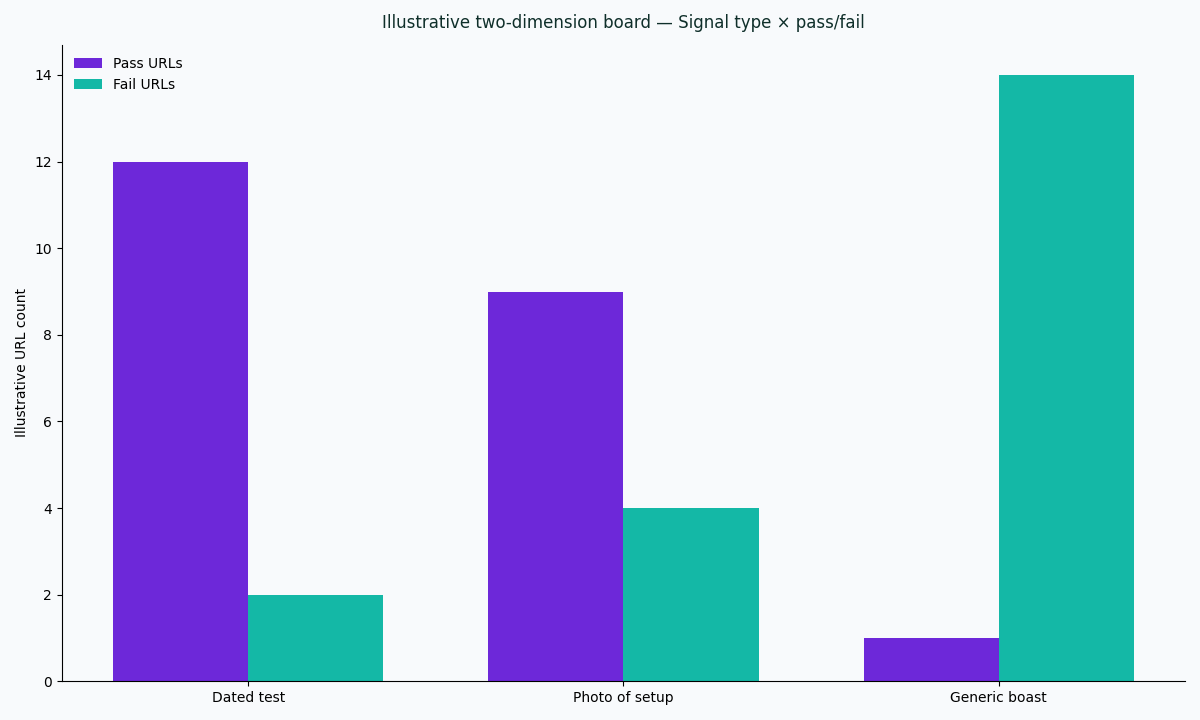
Figure: Present means a file or a printed line. It does not prove Experience.
What the curl body is
The curl body is HTML from a public URL. It is not a transcript of a reviewer clicking through a product. First-hand experience signals that caption a homepage screenshot as “we used the tool” still need the command that produced the file.
The OWASP Web Security Testing Guide is the dated method we point at when someone asks why a terminal crop is not enough. A test has a procedure.
What the CLI JSON is
seo-health check --format json can exit 0 while a module is amber. Exit 0 is not a page pass. First-hand experience signals that promote a green title light into “we proved Experience” are mixing boards.
NIST’s reproducibility and replicability terminology supports a repeatable observation. A one-shot check is not model training.
How to reproduce the two artifacts
curl -sS -A 'InfiniSynapse-SH67-desk/2026-09-14' -o /tmp/editorial-standards.html \
  -w '%{http_code} %{size_download}\n' \
  https://infinisynapse.com/en/editorial-standards

seo-health check https://infinisynapse.com/en/editorial-standards --format json --lang en
Expect HTTP 200 on the curl unless the host moved. Store the title. Store the JSON. Do not paste a customer row under this chart. First-hand experience signals reproduction stops at the public files until a reviewer actually performs a named action and keeps that capture offline.
NIH rigor and reproducibility is why we write the command, not only the conclusion. Open Science Framework guides are a deposit habit: keep the file, not a slide paraphrase.
Package pin on the same morning
Print infinitegrowth@0.1.1 and -V = 0.1.0 on the same page as the empty eeat note. Those strings do not prove Experience. They prove which CLI we could have authorized and did not.
Zenodo documentation is the archive note we cite when a teammate wants to “just remember” the run. Memory is not a file. First-hand experience signals that skip the pin cannot be replayed next quarter.
The GOV.UK Service Manual on measuring success still treats a metric as something you can re-collect. Unauthorized is not that metric.
Fields a later test still needs
When someone does run a test, write six fields: object, action, conditions, observation, friction or failure, and limit. URL and date are provenance. They are not the action.
First-hand experience signals fail when the page names a date and never names the click.
The W3C Data on the Web Best Practices page is why we keep the file next to the claim. The DOI Handbook is why a durable pointer beats “see Slack.” Neither document scores our URL.
If the page cannot be read, stop on cannot score EEAT. Do not invent first-hand experience signals from a wall.
Action and observation stay separate
Describe what you clicked, configured, or fetched. Then write what appeared. A praise sentence is not an observation. DataCite’s metadata schema is a field list, not a boast template.
NARA web records guidance is the records habit: keep the capture you would produce in discovery. First-hand experience signals that delete the failed path inflate the next average.
Limits stay on the page
List untested plans, locales, and account states. If no failure occurred, write “none observed in these runs,” not “reliable everywhere.” The National Academies reproducibility report is why one run stays one run.
If the next job is naming the operator, open about page E-E-A-T. If the next job is the calendar line, open EEAT date and method. Come back here when the missing file is still the defect.
Failure modes that invent a test
Quoted unauthorized as Google Experience. Login failed. Google was not asked.
Shipped a stock laptop photo. Library of Congress web archiving archives pages, not mood images. Caption the action or drop the claim.
Cited a preview only the author can see. Label the account state. Do not generalize.
Listed a method with no action. Process copy is administration.
Advertised a product number as Google’s. Stop. First-hand experience signals do not mint an official meter.
Pasted a customer export. This desk has none. That is not a customer case.
Google’s product-review guidance still asks for evidence of work. It does not approve this folder. The W3C PROV-O ontology is a provenance vocabulary. It is not a score.
How a reviewer should read the folder
Start with the two artifacts. Confirm the curl still returns a title. Confirm the check JSON still names the same URL. Confirm the eeat line is still unauthorized unless a later reviewer logged in and stored a taskId. Only then claim first-hand experience signals for a new action.
Write the command on its own line. Write the exit code. Write the first printed line. If the UI shows a marketing name and the CLI shows a module id, keep both.
W3C Web Annotation is why a highlight without a target URL is not a cite. FTC endorsements guidance is why a testimonial without a test file is an ad, not a desk.
Do not upload a customer packet to prove you worked. This folder is first-party. First-hand experience signals that publish buyer rows to look empirical are leaking context.
If the only artifact you have is this article’s chart, say so. The chart is file present versus file absent. It is a useful stop rule. It is not a customer series. Teams that need a series must cut a dated addendum and keep it off this URL until the captures exist.
Two people repeating this curl should see the same class of 200 unless editorial-standards moved. Two people inventing a test from memory will not. That difference is why the files are the desk.
When legal asks whether we “tested EEAT,” the accurate answer is: we stored check JSON and curl HTML, and eeat printed unauthorized. Anything stronger is a different desk with a token.
Empty folder is a legal state
Keep the two files and a one-sentence note that no customer export was opened. That folder is the 2026-09-14 first-hand experience signals packet. If a later teammate adds a real action, they go in a dated subfolder, not into this chart.
GitHub repository documentation is a storage primer, not a header badge and not a substitute for the CLI file. Store the user-agent. A later fetch with a browser UA can receive a different shell. Write the new status beside the old one.
The decision this page supports is narrow: refuse a boast until command output exists. First-hand experience signals do not decide titles, products, or budgets.
When the addendum folder is still empty next quarter, republish the same two artifacts with a new date if you re-fetched them. Do not backfill a test to make the quarter look complete. Empty is a legal state. A quarter with two dated files and a still-empty customer slot is a complete desk, not an unfinished slide. This does not prove Experience. It cannot establish a ranking change.
A reviewer who needs a punch list can still run seo-health check on the About URL. Expect title-length and alt lights, not Experience bits. First-hand experience signals do not promote those lights into a Google score. Write the package pin on the same page as the empty transcript note. If a later teammate signs in, they store the taskId in a dated subfolder and they still write the action they performed. A token without an action is another slogan.
Keep the printed unauthorized line in the folder even after a later login succeeds. The 2026-09-14 miss is part of the history. Overwriting it makes the next analyst think the desk always had scores[]. First-hand experience signals that tidy the miss to look cleaner are editing the record. The sample size stays one folder until someone adds a dated action file. That later file still has to name object, click, output, and limit, or it is not first-hand experience signals either.
Redact secrets from any terminal paste. Do not commit tokens. The public article can say unauthorized. It cannot paste a session cookie. First-hand experience signals that publish credentials to look empirical are a security incident, not a desk.
Nearby guides
The cannot score EEAT hub owns the empty-folder refuse. Do not copy that stop rule into a fake test.
| Job | Guide |
|---|---|
| Name the operator on About | about page E-E-A-T |
| Write the calendar and the method | EEAT date and method |
First-hand experience signals stay on the file you can reopen.
Keep unauthorized unlabeled as Experience
Replay the check JSON and the curl. Open a signed-in eeat job only when you intend to store a taskId offline.
Run SEO Health CheckerFrequently Asked Questions
Did we store a customer EEAT export?
No. The desk has CLI JSON and curl HTML. First-hand experience signals still have no buyer row to quote.
Does unauthorized mean Google rejected the page?
No. The command was not logged in. That print is not a Google score.
Does a laptop photo count as the test?
No. A photo can support a caption that names the action, conditions, output, and scope. A mood crop demonstrates none of those fields.
May we publish an Experience percentage from this chart?
No. The chart is file present versus file absent. It cannot establish a rate. The sample size is one folder.
What if the folder has only a slogan?
Record cannot observe for the action. Do not invent first-hand experience signals from the slogan.
Conclusion
Use first-hand experience signals when the job is to refuse a boast until command output can be stored. This 2026-09-14 pass recorded check JSON, curl HTML, and an unauthorized eeat line. Stop when those three objects remain visible. A bounded file log beats an unsupported Experience percentage.
If the folder has no command output, do not write that you tested the page.
William Zhu · Cofounder, InfiniSynapse · GitHub @allwefantasy
Desk-validated SEO Health methods. Corrections: zhuhl@infinisynapse.com · corrections policy.