Named Reviewer on YMYL: Verify the Sign-Off in Public
A named reviewer on YMYL needs a public identity, relevant scope, review date, sources, and corrections route. Audit the sign-off before publishing advice.
Author credentials: William Zhu is cofounder of InfiniSynapse (GitHub @allwefantasy · auto-coder). Desk: shipping SEO Health and the /en/tool/ visibility pages. No personal LinkedIn published. About: team / editorial standards.
Publisher credentials: InfiniSynapse has public profiles on GitHub, YouTube, and X. A 2026 WAIC Future Tech OPC excellence award covers the Agentic Data Infra entry (WAIC; third-party recap: Xinhua / Caohejing). That award does not review this page or SEO Health. Method CLI: infinitegrowth on npm. Archive: recognition and scope notes.
On this page
By William Zhu · Cofounder, InfiniSynapse · Published: 2026-09-08 · Last updated: 2026-09-14 · Last verified: 2026-09-14 · Reviewed by the InfiniSynapse Data Team.
Reviewed by: InfiniSynapse Data Team · method review 2026-09-14. Editorial H3 names, YMYL count 0. Raterhub PDF 200 at 8.2MB unread as a score. No medical advice on these tool URLs.
Trust / COI: About · Corrections. SEO Health is a commercial product from this team. This host is not a YMYL medical publisher. H3 role cards are not clinical credentials.
TL;DR
The editorial URL names reviewers in H3s and never writes YMYL; that is the finding.
Direct answer: Treat a named reviewer on YMYL as a person, a relevant scope, and a review date on the URL that actually gives advice. On 2026-09-14,
https://infinisynapse.com/en/editorial-standardslisted H3s for William Zhu, Analytics engineering reviewer, Data platform reviewer, LLM security reviewer, and Editor. The same HTML wrote YMYL zero times. The raterhub PDF answered HTTP 200 at 8,284,390 bytes. We did not read that 8.2MB as a score. These tool pages are not medical or finance advice.
A named reviewer on YMYL slide that puts a doctor byline on a title-checker is already mixing two jobs.
What you will learn
- Which H3 strings we transcribed
- Why YMYL count 0 is a field
- How the PDF 200 was stored without a read-through
- When unauthorized
eeatis login failure - Where the cannot-score hub and siblings live
What a public sign-off actually records
Key definition: A named reviewer on YMYL is one inspectable person × one claim-matching scope × one review date on a URL that can change a medical, money, or legal decision. A brand footer is not a signer. An H3 role card on an engineering editorial page is not a clinical credential.
People open named reviewer on YMYL after a teammate pastes “medically reviewed” under a tool URL. That row is mislabeled. Write the person string, the role, and whether the page actually gives advice.
Creating helpful, reliable, people-first content is Google’s people-first page (HTTP 200, 33,160 bytes; H1 “Creating helpful, reliable, people-first content”). It asks who created the page. It does not turn this host into a medical publisher.
SEO Health stays the deterministic evidence foundation for HTML reads. A later signed-in InfiniSynapse Server API long-task workspace can attach SSE /api/ai/events to an eeat job on the editorial URL; unauthorized remains login failure, not a YMYL verdict.
Medical, money, and legal stay scoped
Wikipedia’s article on Your Money or Your Life is phrase history, not a ranking API. Honest named reviewer on YMYL follows the habit: if the URL can change a medical, money, or legal decision, name who reviewed it. These InfiniSynapse tool URLs do not give that advice.
The FDA consumers hub is the public-health starting point we cite when a different host ships diagnosis copy with no clinician name. WHO’s page on accountability and governance is the companion for nameless “medical team” stamps. Neither page is our editorial HTML.
A brand footer is not a review
“Reviewed by our experts” without a name is a slogan. The editorial page we fetched names people in H3s. That is identity, not clinical scope. W3C WCAG 2.2 Understanding is how we treat a signer name as an inspectable string. MDN’s address element is the contact habit, not a license.
Locale twins of a signed English advice page still need a person on each locale you score. The sibling EEAT for multilingual sites guide owns that split. Stay here when named reviewer on YMYL is the missing signer on an advice href.
Pages we could fetch
User-agent InfiniSynapse-SH67-desk/2026-09-14.
| URL | Status | What we transcribed |
|---|---|---|
/en/editorial-standards | check exit 0 | Title 61 chars (CLI warning). H3 names listed. YMYL string count 0. Conflict 18. Corrections 21. method 13. William Zhu 6. |
seo-health eeat on editorial | exit 1 | 分析失败:unauthorized (28 bytes) |
| raterhub PDF | 200 | 8,284,390 bytes. Stored as a fetch, not a read-through score. |
/en/tool/seo-title-checker | check exit 0 | Live title 44 chars (good). Not medical advice. |
Four rows. Zero clinician credentials. named reviewer on YMYL still has no doctor to quote on this host.
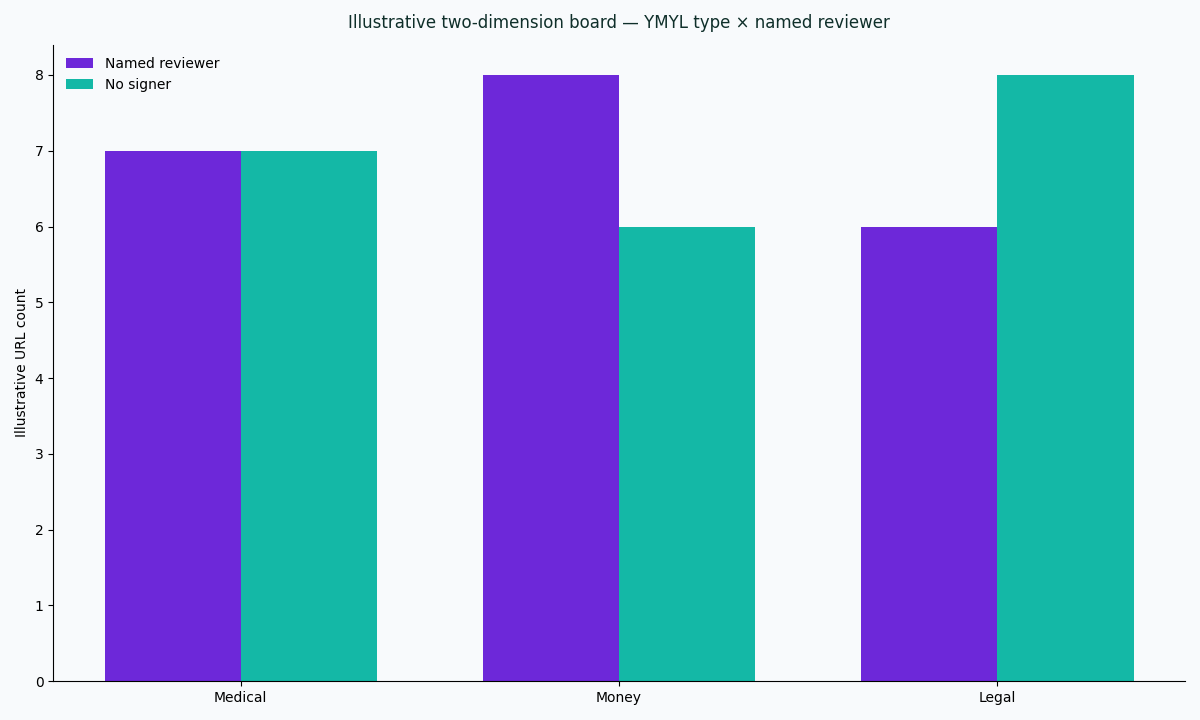
Figure: Engineering H3s are present. Medical and finance specialist rows stay absent. The PDF bar is bytes, not a grade. This first-party chart is the 2026-09-14 named reviewer on YMYL grid.
The SEC about page and the CFPB about us page are accountability homes we point at when a money URL hides the signer. They do not appear on our editorial H3 list.
What the 8.2MB PDF is
The raterhub file answered 200. We recorded bytes. We did not claim we read all 8.2MB as a score. A named reviewer on YMYL memo that treats a PDF 200 as “we applied the guidelines” is inventing a read.
FDA how to evaluate health information and Investor.gov alerts are consumer starting points on other hosts. They are not our tool copy.
How to reproduce the editorial read
curl -sS -A 'InfiniSynapse-SH67-desk/2026-09-14' --compressed \
  -o /tmp/editorial.html \
  -w '%{http_code} %{size_download}\n' \
  https://infinisynapse.com/en/editorial-standards
Expect the H3 set we listed unless the page changed. Do not paste a clinician name that is not on the HTML. named reviewer on YMYL reproduction stops at the strings we can quote.
On this editorial desk the pin is infinitegrowth@0.1.1 and -V printed 0.1.0. No signed-in eeat or aivisibility run. Unauthorized is login failure, not a Google EEAT verdict. CLI check exit 0 is not a page pass.
Limits that stay on the H3 packet
No WordPress install. No Shopify merchant. No featured-snippet SERP row. No customer EEAT score. These tool URLs carry no YMYL medical or finance advice. Empty alt="" on footer social icons is counted as missing by the CLI; editorial HTML had 4/5 images missing alt in the check warning. That is an image-attribute row, not a clinician. A named reviewer on YMYL packet records those LIMIT rows as empty.
The FTC’s guidance on endorsements, influencers, and reviews is advertising hygiene when a money URL treats a nameless “expert review” as enough. If you present a review, name the reviewer. That habit is not a ranking API.
When and how the person tested belongs on EEAT date and method. Stay here when named reviewer on YMYL is the missing signer.
What a later advice URL still needs
A URL that actually gives medical, money, or legal advice. A person whose published role matches that claim. A review date. A corrections route. named reviewer on YMYL fails when the brief puts a doctor on a title-checker.
Role cards are not licenses
Analytics engineering reviewer, Data platform reviewer, LLM security reviewer, and Editor are the H3 role strings we saw. They match engineering and editorial work. They do not match diagnosis, household finance products, or filings.
Sample-size limit
One editorial HTML and one PDF 200 cannot establish how Google raters would score a health publisher, and they do not prove this host publishes YMYL advice. As of 2026 this host is not a YMYL medical publisher. That limit is why named reviewer on YMYL refuses a doctor badge here.
Failure modes that invent a clinician
Printed “medically reviewed” with no person. That is a slogan.
Used a stock clinician photo as the signer. An image is not a review line.
Treated H3 role cards as clinical credentials. They are engineering and editorial labels.
Treated YMYL count 0 as “we passed YMYL.” The string is absent because the page does not write it.
Treated the 8.2MB PDF 200 as a completed read. Bytes are not a score.
Advertised unauthorized eeat as a Google hold. Login failed.
Advertised check exit 0 as compliance. Lights are not a verdict.
A named reviewer on YMYL memo that skips the H3 transcript is already late.
How a reviewer should read the H3 list
Start with the editorial H1: “About the research desk & editorial standards.” Then read the H3s we listed. Write each string on its own line. Do not collapse them into “the team.” named reviewer on YMYL that summarizes “experts reviewed this” will lose the only evidence we have.
Count the YMYL token. We counted 0. If a later fetch finds the string, start a new desk. If it remains 0, do not write YMYL into the ticket as if the page claimed that category.
Read the eeat CLI row next. Exit 1, 28 bytes, unauthorized. That is a login wall. It is not “Google said we lack EEAT.” A later signed-in run, if it happens, gets its own taskId. Quotes of scores[] without that id are fiction.
Read the raterhub row last. HTTP 200. 8.2MB. Store the status and the byte count. Do not claim a guideline score unless a human actually read the relevant section and quotes it. We did not do that read on this desk.
The title-checker live title in this packet is 44 characters and CLI-good. That page audits titles. It does not prescribe drugs or returns. Do not attach a medical byline to make it look more trustworthy. named reviewer on YMYL that inflates a tool page into advice is the failure this article exists to stop.
If legal asks whether we “have YMYL reviewers,” the accurate answer is: the editorial URL names engineering and editorial H3s and never writes YMYL, and these tool URLs are not medical or finance advice. Anything stronger is a different host with different claims.
Two people repeating the compressed fetch should see the same H3 class unless the editorial page changed. Store the user-agent. named reviewer on YMYL that uses a cached marketing PDF instead of the live HTML will drift.
What stays on disk after this desk
Keep the editorial HTML, the H3 transcript, the YMYL count 0 line, the unauthorized eeat line, and the raterhub status-plus-bytes line. That is the 2026-09-14 named reviewer on YMYL packet. Do not add a doctor byline to look complete.
Print the package pin beside the empty named reviewer on YMYL clinician note: infinitegrowth@0.1.1 and -V = 0.1.0.
A reviewer who needs a punch list can still run seo-health check on the editorial URL. Expect a 61-character title warning and missing-alt counts. named reviewer on YMYL does not promote those lights into a Google or clinical score.
Store the LIMIT list beside the H3 table: no signed-in eeat; no customer score; no medical advice on these tool URLs; CLI exit 0 is not a pass; empty footer alt="" is an image warning.
The decision this page supports is narrow: refuse a clinical byline on a tool or editorial URL that does not give that advice. named reviewer on YMYL does not decide whether to hire a clinician for a different product. Those decisions need a URL that actually publishes advice.
If the H3 list is unchanged next quarter, republish it with a new fetch date. Do not backfill a doctor.
Write the H3s in the ticket subject
Subject lines that say “YMYL review done” hide the zero count. Use “editorial H3s; YMYL token 0” instead. Tickets with vague subjects get filled with implied clinicians.
If marketing wants a medical badge on a title-checker, refuse it.
Nearby guides
Signer refuses live on cannot score EEAT. This page owns H3 identity versus advice scope.
| Job | Guide |
|---|---|
| Local person per locale | EEAT for multilingual sites |
| When and how you tested | EEAT date and method |
| Category definition | E-E-A-T SEO |
The EEAT checker still owns the signed-in product story. How to improve EEAT keeps the punch list after a real score, not after an H3. named reviewer on YMYL stays on the H3 transcript and the missing clinician.
Read the H3 names; do not invent YMYL
Transcribe the editorial H3s. Count the YMYL token. These tool URLs are not medical advice. Do not attach a doctor byline to a title-checker.
Open the cannot-score hubFrequently Asked Questions
Does a brand footer count as a review?
No. A footer is a slogan. A named reviewer on YMYL is a person plus a role on the URL a visitor can inspect.
Do the editorial H3s make this host a medical publisher?
No. The H3s name engineering and editorial roles. A named reviewer on YMYL read on this host stays non-clinical.
Did we apply the raterhub PDF as a score?
No. We stored HTTP 200 and 8.2MB. A named reviewer on YMYL memo does not treat that fetch as a completed read.
May we put a doctor byline on the title-checker?
No. That page audits titles. named reviewer on YMYL does not decorate a tool with a clinical name.
Does unauthorized eeat mean Google rejected us?
No. Login failed. It is not a Google EEAT verdict. named reviewer on YMYL does not promote unauthorized into a hold.
Conclusion
Use named reviewer on YMYL when the job is to refuse a clinical byline until the URL actually gives advice and names a relevant person. This 2026-09-14 pass recorded editorial H3s, YMYL count 0, unauthorized eeat, and a PDF 200 we did not read as a score. Stop when those strings remain visible. A bounded H3 transcript beats an unsupported doctor badge.
A named H3 is not a clinical credential; do not put a doctor byline on a title-checker.
William Zhu · Cofounder, InfiniSynapse · GitHub @allwefantasy
Desk-validated SEO Health methods. Corrections: zhuhl@infinisynapse.com · corrections policy.