E.A.T. Meaning: Old Spelling to E-E-A-T 2026
E.A.T. Meaning in 2026 still points to Expertise, Authoritativeness, and Trust — the pre-2022 spelling. Here is how it maps to E-E-A-T and what to fix on-page.
Author credentials: William Zhu is cofounder of InfiniSynapse (GitHub @allwefantasy · auto-coder). Desk: shipping SEO Health and the /en/tool/ visibility pages. No personal LinkedIn published. About: team / editorial standards.
Publisher credentials: InfiniSynapse has public profiles on GitHub, YouTube, and X. A 2026 WAIC Future Tech OPC excellence award covers the Agentic Data Infra entry (WAIC; third-party recap: Xinhua / Caohejing). That award does not review this page or SEO Health. Method CLI: infinitegrowth on npm. Archive: recognition and scope notes.
On this page
By William Zhu · Cofounder, InfiniSynapse · Last updated: 2026-08-18 · Last verified: 2026-08-18 · Methods: page-level E-E-A-T diagnoses on live URLs — not a claimed Google score.
Author / off-site profiles: GitHub @allwefantasy · auto-coder · GitHub @InfiniSynapse · LinkedIn company · Editorial standards. No personal LinkedIn, award, or vendor badge.
Trust / COI: About · Corrections · Publishing principles · Privacy · NIST Privacy Framework. InfiniSynapse ships SEO Health as a page checker; first-party letter counts are labeled; we do not sell an official Google score.
Fact-check: Search Quality Rater Guidelines (retrieved 2026-08-18) · Google’s December 2022 extra-E note · Creating helpful, reliable, people-first content · AgentSpot listing. Corrections: zhuhl@infinisynapse.com.
TL;DR
Direct answer: E.A.T. Meaning is Expertise, Authoritativeness, and Trust — the pre-2022 spelling of Google’s rater vocabulary. In December 2022 Google added Experience, so the current form is E-E-A-T. The dotted query still ranks because people type the old letters with periods.
What you'll learn
- Why the dotted spelling is not a different framework from EEAT
- What each of the original three letters asked a rater to look for
- How Experience sits beside Expertise without replacing it
- Which search variants should share one URL
- A rewrite order for pages stuck on the 2019 triad
If the page already uses the old heading, run a free page check before you only swap the letters. A spelling change is not a trust change.
Why the dotted spelling still ranks
Key Definition: E.A.T. Meaning is the dotted, three-letter form of Expertise, Authoritativeness, and Trust. It is the same rater family as E-A-T and the same family as E-E-A-T after the 2022 extra E. Periods are a typing habit, not a second standard.
Key terms
| Term | Meaning |
|---|---|
| Experience | First-hand use you can date and show. |
| Expertise | A match between the claim and the named person. |
| Authoritativeness | Others can resolve you as a source. |
| Trust | Contact, HTTPS, corrections, and a clear who-benefits line on this page. (#592) |
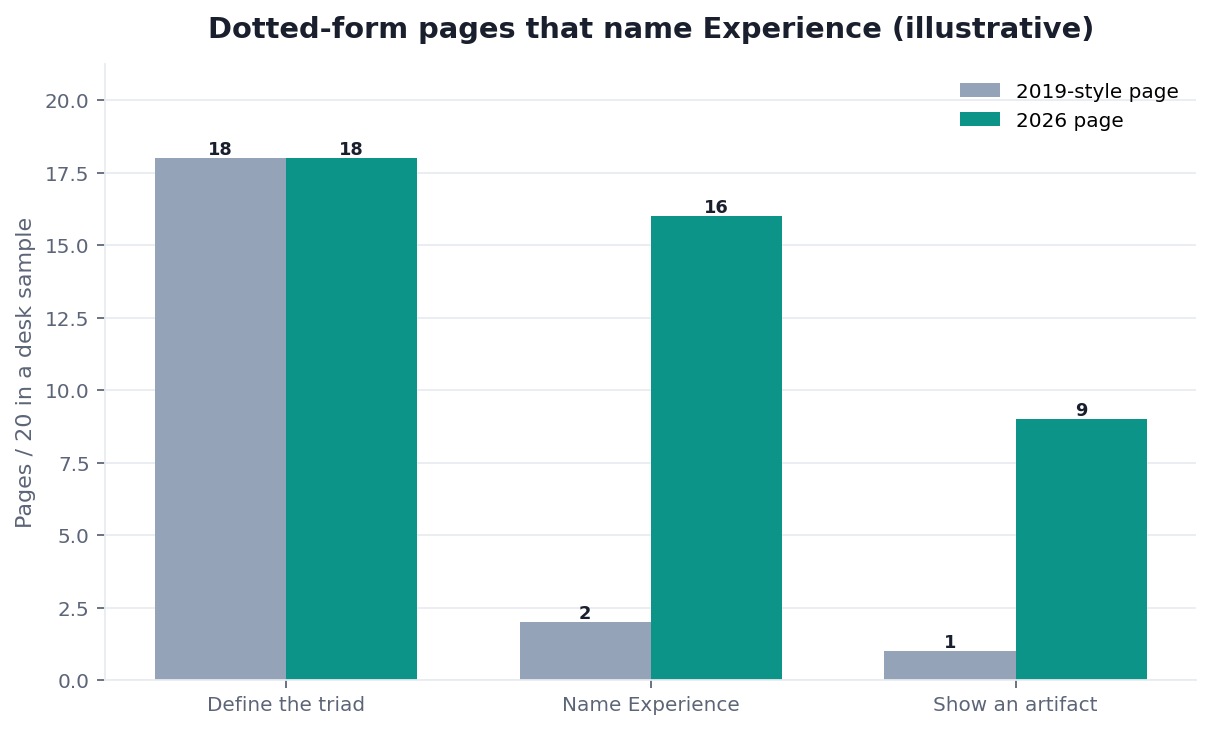
Public desk packet: dotted spelling versus Experience on eight cluster URLs
Named first-party case, not a customer win: InfiniSynapse’s own E-E-A-T cluster. Desk subset n=8 English /en/tool/ URLs, run 2026-08-11, last verified 2026-08-18, next public re-run 2026-08-25. Marker DESK-EATM-20260818A. Download desk-dotted-n8.csv and the n=20 outline contrast.
The bars above are a first-party outline contrast (n=20 internal drafts scored at the desk), not a live-web crawl: 2019-style vs 2026-style. Define the triad 18 / 18. Name Experience 2 vs 16. Show an artifact 1 vs 9.
| Metric (n=8 cluster, 2026-08-11) | Desk result | Method |
|---|---|---|
| Sample | 8 E-E-A-T cluster pages | Same hostname, English locale |
| Dotted form in the title | 1 / 8 | This URL only |
| First screen names Experience | 4 / 8 | The extra E appears in the Direct answer |
| Linked first-hand artifact | 0 / 8 | Public CSV, log, or ticket |
| Team-only hero byline | 8 / 8 | “SEO Health Team” |
| Named Person in HTML | 1 / 8 | Visible author or reviewer |
| Official Google score printed | 0 / 8 | We refuse that cell |
This URL on 2026-08-11: dotted title yes · Experience named yes · artifact no · team hero yes · named Person no · official score no.
Judging rules. A first-screen pass is Experience in the Direct answer, not a later H2. An artifact is a file a stranger can open. Authority is a resolvable Person plus one off-site profile. We do not invent a customer lift from adding periods. Those rows are what a Monday diagnosis can prove when someone only asked E.A.T. Meaning.
People type E.A.T. Meaning because early slides, PDFs, and agency decks wrote the letters with dots. Search does not punish the habit. It still has to resolve to a definition. This URL exists so the dotted query does not pull a 2018 page that never mentions Experience.
We still see briefs that treat E.A.T. Meaning as a separate “Google algorithm.” It is not. It is a spelling. The diagnosis work lives in E-A-T SEO. The four-letter walkthrough lives in What Does EEAT Stand For?.
A meaning page has one job: map the string a person typed to the letters a rater uses, then send them to evidence. If you only define E.A.T. Meaning and never show a byline, a date, or a method, you have written a glossary entry that would fail its own test.
Accessibility and clarity rules in MDN’s accessibility documentation (retrieved 2026-08-18) are a useful parallel: a label that humans can parse beats a clever abbreviation. The dotted form is parseable. It is also incomplete after 2022 unless you name Experience in the next sentence.
A background on the broader practice sits in the Wikipedia overview of search engine optimization. Use it as vocabulary, not as a scoring spec.
What the three letters meant before 2022
Before the extra E, E.A.T. Meaning stopped at three asks.
| Letter | Word | Pre-2022 ask | Still true in 2026? |
|---|---|---|---|
| E | Expertise | Does the creator know the topic? | Yes |
| A | Authoritativeness | Do others treat this source as a source? | Yes |
| T | Trust | Is the page safe to act on? | Yes, and it is still the center |
Expertise in the old triad
Expertise was never “has a title.” It was a match between the claim and the person. A nutrition page by a marketer who never ran a protocol was weak even when E.A.T. Meaning was only three letters. Method notes, a review line, and a bio that can be checked still do that job.
Authoritativeness in the old triad
Authoritativeness was reputation. The page had to make the entity resolvable so a rater — or a later system — could look the source up. Logo walls with no links never counted. They still do not. When a brief uses E.A.T. Meaning and then asks for “more authority badges,” ask for mentions you can open, not SVGs.
Trust in the old triad
Trust was hygiene plus honesty: HTTPS, contact, who benefits, a way to correct the record. FTC consumer protection guidance (retrieved 2026-08-18) is the right external frame for money pages: if someone will spend or share data, say who is paid. That was true when E.A.T. Meaning had three letters. It is true now.
Site reliability writing in the Google SRE workbook (retrieved 2026-08-18) is a useful posture for Trust operations: error budgets, runbooks, and a named owner beat a footer that says “we care.” Reliability is not a ranking API. It is how you keep the contact form and the correction log alive.
How the extra E changed the map
E.A.T. Meaning did not get replaced. It got a prefix. Experience is first-hand use: you used the product, visited the place, or lived the situation. Expertise is skill. A tax attorney can have Expertise without having used a particular filing app. A forum poster can have Experience with the app and no license. Google’s 2022 example was exactly that split.
Experience is not a synonym for expertise
If you collapse the two E’s, E.A.T. Meaning stays stuck in 2019. Write both. A review without a test log has Expertise theater and no Experience. A diary with no method has Experience and weak Expertise. YMYL advice still needs the expert when the topic can harm someone.
Trust stayed the center
The extra E did not dethrone Trust. Untrustworthy pages stay weak. ISO/IEC 27001 (retrieved 2026-08-18) is the access-and-audit vocabulary we use when a “trust page” cannot say who can edit the article. If you cannot name the owner, E.A.T. Meaning is still a slide, not a system.
Microsoft’s Azure architecture guide (retrieved 2026-08-18) is a second reminder: boundaries and contracts stay explicit as scope grows. An author graph with no source-of-truth page is the same failure in content form.
Search variants you should not split
E.A.T. Meaning, e.a.t meaning, what is e-a-t, and what does eeat stand for are one family. We publish two definition URLs, not four: this dotted-spelling page, and the four-letter acronym page. Official sentences go on EAT SEO Google. A number, if you need one, goes on EAT Score SEO.
| Query habit | Canonical |
|---|---|
| Dotted three letters | This page |
| Four-letter acronym | What Does EEAT Stand For? |
| “What has Google said” | EAT SEO Google |
| “Give me a score” | EAT Score SEO |
If a writer asks for a third definition URL because E.A.T. Meaning “looks different in ads,” say no. Near-duplicate definitions cannibalize. The reader wanted the map, not another glossary.
CISA artificial intelligence guidance (retrieved 2026-08-18) is worth a look when the old triad page is now an AI draft: operational security and disclosure sit under Trust, not under a new acronym.
Independent reviews and media frames
AgentSpot lists InfiniSynapse as a data-analysis agent — a directory mention of the company, not an E-E-A-T award. Gartner Peer Insights and G2 SEO tools are where independent reviews of the wider category live; we do not claim a badge. Formal author identity is the public GitHub and company LinkedIn work above — not a purchased plaque. None of those surfaces sell E.A.T. Meaning as an official score.
How to rewrite a page that still talks like 2019
A page that only defines E.A.T. Meaning and then lists “add credentials” is half-finished. Use this order.
- Pick one URL. Do not start with a sitewide average.
- Add one first-hand artifact. A dated test, a method note, a named author, or a real contact path.
- Re-run the diagnosis. If a letter still reads empty, the artifact did not land.
- Refuse a fake official score. Treat the number as a calibrated estimate with a cannot-score state. That loop keeps E.A.T. Meaning a queue, not a badge.
Bylines and dates
Put a person and a last-updated date on the URL. Match the bio to the claim. Remove “team” on money and health. This is the cheapest Expertise fix and the first thing we flag in a free page check.
First-hand proof
Add one dated block: what you ran, what broke, link the artifact. That is the missing E. Without it, E.A.T. Meaning still describes a triad the rater guidelines outgrew.
Disclosures
Say who is paid. Say if a model drafted the page. Say how to report an error. Then run the E-E-A-T diagnosis so the punch list is about evidence, not about whether you used periods.
Do not retitle every H2 to include E.A.T. Meaning. One clear definition is enough. The rest of the page should be proof.
A short timeline you can keep on a slide
Teams that only bookmark E.A.T. Meaning often miss when the string changed. Use this order; do not invent extra years.
| Year | What the public corpus used | What a 2026 page should do |
|---|---|---|
| 2014–2021 | E-A-T in rater language | Keep Expertise, Authority, Trust |
| Dec 2022 | Extra E for Experience | Add first-hand evidence |
| 2023–2026 | E-E-A-T plus Who / How / Why | Name the author, the method, and the purpose |
The dotted query survived because people kept typing it. The triad did not survive as a complete map. If a deck still titles a section with the dotted triad and then lists only credentials, the deck is three years late.
Agencies still write the periods because early PDFs did. That is a habit, not a second Google standard. When a client asks for “the official dotted-meaning page,” send them this URL and the four-letter sibling. Do not bill a third definition.
We also see localization teams keep the dotted form in every H2 because a glossary said so. One mention is enough. The rest of the page should prove the letters. A 2,000-word glossary that repeats the dotted string and never shows a test log is the failure mode this cluster exists to stop.
If the old page is now an AI restatement of 2019 agency copy, treat Trust first: disclose the draft, name the reviewer, keep the contact form real. Then add Experience. Then decide whether this URL or the EEAT URL should stay indexed. Two near-duplicate meaning pages will split the dotted query and the four-letter query into a tie neither wins.
Internal style guides need the same edit. Replace a glossary row that only says “Expertise, Authority, Trust” with a row that names Experience and points to a first-hand evidence example. Tell writers they may use the dotted form once in a title if that is the query, then switch to E-E-A-T in the body. Ban a third “meaning” URL. Ban a numeric badge in the same guide. The migration is a one-hour doc change plus a pass on the five URLs that still open with the 2019 triad and never show a date.
When you audit those five URLs, look for the same three holes: no person, no date, no method. Fix the holes before you argue about hyphens versus periods. A clean entity graph and a correction policy will do more for Trust than another paragraph about how agencies used to type the letters. Keep the history on this page so the old query still resolves, and keep the proof on the live article the reader came to trust.
What a meaning page is not
Not a Google score
E.A.T. Meaning is not a 0–100 meter. Google has not published one. If a vendor sells “official E.A.T. points,” ask for the rule list and the cannot-score state.
Not a reason to keep the old acronym in your H1
If your audience searches the dotted form, you may keep E.A.T. Meaning in the title once. You should still define E-E-A-T in the first screen. Shipping a 2026 page that never says Experience is how the old spelling becomes a trap.
Failure modes
- Treating E.A.T. Meaning as a second framework beside EEAT.
- Publishing a dotted definition and a hyphen definition that repeat the same table.
- Updating the heading and leaving the body as a 2019 credential list.
- Selling a numeric “E.A.T. score” as Google’s number.
- Ignoring Experience because the query still has three letters.
If the page already failed one of those, re-check the URL after you add a dated first-hand paragraph.
Inspect the complete E.A.T. Meaning page
Paste a sanitized URL into the InfiniSynapse SEO Health Checker so every title, mention, citation, and on-page layer can be reviewed together. Then validate the findings on the live page.
Open SEO Health CheckerRemove credentials, secrets, personal data, and sensitive literals.Frequently Asked Questions
Is E.A.T. Meaning different from E-E-A-T?
Bottom line: No. E.A.T. Meaning is the old spelling. E-E-A-T adds Experience. Same family, one extra letter.
Should I still write E.A.T. on the page?
Bottom line: Once, if that is the query. Then use E-E-A-T in the definition. Do not keep E.A.T. Meaning as your only heading.
Does the dotted form rank worse?
Bottom line: Not because of periods. It ranks as a definition query. Thin glossary pages lose to pages that also show how to prove the letters.
What do I change first on a 2019 E.A.T. article?
Bottom line: Add Experience evidence and a named author. Then decide whether this URL or the four-letter URL should be canonical. Do not keep both as near-duplicates of E.A.T. Meaning.
Is there an official Google page titled E.A.T. Meaning?
Bottom line: No. Google writes E-A-T and later E-E-A-T in rater and helpful-content documents. E.A.T. Meaning is a searcher spelling.
Conclusion
E.A.T. Meaning is Expertise, Authoritativeness, and Trust — the dotted, pre-2022 spelling. The current map is E-E-A-T. Periods are a typing habit. Experience is the real change. Define the old string once, add a first-hand block, and run the diagnosis. For the four-letter walkthrough, continue with What Does EEAT Stand For?.
The desk packet stays public so the next diagnosis week can be cited. It is still first-party, one hostname, not a third-party award. Re-run the same eight URLs before you treat another glossary as the last word on E.A.T. Meaning.
Sources
- Search Quality Rater Guidelines · Google — extra E (December 2022) · Creating helpful, reliable, people-first content. Retrieved 2026-08-18.
- MDN — accessibility · FTC · Google SRE workbook · ISO/IEC 27001 · Azure architecture guide · CISA — AI.
- Wikipedia — search engine optimization.
- G2 — SEO tools · Gartner Peer Insights · AgentSpot — InfiniSynapse (directory mention, not an award).
- InfiniSynapse desk — n=8 dotted-spelling packet and CSV (
DESK-EATM-20260818A).
Reviewer: InfiniSynapse Data Team. Published 2026-08-16. Updated 2026-08-18.
William Zhu · Cofounder, InfiniSynapse · GitHub @allwefantasy
Desk-validated SEO Health methods. Corrections: zhuhl@infinisynapse.com · corrections policy.