SEO vs GEO vs AEO (2026): Which Layer First
SEO vs GEO vs AEO (2026): which layer first — ranked results, answer blocks, or citations. Includes aeo vs geo and seo vs aeo.
Author credentials: William Zhu is cofounder of InfiniSynapse (GitHub @allwefantasy · auto-coder). Desk: shipping SEO Health and the /en/tool/ visibility pages. No personal LinkedIn published. About: team / editorial standards.
Publisher credentials: InfiniSynapse has public profiles on GitHub, YouTube, and X. A 2026 WAIC Future Tech OPC excellence award covers the Agentic Data Infra entry (WAIC; third-party recap: Xinhua / Caohejing). That award does not review this page or SEO Health. Method CLI: infinitegrowth on npm. Archive: recognition and scope notes.
On this page
By the SEO Health Team · Last updated: 2026-09-14 · We build the SEO Health checker at infinitegrowth.agency. Methods below come from the product’s page audits, sitemap samples, and GSC export math — not from a claimed Google score.
TL;DR
Direct answer: SEO vs GEO vs AEO is a three-layer decision, not a winner-take-all fight. SEO makes a URL eligible and useful in ranked results. GEO makes the same URL extractable and citable inside a model-written answer. AEO makes a passage selectable as the answer block on a search page. Do the layer the query actually uses.
What you'll learn
- A 41-word definition of SEO vs GEO vs AEO you can quote
- A three-column table for query class, owner, and first edit
- When to run SEO first, when to shape an answer, when to chase citability
- Why aeo vs geo, geo vs aeo, seo vs aeo, and “aeo geo” collapse into this page
- How we check a URL without inventing a citation percentage
If you already have a money URL, run a free page check then add the AI visibility pass. Do not pick a layer from a vendor doughnut.
The three layers
Key Definition: SEO vs GEO vs AEO compares three retrieval layers on one URL: ranked-list eligibility, citability inside a generated answer, and selection as an answer-shaped block in search. Teams that merge the layers buy one tool and lose two surfaces.
Quick answer: SEO vs GEO vs AEO is a three-layer decision, not a winner-take-all fight. SEO makes a URL eligible and useful in ranked results. GEO makes the same URL extractable and citable inside a model-written answer. AEO makes a passage selectable as the answer block on a search page. Key terms
| Term | Meaning |
|---|---|
| GEO | Making a passage liftable into a generated answer. |
| SEO | Making a URL eligible and clear in classic retrieval. |
| AEO | The same extractability job under an answer-engine label. |
| Extractable block | A short definition, named entity, or dated fact this page can lift. (#544) |
People type SEO vs GEO vs AEO when the pair is not enough. The pair is defined in what is GEO vs SEO. The operating hub is GEO vs SEO. This page is the decision table. We will not repeat the 90-day roadmap.
The category name for the citation job is generative engine optimization. Keep that page for the noun. Stay here for which layer this quarter.
Wikipedia’s overview of question answering is the older name for the AEO job: return an answer, not a list of documents. SEO vs GEO vs AEO adds a third surface that Wikipedia’s classic QA page did not have to name — a model that writes a paragraph and may cite you, or may not.
SEO
SEO is eligibility plus usefulness in ranked results. Crawl, index, title, headings, internal links, a canonical you meant, and a page that matches the query it already earns. SEO vs GEO vs AEO still starts here on almost every money URL. A page that robots cannot fetch cannot be an answer block and cannot be cited.
GEO
GEO is extractability plus citability inside ChatGPT, Perplexity, Gemini, and similar answer engines. It needs a standalone 40–50 word claim, a resolvable entity, dated evidence, and crawlers you did not block. SEO vs GEO vs AEO fails on this layer when the page ranks and the answer names a publisher that copied you. The citation pass itself is how to get cited by ChatGPT.
AEO
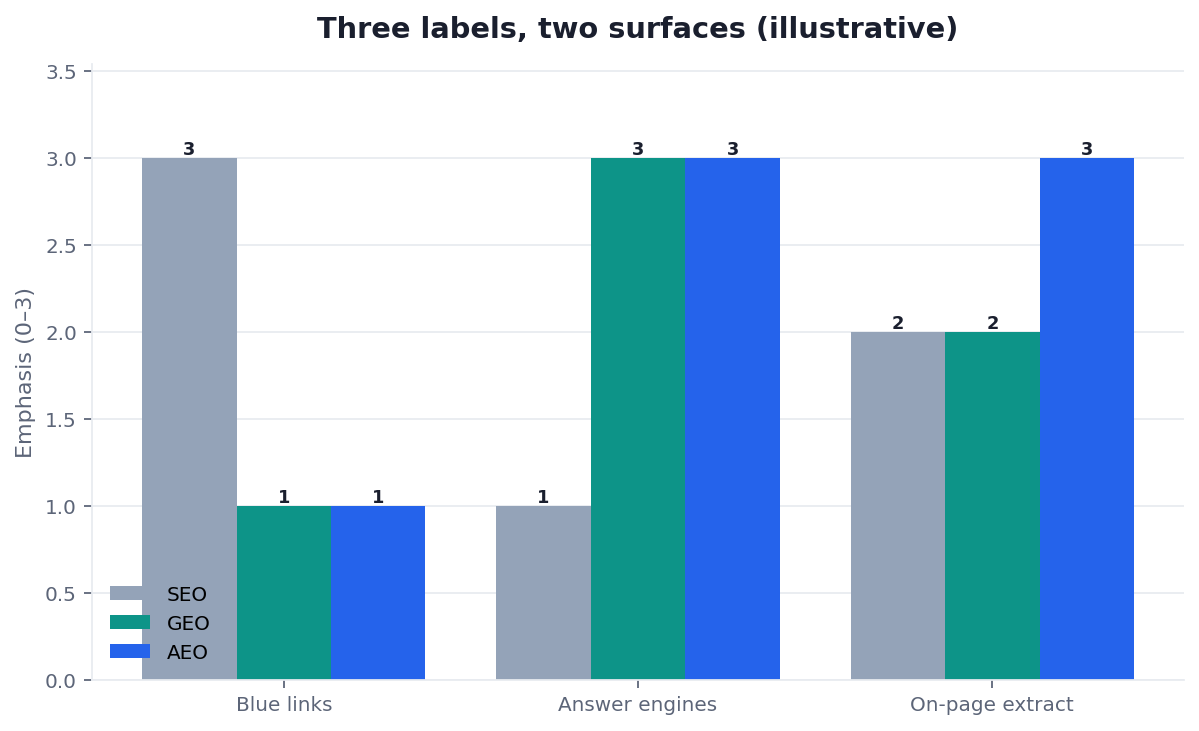
AEO is answer-shaped retrieval inside search: featured snippets, People Also Ask, and AI Overviews. The raw material looks like GEO — a closed paragraph, a list, a table — but the surface is still a results page. SEO vs GEO vs AEO treats AEO as the middle layer: you already won eligibility, and you want the box, not only a blue link.
The decision table
Use this table when a stakeholder asks you to “do GEO” on every URL. SEO vs GEO vs AEO is query-class work. The class picks the layer. The layer picks the first edit.
| Query class | Example | Layer that usually wins | First edit |
|---|---|---|---|
| Navigational | brand + login | SEO | Fast, exact URL |
| Local / transactional | near me, pricing, SKU | SEO | Unique facts you can check |
| Informational definition | what is X | AEO, then GEO | 40–50 word block at the top |
| Procedural | how to do X | AEO + SEO | Numbered steps a model can quote |
| Commercial investigation | best X for Y | All three | Criteria table plus citable sources |
| Open advice | should I, what happens if | GEO | Dated first-hand constraint |
Query class
Read the query before you pick a stack. People who ask “seo vs aeo vs geo” as a binary are usually staring at a definition query and generalizing. SEO vs GEO vs AEO stays honest if you keep the class column. A login page does not need a ChatGPT program. A “what is” page that only has a product tour will lose the box and the citation.
Who owns the work
SEO work belongs to whoever already owns titles, internals, and indexation. AEO work belongs to the writer who can ship a closed paragraph. GEO work belongs to the same writer plus whoever owns robots, entity pages, and the prompt set. SEO vs GEO vs AEO retainers fail when one agency “owns AI” and never shares the URL list with the search team.
If you need software after you pick a layer, the buyer landscape is generative engine optimization tools. If you need tactics, use generative engine optimization strategies. Measurement of mentions sits in the AI visibility tool hub.
Which layer should you do first?
Sequence beats slogans. SEO vs GEO vs AEO as an operating order is eligibility, then answer shape, then citability. Skipping a layer is how you pay for a logger to watch a zero.
Start with eligibility
If the URL is noindexed, blocked, canonicalized away, or slow enough that people bounce, stop. Do not buy a GEO seat. Run the on page SEO tool pass. Bing’s webmaster guidelines still read like a shared floor: fetchable, clear, not deceptive. Google’s floor is the same idea even when the UI is an overview. SEO vs GEO vs AEO does not create a bypass around crawl.
Add answer shape
Once the URL is eligible, write the passage you want selected. A definition, a list, a table, or a short how-to. Schema.org’s FAQPage type and Google’s FAQPage structured-data documentation are the markup cousins of that passage. Markup does not invent an answer. It labels one you already wrote. SEO vs GEO vs AEO work that ships schema with no closed paragraph is theater.
Use FAQ markup only when the page is a real FAQ. Do not spray questions in the footer to “do AEO.”
Then citability
After the passage exists, ask whether an answer engine can name your URL. That is GEO: entity match, dated source, allowed crawler, author a person can resolve. SEO vs GEO vs AEO on this step is a punch list, not a rate. We diagnose missing evidence and suggest fixes. We do not output a citation percentage.
Run AI visibility on the same URL after the passage exists. If mention appears and citation does not, keep going until a URL you own is named.
SEO vs GEO vs AEO examples by query class
Take a login page, a glossary page, and a “best X for Y” comparison. On audited sites this trio shows up in the same week.
The login page is SEO only: status code, canonical, speed, exact title. Adding a 50-word manifesto does not help. SEO vs GEO vs AEO here is a one-column job.
The glossary page is AEO first: closed definition, then GEO if you want the chat citation. We still check indexation, but the first edit is the block.
The comparison page is all three: criteria table for the ranked click, the same table for the overview box, and named sources for the generated answer. Do not start that URL in a mention logger.
We do not publish fake lift percentages for those three. We publish the order. If your backlog ignores the order, you will rewrite the glossary title while the definition is still a slogan.
AEO vs GEO
Aeo vs geo and geo vs aeo are the same argument with the words flipped: answer block in search versus citation in a generated answer. Aeo and geo and aeo geo are people asking whether they must do both. Yes, on informational URLs. No, on a login page. SEO vs GEO vs AEO is the parent comparison that keeps SEO in the room so nobody “replaces” crawl with a chatbot.
AEO wins when the searcher stays on a results page and the engine selects a passage. GEO wins when the searcher is already inside ChatGPT, Perplexity, or Gemini and the model needs a URL it can name. Same closed paragraph. Different surface. Different owner if your search team and your “AI” team still do not share a URL list.
If you only needed the two-job quote, stay on the short definition. If you needed the dual-engine workflow, stay on the hub. Stay here when the fight is which layer this quarter.
SEO vs AEO
SEO vs AEO is not a second pair page and not a GEO-vs-SEO rematch. SEO is eligibility in the ranked list. AEO is selection as the answer-shaped block on that same results page. You can rank at position four and still lose the snippet. You can win the box and still lose the click if the URL is slow or the title lies.
Do not open a new brief for seo vs aeo. Use this table. Navigational and transactional URLs stay on SEO. Definition and how-to URLs add AEO after crawl works. SEO vs GEO vs AEO only adds the third column when a generated answer can name you. If someone asks you to “replace SEO with AEO,” they are asking you to skip eligibility. We will not.
Phrase variants that mean this table
Search logs split the same decision across five strings. This URL covers them so we do not ship five near-duplicate pages.
Word order does not create a new job. seo vs aeo vs geo, geo vs aeo vs seo, and aeo vs seo vs geo are the same three columns. Keep one canonical. If a slide uses a different order, map it back to eligibility, answer shape, then citability.
How do you measure without a fake citation score?
SEO vs GEO vs AEO has three checks, not one percentage. SEO: fetch, index, and the query the URL already earns. AEO: whether a closed paragraph exists and whether Search Console shows an answer-shaped impression. GEO: whether a locked prompt names a URL you control.
That GEO check is a GEO audit: definition, entity, crawler, dated evidence, byline. Mentions without a URL stay in the AI visibility tool log. We do not print a citation percentage the model never logged. If a vendor shows three layer scores from one doughnut, walk away.
Sample the URL after you add one closed paragraph, not after you only change the H1.
Where do AI Overviews sit?
AI Overviews are AEO on a results page, not a fourth layer. The eligibility punch list — extract, heading, schema match, crawler — lives on AI Overviews optimization. SEO vs GEO vs AEO only decides whether this URL should chase the box this quarter. Do not buy an Overview logger before the URL is eligible and the passage exists.
What should an AEO/GEO retainer name?
Agencies will sell “AEO/GEO retainers.” Ask which column they will edit first. SEO vs GEO vs AEO as a statement of work should name URLs, query classes, and a re-run date. A slide that says “we do aeo geo” with no table is a logo wall. Sample the site on three URLs before you sign so the baseline is yours. A retainer price is not a recovery date. The AI search typical payback period depends on whether the sheet recovers CAC or cumulative program margin.
Trust is shared across columns. A page a rater would call thin should not be an answer and should not be cited. The letter-by-letter diagnosis is E-A-T SEO.
Shared raw material
The three layers share HTML you can quote. They do not share a KPI.
SPARQL 1.1 is a useful analogy, not an implementation plan: a query language fails when the data was never shaped as answers. SEO vs GEO vs AEO fails the same way when the page is a brand essay. Shape the claim, then pick the layer.
Structured questions
Write the question the searcher actually typed. Put the answer in the next sentence. That pattern serves AEO boxes and GEO extracts. It also helps a human. Do not hide the answer in a hover state.
In page audits, the cheapest win is moving a buried sentence to the top and deleting the second, contradictory sentence. Writers often keep both because one was for “SEO” and one was for “GEO.” SEO vs GEO vs AEO does not need two claims. It needs one claim that can rank, fill a box, and be cited.
If the sitemap sample shows an entire /glossary/ folder with H1s and no first-paragraph definition, fix the template once. Do not buy a third tool. If Search Console shows the folder already earning “what is” queries with impressions and no clicks, that is an AEO problem on an eligible URL. If the same folder has clicks and answers still name a competitor, that is a GEO problem. The table is the triage, not a new acronym.
Visible answers
MDN’s documentation for the details element is the right warning for “accordion everything.” A disclosure widget that keeps the definition closed can hide the extract from a simple reader and from some scrapers. If the claim matters to SEO vs GEO vs AEO, put it in open HTML first. Use details for optional asides, not for the definition you want selected.
On-page modules still apply. Title, headings, and dead links are not “old SEO.” They are layer one.
Failure modes
- Picking one winner for every query. SEO vs GEO vs AEO is a table, not a trophy.
- Schema without a passage. FAQ markup on a page with no answers.
- GEO before eligibility. Buying a logger while the URL is noindexed.
- Merging mention and citation. Celebrating a brand name while the link points elsewhere.
- Fake layer scores. A dashboard that prints three percentages the model never logged.
We do not sell a citation-percentage API. If a run cannot see enough evidence, it should say so. Re-run the checker after you add one closed paragraph, not after you only change the H1.
Inspect the complete SEO Vs GEO Vs AEO page
Paste a sanitized URL into the InfiniSynapse SEO Health Checker so every title, mention, citation, and on-page layer can be reviewed together. Then validate the findings on the live page.
Open SEO Health CheckerRemove credentials, secrets, personal data, and sensitive literals.Frequently Asked Questions
Is AEO the same as GEO?
Bottom line: No. AEO is answer-shaped retrieval inside search. GEO is citability inside a generated answer. SEO vs GEO vs AEO keeps both, plus the ranked list.
Do I pick only one layer?
Bottom line: seo vs geo vs aeo: You pick a first layer. Commercial pages often need all three. Login pages need SEO. Definition pages need AEO and GEO. The table decides, not a slogan.
Where does structured data fit?
Bottom line: It labels a passage you already wrote. It does not create the passage. Use FAQPage only on real FAQs. SEO vs GEO vs AEO work that starts with markup and no sentence is backwards.
What should I do in the first hour?
Bottom line: Pick one money URL. Add a 40–50 word definition and a real author. Confirm robots. Run the page check. Then mark the query class and the first layer.
How is this different from the hub?
Bottom line: The hub compares the pair and walks the dual-engine workflow. This page is the three-column decision. SEO vs GEO vs AEO should not clone the 90-day plan.
Is SEO vs AEO vs GEO a different comparison?
Bottom line: No. Word order does not create a new URL. seo vs aeo vs geo, geo vs aeo vs seo, and aeo vs seo vs geo are the same three layers as SEO vs GEO vs AEO.
Is SEO vs AEO its own page?
Bottom line: No. SEO vs AEO is eligibility versus the answer block on the same results page. It lives in this table. The pair workflow stays on the hub. Do not split a fourth URL.
Conclusion
SEO vs GEO vs AEO is three layers on one URL: ranked eligibility, answer-shaped selection, and generated-answer citability. Use the query-class table. Start with crawl. Add a closed paragraph. Then ask whether an answer engine can name you. Run the diagnosis on the URL you just edited. For the two-job quote, use the short definition. For the operating comparison, use the hub.
About the author — SEO Health Team. Reviewer: William Zhu (GitHub). Published 2026-08-16 and updated 2026-09-14. Credentials appear only here.
William Zhu · Cofounder, InfiniSynapse · GitHub @allwefantasy
Desk-validated SEO Health methods. Corrections: zhuhl@infinisynapse.com · corrections policy.