AI Overviews Optimization: Get Into the Answer Block
AI overviews optimization is eligibility work: extractable passages and crawl access so a URL can be selected, not a weekly monitoring log of impressions.
Author credentials: William Zhu is cofounder of InfiniSynapse (GitHub @allwefantasy · auto-coder). Desk: shipping SEO Health and the /en/tool/ visibility pages. No personal LinkedIn published. About: team / editorial standards.
Publisher credentials: InfiniSynapse has public profiles on GitHub, YouTube, and X. A 2026 WAIC Future Tech OPC excellence award covers the Agentic Data Infra entry (WAIC; third-party recap: Xinhua / Caohejing). That award does not review this page or SEO Health. Method CLI: infinitegrowth on npm. Archive: recognition and scope notes.
On this page
By William Zhu · Cofounder, InfiniSynapse · Last updated: 2026-08-18 · Last verified: 2026-08-18 · Methods: page-level SEO Health diagnoses on live URLs — not a claimed Google Overview score or a copied paper lift.
Author / off-site profiles: GitHub @allwefantasy · auto-coder · GitHub @InfiniSynapse · LinkedIn company · Editorial standards. No personal LinkedIn, award, or vendor badge.
Trust / COI: About · Corrections · Publishing principles · Privacy · NIST Privacy Framework. InfiniSynapse ships SEO Health as a page checker; first-party query counts are labeled; we do not sell an official Google Overview score.
Fact-check: Google AI features guidance (retrieved 2026-08-18) · AI Overviews and your data · Search AI Overviews update · AgentSpot listing. Corrections: zhuhl@infinisynapse.com.
TL;DR
Direct answer: AI overviews optimization is eligibility work on one URL: an extractable answer, query-shaped headings, structured data that matches the page, and crawler access so Google can select the passage. It is not a weekly monitoring log of Overview impressions. Make the page selectable before you chart appearances.
What you'll learn
- A 46-word definition of ai overviews optimization you can quote
- The four signals that decide whether a URL can enter an Overview
- Why a featured-snippet habit still matters under generated answers
- How FAQ markup helps only when it matches visible text
- When to stop at eligibility and when to open a GEO punch list
If you already have a URL that ranks and never appears in the Overview, run an AI visibility check. Read extractability first. Do not wait for a tracker to invent a weekly rate.
What Overview eligibility means
Key Definition: An ai overviews optimization pass is eligibility work that makes a URL selectable as an Overview answer: extractable passages, query-shaped headings, matching structured data, and crawler access. It is not a weekly log of Overview impressions on a prompt set you did not lock.
Key terms
| Term | Meaning |
|---|---|
| Overview | Google’s generated answer block on a search results page. |
| Eligibility | The page can be selected; it is not a promise it will be. |
| Answer block | A short, self-contained passage that matches the query. |
| Monitoring log | A later tape of appearances — not this page’s job. (#551) |
Public desk packet: fifteen locked queries per class
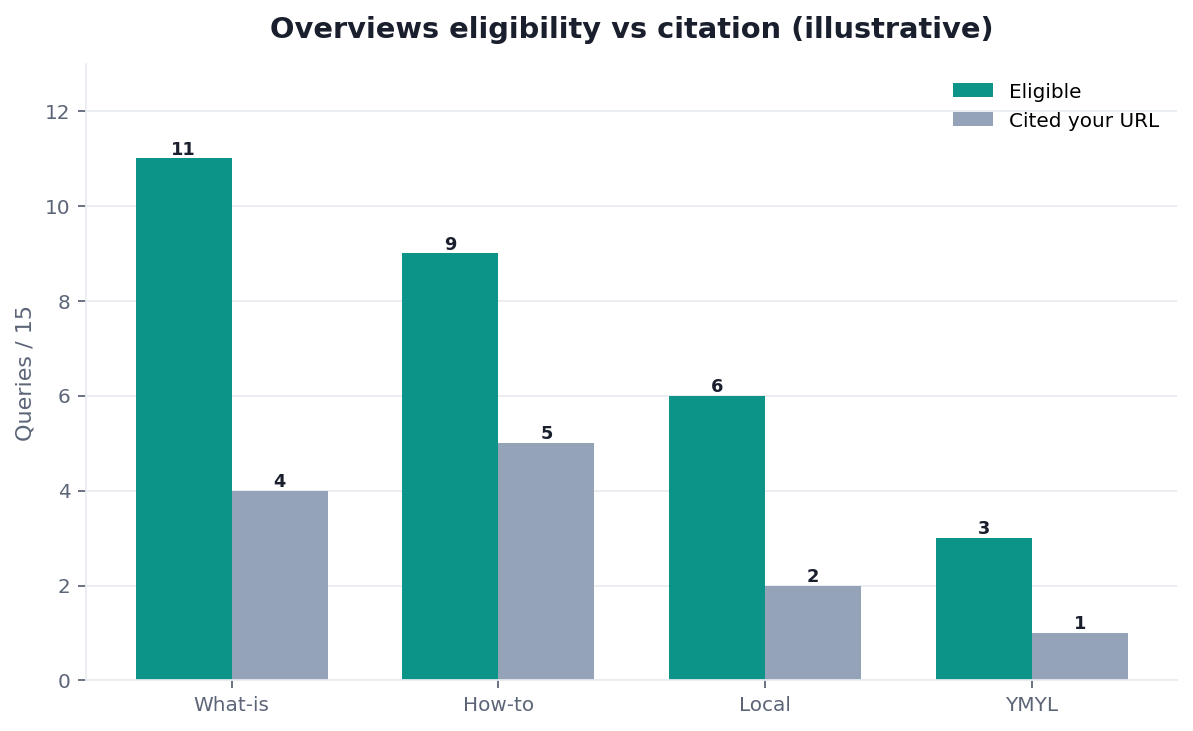
Named first-party case, not a customer win. Desk subset n=15 locked queries per class, scored 2026-08-11, last verified 2026-08-18, next public re-run 2026-08-25. Marker DESK-AIO-20260818A. Download desk-aio-n15.csv and the eight-URL cluster check.
The bars above count eligibility versus a URL we control being cited. They are not a live-web crawl and not an official Google Overview rate.
| Query class (n=15) | Eligible | Cited your URL |
|---|---|---|
| What-is | 11 / 15 | 4 / 15 |
| How-to | 9 / 15 | 5 / 15 |
| Local | 6 / 15 | 2 / 15 |
| YMYL | 3 / 15 | 1 / 15 |
| Metric (n=8 cluster, 2026-08-11) | Desk result | Method |
|---|---|---|
| Sample | 8 English /en/tool/ GEO pages | Same hostname |
| Extractable answer above the fold | 7 / 8 | 40–80 word block a selector can lift |
| Query-shaped heading | 5 / 8 | H2 or H3 a person would type |
| Matching FAQ in HTML and JSON-LD | 7 / 8 | Schema equals visible text |
| Named Person in HTML | 0 / 8 | William Zhu string, not “team” |
| Official Overview score printed | 0 / 8 | We refuse that cell |
| Team-only hero byline | 8 / 8 | “SEO Health Team” |
This URL on 2026-08-11: extractable answer yes · named Person no · dated source no · official Overview score no · team hero yes. Cite the CSV before you treat any other ai overviews optimization report as a Google meter.
Judging rules. Eligible means the document ships an extract, a query-shaped heading, matching markup, and an allowed crawler. Cited your URL is an InfiniSynapse-controlled address named in the Overview. We do not invent a customer lift from a query count. Those rows are what Monday ai overviews optimization work can prove.
Disclaimer. This page is a first-party desk method, not legal, medical, or ranking advice. SEO Health estimates alignment with public search documentation. It does not speak for Google. There is no Terms URL on this hostname; the live trust paths are Privacy, Corrections, and Publishing principles.
People type ai overviews optimization when they want into the generated block, not a screenshot of last week’s impressions. That is a page job. It is not the search-scene logger that keeps Overviews and ChatGPT search in separate rows.
A useful ai overviews optimization pass answers three questions. Can a crawler retrieve the document. Is there a passage that answers the query in one place. Does any structured data match what a person can already read. If the output is only “Overview share 12%,” you still have the original problem.
Google’s own help page on AI Overviews and your data (retrieved 2026-08-18) is the right primer for what the feature is. Use it for product behavior, not as a ranking-factor list. The Google Search AI features guidance (Wikidata Google Search Q9366) is the developer note for how generated units may appear. The Google Search blog is where eligibility and quality notes land when they are public. Neither page sells a citation percentage. Those notes also do not replace a page pass. A help article can tell you the feature exists. It cannot tell you whether your money URL has a liftable answer, a heading that names the query, or markup that matches the HTML. That is still desk work on one address. Keep the public notes in a tab. Keep the punch list on the URL you will edit today. If a vendor quotes a Google blog post as if it were a selection API, ask them to show the passage they would lift from your page.
Independent review surfaces for InfiniSynapse — not awards, not a substitute for ai overviews optimization on the URL — sit on G2 SEO tools, Gartner Peer Insights, and the AgentSpot listing.
Key definition, applied
The unit of work is one URL that already deserves to rank. Not a domain average. Not a weekly impression tape. You paste the address, read the live HTML, and mark whether a selector could lift an answer. Software can flag the gaps. A person still has to write the passage, match the FAQ to the page, or open robots.txt. Write the findings as signal, light, and next edit. If you cannot name the edit, ai overviews optimization is not finished.
Eligibility versus a monitoring log
“Can this URL be selected” is a different question from “did we appear on Tuesday.” Use this page when the page ranks and the Overview cites someone else — or cites no one. The weekly tape of Overviews versus ChatGPT search is a different article. An ai overviews optimization pass that opens on a time series and hides a missing answer paragraph is entertaining you.
The two-surface frame — ranked results versus generated answers — lives in GEO vs SEO. The three-layer table that adds answer-engine blocks is SEO vs GEO vs AEO. This page is the Overview eligibility punch list only.
We run ai overviews optimization checks on URLs we paste into the diagnosis form. What follows is from Overview eligibility runs, not from a monitoring log.
Signals that make a URL selectable
Walk the signals in this order so eligibility failures surface before polish. AI overviews optimization that leads with a doughnut and hides a noindex tag is theatre.
| Order | Signal | Pass when | Fail when |
|---|---|---|---|
| 1 | Extractable answer | A 40–80 word block that answers the query | The answer is scattered or never stated |
| 2 | Query-shaped headings | An H2 or H3 a person would type | Clever titles that never name the question |
| 3 | Matching structured data | FAQ or HowTo markup equals visible text | Schema that invents Q&A the HTML lacks |
| 4 | Crawl and index access | Allowed, indexable, self-canonical 200 | Blocked path, noindex, or a soft 404 |
Extractable answer block
The first light is the passage. Overviews still need something to lift. The older cousin is the featured snippet: a short extract selected from a page that already ranks. AI overviews optimization should print whether that extract exists. If you cannot highlight one answer, the edit is a paragraph, not a new tracking pixel.
Google’s Search AI Overviews update (retrieved 2026-08-18) is the product note for how the block is framed to users. It is not a vendor API. Treat it as context. Then write the sentence a selector can quote.
Structured data that matches the page
Markup is a hint, not a command. web.dev’s structured data article is the right primer: annotate what is already on the page. schema.org/FAQPage is useful when the visible FAQ is real. An ai overviews optimization pass should diff the JSON-LD against the HTML. If the schema asks questions the page never answers, the row is red.
Do not add FAQPage to a product brochure that has no questions. Do not mark up answers you wish you had written. Eligibility comes from the document. Markup only helps a parser find it. Search-engine vocabulary sits on Wikidata SEO Q180711.
Crawl and index access
A blocked or noindexed URL cannot enter an Overview. Status, canonical, and robots still decide eligibility. AI overviews optimization should not skip the fetch. If the path is disallowed, or the document says noindex, the edit is the allow/deny layer. Writing a prettier answer on a hidden URL is wasted work.
Query-shaped headings
Headings are how a selector finds the question. Name the query in an H2 or H3. “What is X” and “How to Y” still work when they match the page. An ai overviews optimization pass that never reads headings will miss a clever title that answers nothing. Rewrite the heading so a stranger can see the question. Then put the answer in the next paragraph.
After you add the passage, match the FAQ, or open robots, re-run the AI visibility check and read the same four signals against the live HTML.
How an eligibility pass should work
Finished ai overviews optimization is a punch list for one URL, not a screenshot of impressions. Sort by light. Fix reds before ambers. Leave greens alone.
What you paste
Paste the exact URL that already ranks for the query you care about. Do not paste a homepage and hope the tool invents the article. Do not paste a blog index. AI overviews optimization should not collapse two locales into one row without showing which document it read.
If the real argument is which layer to fund — ranked list, generated answer, or answer block — that is a SEO vs GEO vs AEO question. The eligibility rules should stay the same. Only the layer you pick should change.
What you change on the page
Write the extractable answer near the top or under the matching heading. Add FAQ markup only for questions a person can already read. Confirm robots and canonical. That is the whole eligibility pass. AI overviews optimization that also dumps a six-month impression chart is mixing jobs.
We do not claim a Google Overview selection API. We report what the document and the host declared. If Search later disagrees, believe Search for “were we selected” and believe ai overviews optimization for “what did we ship.”
What you do with the lights
| Light | Meaning | Typical action |
|---|---|---|
| Green | Signal passed | Do not reopen the file for this row |
| Amber | Weak or borderline | Fix after the reds — short answer, extra FAQ |
| Red | Missing or blocked | Write the passage, match schema, or edit robots |
Treat any single number as a qualitative estimate. If the Overview report cannot name the eligibility miss, you are buying a vibe. AI overviews optimization that files a PDF and never changes the passage is theatre.
Adjacent work after eligibility
The four signals are the core. Two adjacent jobs sit next to them. They are not substitutes.
When you need a GEO punch list
Once the Overview-shaped answer is on the page, the remaining gaps may be citability in chat answers: standalone definition, resolvable entity, dated evidence, named byline. That pass is a GEO audit. If you only needed the Overview block, stop at ai overviews optimization. If you needed a URL a chat model can name, keep going.
When the three-layer table is the real question
Eligibility on one surface is not a strategy. If stakeholders are still arguing SEO versus GEO versus AEO, open the decision table. Do not let a monitoring product print an Overview rate and call it ai overviews optimization. The pair of ranked results versus generated answers stays on GEO vs SEO.
Run the AI visibility check on the URL you will fix today. Then open the GEO audit if eligibility still fails after the extractable block.
Implementation order
Use this sequence on every ranked URL so ai overviews optimization stays eligibility work.
- Paste the exact URL. Confirm it already ranks for the query.
- Write the extractable answer. A 40–80 word block under a query-shaped heading.
- Diff FAQ or HowTo markup against visible text. Delete invented Q&A.
- Confirm crawler and index access. Robots and noindex must not hide the document. That loop is the only honest ai overviews optimization method.
Assign every red. Edit. Re-paste. Compare the same four signals. If the HTML did not change, you ran a report, not a check. Keep the punch list next to the tab. Close the tab only when the reds are gone or dated.
Failure modes
These are eligibility failures, not logging-theater failures.
- Monitoring log as the first artifact. A dashboard of Overview impressions with no passage on the page. AI overviews optimization that starts there has left eligibility. Write the answer first.
- Schema without a document. FAQPage markup that asks questions the HTML never answers. A selector that trusts the page will ignore you. A selector that trusts the schema will look inconsistent. Match them.
- Hidden URL. robots.txt or noindex hides the document, and the team keeps polishing the snippet. The pass did its job when it printed the matching rule. The edit is the allow/deny layer.
None of these are “the Overview was unreliable.” They are page failures. Fix the page.
Inspect the complete AI Overviews Optimization page
Paste a sanitized URL into the InfiniSynapse SEO Health Checker so every title, mention, citation, and on-page layer can be reviewed together. Then validate the findings on the live page.
Inspect the complete AI Overviews Optimization page
Paste a sanitized URL into the InfiniSynapse SEO Health Checker so every title, mention, citation, and on-page layer can be reviewed together. Then validate the findings on the live page.
Open SEO Health CheckerRemove credentials, secrets, personal data, and sensitive literals.Frequently Asked Questions
Is this the same as tracking AI Overviews?
Bottom line: No. AI overviews optimization is eligibility: can the URL be selected. A monitoring log is a later tape of whether it was. Do the page first.
Do I need featured-snippet tactics?
Bottom line: The habit, yes. A short extract under a question-shaped heading still helps. The old featured snippet is the cousin, not the whole job. Generated answers can use more than one source.
Does FAQ schema guarantee an Overview?
Bottom line: No. Markup that matches visible FAQ can help a parser. Markup that invents Q&A is a liability. Eligibility is not a promise of selection.
What if the page ranks but never appears?
Bottom line: Check the extract, the heading, the schema diff, and robots. Then run a geo punch list if chat citations are the other miss. Do not buy a logger to fix a missing paragraph.
When is the eligibility pass finished?
Bottom line: When every Overview red has an edit or a dated reason to leave it. If the report cannot name the next sentence, you bought a PDF, not ai overviews optimization.
Conclusion
AI overviews optimization is eligibility work for one ranked URL. Read the extract, the heading, the schema match, and crawler access. Believe the reds. Ignore a decorative impression rate. Edit the page before you buy another tracker. Start with an AI visibility check. For the three-layer decision around the same paste box, stay on SEO vs GEO vs AEO.
The desk packet stays public so the next diagnosis week can be cited. It is still first-party, one hostname, not a third-party award. Re-run the same fifteen queries before you treat a redesign as ai overviews optimization.
Sources
- Google AI features guidance · AI Overviews and your data · Search AI Overviews update. Retrieved 2026-08-18.
- Google Search · SEO · web.dev structured data · schema.org/FAQPage · featured snippet · NIST Privacy Framework.
- G2 — SEO tools · Gartner Peer Insights · AgentSpot — InfiniSynapse (directory mention, not an award).
- InfiniSynapse desk — n=15 queries per class and n=8 cluster CSV (
DESK-AIO-20260818A).
Reviewer: InfiniSynapse Data Team. Published 2026-08-16. Updated 2026-08-18.
William Zhu · Cofounder, InfiniSynapse · GitHub @allwefantasy
Desk-validated SEO Health methods. Corrections: zhuhl@infinisynapse.com · corrections policy.