GEO Audit: Punch List, Not a Fake Citation Rate
A geo audit is a diagnosis punch list: definitions, entities, crawlers, and bylines. It refuses a fake citation percentage you cannot reproduce from prompts.
Author credentials: William Zhu is cofounder of InfiniSynapse (GitHub @allwefantasy · auto-coder). Desk: shipping SEO Health and the /en/tool/ visibility pages. No personal LinkedIn published. About: team / editorial standards.
Publisher credentials: InfiniSynapse has public profiles on GitHub, YouTube, and X. A 2026 WAIC Future Tech OPC excellence award covers the Agentic Data Infra entry (WAIC; third-party recap: Xinhua / Caohejing). That award does not review this page or SEO Health. Method CLI: infinitegrowth on npm. Archive: recognition and scope notes.
On this page
By the SEO Health Team · Last updated: 2026-08-16 · We build the SEO Health checker at infinitegrowth.agency. Methods below come from the product’s page audits, sitemap samples, and GSC export math — not from a claimed Google score.
TL;DR
Direct answer: A geo audit is a diagnosis punch list for one URL: standalone definition, resolvable entity, crawler access, dated evidence, and a named byline. It tells you what to edit so a model can extract and cite the page. It does not print a citation percentage the model never logged.
What you'll learn
- A 43-word definition of a geo audit you can quote
- The five signals a diagnosis punch list should return
- Why a citation percentage with no prompt list is decoration
- How blocked answer crawlers and “team” bylines kill citability
- When to stop at the punch list and when to open Overviews eligibility
If you already have a money URL, run an AI visibility check. Read the missing-evidence rows first. Do not wait for a vendor doughnut to invent a rate.
What a GEO audit returns
Key Definition: A geo audit is a diagnosis punch list that reports whether a URL is extractable and citable: standalone definition, resolvable entity, crawler access, dated evidence, and a named byline. It refuses a citation percentage the model never logged against a prompt you cannot inspect.
Quick answer: A geo audit is a diagnosis punch list for one URL: standalone definition, resolvable entity, crawler access, dated evidence, and a named byline. It tells you what to edit so a model can extract and cite the page. It does not print a citation percentage the model never logged. Key terms
| Term | Meaning |
|---|---|
| Extractable block | A short definition, named entity, or dated fact a model can lift. |
| Citation | A URL you control named as the source, not a brand mention. |
| Cannot-score | The honest state when the method does not apply. |
| Punch list | Signal, light, and next edit — not a vanity 100. (#550) |
People type geo audit when they want a verdict on one page: can an answer engine lift a sentence, name the entity, and point at a URL you own. That is a diagnosis job. It is not a weekly mention log and it is not a share-of-answer chart.
A useful geo audit answers three questions. Can a crawler retrieve the document. Is there a passage a model can quote without inventing glue. Is the author and the entity resolvable. If the output is only “citation rate 37%,” you still have the original problem.
The older retrieval vocabulary sits in the Wikipedia overview of information retrieval. Use it for terms — query, document, ranking — not as a 2026 citation-rate spec. Generated answers still retrieve; they just hide the ranked list.
Key definition, applied
The unit of work is one URL. Not a domain average. Not a prompt-cloud percentage. You paste the address, read the live HTML, and mark the evidence that is missing. Software can flag the gaps. A person still has to write the definition, name the author, or open robots.txt. Write the findings as signal, light, and next edit. If you cannot name the edit, the geo audit is not finished.
Audit versus mention log
“What is missing on this URL” is a different question from “did we appear in last week’s answers.” Use this page when the page ranks and still never gets cited. Return to generative engine optimization tools when you are buying a logger versus a diagnosis product. The two-surface frame around both jobs lives in GEO vs SEO. A geo audit that stops at a decorative rate and calls the brand “visible” is doing half the job.
We run a geo audit on URLs we paste into the diagnosis form. What follows is from GEO punch-list runs, not from a citation percentage we invent.
Signals you can read on the punch list
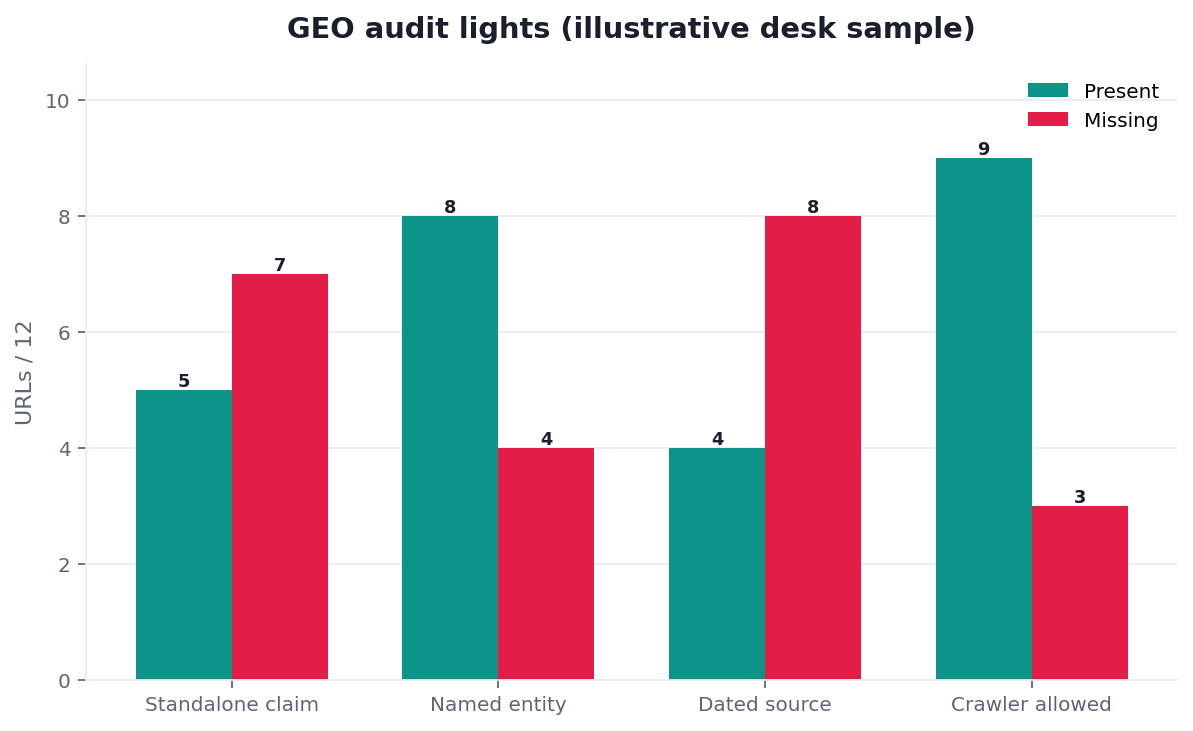
Walk the signals in this order so extractability failures surface before polish. A geo audit that opens on a citation doughnut and hides a blocked GPTBot rule is entertaining you.
| Order | Signal | Pass when | Fail when |
|---|---|---|---|
| 1 | Standalone definition | A 40–50 word block a model can lift | The page only alludes; the term is never stated |
| 2 | Resolvable entity | Named org or person with a sameAs-quality identifier | “We” and a logo, no legal name |
| 3 | Crawler access | Answer-engine bots allowed on the path | Disallow or a leftover noindex on the money URL |
| 4 | Dated evidence | Statistic or claim with a date and a source | Bare percentages with no year |
| 5 | Named byline | A person the reader can resolve | “Team” or an empty author slot |
Extractable definition
The first light is the quote-sized block. Answer engines lift short, self-contained sentences. A geo audit should print whether the page states the thing in one place, or only implies it across three H2s. If you cannot highlight a 40–50 word definition, the edit is a paragraph, not a new title.
ACM is the right reminder that computing claims need a method, not a vibe. Apply that test to the definition: can a stranger quote it without opening the rest of the page. If they cannot, keep this row red until the sentence exists.
Resolvable entity
Entity is the name a model can attach to the passage. A brand that only says “we” is a ghost. Print the legal name. Link an about or author URL a person can fetch. A geo audit that never asks “who is speaking” will green-light a brochure.
The ACM Digital Library is how researchers resolve a paper to authors and a venue. Your page needs a cheaper version of the same habit: a name, a page, a date. If the entity is a product, say the product and the company. Do not make the model guess.
Crawler and robots access
Robots is the allow/deny layer for answer engines as well as Googlebot. Google’s overview of Google crawlers is the primer for user-agent names and what each bot is for. A geo audit should match the path against robots.txt and say which answer-engine bot is blocked.
A fetch as a person can still 200. A crawler that honors Disallow will not use the document. If GPTBot, Google-Extended, or the host’s answer crawler is blocked and you want citations, the edit is the robots file, not another adjective in the H1.
Dated evidence and byline
Undated statistics are how dashboards invent authority. A geo audit should flag a percentage with no year, a “studies show” with no link, and a byline that says “team.” Brookings’ artificial intelligence topic page is the shape we want for public claims: a named institution, a date, a document a stranger can open. Your product page will not be a think-tank essay. It still needs a person and a date.
ISO’s catalog entry 81230 is the posture we want from any “GEO score”: published requirements you can audit, not a feature cartoon. If the vendor cannot show the prompt list and the refuse state, treat the number as decoration.
After you add a definition, open robots, or name the author, re-run the AI visibility check and read the same five signals against the live HTML.
How a diagnosis pass should work
A finished geo audit is a punch list for one URL, not a screenshot of a rate. Sort by light. Fix reds before ambers. Leave greens alone.
What you paste
Paste the exact money URL a model would cite: scheme, host, and path. Do not paste a homepage and hope the tool invents the article. Do not paste a PDF the HTML never links. The checker should not “helpfully” collapse two locales into one row without showing which document it read.
If you are still choosing a logger versus a diagnosis product, that is a generative engine optimization tools question. The punch-list rules should stay the same. Only the place you paste should change.
What the auditor checks
Request the URL. Read the first definition-shaped block. Look for a named entity and a byline. Fetch robots.txt and match answer-engine user agents. Flag undated percentages. That is the whole diagnosis. A geo audit that also dumps a keyword cloud is mixing jobs.
We do not claim a Google or OpenAI citation API. We report what the document and the host declared. If a later prompt run disagrees, believe the logged answer for “were we named” and believe a geo audit for “what did we ship.”
What you do with the lights
| Light | Meaning | Typical action |
|---|---|---|
| Green | Signal passed | Do not reopen the file for this row |
| Amber | Weak or borderline | Fix after the reds — short definition, thin about page |
| Red | Missing or blocked | Write the definition, name the author, or edit robots |
Treat any single number as a qualitative estimate. If the GEO report cannot name the missing block, you are buying a vibe. A geo audit that files a PDF and never changes the page is theatre.
Adjacent work after the audit
The five signals are the core. Two adjacent jobs sit next to them. They are not substitutes.
When you need Overviews eligibility
Once definition, entity, crawler, evidence, and byline are green, the remaining work may be the search-shaped answer block: query-shaped headings, FAQ markup that matches the page, a passage Google can select. That pass is AI Overviews optimization. If you only needed to know why the URL is un-citable, stop at the geo audit. If you needed the Overview surface, keep going.
When you are still choosing tools
A punch list is not a buyer scorecard. If procurement wants monitoring versus diagnosis versus a suite tab, open the tools page. Do not let a suite add-on print a rate and call it a geo audit. The comparison of ranked results versus generated answers stays on GEO vs SEO. When the argument is which layer to audit first — ranked, answer block, or citation — open that table instead of reprinting it here.
Run the AI visibility check on the URL you will fix today. Then open Overviews work only after this punch list has a named edit. Mention and citation cells from locked prompts are a one-shot AI visibility checker, not a second GEO score.
Implementation order
Use this sequence on every money URL so a geo audit stays a diagnosis.
- Paste the exact URL. Confirm scheme and host.
- Highlight the standalone definition, or mark the row red.
- Read the entity and the byline. Name a person if the slot is empty.
- Match robots.txt for answer-engine crawlers.
- Date every statistic you intend a model to lift.
- Assign every red. Edit. Re-paste. Compare the same five signals.
If step 6 does not change the live HTML, you filed a GEO report, not a check. Keep the punch list next to the tab. Close the tab only when the reds are gone or dated.
Failure modes
These are citability failures, not scoring-theater failures.
- Fake citation percentage. A dashboard prints 37.4% with no prompt list, no date, and no cannot-score state. A geo audit that emits that number has left diagnosis. Refuse it. Ask for the log or walk away.
- Blocked answer crawler. robots.txt
Disallows GPTBot or Google-Extended, and the team keeps rewriting the definition. The geo audit did its job when it printed the matching rule. The edit is the allow/deny layer. - Definition-shaped marketing. The page says it is “GEO-ready” and never states the product in one liftable block. Status is not the document. Write the sentence a model can quote.
None of these are model noise. They are audit failures. Fix the page.
Inspect the complete GEO Audit page
Paste a sanitized URL into the InfiniSynapse SEO Health Checker so every title, mention, citation, and on-page layer can be reviewed together. Then validate the findings on the live page.
Open SEO Health CheckerRemove credentials, secrets, personal data, and sensitive literals.Frequently Asked Questions
What does a citation percentage miss?
Bottom line: The missing definition, the blocked crawler, the unresolved entity, and the “team” byline. A rate means a vendor did math. It does not mean the URL is extractable.
Can I trust a vendor GEO score?
Bottom line: Only if they show the prompt list, the date, and a refuse state. A score with no method is decoration. Honest diagnosis says “cannot score” when the method does not apply.
What if GPTBot is blocked?
Bottom line: The fetch as a person can still 200. An answer crawler that honors the file will not use the document. Remove or narrow the Disallow, or stop expecting citations. Do not fix a blocked path with a longer H1.
Do I need a monitoring log first?
Bottom line: Not first. Finish the URL you will edit today. Then log mentions on a fixed prompt set if you need a weekly tape. A logger is a later luxury, not a prerequisite for a geo audit.
When is the punch list finished?
Bottom line: When every GEO red has an edit or a dated reason to leave it. If the report cannot name the next sentence, you bought a PDF, not a geo audit.
Conclusion
A geo audit is a diagnosis punch list for one URL. Read definition, entity, crawler, dated evidence, and byline. Believe the reds. Ignore a decorative citation rate. Edit the page before you buy another logger. Start with an AI visibility check. For the two-surface frame around the same paste box, stay on GEO vs SEO.
About the author — SEO Health Team. Reviewer: William Zhu (GitHub). Published and updated 2026-08-16. Credentials appear only here.
William Zhu · Cofounder, InfiniSynapse · GitHub @allwefantasy
Desk-validated SEO Health methods. Corrections: zhuhl@infinisynapse.com · corrections policy.