Generative Engine Optimization Tools in 2026
Generative engine optimization tools in three tiers: monitoring, diagnosis, and suite add-ons, plus a scorecard that refuses fake citation-rate APIs in 2026.
Author credentials: William Zhu is cofounder of InfiniSynapse (GitHub @allwefantasy · auto-coder). Desk: shipping SEO Health and the /en/tool/ visibility pages. No personal LinkedIn published. About: team / editorial standards.
Publisher credentials: InfiniSynapse has public profiles on GitHub, YouTube, and X. A 2026 WAIC Future Tech OPC excellence award covers the Agentic Data Infra entry (WAIC; third-party recap: Xinhua / Caohejing). That award does not review this page or SEO Health. Method CLI: infinitegrowth on npm. Archive: recognition and scope notes.
On this page
By the SEO Health Team · Last updated: 2026-08-16 · We build the SEO Health checker at infinitegrowth.agency. Methods below come from the product’s page audits, sitemap samples, and GSC export math — not from a claimed Google score.
TL;DR
Direct answer: Generative engine optimization tools split into three tiers: monitoring logs mentions on a fixed prompt set, diagnosis returns missing evidence on a URL, and suite add-ons hide a GEO tab inside a crawl you already pay for. Buy the tier that matches the bottleneck. A logger is not a punch list.
What you'll learn
- How we bucket generative engine optimization tools without inventing a citation-rate API
- An eight-row scorecard you can reuse in a vendor call
- When monitoring is enough, and when you need diagnosis
- Where SEO Health sits (diagnosis: page issues plus suggested fixes)
- A 30-day trial that produces edits, not a doughnut chart
If you already have a URL, run a free page check then add the AI visibility pass. Do not wait for a suite to print a decorative rate.
How we tier the category
Key Definition: Generative engine optimization tools are software that log how answer engines treat a brand or diagnose why a URL is hard to extract and cite. The split is monitoring, diagnosis, and suite add-on. A product that emits a citation percentage without a prompt list is not a measurement.
Quick answer: Generative engine optimization tools split into three tiers: monitoring logs mentions on a fixed prompt set, diagnosis returns missing evidence on a URL, and suite add-ons hide a GEO tab inside a crawl you already pay for. Buy the tier that matches the bottleneck. A logger is not a punch list. Key terms
| Term | Meaning |
|---|---|
| GEO | Making a passage liftable into a generated answer. |
| SEO | Making a URL eligible and clear in classic retrieval. |
| AEO | The same extractability job under an answer-engine label. |
| Extractable block | A short definition, named entity, or dated fact this page can lift. (#543) |
People search generative engine optimization tools after they accept that ranked results and generated answers are different jobs. The pair is defined in GEO vs SEO. This page is the buyer landscape. We do not sell a citation-percentage API. We diagnose pages and suggest fixes.
Gartner’s glossary entry for augmented analytics is the right warning label: a score without a next action is a dashboard. Apply that test to every GEO tab you are shown.
Monitoring
Monitoring logs mention, citation, and competitor co-mention against a fixed prompt set. It is the right tier when you already know what to edit and you need a weekly tape. Most generative engine optimization tools that lead with a “share of answer” chart live here. They are useful. They are not a punch list.
Diagnosis
Diagnosis returns missing evidence on a URL: no standalone definition, unresolved entity, blocked crawler, undated statistic, “team” byline. SEO Health sits in this tier. We run page audits and AI visibility as a queue, not as a fake official rate. Generative engine optimization tools in this row should say “cannot score” when the method does not apply.
Suite add-on
A suite add-on is a GEO or AI-visibility tab inside a crawl, rank, or backlink product you already buy. It is convenient. It is rarely the reason to keep the suite. Treat it as a logger with worse prompt control unless the vendor shows the prompt list and the refuse state.
Scorecard
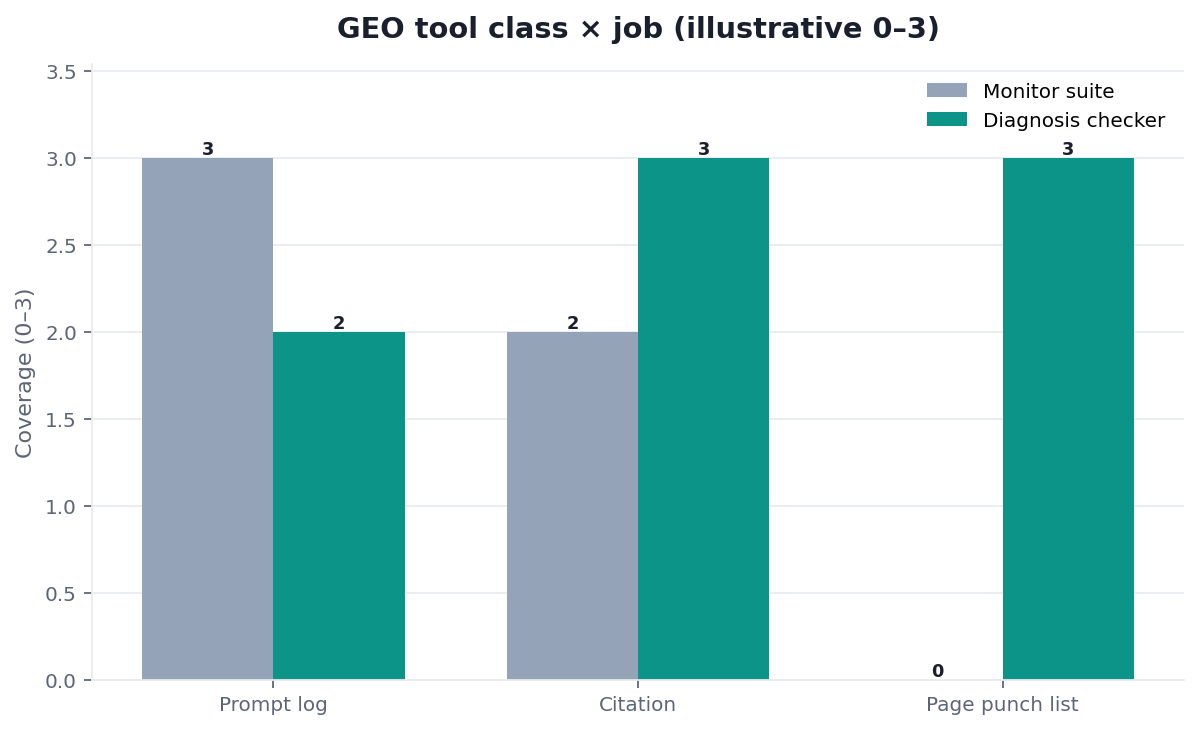
We score generative engine optimization tools on eight checks we can run without a vendor’s marketing PDF. The table is qualitative on purpose. We have not bought every seat, and we will not invent a 0–100 “GEO tool score.”
| Check | Monitoring | Diagnosis | Suite add-on | SEO Health |
|---|---|---|---|---|
| Fixed prompt set you can see | Should | Optional | Rare | Used on the AI visibility pass |
| Missing-evidence punch list | Rare | Required | Rare | Yes: definition, entity, crawler, byline |
| Invents a citation % with no log | Common fail | Fail | Common fail | We do not emit one |
| Export a writer can edit | CSV of mentions | Notes + URL | Screenshot | Markdown / PDF punch list |
| Same-day re-run stays stable | If prompts pinned | If rules pinned | Often not | Re-run the same URL |
| On-page diagnosis included | No | Yes | Partial crawl | Free page check first |
| Locale / language named | Should | Should | Marketing claim | Named on the run |
| Honest price story | Seat + overage | Credits / pass | Bundled | Free check; depth is paid |
Evidence over a rate
The first row that matters is “does it show the evidence.” McKinsey QuantumBlack’s insight stream keeps repeating a boring idea: measurement has to change a decision. Generative engine optimization tools that cannot name the missing sentence have not changed a decision. They have decorated a QBR.
We refuse a citation-percentage API because we do not log every model, every day, on your prompt set as a public feed. Pretending otherwise is how GEO theater starts. If a vendor does log real outputs, ask for the prompt list, the date, and the cannot-score state. Then decide if you still need diagnosis.
Export and re-run
If the only artifact is a PNG, you bought a slide. Generative engine optimization tools should export something a writer can assign: URL, missing block, owner. Re-run after one edit. If the chart moves and the page did not, the meter is scoring tokens.
BCG’s artificial intelligence practice page is useful here only as a buyer posture: AI programs fail when the output cannot be governed. Demand that of a $99 GEO add-on the same way you would demand it of a transformation deck.
Monitoring products
Use monitoring when the content team already ships lift-ready pages and you need to know whether ChatGPT, Perplexity, Gemini, or AI Overviews named you this week. Generative engine optimization tools in this tier should let you pin twenty prompts, freeze them for a quarter, and log mention versus citation as two columns.
Do not start here if your money URLs have no 40–50 word definition. You will pay to watch a zero. The short definition of the pair is what is GEO vs SEO. Write that block first.
When a logger is enough
A logger is enough when three things are true: the prompt set is written down, someone owns weekly review, and the page-level punch list already exists. If any of those is missing, buy diagnosis first. Generative engine optimization tools that only email a “visibility rose 4%” line will train leadership to ask for a fake official meter.
The Harvard Business Review AI topic page is crowded with strategy essays for a reason: executives want a number they can govern. Give them a prompt list and a URL queue instead. That is slower to screenshot and faster to edit.
Diagnosis products
Diagnosis is the tier we actually ship. Generative engine optimization tools here should open a URL, apply written rules, and return work. Typical flags we see on audited pages: definition buried under a brand story, author is “team,” statistic has no date, GPTBot is blocked, entity on the page does not match the about page.
This is also where on-page work and GEO meet. A page that fails ordinary title and heading checks will not become citable because you bought a mention logger. Run the on page SEO tool pass first if the URL is messy. Then run AI visibility on the same URL so the queue is one list.
Where SEO Health sits
SEO Health is a diagnosis product among generative engine optimization tools. Run the free page check, then add the paid AI visibility pass when you need the answer-engine punch list. We suggest fixes. We do not sell a citation-percentage API. We do not claim an official Google GEO score. Methods are page audits, sitemap samples, and Search Console export math.
If you need a retained team after the punch list, that is a service, not a tool. Use generative engine optimization services. If you need a partner diligence list, use generative engine optimization agency. Generative engine optimization tools should not pretend to interview your stakeholders.
Trust still sits under E-A-T SEO. A diagnosis that ignores Experience and only paints a footer is half a product.
Suite add-ons
Suites will keep shipping GEO tabs. Some will be real loggers. Many will be a prompt box on top of the crawl you already run. Generative engine optimization tools inside a suite fail the scorecard when you cannot see the prompts, cannot export notes, and cannot refuse a rate.
The buried tab test
Ask to run one URL you already labeled by hand: a login wall, a named-author lab note, and a fluent explainer with no person. If the suite scores the login wall, close the tab. If all three get the same mid score, the scale is not discriminating. Generative engine optimization tools that always emit a number are optimizing for a screenshot.
MIT Sloan Management Review has spent years on why dashboards fail to change work. A GEO tab that nobody assigns is that failure with a new acronym. If the suite cannot produce a ticket, it is not diagnosis.
How to buy without theater
Write the bottleneck before you book a demo for generative engine optimization tools. If the bottleneck is “we do not know if answers name us,” you want monitoring. If the bottleneck is “we rank and answers ignore us,” you want diagnosis. If the bottleneck is “we already pay for a suite,” test the add-on against the scorecard before you add a second seat.
Forrester’s blogs are full of vendor categories that outlive the product. Generative engine optimization tools will get the same treatment. Your job is to keep the three tiers, not to memorize this year’s logo wall.
Diligence questions
- Show the prompt set.
- Show mention, citation, and co-mention as separate columns.
- Show a cannot-score state.
- Show an export a writer can use without the vendor UI.
- Say out loud whether you sell a citation-percentage API. If yes, show the log. If no, do not print the percentage.
Then open AI visibility on three money URLs so the baseline is yours before you sign.
A 30-day trial that is not a dashboard
Day 1–7: pick ten money URLs. Add one 40–50 word definition and a named author. Confirm robots. Run diagnosis. Do not buy generative engine optimization tools this week if the pages have no extract.
Day 8–21: freeze twenty prompts. If you already own a logger, run it. If not, skip the seat. Fix the three URLs answers almost use. Re-run diagnosis after each edit.
Day 22–30: decide which generative engine optimization tools you still need. Keep monitoring only if someone will read the tape. Keep diagnosis if the punch list is still long. Keep a suite add-on only if it passed the buried-tab test. The three-column decision for which layer to work is SEO vs GEO vs AEO. Tactics after you buy sit in generative engine optimization strategies.
Failure modes
- Buying a logger to postpone writing a definition.
- Treating a suite tab as a GEO program.
- Printing a citation percentage the model never logged.
- One-engine roadmaps: SEO tools that never open an answer engine, and generative engine optimization tools that ignore crawl.
- No export. The work dies in a vendor UI.
If a report already failed one of those, re-check the URL after you add one standalone definition. Then decide whether you still need a second product.
Inspect the complete Generative Engine Optimization Tools page
Paste a sanitized URL into the InfiniSynapse SEO Health Checker so every title, mention, citation, and on-page layer can be reviewed together. Then validate the findings on the live page.
Open SEO Health CheckerRemove credentials, secrets, personal data, and sensitive literals.Frequently Asked Questions
Do I need a logger and a checker?
Bottom line: Often, in that order, after the pages are lift-ready. Start with diagnosis if the URLs are thin. Generative engine optimization tools that only monitor a zero waste a quarter.
Can these tools report a true citation percentage?
Bottom line: generative engine optimization tools: Only if they logged real model outputs against a fixed prompt set, with a date and a refuse state. We do not sell that API. A number with no log is decoration.
Where does SEO Health sit?
Bottom line: In the diagnosis tier of generative engine optimization tools. Page audit first, AI visibility when you need the answer-engine punch list. Suggested fixes. No official score. No invented citation rate.
What should I do in the first hour?
Bottom line: Pick one money URL. Add a 40–50 word definition and a real author. Run the checker. Then decide if you still need a logger.
Are suite add-ons enough?
Bottom line: Only if they pass the scorecard: visible prompts, separate mention and citation, export, refuse state. Most are convenience tabs. Generative engine optimization tools you already pay for still have to earn the row.
Conclusion
Generative engine optimization tools are a three-tier buy: monitor, diagnose, or accept a suite tab. SEO Health sits in diagnosis. We return missing evidence and suggested fixes. We do not sell a citation-percentage API. Start with one URL, add one extractable definition, and run the diagnosis. Use the hub when you still need the pair explained, and the three-column page when AEO is the real argument.
About the author — SEO Health Team. Reviewer: William Zhu (GitHub). Published and updated 2026-08-16. Credentials appear only here.
William Zhu · Cofounder, InfiniSynapse · GitHub @allwefantasy
Desk-validated SEO Health methods. Corrections: zhuhl@infinisynapse.com · corrections policy.