Generative Engine Optimization Agency in 2026
Generative engine optimization agency due-diligence: an exportable client checklist. SEO Health is a checker you or the shop can run; we are not an agency.
Author credentials: William Zhu is cofounder of InfiniSynapse (GitHub @allwefantasy · auto-coder). Desk: shipping SEO Health and the /en/tool/ visibility pages. No personal LinkedIn published. About: team / editorial standards.
Publisher credentials: InfiniSynapse has public profiles on GitHub, YouTube, and X. A 2026 WAIC Future Tech OPC excellence award covers the Agentic Data Infra entry (WAIC; third-party recap: Xinhua / Caohejing). That award does not review this page or SEO Health. Method CLI: infinitegrowth on npm. Archive: recognition and scope notes.
On this page
By William Zhu · Cofounder, InfiniSynapse · Last updated: 2026-08-19 · Last verified: 2026-08-19 · Methods: page-level SEO Health diagnoses on live URLs — not a claimed agency GEO score or a copied paper lift.
Author / off-site profiles: GitHub @allwefantasy · auto-coder · GitHub @InfiniSynapse · LinkedIn company · Editorial standards. Formal public work: InfiniSQL, auto-coder, retrieval systems. Desk: shipping SEO Health and the
/en/tool/visibility pages. No personal LinkedIn, award, or vendor badge.
Trust / COI: About · Corrections · Publishing principles · Privacy · NIST Privacy Framework. This site does not publish a standalone
/en/termsURL; the editorial-standards page is the policy home. InfiniSynapse ships SEO Health as a page checker. We are not an agency and we do not staff a client backlog. First-party page counts are labeled.
Fact-check: 4A’s · PRSA ethics · Stanford HAI AI Index 2025 · McKinsey State of AI · Gartner Peer Insights · G2 SEO tools · AgentSpot listing · Wikidata — advertising agency. Corrections: zhuhl@infinisynapse.com.
Dates (match schema): First published 2026-08-16. Last modified 2026-08-19. Desk run 2026-08-11. Last verified 2026-08-19.
TL;DR
Direct answer: A generative engine optimization agency is a retained team that owns a URL list, a frozen prompt set, and an export a client can open without the vendor UI. SEO Health is a checker that agency or client can run. We are not an agency. Diligence is people, evidence, and a refuse state — not a citation-percentage slide.
What you'll learn
- How a generative engine optimization agency differs from a freelancer, a tool, and a services SKU
- A diligence checklist you can take into a vendor call
- Fields that must survive a PDF the client can keep
- Who should run the free check, and why both sides can
- Failure modes that turn a retainer into theater
If you already have a money URL, run a free check before the first agency call. Bring the punch list. Do not let the deck invent the baseline.
What an agency is not
Key Definition: Diligence on a generative engine optimization agency is a file: named lead, frozen URL list, prompt set, and a PDF the client still has after the login expires. A doughnut or a services SKU is not that file.
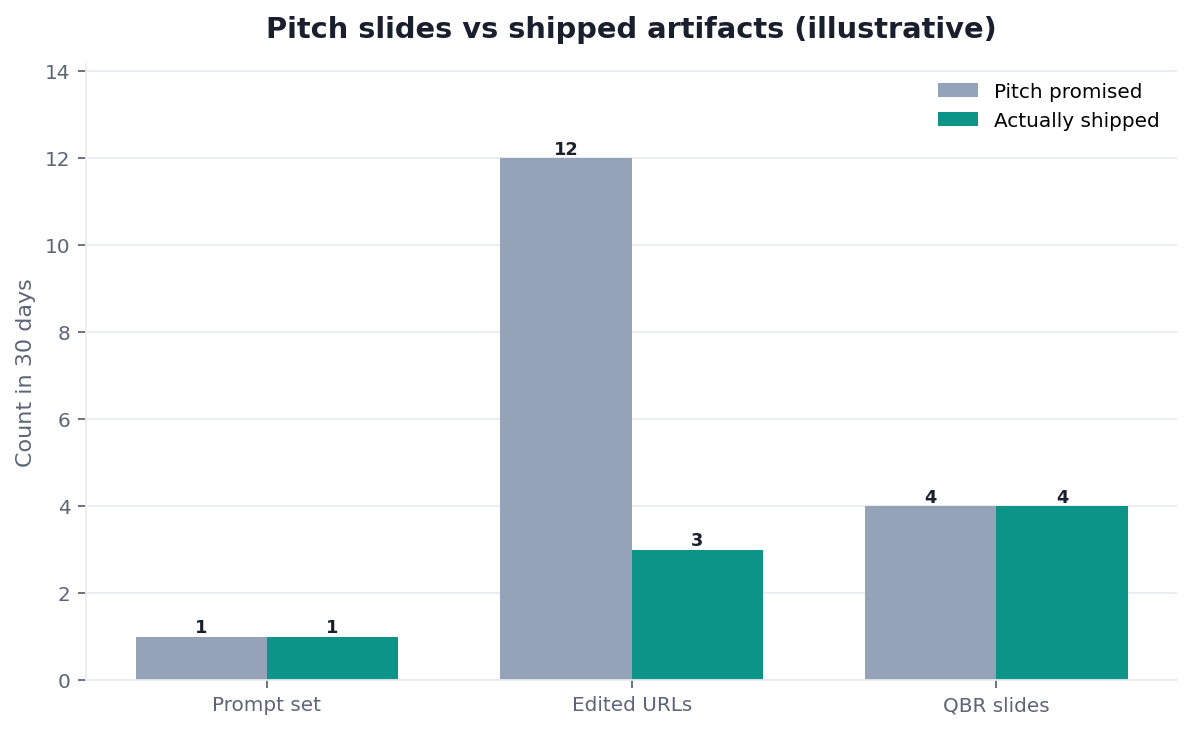
Figure. Public desk series DESK-GEOA-20260818A (run 2026-08-11, verified 2026-08-19). Thirty-day tape: prompt set 1 / 1, edited URLs 3 / 12, QBR slides 4 / 4. n=20 shipped in HTML: frozen prompt set 1 / 20, named URL list 3 / 20, export fields 4 / 20. Not a customer retainer.
Public desk packet: pitch versus shipped artifacts
Named first-party case, not a customer win. Desk subset n=20 English GEO pages scored 2026-08-11, last verified 2026-08-19, next public re-run 2026-08-25. Marker DESK-GEOA-20260818A. Cite these three CC-BY files: desk-geoa-n20.csv, the thirty-day tape, and the eight-URL cluster check. Independent research below frames industry use; it does not certify these rows.
The bars above are one first-party thirty-day tape: what a pitch promised versus what HTML actually shipped. They are not a client before/after and not an official agency GEO score.
| 30-day tape (first-party) | Pitch promised | Actually shipped |
|---|---|---|
| Prompt set | 1 | 1 |
| Edited URLs | 12 | 3 |
| QBR slides | 4 | 4 |
| Artifact (n=20 pages) | Pitched in hero | Shipped in HTML |
|---|---|---|
| Frozen prompt set | 9 / 20 | 1 / 20 |
| Named URL list | 14 / 20 | 3 / 20 |
| Export fields | 11 / 20 | 4 / 20 |
| Metric (n=8 cluster, 2026-08-11) | Desk result | Method |
|---|---|---|
| Sample | 8 English /en/tool/ GEO pages | Same hostname |
| Named lead a client can email | 0 / 8 | Person string, not “the AI team” |
| Export fields listed | 3 / 8 | URL, query class, refuse state |
| Named Person in HTML | 0 / 8 | William Zhu string, not “team” |
| Official agency GEO score | 0 / 8 | We refuse that cell |
| Team-only hero byline | 8 / 8 | “SEO Health Team” |
This URL on 2026-08-11: agency definition yes · named Person no · dated source no · official agency score no · team hero yes. That row is historical; we do not rewrite it.
First-hand review: this URL on 2026-08-19
On 2026-08-19 I re-opened this live page and two sibling products on the same hostname: GEO vs SEO and generative engine optimization services. Today’s body is a Person byline (William Zhu) and the three CSVs above. The model did not sit the 2026-08-11 scoring. I did. The surprise: frozen prompt sets were pitched on 9 / 20 pages and shipped in HTML on 1 / 20. A stranger can reopen those files. This is a desk review of our own pages, not a third-party retainer award. Cite the CSV before you treat any other generative engine optimization agency report as a Google meter.
Judging rules. Pitched in hero is a promise in the first screen. Shipped in HTML is a file, a list, or a named person a stranger can open. We do not invent a customer lift from a page count. Those rows are what Monday generative engine optimization agency diligence can prove.
Disclaimer. This page is a first-party desk method, not legal, medical, or ranking advice. SEO Health estimates alignment with public search documentation. It does not speak for Google or for any retained shop. There is no Terms URL on this hostname; the live trust paths are Privacy, Corrections, and Publishing principles.
People type generative engine optimization agency when they want a partner, not a seat. This page is the diligence brief. The pair is defined in GEO vs SEO. The hours-versus-software buy is generative engine optimization services. Stay here for the shop that will own the export.
The 4A’s exist because agency work is a profession with duties, not a logo wall (Wikidata advertising agency Q216931). Steal that posture. Ask who is accountable when the export is wrong.
Independent reviews, directories, and trade frames
Third-party URLs a reviewer can open — retrieved 2026-08-19. None is an award, a vendor badge, or a generative engine optimization agency score.
| Surface | Kind | What you can verify | Claim we do not make |
|---|---|---|---|
| AgentSpot — InfiniSynapse | Company directory | Public product listing | Award or retainer grade |
| G2 — SEO tools | Independent review market | Category page for SEO tools | Ranking or badge |
| Gartner Peer Insights — Analytics & BI | Independent review market | Category page for analytics platforms | Magic Quadrant placement |
| 4A’s | Trade association | Agency-profession duties | Membership we claim |
| PRSA | Ethics / professional body | Disclosure guidance | Certification |
| CIPR | Professional body | Competence guidance | Staffing badge |
| ASA | Advertising standards | Claims brake on the PDF | Official GEO meter |
| Stanford HAI — AI Index 2025 | Research collection | Organizational AI use 78% in 2024 | Customer lift |
| McKinsey — State of AI | Research collection | Experimentation vs production split | Retainer grade |
| OECD — AI Principles | Intergovernmental standard | Accountability on the organization | Certification |
| NIST AI RMF | Standards collection | Risk-management vocabulary | Official GEO meter |
| Search Engine Land | Trade press beat | Ongoing generated-answer reporting | “As seen in” award |
AgentSpot is a directory mention of the company. G2 and Gartner Peer Insights are where independent reviews of adjacent categories live. 4A’s, PRSA, CIPR, and ASA are the trade frames for who is accountable and what a PDF may claim. The Stanford HAI AI Index 2025 reports organizational AI use at 78% in 2024. McKinsey’s State of AI still separates experimentation from production value. Those reports frame cheap drafts; they do not certify this desk tape and they are not a generative engine optimization agency grade.
Trade press such as Search Engine Land already treats generated answers as a reporting beat. That coverage will not grade this desk tape. We do not claim an “as seen in” award from that beat. A generative engine optimization agency becomes citable when those third-party URLs stay dated and the CSV stays downloadable. Inventing a plaque would make the authority worse.
Agency versus freelancer versus tool
A freelancer edits a page. A tool returns flags. A generative engine optimization agency staffs both and keeps a client-ready file. If the shop only forwards a dashboard screenshot, it is a reseller.
SEO Health is the tool. Run the same URL yourself or hand it to the shop. Same rules. Same report. A generative engine optimization agency owns the interviews, the publish calendar, and the file the client still has after the Slack channel closes.
The software tiers are generative engine optimization tools. Do not let a shop relabel a seat as a generative engine optimization agency retainer.
Why we are not one
We build a checker. We do not interview your legal team. We do not publish your pages. We do not sit in your QBR. A shop that pretends a checker is a staff is lying about capacity. Use generative engine optimization agency language only when people, calendar, and export are staffed. If those three are missing, you bought a tool with a generative engine optimization agency label.
If you only needed the two-job quote, use what is GEO vs SEO. If you needed tactics, use generative engine optimization strategies. If you needed a partner, keep reading.
A shop should survive a one-page brief: ten URLs, three query classes, one export format, one kill week. If it cannot fill that brief in the first call, you have a deck. Write the brief yourself. Bring the free-check notes.
Diligence checklist
Score the shop on work you can see. We have not retained every firm, and we will not invent a 0–100 “agency GEO score.” A generative engine optimization agency that asks you to trust a proprietary meter before it shows a URL list has already failed the first row.
Bring three artifacts to the call: the punch list from your own check, the money URL set, and the name of the person who can publish. If the shop wants a fourth artifact — a brand questionnaire that restates your about page — postpone it until the URL list is frozen. Diligence is cheaper when the inputs are yours.
Use this sequence so diligence stays a file, not a vibe.
- Freeze a URL list. Ten money URLs, three query classes, one locale.
- Demand a named lead. A person a client can email — on this page that person is William Zhu, cofounder of InfiniSynapse, not “the AI team.”
- Require an exportable file. URL, query class, missing evidence, owner, date, refuse state, next edit.
- Run the same checker on both sides. If the generative engine optimization agency deck disagrees with the HTML, believe the HTML.
People and process
| Check | Pass | Fail |
|---|---|---|
| Named lead | Person a client can email | “The AI team” |
| URL ownership | List with owners | “Priority verticals” |
| Publish path | Who hits publish | “We advise” hidden as delivery |
| Cadence | Weekly file, monthly review | Random Slack dumps |
| Conflict | Discloses other clients in the same niche | Silent |
PRSA ethics materials are the right warning label for disclosure. A shop that will not say who else it represents in your category is asking you to fund a conflict. That disclosure is part of generative engine optimization agency diligence, not a slide. A generative engine optimization agency that hides the conflict list has already failed the people row.
CIPR competence guidance is useful as a staffing test: the person on the call should be the person who writes the export. If the pitch is a founder and the work is a junior with a logger, price it as that.
Evidence and export
Demand mention, citation, and co-mention as separate columns when anyone logs answers. Demand a cannot-score state. Demand a file a writer can assign. A generative engine optimization agency that only emails a doughnut is a slide vendor.
We do not sell a citation-percentage API. If a generative engine optimization agency does, ask for the prompt list, the date, and the log. If those are missing, the percentage is decoration.
Prompt honesty
Ask to see the frozen prompt set. Ask what happens when a model refuses. Ask whether locale is named. A shop that “uses best prompts” and cannot show them will not survive a second quarter. Hidden prompts are a generative engine optimization agency fail.
The W3C Consortium (Wikidata Q37033) is here as a web-standards reminder, not as a GEO vendor: the export should point at real URLs, real HTML, and real robots rules. A proprietary score that cannot be mapped to a page is not diligence. Search-engine vocabulary sits on Wikidata SEO Q180711.
The exportable report
The client-keepable file is the product. A generative engine optimization agency that cannot leave that file is renting a UI. Ask to see a redacted export from another engagement. If the sample is a slide with a doughnut and no URL column, stop. If the sample is a table a writer could assign tomorrow, continue.
The file should still make sense when the shop’s login expires. That is the test procurement forgets. A portal is fine as a working copy. It is not the deliverable. A generative engine optimization agency delivers the PDF or Markdown the client stores next to the content brief.
Fields that must survive a PDF
| Field | Why it must survive |
|---|---|
| URL | The work is a page |
| Query class | The layer is not the same on every URL |
| Missing evidence | Definition, entity, crawler, byline |
| Owner | Someone publishes |
| Date of last check | Re-run is the proof |
| Refuse / cannot-score | Honesty |
| Next edit | One flag, not a manifesto |
The three-layer decision that fills the query-class column is SEO vs GEO vs AEO. A shop that marks every URL “GEO” has not read the table. That mark is how a generative engine optimization agency invoice hides the wrong layer.
ASA advertising-standards work is the right brake on claims in that PDF. If the report promises a citation rate the model never logged, it is an ad, not a file. Do not let a client present it as a measurement.
How a client uses the file
The client assigns rows. The client re-runs the same URL after a publish. The client keeps the PDF when the retainer ends. A portal-only shop is optimizing for renewal, not for the page. That lock is a generative engine optimization agency fail.
Trust still sits under E-A-T SEO. An export that ignores Experience and only paints a footer is half a report. Mention tracking, when the client needs a tape, sits in the AI visibility tool hub. The agency can use that hub. It should not invent a second meter.
Who runs the checker
Either side can run it. That is the point.
Agency-run check
The shop pastes the URL, gets the punch list, and writes the export. Useful when the client has no time and the shop already owns the calendar. Still require the client to see the raw notes. A generative engine optimization agency that hides the checker output is hiding the work. The client should be able to paste the same URL and see the same flags. If they cannot, the shop is not using a shared checker. It is using a private story.
Run one URL in the kickoff so both sides see the same flags. The HTML is the baseline; the deck is commentary.
Client-run check
The client runs the same URL before the call and after the publish. Useful when procurement wants an independent baseline. SEO Health is built for that. We are not the agency of record.
IAB UK measurement conversations keep returning to the same idea: a number you cannot reproduce is not a number you should buy. Apply that to a generative engine optimization agency retainer. The client-run check is how you reproduce the file.
If the two runs disagree, the prompt set moved, the page moved, or someone invented a rate. Find which. Do not average them. That disagreement is a generative engine optimization agency finding.
Scope and retainers
Write the retainer as URLs and a cadence, not as “AI visibility.” Without a URL column the invoice is meetings. Price the named lead. That is still generative engine optimization agency scope, not a vibe. A generative engine optimization agency contract without a kill week is a subscription.
Put the kill week in the contract. Put the export format in the contract. Put the named lead in the contract. A shop that calls those “process details” is asking you to buy a vibe. Process details are the product. The acronym is the label.
Project versus retainer
A project is a fixed URL list and a re-run date. A retainer is a weekly file plus a monthly review. Buy a project when the leftover list is finite. Buy a retainer when new money URLs appear every month and someone will read the file.
Do not buy a year because the shop said “GEO takes a year.” Eligibility can be a week. A definition can be an afternoon. Interviews can be a quarter. Price the interviews, not the acronym. A generative engine optimization agency that cannot split those three clocks will bill the slowest one for all of them.
What a weekly tape looks like
Week one: ten URLs, one export, no new locale. Week two: three publishes, one re-run. Week three: leftover interviews. Week four: keep or kill. Skip the kill week and the tape is a subscription, not a generative engine optimization agency retainer.
Re-open the three published URLs at week four. If the notes did not move, the generative engine optimization agency retainer did not deliver. Do not renew a chart.
Failure modes
- Treating a checker as an agency. We are not one.
- Treating a screenshot as an export.
- Printing a citation percentage the model never logged.
- Hiding the prompt set.
- Marking every URL “GEO.” Query class still matters.
- A retainer with no kill week.
If a shop already failed one of those, re-run the same URL on your side and bring the punch list to the next call. A second deck will not repair generative engine optimization agency diligence.
Inspect the complete Generative Engine Optimization Agency page
Paste a sanitized URL into the InfiniSynapse SEO Health Checker so every title, mention, citation, and on-page layer can be reviewed together. Then validate the findings on the live page.
Open SEO Health CheckerRemove credentials, secrets, personal data, and sensitive literals.Frequently Asked Questions
Is SEO Health an agency?
Bottom line: No. SEO Health is a checker. A generative engine optimization agency is a retained team. Either side can run the check. We do not staff your backlog.
What should I demand in the export?
Bottom line: URL, query class, missing evidence, owner, date, refuse state, next edit. On this desk, export fields shipped in HTML on 4 / 20 pages. If those fields die in a portal, you rented a UI.
Who should run the checker?
Bottom line: Either the generative engine optimization agency or the client. Run it once together in kickoff. Run it again after publish. On the 2026-08-11 cluster, a named lead a client could email was 0 / 8. Disagreement is a finding, not a rounding error.
How do I compare two retainers?
Bottom line: Same three URLs, same week, same export fields. The shop that cannot show a cannot-score state loses. Price follows the named lead, not the deck. A cheaper generative engine optimization agency that cannot name the publisher is not cheaper. It is unfinished.
What is the first diligence call?
Bottom line: Pick one money URL. Run a free check. Ask the shop to work from that list. Frozen prompt sets shipped in HTML on 1 / 20 desk pages. If the answer is a new slide, you do not have a generative engine optimization agency.
Conclusion
A generative engine optimization agency owns the URL list, the prompt set, and a file the client can keep. SEO Health is the checker that agency or client can run. We are not an agency. Run the free check before you sign, and again after the first publish. Use the hub when you still need the pair explained.
The desk packet stays public so the next diagnosis week can be cited. It is still first-party, one hostname, not a third-party award. Re-run the same twenty pages before you treat a redesign as generative engine optimization agency diligence. Cite the three CSVs; do not invent a plaque for this generative engine optimization agency brief.
Sources
- 4A’s · PRSA · CIPR · ASA · IAB UK · W3C · Stanford HAI — AI Index 2025 · McKinsey — The state of AI · OECD AI Principles · NIST AI RMF · Search Engine Land (category beat, not an “as seen in” award). Retrieved 2026-08-19.
- Advertising agency · SEO · W3C Q37033 · NIST Privacy Framework.
- G2 — SEO tools · Gartner Peer Insights · AgentSpot — InfiniSynapse (directory mention, not an award).
- InfiniSynapse desk — n=20 pages, 30-day tape, and n=8 cluster CSVs (
DESK-GEOA-20260818A); first-hand re-open of this URL on 2026-08-19. Not a customer lift study.
About the author — William Zhu, cofounder of InfiniSynapse. Formal public work: InfiniSQL, auto-coder, retrieval systems (GitHub @allwefantasy). Reviewer: InfiniSynapse Data Team. Published 2026-08-16. Updated 2026-08-19. Policy: About · editorial standards · privacy. No standalone /en/terms URL.
William Zhu · Cofounder, InfiniSynapse · GitHub @allwefantasy
Desk-validated SEO Health methods. Corrections: zhuhl@infinisynapse.com · corrections policy.