Generative Engine Optimization Services in 2026
Generative engine optimization services vs tools: when an independent site should buy consulting, how to scope a SOW, and why a free check comes first.
Author credentials: William Zhu is cofounder of InfiniSynapse (GitHub @allwefantasy · auto-coder). Desk: shipping SEO Health and the /en/tool/ visibility pages. No personal LinkedIn published. About: team / editorial standards.
Publisher credentials: InfiniSynapse has public profiles on GitHub, YouTube, and X. A 2026 WAIC Future Tech OPC excellence award covers the Agentic Data Infra entry (WAIC; third-party recap: Xinhua / Caohejing). That award does not review this page or SEO Health. Method CLI: infinitegrowth on npm. Archive: recognition and scope notes.
On this page
By the SEO Health Team · Last updated: 2026-08-16 · We build the SEO Health checker at infinitegrowth.agency. Methods below come from the product’s page audits, sitemap samples, and GSC export math — not from a claimed Google score.
TL;DR
Direct answer: Generative engine optimization services are paid people work, not a software seat. Buy them when money URLs already rank and answer engines still ignore the page, and when the punch list is longer than one in-house week. Run a free check first. Hire a consultant only for the leftover edits, stakeholder interviews, and a re-run plan you can own.
What you'll learn
- How generative engine optimization services differ from a checker or a logger
- When an independent site should wait, and when it should hire
- Why searches for “generative engine optimization companies” collapse into this buyer page
- A scorecard for proposals that refuse a fake citation percentage
- A 30-day sequence: check, decide, then consult
If you already have a money URL, run a free page check and read the punch list before you book a call. The consult is the leftover work, not the first click.
What a service engagement actually is
Key Definition: Generative engine optimization services are paid engagements that diagnose why answer engines ignore a URL, then ship extractable pages, entity fixes, and a re-run plan. They are not a software seat. Independent sites buy them when the in-house week cannot clear the punch list.
Quick answer: Paid people work, not a software seat. Buy it when money URLs already rank and answer engines still ignore the page, and when the punch list is longer than one in-house week. Key terms
| Term | Meaning |
|---|---|
| GEO | Making a passage liftable into a generated answer. |
| SEO | Making a URL eligible and clear in classic retrieval. |
| AEO | The same extractability job under an answer-engine label. |
| Extractable block | A short definition, named entity, or dated fact this page can lift. (#545) |
People type generative engine optimization services after they accept the pair in GEO vs SEO and still cannot staff the edits. This page is the buyer brief. It is not a vendor logo wall. We sell a checker. We do not staff your backlog.
The U.S. Small Business Administration is the right posture for an independent site: know the job before you buy outside help. A GEO retainer that cannot name URLs, owners, and a re-run date is not a job. It is a slide.
Services versus tools
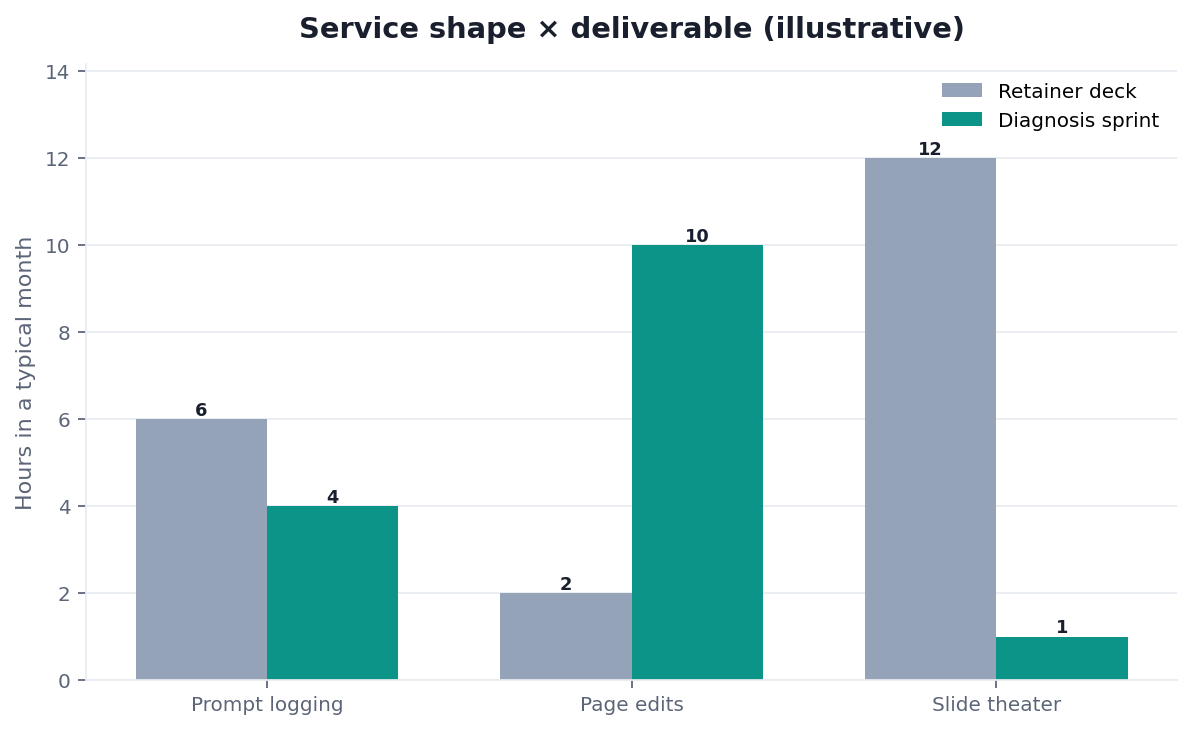
A tool opens a URL and returns missing evidence. A service interviews the people who can change the page, writes the missing block, and comes back after the publish. Generative engine optimization services fail when they only resell a dashboard you could have run yourself.
SEO Health sits on the tool side. Run the free check, then decide whether you still need a person. If the list is “add a 40–50 word definition, name the author, unblock GPTBot,” you do not need a six-month retainer. If the list is “twenty money URLs, three locales, no owner, legal will not date a statistic,” you need people.
The software landscape is generative engine optimization tools. Keep that page for tiers. Stay here for the buy decision.
What companies usually means
Search logs also show “generative engine optimization companies.” That string is the same buyer intent with a logo-shaped noun. Some of those firms are agencies. Some are two-person shops. Some are software vendors who added a services SKU. Generative engine optimization services is the parent phrase because you are buying hours and a statement of work, not a company name.
If the firm will own the URL list and the export, treat it as an agency and use the diligence list on generative engine optimization agency. If the firm will only advise and you will publish, stay on this page. The SEC’s small-business resource hub is useful here only as a disclosure habit: if you will report “AI visibility” to investors or a board, do not let a vendor invent a meter you cannot show.
When an independent site should buy
Buy generative engine optimization services when three things are true at once: the URL is eligible in search, the page is missing extractable evidence, and nobody on staff will ship the edit this month. Skip the retainer when any one of those is false.
The short definition of the pair is what is GEO vs SEO. Write that block yourself if you can. Hire only for the rest.
Signals you can wait
Wait if the money URL has no standalone definition, no named author, and a blocked answer-engine crawler. Those are one-afternoon edits. Generative engine optimization services that start with a “strategy workshop” before those three fixes are selling time you do not need.
Wait if you have never run a page audit. The first artifact should be yours. Open the free check on three URLs you already care about. If the same three flags repeat, fix the template. Do not buy generative engine optimization services to discover a missing byline you can see in the HTML.
Wait if Search Console already shows the URL earning the query and the only gap is a closed paragraph. That is writing, not a program. The three-layer decision for which job you are actually buying is SEO vs GEO vs AEO.
Signals you should hire
Hire when the punch list spans more URLs than your week, when legal or brand must approve every dated claim, or when two teams disagree about which entity the about page is. Generative engine optimization services earn the invoice on interviews and publish discipline, not on a screenshot.
Hire when you need a 60-day calendar with owners, not when you need a mention chart. Monitoring is a different buy. Measurement of mentions sits in the AI visibility tool hub. Do not pay a consultant to watch a zero.
ISO 9001 is a quality-management standard, not a GEO spec. Steal one idea from it: a process you cannot audit is not a process. Ask the firm how a second person would re-run the same URL next quarter.
Scope that survives a contract
Write the scope before the logo. Generative engine optimization services should name URLs, query classes, locales, a definition of done, and a re-run date. A slide that says “we will improve AI citations” is not scope.
Project Management Institute materials keep repeating a boring idea: uncontrolled change is how projects become theater. Apply that to a GEO SOW. If the firm can add “more prompts” without a change note, you will pay for a moving target.
Deliverables you can re-run
Demand artifacts a writer can open without the vendor UI:
| Deliverable | Pass | Fail |
|---|---|---|
| URL list with owner | Named person, date | “Priority pages” |
| Missing-evidence notes | Definition, entity, crawler, byline | A doughnut |
| Prompt set | Frozen for the quarter | “We use best prompts” |
| Export | Markdown or PDF punch list | Screenshot only |
| Re-run | Same URL, same rules | A new percentage |
| Refuse state | “Cannot score” is allowed | Every URL gets a number |
Generative engine optimization services that cannot fill the Pass column are a workshop, not a delivery. Tactics after you hire sit in generative engine optimization strategies. Do not let the SOW replace that how-to with a vibe.
Trust still sits under E-A-T SEO. A service that paints a footer and ignores Experience is half a job.
What does not belong in the SOW
Do not buy a citation-percentage API as a line item. We do not sell one. A number with no prompt list, no date, and no refuse state is decoration. Generative engine optimization services that lead with a lift forecast are selling a slide.
Do not buy “we will get you into ChatGPT” as a guarantee. Answer engines choose sources. A firm can make a URL extractable. It cannot sign the model’s output.
Do not buy a second crawl as generative engine optimization services when you already sampled the site. If you need a site-level view, use the sitemap sample in the checker. People work should start after the sample, not instead of it.
The World Economic Forum stories desk is crowded with essays about AI changing discovery. That is context, not a statement of work. A shifting interface is not a reason to skip named URLs.
How to compare proposals
Score generative engine optimization services on work you can see, not on a deck. We have not staffed every firm, and we will not invent a 0–100 “GEO services score.”
A buyer scorecard
| Check | Independent site should require |
|---|---|
| Starts from your punch list | Yes, after your free check |
| Names URLs and owners | Yes |
| Separates mention from citation | Yes |
| Invents a citation % with no log | Disqualify |
| Exports a writer can assign | Yes |
| Interviews legal / brand when claims are dated | If you sell in a regulated niche |
| Same-day re-run stays stable | If rules are pinned |
| Honest about tools versus hours | Yes |
Association for Project Management guidance is useful as a buyer posture: definition of done before kickoff. Generative engine optimization services without a done state will invoice forever.
Questions that kill theater
- Show the first three URLs you would edit, and why.
- Show a cannot-score state.
- Say out loud whether you sell a citation-percentage API. If yes, show the log. If no, do not print the percentage.
- Show an export a writer can use after the contract ends.
- Name who publishes. If the answer is “we advise, you publish,” price the hours accordingly.
Then keep the scorecard. Two proposals for generative engine optimization services that cannot answer question 2 are the same firm with different logos.
A 30-day buy sequence
Do not start generative engine optimization services on day one. Start with evidence you already own.
Week one: check then decide
Day 1–2: pick ten money URLs. Run a free page check on each. Add one 40–50 word definition and a named author where they are missing. Confirm robots.
Day 3–5: group the leftover flags. If they are template bugs, fix the template. If they are interviews — entity disputes, legal dates, multi-locale owners — write a one-page brief.
Day 6–7: decide. If the leftover list is short, stop. If it is long, send the brief to two firms. You are now buying generative engine optimization services against a list, not against a fear.
Weeks two to four
Week two of generative engine optimization services: one kickoff. Freeze the URL list. Freeze twenty prompts if anyone will monitor. Do not add a third locale mid-week.
Week three: publish the first three URL edits. Re-run the same checker. If the notes did not move, the edit missed the flag.
Week four: keep or kill the retainer. Keep generative engine optimization services only if an owner still exists and the export is still assigned. Kill the retainer if the firm is now only emailing a chart.
Failure modes
- Hiring before a check. You will pay to hear flags the HTML already shows.
- Buying a logger as a service. A weekly tape is not generative engine optimization services.
- Printing a citation percentage the model never logged.
- Scope with no URLs. “Improve AI visibility” is a slogan.
- No export. The work dies when the Slack channel closes.
If a proposal already failed one of those, re-check the URL yourself, then ask the firm to work from your list. That is the consult. That is not a new product category.
Inspect the complete Generative Engine Optimization Services page
Paste a sanitized URL into the InfiniSynapse SEO Health Checker so every title, mention, citation, and on-page layer can be reviewed together. Then validate the findings on the live page.
Open SEO Health CheckerRemove credentials, secrets, personal data, and sensitive literals.Frequently Asked Questions
Do I need a consultant if I already have a checker?
Bottom line: Only if the punch list is longer than your week or needs interviews you cannot run. Generative engine optimization services are leftover people work. They are not a second dashboard.
What should a statement of work include?
Bottom line: URLs, owners, locales, a definition of done, a re-run date, and an export a writer can open. If those lines are missing, you are not buying generative engine optimization services. You are buying a workshop.
Are GEO companies the same as agencies?
Bottom line: Sometimes. “Companies” is a search variant. If the firm owns the URL list and the client export, use the agency diligence page. If it only advises, stay here. The parent buy is still generative engine optimization services.
What should I do before I sign?
Bottom line: generative engine optimization services: Pick three money URLs. Add one closed definition. Run the free check. Send that punch list with the brief. Do not sign a retainer against a blank URL column.
How is this different from buying software?
Bottom line: Software returns flags. People ship edits and hold interviews. Buy the seat when you will assign the list. Buy the hours when you will not. Do not let a services SKU hide a tool you could have clicked.
Conclusion
Generative engine optimization services are a people buy that starts after a check, not instead of one. Independent sites should wait when the first three flags are a definition, an author, and a crawler. They should hire when the leftover list needs interviews and a calendar. We are the checker. Run the free diagnosis, then consult only for what you cannot ship this month. Use the hub when you still need the pair explained.
About the author — SEO Health Team. Reviewer: William Zhu (GitHub). Published and updated 2026-08-16. Credentials appear only here.
William Zhu · Cofounder, InfiniSynapse · GitHub @allwefantasy
Desk-validated SEO Health methods. Corrections: zhuhl@infinisynapse.com · corrections policy.