AI Visibility Tool: How AI Search Sees Your Brand
An ai visibility tool measures mention, citation, and share of voice across ChatGPT, Gemini, Perplexity, and Google AI Overviews — then shows what to fix.
Author credentials: William Zhu is cofounder of InfiniSynapse (GitHub @allwefantasy · auto-coder). Desk: shipping SEO Health and the /en/tool/ visibility pages. No personal LinkedIn published. About: team / editorial standards.
Publisher credentials: InfiniSynapse has public profiles on GitHub, YouTube, and X. A 2026 WAIC Future Tech OPC excellence award covers the Agentic Data Infra entry (WAIC; third-party recap: Xinhua / Caohejing). That award does not review this page or SEO Health. Method CLI: infinitegrowth on npm. Archive: recognition and scope notes.
On this page
By the SEO Health Team · Last updated: 2026-09-27 · We build the SEO Health checker at infinitegrowth.agency. Methods below come from the product’s AI visibility runs, fixed prompt sets, and calibration math — not from a claimed Google score.
TL;DR
Direct answer: An AI brand visibility checker logs, on one locked prompt set, whether the brand is named, whether a URL you control is cited, and whether a named rival appears in the same answer. An ai visibility tool is that loop: mention, citation, and share of voice across ChatGPT, Gemini, Perplexity, and Google AI Overviews. Google rank is a different column.
What you'll learn
- A 44-word definition of an ai visibility tool you can quote
- Mention versus citation versus share of voice
- The four surfaces that matter in 2026
- Why a score must come from fixed prompts, not a chat vibe
- How to choose monitoring-only software versus diagnosis-plus-fix
If you already have a brand and a URL, run an AI visibility check. Do not wait for a rank tracker to invent an answer-engine number.
What an AI Visibility Tool Actually Measures
Key Definition: An AI visibility tool measures how often a brand is mentioned or cited inside AI-generated answers — across ChatGPT, Perplexity, Gemini, and Google AI Overviews — and how that share compares with named competitors on the same prompt set. It is not a Google rank tracker.
Quick answer: An ai visibility tool measures how often a brand is mentioned or cited inside AI-generated answers — and how that share compares to named competitors on a locked prompt set. It is not a rank tracker. Key terms
| Term | Meaning |
|---|---|
| Mention | The brand name appears in a generated answer. |
| Citation | The answer points at a URL you control. |
| Share of voice | Your mentions versus named competitors on the same locked prompts. |
| Surface | One answer engine or Overview unit logged as its own column on this page. (#501) |
People type ai visibility tool when they want a definition, a weekly chart, or a punch list. Those are three jobs. This hub covers the category and the diagnosis. The short definition of the metric itself lives in AI Visibility.
A useful AI visibility tool splits three signals that vendors love to mash into one vanity number:
| Signal | What it means | What it is not |
|---|---|---|
| Mention | The brand name appears in the answer | A ranking, a click, a citation |
| Citation | The answer points at a URL you control | A casual name-drop |
| Share of voice | Your mentions versus named competitors on the same prompts | Sitewide traffic share |
The Wikipedia overview of Google Search is still the right vocabulary for classic retrieval. An ai visibility tool adds a second surface: generated answers that may never show ten blue links.
Mention versus citation versus share of voice
Mention is cheap. A model can say your name while sending the reader to a competitor. Citation is the extractable URL. Share of voice is the comparison that makes a weekly log useful. A brand-first pass — names, sentiment, who appears in the same paragraph — is the job of a brand visibility tool, not a rank crawl.
Why rank and mention diverged in 2025–2026
The UN AI Advisory Body still treats ranking-era search and generative answers as different systems, not one mention meter. That is why a page can sit in the top three and stay invisible in ChatGPT. MIT CSAIL tracks how fast organizations moved everyday questions into generative products. Adoption is not citability. If you need the search-scenario cut — AI Overviews plus conversational search — use the AI search visibility tool guide after this hub.
Zero-click answers are why teams still instrument this layer. The argument for watching the answers, not only the SERP, is in Why Use AI Search Monitoring Tools.
The Four Surfaces You Must Track
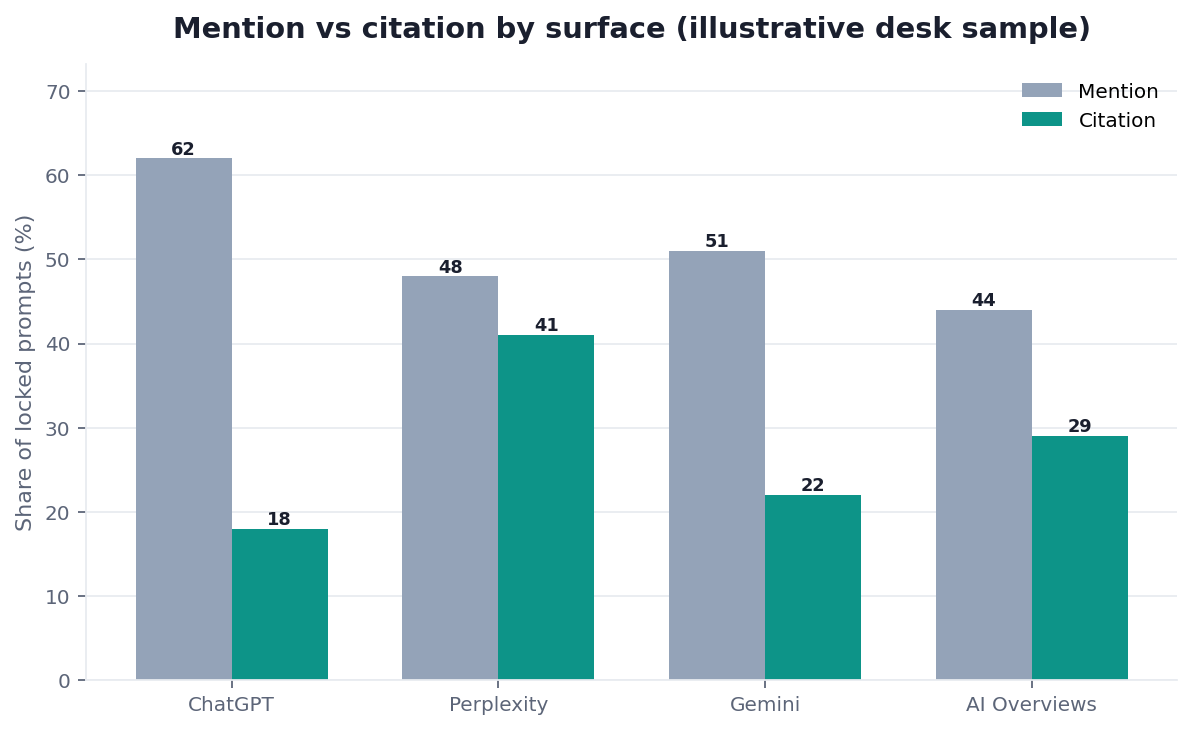
An AI visibility tool that only logs one chat window is a toy. The four surfaces below disagree with each other on the same prompt. We run them as a set, not as a vibe from whichever tab is open. Copilot and Claude stay off that blended score. Log either one only when that run actually queried it, and keep the row separate.
ChatGPT
ChatGPT is mention-heavy and citation-light unless browsing is on. Treat a name-drop without a URL as a mention, not a win. Log the model label and whether browsing ran. An ai visibility tool that cannot record that toggle will invent a trend from mixed modes.
Perplexity
Perplexity leads with sources. Here the ai visibility tool should log citation rate as the useful column. Buy perplexity search rank tracking software only when the export keeps every visible card. If you are named and your URL is missing, the gap is extractability — titles, definition blocks, entities — not “the model hates us.”
Gemini
Gemini is a separate product from the AI Overview in Search. Do not average the two. A Gemini answer can cite a different URL than the Overview for the same query. Keep the rows apart in any AI visibility tool export.
Google AI Overviews
AI Overviews sit inside Search. Google Search Central’s AI features documentation is the public rule set for how those units appear. Eligibility still starts with ordinary search hygiene. The Overview is the new snippet, not a replacement for ordinary ranking systems. Enterprise teams that need a wider AI primer can start from Google Cloud’s AI overview and then come back to prompt-level logs.
Tool vs Platform vs Tracker vs Checker
The word ai visibility tool is the hub term. Adjacent queries mean different buying jobs. Do not let a vendor collapse them.
| Word | Job | You need it when |
|---|---|---|
| Tool | One diagnosis, one brand, a punch list | You have a URL and a question this week |
| Platform | Seats, roles, multi-brand history | An agency or a portfolio |
| Tracker | The same prompt set on a schedule | You already believe the metric |
| Checker | A single run, no history | You want a yes/no before a rewrite |
A platform is seats and history, not a fancier chart. That split is the whole point of AI Visibility Platform.
Continuous weeks of the same prompts belong in AI Visibility Tracker.
The habit of writing mention and citation into a log is AI Brand Visibility Tracking.
When a one-shot checker is enough
A one-shot checker is enough when you have one brand, one locale, and no need for last quarter’s line. Paste the URL, run the prompt set, read the punch list. That is the AI visibility checker (one URL). If you already know the page is thin, start the check before you buy a seat.
What you type in
An AI brand visibility checker takes a brand name, one URL, the rivals you want named, and a country. If the method cannot see a mention or a citation, the cell is “cannot score,” not a made-up rate. Weekly repeats of the same prompts belong on the AI visibility tracker, not in this one-shot row.
Why a Visibility Score Must Be Reproducible
Buyers ask whether a mention rate is just the model inventing a feeling. A number you can defend is not a vibe. A reliable AI visibility tool score comes from a fixed prompt set, the same locale and date window, and a calibration pass that pulls repeat runs onto one scale. If the rules cannot see a mention or a citation, the output is “cannot score,” not an invented percentage.
Workflow: Prompt Set, Run, Log, Fix, Re-run
Treat the ai visibility tool as a loop, not a screenshot.
- Write a fixed prompt set. Ten to thirty prompts. Include brand, category, and competitor-comparison questions. Lock locale and language.
- Run the four surfaces. Same week, same prompts. Do not mix model versions in one row.
- Log mention, citation, and competitor names. A table beats a chat transcript.
- Fix extractability. Definition block, named author, dated fact, resolvable entity. The how-to is AI Visibility Optimization.
- Re-run the same set. A new prompt is a new test. It is not proof the last fix worked.
When you log model output, treat the transcript as untrusted text. Nature’s machine-learning research is the right caution: a fluent answer is not a verified measurement, which is why you do not paste customer secrets into a visibility run. Brookings on technology and innovation is the posture for any tool that turns a qualitative answer into a number: show the method, map the risk, refuse when the method does not apply.
After you edit the page, re-run the AI visibility pass on the same prompts. A different prompt set cannot tell you if the fix landed.
Buyer Landscape: Monitoring-Only vs Diagnosis-Plus-Fix
Most lists of an AI visibility tool hide two products under one screenshot. Monitoring-only software draws a line chart. Diagnosis-plus-fix software returns a punch list. SEO Health sits in the second row: paid AI visibility and an llm-tracker, not a free title-tag scan pretending to be an answer-engine score.
A shortlist that mixes both jobs is in the visibility checking tools bake-off. Read that after you know which job you are buying.
Suite add-ons from Semrush and Ahrefs
Suite add-ons are convenient if you already pay for a crawl. They are monitoring-first, not a complete AI visibility tool. They will not write your definition block. They also will not invent a web-wide mention index you can treat like a backlink graph. If the suite cannot export the prompt set, you cannot reproduce the week.
Single-surface monitors
A ChatGPT-only logger is cheap and honest about scope. It is not an ai visibility tool for a brand that also appears in Overviews. Use it as a probe, then graduate to four surfaces.
Diagnosis-plus-fix tools
Diagnosis tools return missing evidence: no citation, no entity, no locale, unstable prompts. SEO Health is in this row. Run the visibility check when you want the punch list, not another unlabeled 67.
Scorecard: Eight Criteria for Choosing
Score any AI visibility tool against work you can assign, not against a homepage animation.
| Criterion | Why it matters |
|---|---|
| Four named surfaces | ChatGPT, Perplexity, Gemini, AI Overviews disagree |
| Mention ≠ citation | Name-drops are not links |
| Fixed prompt set | Otherwise you are sampling noise |
| Calibration and “cannot score” | Repeat runs must not invent a swing |
| Locale and language | A US English prompt is not a 简体 query |
| Export | Markdown or PDF you can send |
| CLI or repeatable run | Agents and humans should hit the same rules |
| Punch list | A chart without a fix is a dashboard |
Calibration, export, CLI, and locale
Ask how two runs on the same prompt set stay on one scale. Ask for an export a client can read. If your audience is in Chinese, a PDF that survives that export is a real criterion, not a nice-to-have. Reports that reach a wide audience should still meet W3C’s WCAG overview — contrast, headings, and text that a reader can extract. An ai visibility tool that only lives inside a dark chart fails that test.
Failure Modes
- Treating a single chat as a mention rate. That is the hallucination buyers fear.
- Changing the prompt every week and calling the delta a trend.
- Skipping locale, then comparing a US answer to a 上海 query.
- Buying monitoring and never opening AI Visibility Optimization.
An AI visibility tool that cannot refuse a score will decorate a guess. Do not accept a percentage with no prompt list behind it.
Cluster guides in this pillar
Use the table when the ai visibility tool hub is too wide for the job.
| Guide | Use it when |
|---|---|
| AI Visibility | You need the metric definition, not a buyer guide |
| AI Visibility Platform | You need seats, roles, and multi-brand history |
| AI Search Visibility Tool | The job is Overviews plus conversational search |
| AI Brand Visibility Tool | The job is name, sentiment, and competitor framing |
| Why Use AI Search Monitoring Tools | You still need the zero-click argument |
| Best AI Visibility Tools | You want a scored shortlist |
| AI Visibility Tracker | You are ready for a weekly prompt set |
| AI Visibility Checker | You want one run on one brand |
| AI Visibility Optimization | You already have a miss and need a fix |
| AI Brand Visibility Tracking | You need the logging habit |
| Perplexity source-card desk | You need source cards, not a Perplexity score tile |
Inspect the complete AI Visibility Tool
Paste a sanitized URL into the InfiniSynapse SEO Health Checker so every title, mention, citation, and on-page layer can be reviewed together. Then validate the findings on the live page.
Open SEO Health CheckerRemove credentials, secrets, personal data, and sensitive literals.Frequently Asked Questions
What is an AI brand visibility checker?
Bottom line: An AI brand visibility checker records, on a locked prompt set, whether the brand is named and whether a URL you control is cited. Rank is a different column.
Does a mention in ChatGPT equal a Google ranking?
Bottom line: No. An ai visibility tool measures generated mentions, not rank. Rank is a retrieval position. Mention is a generated sentence. A page can win one and lose the other.
How often should I re-run the same prompt set?
Bottom line: Weekly is enough for most brands. Re-run after a material page edit. Do not invent a new prompt and call it a re-test. An ai visibility tool only earns the word tracker when the prompts stay still.
Can I trust a mention rate from a single chat?
Bottom line: No. One chat is an anecdote. Trust starts when the same prompts, locale, and surfaces repeat. If a vendor cannot show that method, treat the rate as marketing.
What should I do in the first hour?
Bottom line: Pick ten prompts. Run the four surfaces. Write mention and citation into a table. Start the AI visibility check if you want the punch list generated, then fix extractability on the weakest URL.
How is a tool different from a platform?
Bottom line: A tool answers this week. A platform stores last quarter and manages who can see it. Buy the tool first unless you already have three brands and a reporting chain.
Conclusion
An AI visibility tool is a measurement loop: fixed prompts, four surfaces, mention versus citation, then a fix you can re-run. Google will not sell you an official mention score. Start with one brand, lock the prompt set, and run the AI visibility check. Use AI Visibility if the metric name is still the blocker.
About the author — SEO Health Team. Reviewer: William Zhu (GitHub). Published 2026-08-16. Updated 2026-09-27. Credentials appear only here.
William Zhu · Cofounder, InfiniSynapse · GitHub @allwefantasy
Desk-validated SEO Health methods. Corrections: zhuhl@infinisynapse.com · corrections policy.