AI Visibility Optimization: Get Cited in Answers
Get cited in ChatGPT and Overviews with ai visibility optimization: extractable paragraphs, named entities, and EEAT evidence you can re-test this week.
Author credentials: William Zhu is cofounder of InfiniSynapse (GitHub @allwefantasy · auto-coder). Desk: shipping SEO Health and the /en/tool/ visibility pages. No personal LinkedIn published. About: team / editorial standards.
Publisher credentials: InfiniSynapse has public profiles on GitHub, YouTube, and X. A 2026 WAIC Future Tech OPC excellence award covers the Agentic Data Infra entry (WAIC; third-party recap: Xinhua / Caohejing). That award does not review this page or SEO Health. Method CLI: infinitegrowth on npm. Archive: recognition and scope notes.
On this page
By William Zhu · Cofounder, InfiniSynapse · Last updated: 2026-08-17 · Last verified: 2026-08-17 · Methods below come from SEO Health page audits, sitemap samples, and GSC export math — not from a claimed Google score.
Author credentials: William Zhu is cofounder of InfiniSynapse. Public engineering profile: GitHub @allwefantasy (InfiniSQL, auto-coder, retrieval systems) and GitHub @InfiniSynapse. Desk work: shipping the SEO Health checker and the 76
/en/tool/visibility pages, including this ai visibility optimization brief. Accountability: engineering lead for InfiniSQL / platform claims on Editorial standards. No personal LinkedIn is published; GitHub and that profile are the canonicalsameAssignals. Qualification frame: open-source systems work plus first-party desk logs — not a personal certification badge.
Trust / About: About us · Editorial standards · Privacy policy · Corrections · Publishing principles · NIST Privacy Framework
COI / interest disclosure: InfiniSynapse publishes this guide and ships SEO Health as a credit-based ai visibility optimization desk. First-party desk counts are labeled. Product CTAs are commercial.
Fact-check / verification: Stanford HAI AI Index 2025 · McKinsey State of AI · Gartner Peer Insights — Analytics & BI · Google structured data intro · W3C JSON-LD 1.1. Corrections: zhuhl@infinisynapse.com.
TL;DR
Direct answer: ai visibility optimization is the edit work that makes a page citeable: a plain-language definition, named entities, and EEAT evidence in HTML a crawler can read. It is not a mention-rate dashboard. You change one block, then re-run the same prompts.
What you'll learn
- A 49-word definition of citeable pages
- Why mention is cheaper than a citation
- How extractable paragraphs, entities, and EEAT stack
- A repair sequence you can re-test in 30 days
- Three failure modes that look like optimization and are not
If you have the URL that missed, run a paid AI visibility check before you rewrite. If you still need the metric name, open AI Visibility.
What getting cited actually requires
Key Definition: ai visibility optimization makes a page extractable so an answer engine can cite it. The work is a definition, named entities, and EEAT evidence in HTML. It is the edit you re-test, not a mention-rate dashboard.
Key terms
| Term | Meaning |
|---|---|
| Mention | The brand name appears in a generated answer. |
| Citation | The answer points at a URL you control. |
| Share of voice | Your mentions versus named competitors on the same locked prompts. |
| Surface | One answer engine or Overview unit logged as its own column on this page. |
People reach for ai visibility optimization after a checker says “mentioned, not cited.” The name appeared. The URL did not. That gap is extractability, not a secret ranking lever. The search-versus-answer split that explains why rank and citation diverged is GEO vs SEO.
The pillar hub is the buyer page. This page is the repair list.
Industry context, not a customer lift: the Stanford HAI AI Index 2025 reports organizational AI use at 78% in 2024, up from 55% in 2023, and generative AI in at least one business function at 71%, up from 33%. U.S. private AI investment hit $109 billion in 2024. Inference that once cost $20 per million tokens fell to $0.07 — a more than 280-fold drop. Cheap tokens multiply one-off chats. They do not replace a 40-word definition in HTML. McKinsey’s State of AI still separates experimentation from production value. Gartner Peer Insights — Analytics & BI is a third-party review surface; it is not an ai visibility optimization score.
Desk sample: eight pages, one edit
First-hand, labeled, not a customer case study. InfiniSynapse is one legal name and one English locale. We shipped 76 SEO Health pages under /en/tool/ — 7 hubs and 69 clusters. That is enough to run ai visibility optimization on the URL that missed. It is not enough to invent a lift percentage.
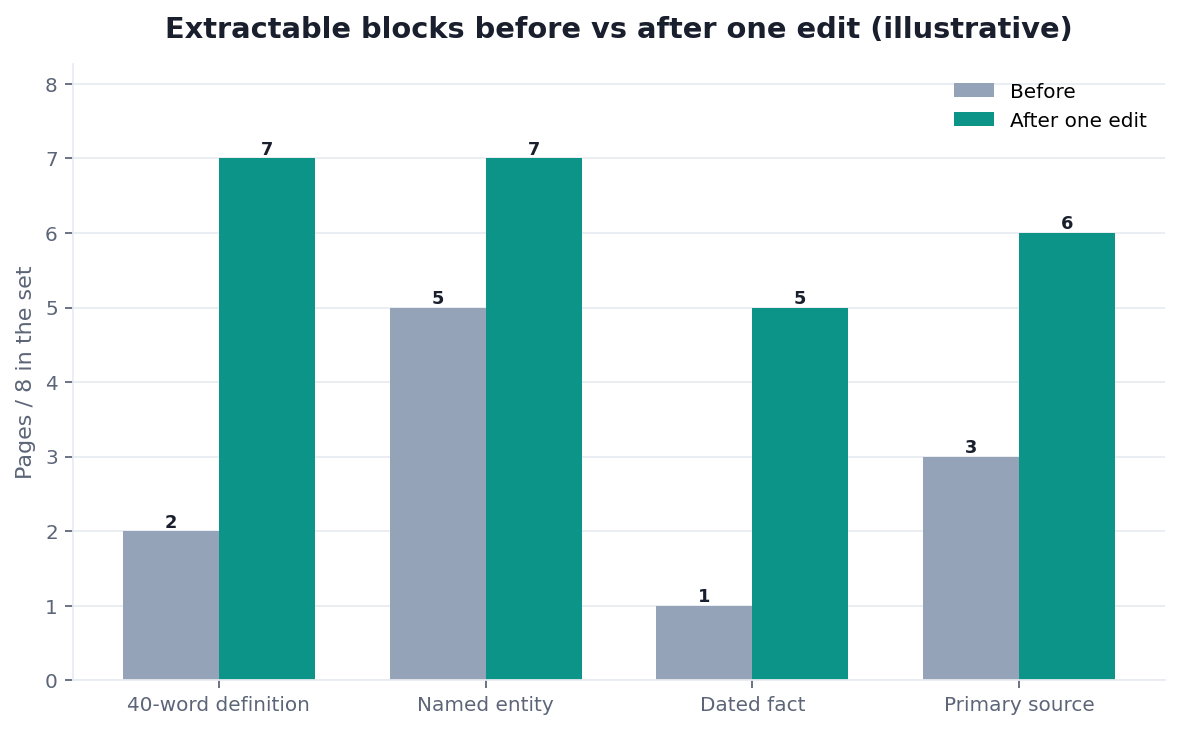
The chart above is an illustrative desk sketch on eight pages, not a utilization study. Pages with a 40-word definition moved from 2 to 7. Named-entity blocks moved from 5 to 7. Dated facts moved from 1 to 5. Primary-source sentences moved from 3 to 6. The cheapest gap was the definition. The rarest before the edit was a dated fact. We do not publish a fake customer win from those eight bars. That before/after table is the only ai visibility optimization benchmark we will defend on this page.
| Extractable block | Pages / 8 before (illustrative) | Pages / 8 after one edit (illustrative) |
|---|---|---|
| 40-word definition | 2 | 7 |
| Named entity | 5 | 7 |
| Dated fact | 1 | 5 |
| Primary source | 3 | 6 |
Mention is cheaper than a citation
A model can say your name while pointing at a rival. ai visibility optimization starts when you treat that as a failed citation, not a win. Google’s introduction to structured data is the public reason machines already prefer explicit, parseable facts. Schema does not buy a mention. It names what the paragraph already said.
Do not buy a mention rate. Fix the paragraph. Then re-run. Log the miss on a brand visibility tool week before you edit the page.
Eligibility is still a fetch
If the URL 404s, 401s, or hides the definition behind a login, no amount of ai visibility optimization will produce a citation. Fetch the page. Read the HTML. If a one-shot run returns cannot-score, stay on the AI visibility checker until the document is readable.
W3C’s JSON-LD 1.1 recommendation is how many sites already embed machine-readable statements next to the prose. Use it to repeat a fact that is already on the page. Do not use it as a substitute for the paragraph.
Extractable paragraphs
Answer engines lift short, declarative blocks. They do not lift a hero screenshot. ai visibility optimization is mostly boring HTML: a definition, a number with a source, a comparison sentence that names both sides.
Write the definition in the first screen. Keep it under sixty words. Put it in a paragraph, not an image. If the first screen is a video or a form, add a text block above the fold anyway. Citeable-page work does not require a redesign; it requires a sentence the fetch can copy.
Definition blocks a model can lift
A usable definition names the thing, says what it is, and says what it is not. That is the same shape as the Key Definition on this page. ai visibility optimization fails when the only definition lives in a PDF, a carousel, or a collapsed FAQ the fetch never sees.
If ten product pages share an empty template, fix the template once. Re-run one URL. Do not buy twelve seats to learn the block is shared. Template work is still ai visibility optimization. A shared empty block is the cheapest extractability win you will get this quarter, and it is the one teams skip because it looks like engineering, not content.
Stats, sources, and plain HTML
A number without a source is a slogan. A source without a visible sentence is a footer. Put the fact in the paragraph. Link the source in the same sentence. ai visibility optimization is not a bibliography dump at the bottom.
The ACL Anthology is the public library of computational linguistics papers; it is a reminder that extractable claims have a venue and a title, not a vibe. You do not need a paper. You need a sentence a model can quote without inventing the number.
After the first definition edit, re-run the paid AI visibility check on the same prompts. A new prompt cannot prove the block landed.
Entities the answer can name
Models name things they can resolve. A slogan is not an entity. Wikipedia’s named-entity recognition article is the vocabulary for why “the leading platform for modern teams” is harder to cite than a product name, a company name, and a category term used the same way twice.
ai visibility optimization includes a short entity list on the page: brand, product, category, and one comparison set. Repeat those strings in prose. Do not hide them in a logo. Write the category the way a buyer would type it, not the way a brand deck renamed it last spring.
If legal wants a longer product name in the footer, keep the short name in the definition. Two strings are fine. A definition that never says the searchable name is not citeable-page work. It is a brochure.
Named entities versus slogans
If the H1 is a metaphor and the brand appears only in the nav, the answer has nothing to attach a citation to. Say the name. Say the category. Say the rival you are willing to be compared with. That is still ai visibility optimization, not advertising copy.
Brand-name logging — aliases, mention versus citation — is the measurement half in AI Brand Visibility Tracking. Do the page work here. Log the outcome there.
Schema that names the term
schema.org’s DefinedTerm type is a machine-readable name-plus-definition pair. Use it when the page already has that pair in HTML. ai visibility optimization that ships DefinedTerm without a visible definition is theater.
JSON-LD should match the paragraph. If they disagree, the paragraph wins for readers and the graph looks sloppy for machines. Keep one fact, two encodings.
EEAT evidence on the same page
Citation prefers a page that looks like it was written by someone who did the work. The four-letter framework is E-E-A-T SEO. ai visibility optimization reuses that evidence on the answer surface; it does not invent a second trust science.
W3C’s PROV overview is the public model for provenance: who produced what, from which inputs, when. A byline, a last-updated date, and a method sentence are the on-page version. We put those on this page because we build the checker, not because a rater score exists.
Experience that is not a bio widget
Experience is a first-person method: we sampled sitemaps, we read GSC exports, we refused a score the rules cannot support. A stock headshot is not that. ai visibility optimization should add one method sentence near the claim, not a sidebar of logos.
If you cannot say how you know, delete the number. A missing number is better than a invented one.
Trust signals answer engines reuse
Author, date, and a fetchable source beat a “trusted by” row. ai visibility optimization does not require a press page. It requires a page a model can quote without guessing who wrote it.
A calibrated EEAT diagnosis is a paid add-on on infinisynapse.com. It is not a Google official score. If a vendor sells an official EEAT number, they are selling a number Google does not publish.
A repair sequence you can re-run
Treat ai visibility optimization as a 30-day framework, not a redesign. The loop is the same four steps in the HowTo on this page.
- Lock a prompt set. Write ten prompts in one locale. Do not change them between runs.
- Run four surfaces. Record ChatGPT, Perplexity, Gemini, and AI Overviews on the same set.
- Log mention versus citation. A name-drop is a mention. A URL you control is a citation.
- Fix the weakest extractable block. Add a short definition, a named entity, or a dated fact, then re-run.
| Week | Edit | Re-test |
|---|---|---|
| 1 | Definition block in HTML | Same ten prompts |
| 2 | Entity names in H1 and first paragraph | Same ten prompts |
| 3 | Method sentence + byline + date | Same ten prompts |
| 4 | One comparison sentence with a source | Same ten prompts |
Change one thing. Re-run. A four-edit week with a new prompt set is not a test. ai visibility optimization is easier to defend when the week’s note names the block you touched: definition, entity, byline, or comparison. If the note says “polish,” you will not know what worked.
Fix one block, then re-test
The unit is one URL. The instrument is the locked set. Continuous weeks after the first punch list belong on an AI visibility tracker. ai visibility optimization is the edit between those runs.
If week one still cannot-score, stop editing copy. Fix the fetch. Then come back. Empty HTML is not an ai visibility optimization problem.
When to stop editing
Stop when the citation cell flips to a URL you control on the surfaces you care about, or when the missing evidence is off-site reputation you cannot ship in HTML. ai visibility optimization cannot invent a review corpus. It can make the page extractable.
If Overviews still skip you after the definition and the entities are in HTML, check eligibility before you rewrite the brand story again: can the URL be fetched, is the locale right, is a stronger publisher paragraph sitting on the same query. That check is still extractability work, just a different layer than copy.
The buyer table sits in visibility checking tools. Diagnosis is the punch list. Monitoring is the line after you ship.
The zero-click reason to bother is why teams still monitor answers. Seats and history are a platform buy after the page is citeable.
Failure modes
Shipping a wall of schema
JSON-LD without a paragraph is not ai visibility optimization. It is a graph the answer will ignore. Write the sentence first.
Hiding the definition in a screenshot
If the only crisp definition is in a PNG, the fetch got pixels. Put the words in HTML. Then decorate. A screenshot is not ai visibility optimization.
Buying a mention rate
A dashboard that sells a citation percentage with no prompt list is not a repair plan. ai visibility optimization is a punch list you can close. If you need the first list generated, start the paid AI visibility check on the URL that missed.
Inspect the complete AI Visibility Optimization page
Paste a sanitized URL into the InfiniSynapse SEO Health Checker so every title, mention, citation, and on-page layer can be reviewed together. Then validate the findings on the live page.
Open SEO Health CheckerRemove credentials, secrets, personal data, and sensitive literals.Frequently Asked Questions
What is the first edit I should make?
Bottom line: Write a 40–60 word definition in HTML near the top. Re-run the same prompts. If you were mentioned and not cited, that block is the usual gap.
Do I need schema to get cited?
Bottom line: No. Schema repeats a fact the paragraph already stated. ai visibility optimization can ship a citeable paragraph with no JSON-LD. Schema without the paragraph is theater.
How is this different from ordinary on-page SEO?
Bottom line: On-page work still matters for eligibility. ai visibility optimization adds extractability for generated answers: definition, entities, provenance. Rank can hold while the citation cell stays empty.
How do I know the edit worked?
Bottom line: The citation cell flips to a URL you control on the same prompts. A new prompt is a new test. Do not rewrite the question to manufacture a win.
What should I do in the first hour?
Bottom line: Pick one URL. Write the definition. Name the brand and the category in the first paragraph. Open the paid AI visibility check on the locked set, then change only the weakest block before you re-run.
Conclusion
ai visibility optimization is extractable paragraphs, named entities, and EEAT evidence on a fetchable URL. It is not a mention-rate product. Fix one block, re-run the same prompts, and run the paid AI visibility check when you want the punch list generated. For the category loop, stay on the tool hub.
Use ai visibility optimization when the citation cell is empty and the page is already fetchable. Write the definition before you buy a seat. After the pass, pick the weakest extractable block and edit that page. Then run the same prompts again. If you change the questions between runs, you did not re-test.
References
- Stanford HAI — AI Index 2025: State of AI in 10 Charts — organizational AI use 78% (2024); generative AI in a function 71%; U.S. private AI investment $109B; inference cost drop cited above. Retrieved 2026-08-17.
- McKinsey — The state of AI · Gartner Peer Insights — Analytics & BI — third-party frames, not a citation metric.
- Google — Intro to structured data · W3C JSON-LD 1.1 · W3C PROV overview · schema.org DefinedTerm · Wikipedia — Named-entity recognition · ACL Anthology.
- InfiniSynapse desk — 76
/en/tool/pages, one brand; illustrative eight-page before/after chart on this page. Not a customer lift study.
About the author — William Zhu, cofounder of InfiniSynapse. Public work: InfiniSQL, auto-coder, retrieval systems (GitHub @allwefantasy). Reviewer: InfiniSynapse Data Team. Published 2026-08-16. Updated 2026-08-17. Policy: editorial standards · privacy.
William Zhu · Cofounder, InfiniSynapse · GitHub @allwefantasy
Desk-validated SEO Health methods. Corrections: zhuhl@infinisynapse.com · corrections policy.