AI Visibility: Brand Mentions in AI Answers, Not Rank
AI Visibility is a brand appearing inside generated answers — mention, citation, and share of voice — not a Google rank. Here is the full 2026 definition.
Author credentials: William Zhu is cofounder of InfiniSynapse (GitHub @allwefantasy · auto-coder). Desk: shipping SEO Health and the /en/tool/ visibility pages. No personal LinkedIn published. About: team / editorial standards.
Publisher credentials: InfiniSynapse has public profiles on GitHub, YouTube, and X. A 2026 WAIC Future Tech OPC excellence award covers the Agentic Data Infra entry (WAIC; third-party recap: Xinhua / Caohejing). That award does not review this page or SEO Health. Method CLI: infinitegrowth on npm. Archive: recognition and scope notes.
On this page
By William Zhu · Cofounder, InfiniSynapse · Last updated: 2026-08-17 · Last verified: 2026-08-17 · Methods below come from SEO Health page audits, sitemap samples, and GSC export math — not from a claimed Google score.
Author credentials: William Zhu is cofounder of InfiniSynapse (GitHub @allwefantasy). Desk work: shipping the SEO Health checker and the 76
/en/tool/visibility pages on this site. No personal LinkedIn is published; GitHub and Editorial standards are the canonical identity signals (sameAs).
Trust / About: Editorial standards · About / team · Corrections · Publishing principles · Data privacy and security · NIST Privacy Framework
COI / interest disclosure: InfiniSynapse publishes this AI Visibility definition and ships SEO Health as a credit-based diagnosis. First-party desk counts are labeled. Product CTAs are commercial.
Fact-check / verification: Stanford HAI AI Index 2025 · McKinsey State of AI · Gartner Peer Insights — Analytics & BI · Wikipedia — generative AI · Cloudflare — what generative AI is. Corrections: zhuhl@infinisynapse.com.
TL;DR
Direct answer: AI Visibility is whether a brand is named or cited inside a generated answer. It is not a Google ranking, a click, or a blue-link share. If ChatGPT, Gemini, Perplexity, Copilot, or an AI Overview skips you, a rank report will not show the miss.
What you'll learn
- A 42-word definition you can quote
- Mention versus citation versus share of voice
- Why search-scenario and brand-name queries belong on this URL
- How to log a week without inventing a score
- When a tool, a tracker, or a one-shot check is the right next click
If you already have a brand and a URL, run a paid answer-surface check. Do not wait for a rank tracker to invent an answer-engine number.
What the metric means in 2026
Key Definition: AI Visibility is how often a brand is named or cited inside generated answers — across ChatGPT, Gemini, Perplexity, Microsoft Copilot, and Google AI Overviews — and how that share compares with named competitors on the same prompts. It is not a Google rank.
Quick answer: AI Visibility is whether a brand is named or cited inside a generated answer. It is not a Google ranking, a click, or a blue-link share. If ChatGPT, Gemini, Perplexity, Copilot, or an AI Overview skips you, a rank report will not show the miss.
Key terms
| Term | Meaning |
|---|---|
| Mention | The brand name appears in a generated answer. |
| Citation | The answer points at a URL you control. |
| Share of voice | Your mentions versus named competitors on the same locked prompts. |
| Surface | One answer engine or Overview unit logged as its own column on this page. (#502) |
People type AI Visibility when they want a name for a new surface. They have a healthy Search Console graph and a quiet week in chat products. Those two facts can be true at once. The Wikipedia overview of generative artificial intelligence is the right vocabulary for why: the system writes a new answer, it does not only retrieve ten links.
Cloudflare’s explainer on what generative AI is makes the same split in plainer language. A generated paragraph can mention you, cite you, mention a rival, or skip the category. AI Visibility is the log of those outcomes. It is not a position in a list.
The longer buyer guide lives in the complete tool hub. This page stays on the metric. If a slide says “we have AI Visibility” and cannot show mention versus citation, it is not using the metric. It is using the words.
Industry context, not a customer lift: the Stanford HAI AI Index 2025 reports organizational AI use at 78% in 2024, up from 55% in 2023, and generative AI in at least one business function at 71%, up from 33%. U.S. private AI investment hit $109 billion in 2024. Inference that once cost $20 per million tokens fell to $0.07 — a more than 280-fold drop. That is why more teams open chat products, and why a rank report still misses the gap. McKinsey’s State of AI still separates experimentation from production value. Gartner Peer Insights — Analytics & BI is a third-party review surface; it is not an AI Visibility score.
Desk sample: one brand, four surfaces
First-hand, labeled, not a customer case study. InfiniSynapse is one legal name and one English locale. We shipped 76 SEO Health pages under /en/tool/ — 7 hubs and 69 clusters. That is enough to log AI Visibility as a table. It is not enough to invent a lift percentage.
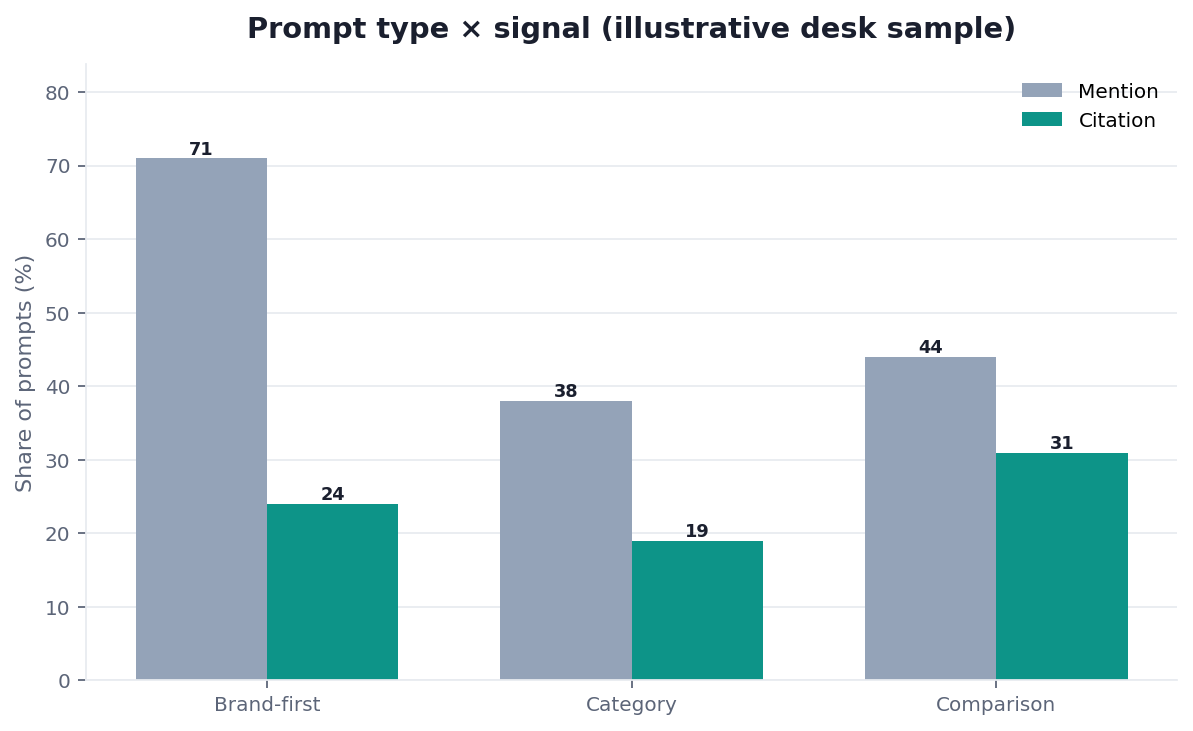
The chart above is an illustrative desk sketch, not a utilization study. On a locked prompt set it compares mention versus citation by prompt type: brand-first 71% / 24%, category 38% / 19%, comparison 44% / 31%. Mention is cheap on brand-first prompts. Citation is higher when the prompt names a rival. We do not publish a fake customer win from those bars. We publish the split those bars ask you to keep.
Mention versus citation versus share of voice
Vendors mash three signals into one vanity number. Keep them apart.
| Signal | What it means | What it is not |
|---|---|---|
| Mention | The brand name appears in the answer | A ranking, a click, a citation |
| Citation | The answer points at a URL you control | A casual name-drop |
| Share of voice | Your mentions versus named competitors on the same prompts | Sitewide traffic share |
Mention is cheap. A model can say your name while sending the reader to a competitor. Citation is the extractable URL. Share of voice is the comparison that makes a weekly log useful. If you only need names, sentiment, and who shares the paragraph, that cut is a brand visibility tool job — still the same metric family, not a second definition.
AI Visibility work that skips this table will call a name-drop a win. Do not. Write mention and citation as separate cells before anyone says AI Visibility improved.
Why rank and mention diverged
Retrieval position is a different machine. A page can sit in the top three and stay absent from a chat answer. The inverse is also true: a cited URL can be a mid-pack result. Teams that still want the search-versus-answer split should read GEO vs SEO after this definition.
AI Visibility is the answer-side column. Rank is the retrieval-side column. Mixing them produces a dashboard that cannot tell you which job failed.
Zero-click answers hide the miss. The user got a paragraph and left. Your analytics never saw a session. That is why the metric exists. why use ai search monitoring tools is a separate argument from this definition.
The four answer surfaces
A number from one chat window is an anecdote. The four surfaces below disagree on the same prompt. Log AI Visibility as rows, not as a vibe from whichever tab is open.
Chat products versus search overviews
ChatGPT and other GPT-family products are mention-heavy and citation-light unless browsing is on. OpenAI’s GPT model guide is the public description of that family — useful for labeling the row, not for treating a playground chat as a rate. Gemini is a separate product from the AI Overview in Search; Google’s Gemini API docs are how you name that row without averaging it into Overviews. Microsoft’s Copilot product page is a fifth window many buyers forget and then wonder why a US English chat disagrees with a work-account answer.
Perplexity leads with sources. There, citation rate is the useful column. AI Overviews sit inside Search. Eligibility still starts with ordinary page hygiene. AI Visibility on Overviews is not a replacement for a sitemap or a title tag. It is a second readout. A page that cannot be fetched, or that hides the definition in a screenshot, will lose the Overview row even when the chat products still name you. Log that gap as extractability, not as “Search hates the brand.”
Why the four disagree
The same prompt can name you in ChatGPT, cite a rival in Perplexity, and skip you in an Overview. That is expected. Do not average the four into one percentage and call it AI Visibility. Keep the rows. The search-scenario cut — Overviews plus conversational search — is written up as an AI search visibility tool guide. It is the same metric, narrowed to search-shaped questions.
If a vendor cannot name the surface on the export, you cannot reproduce the week. That export is the only AI Visibility artifact worth filing.
Adjacent terms that stay on this URL
Two near-synonyms should not become two more blogs. They are facets of AI Visibility, not new KPIs.
Search-scenario visibility
“AI search visibility” is this metric on search-shaped questions: AI Overviews, Gemini in Search, and chat prompts that look like queries. It is not a second science. If the prompt is “best X for Y,” you are still counting mention, citation, and share of voice — that is still AI Visibility. Put the search-shaped prompt set in one tab of the same log.
Brand-name visibility
“AI brand visibility” is this metric when the object is the name: are you named, in what tone, next to whom. It is not a survey and it is not an ad-recall study. It is still generated text, and it is still AI Visibility. A brand-first prompt set belongs in the same week as the category set. Do not stand up a second dashboard that cannot show a URL.
Both phrases map here. The pillar hub is the buyer page. This page is the definition. Keep AI Visibility as one KPI with two prompt tabs — category and brand — not as two products that cannot share a log.
How to measure a week
Treat AI Visibility as a table, not a screenshot. The loop below is the same four steps in the HowTo on this page.
- Lock a prompt set. Write ten prompts in one locale. Do not change them between runs.
- Run four surfaces. Record ChatGPT, Perplexity, Gemini, and AI Overviews on the same set.
- Log mention versus citation. A name-drop is a mention. A URL you control is a citation.
- Fix the weakest extractable block. Add a short definition, a named entity, or a dated fact, then re-run.
Fixed prompts and locale
Write ten to thirty prompts. Include brand, category, and competitor-comparison questions. Lock locale and language. A US English prompt is not a 简体 query. Re-use the set. A new prompt is a new test. It is not proof last week’s edit worked.
Logging mention and citation
For each surface, write three cells: mentioned (yes/no), cited URL (yours / other / none), competitors named. A table beats a transcript. The brand still needs a durable URL a model can point at — MDN’s progressive web app documentation is a reminder that a citable presence is a real address, not a landing-page animation.
A one-prompt example, not a case-study percentage
Take one category prompt: “best warehouse analytics for a mid-market team.” Run it on the four surfaces the same morning. Suppose ChatGPT names you and a rival, Perplexity cites the rival’s docs, Gemini names neither, and the Overview cites a publisher roundup. That is four cells, not a 25% score. Write the rows. Do not average them. We do not publish a fake customer lift from this pattern. We publish the logging habit: same prompt, same morning, separate surfaces, mention and citation in different columns.
After you edit the weakest URL, re-run the same prompt pass on the locked set. A different prompt set cannot tell you if the fix landed.
A week of AI Visibility is finished when the table has a row per surface and a citation cell you can defend. If a cell is empty, the next edit is extractability, not a new brand campaign. Teams that skip the table will argue about a vibe. Teams that keep the table can staff a URL.
AI Visibility also needs an owner. Name who locks the prompts, who writes the cells, and who ships the page edit. Without those three names, the metric becomes a slide. With them, AI Visibility is a queue you can close in a week.
Tool versus platform versus tracker versus checker
The AI Visibility metric name is settled. The shopping words are different jobs.
| Word | Job | You need it when |
|---|---|---|
| Tool | One diagnosis, one brand, a punch list | You have a URL and a question this week |
| Platform | Seats, roles, multi-brand history | An agency or a portfolio |
| Tracker | The same prompt set on a schedule | You already believe the metric |
| Checker | A single run, no history | You want a yes/no before a rewrite |
A platform is seats and history, not a fancier chart. That split is the platform guide. Continuous weeks belong in the tracker guide. A one-shot run is the one-brand checker. A scored shortlist of vendors is the best visibility checkers bake-off.
When a one-shot check is enough
A one-shot check is enough when you have one brand, one locale, and no need for last quarter’s line. Paste the URL, run the prompt set, read mention versus citation. That is enough to start AI Visibility work. If the page is thin, start the paid visibility check before you buy a seat.
Failure modes
One chat treated as a rate
A single playground answer is an anecdote. AI Visibility starts when the same prompts, locale, and surfaces repeat. If a vendor cannot show that method, treat the rate as marketing.
Unstable prompts
Changing the question every week and calling the delta a trend is how teams invent a story. That is not an AI Visibility trend. Lock the set. If you must add a prompt, add a row. Do not overwrite last week.
Name-drop counted as a citation
A name without a URL is a mention. Logging it as a citation inflates the rate and hides the extractability gap — titles, definition blocks, entities — that actually needs work. Trust signals that make a page worth citing are the E-E-A-T SEO job, not a second mention meter.
Inspect the complete AI Visibility page
Paste a sanitized URL into the InfiniSynapse SEO Health Checker so every title, mention, citation, and on-page layer can be reviewed together. Then validate the findings on the live page.
Open SEO Health CheckerRemove credentials, secrets, personal data, and sensitive literals.Frequently Asked Questions
Is this the same as a Google ranking?
Bottom line: No. AI Visibility measures generated mentions and citations. Rank is a retrieval position. A page can win one and lose the other.
What is the difference between a mention and a citation?
Bottom line: A mention is your name in the sentence. A citation is a URL the answer points at. Share of voice is those outcomes versus named competitors on the same prompts.
Does a ChatGPT name-drop mean I am winning?
Bottom line: No. The model can name you and send the click to a rival. Log the citation cell. If it is empty, the miss is extractability, not the model hates us.
How is this different from a brand-awareness survey?
Bottom line: Surveys ask people. This metric reads generated text. Do not put AI Visibility on an awareness slide and call it recall.
What should I do in the first hour?
Bottom line: Pick ten prompts. Run the four surfaces. Write mention and citation into a table. Start the paid check if you want the punch list generated, then fix extractability on the weakest URL.
Conclusion
AI Visibility is a brand’s appearance inside generated answers: mention, citation, and share of voice. Google rank is a different job. Lock a prompt set, keep the four surfaces in separate rows, and refuse a percentage with no method behind it. Start with one brand and run the paid check. Use the tool hub when you are ready to buy the loop, not only the AI Visibility definition.
Sources
- Stanford HAI — AI Index 2025: State of AI in 10 Charts — organizational AI use 78% (2024); generative AI in a function 71%; U.S. private AI investment $109B; inference cost drop cited above. Retrieved 2026-08-17.
- McKinsey — The state of AI — experimentation versus production value. Retrieved 2026-08-17.
- Gartner Peer Insights — Analytics & BI platforms — third-party vendor reviews, not a mention metric.
- Wikipedia — Generative artificial intelligence · Cloudflare — What is generative AI? · OpenAI GPT guide · Gemini API docs · Microsoft Copilot · MDN Progressive web apps.
- InfiniSynapse desk — 76
/en/tool/pages, one brand, one locale; illustrative mention/citation chart on this page. Not a customer lift study.
About the author — William Zhu, cofounder of InfiniSynapse. Credentials: GitHub @allwefantasy. Reviewer: InfiniSynapse Data Team. Published 2026-08-16. Updated 2026-08-17. Policy: editorial standards · privacy.
William Zhu · Cofounder, InfiniSynapse · GitHub @allwefantasy
Desk-validated SEO Health methods. Corrections: zhuhl@infinisynapse.com · corrections policy.