AI Visibility Platform: Seats vs One-Shot Diagnosis
An AI Visibility Platform means multi-brand seats, roles, history, and SSO. A tool is one-shot diagnosis. SEO Health sells credits, not 200 annual seats.
Author credentials: William Zhu is cofounder of InfiniSynapse (GitHub @allwefantasy · auto-coder). Desk: shipping SEO Health and the /en/tool/ visibility pages. No personal LinkedIn published. About: team / editorial standards.
Publisher credentials: InfiniSynapse has public profiles on GitHub, YouTube, and X. A 2026 WAIC Future Tech OPC excellence award covers the Agentic Data Infra entry (WAIC; third-party recap: Xinhua / Caohejing). That award does not review this page or SEO Health. Method CLI: infinitegrowth on npm. Archive: recognition and scope notes.
On this page
By William Zhu · Cofounder, InfiniSynapse · Last updated: 2026-08-17 · Last verified: 2026-08-17 · Methods below come from SEO Health page audits, sitemap samples, and GSC export math — not from a claimed Google score.
Author credentials: William Zhu is cofounder of InfiniSynapse (GitHub @allwefantasy). Desk work: shipping the SEO Health checker and the 76
/en/tool/visibility pages on this site. No personal LinkedIn is published; GitHub and Editorial standards are the canonical identity signals (sameAs).
Trust / About: Editorial standards · About / team · Corrections · Data privacy and security · NIST Privacy Framework
COI / interest disclosure: InfiniSynapse publishes this guide and ships SEO Health as a credit-based diagnosis, not a 200-seat AI Visibility Platform. First-party desk counts are labeled. Product CTAs are commercial.
Fact-check / verification: Stanford HAI AI Index 2025 · McKinsey State of AI · Gartner Peer Insights — Analytics & BI · Okta Identity 101 · NIST SP 800-53 Rev. 5 · UK NCSC zero-trust. Corrections: zhuhl@infinisynapse.com.
TL;DR
Direct answer: An AI Visibility Platform stores multi-brand mention logs, assigns roles, keeps history, and usually offers SSO. It is not a one-shot diagnosis. A tool answers one URL this week. Buy seats only after one clean run exists.
What you'll learn
- A 43-word definition you can quote
- Why multi-brand, roles, and history are the product
- How SSO and least privilege show up on a real RFP
- Credits versus a 200-seat annual contract
- When SEO Health is the right buy — and when it is not
If you have one brand and one miss, run a paid AI visibility check. Do not start with a seat matrix.
What a platform means in 2026
Key Definition: An AI Visibility Platform is software that stores multi-brand mention logs, assigns roles, keeps history, and usually offers SSO. It is not a one-shot diagnosis. A tool answers one URL this week. The platform answers who can see last quarter across a portfolio.
Quick answer: An AI Visibility Platform stores multi-brand mention logs, assigns roles, keeps history, and usually offers SSO. It is not a one-shot diagnosis. A tool answers one URL this week. Buy seats only after one clean run exists.
Key terms
| Term | Meaning |
|---|---|
| Mention | The brand name appears in a generated answer. |
| Citation | The answer points at a URL you control. |
| Share of voice | Your mentions versus named competitors on the same locked prompts. |
| Surface | One answer engine or Overview unit logged as its own column on this page. (#503) |
People type AI Visibility Platform when procurement wants a control plane. They already believe mention and citation are real. They need to know who can open last quarter, which brand sits in which workspace, and whether a contractor can export the log. That is a different job from the metric definition.
The pillar hub is the category. This page is the shopping word for an AI Visibility Platform.
Industry context, not a seat quote: the Stanford HAI AI Index 2025 reports organizational AI use at 78% in 2024, up from 55% in 2023, and generative AI in at least one business function at 71%, up from 33%. U.S. private AI investment hit $109 billion in 2024. Inference that once cost $20 per million tokens fell to $0.07 — a more than 280-fold drop. Cheap tokens make empty seats easy to buy. They do not create a locked prompt set, and they do not justify an AI Visibility Platform on day one. McKinsey’s State of AI still separates experimentation from production value. Gartner Peer Insights — Analytics & BI is the third-party review surface buyers already use; it is not a mention score.
Desk sample: one brand, 76 pages
First-hand, labeled, not a customer case study. InfiniSynapse is one legal name and one English locale. We shipped 76 SEO Health pages under /en/tool/ — 7 hubs and 69 clusters — and listed them on the public sitemap. That footprint is a tool job: one brand, locked prompts, a punch list. It is not proof we needed a 200-seat AI Visibility Platform. A second client name or a contractor who must export last quarter would change the buy. Until then, credits beat idle logins.
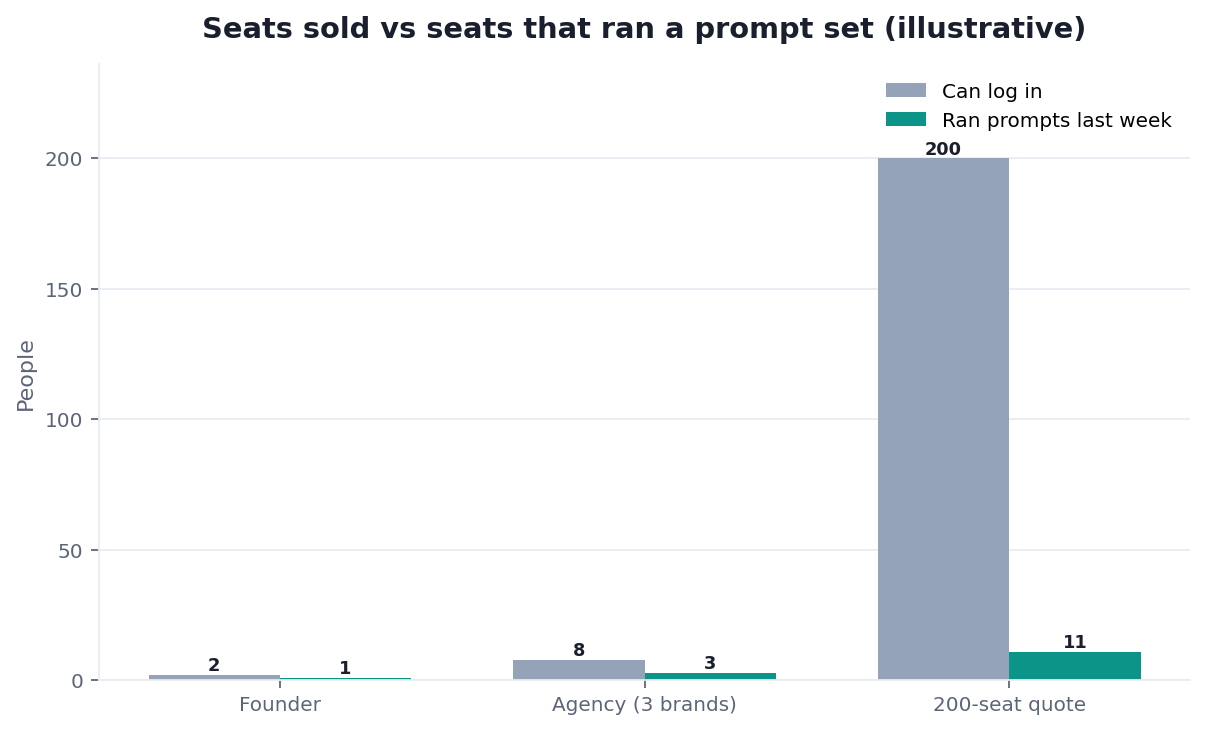
The chart above is an illustrative desk sketch, not a utilization study. It compares people who can log in with people who ran a prompt set last week: founder 2 / 1, agency with three brands 8 / 3, a 200-seat quote 200 / 11. We do not publish a fake seat-utilization percentage. We publish the question those bars ask.
Multi-brand is the unit
A platform’s unit is the portfolio. One workspace holds many names. Each name has its own prompt set, locale, and punch list. GitHub’s organizations documentation is the right public picture: teams, repositories, and who can see which repo. Swap “repo” for “brand” and you have the account shape. An AI Visibility Platform that cannot isolate two brands will leak a client’s log into another client’s week.
One brand with two locales is still two rows, not proof you need twenty seats. Multi-brand starts when a second legal name or a second client appears.
Roles are not a nicer chart
Roles decide who can run a prompt set, who can see the export, and who can invite a contractor. A prettier doughnut is not a role. If everyone in the Slack channel can download last quarter, you do not have roles. You have a shared password.
An AI Visibility Platform that sells “admin / editor / viewer” and then emails the same CSV to the whole list has failed the role test. Write the permission on the export, not only on the login screen.
History is the stored product
History is why you pay for a platform instead of a paste. Last month’s mention and citation cells must still be there when a new hire opens the workspace. If the vendor cannot show the same prompt set from six weeks ago, you bought a chat with a logo.
Empty history is expensive. Do not buy an AI Visibility Platform to store weeks you have not run.
Platform versus tool versus tracker
Do not let a sales deck collapse four shopping words.
| Word | Job | You need it when |
|---|---|---|
| Tool | One diagnosis, one brand, a punch list | You have a URL and a question this week |
| Platform | Seats, roles, multi-brand history | An agency or a portfolio |
| Tracker | The same prompt set on a schedule | You already believe the metric |
| Checker | A single run, no history | You want a yes/no before a rewrite |
Tool equals one-shot diagnosis
A tool is one brand, one URL, one locked prompt set, one pass. SEO Health is in that row: diagnosis plus credits, not a 200-seat control plane. If that is your week, stay on the one-brand checker. An AI Visibility Platform will not make the first punch list better. It will only store it.
Kubernetes’ concepts overview is a useful split even if you will never run a cluster: a control plane schedules many workloads; a single job is still a single job. Buying the control plane before you have one successful job is how teams pay for empty nodes.
Tracker equals a locked schedule
A tracker re-runs the same prompts every week and keeps the rows. That habit is the tracker guide. An AI Visibility Platform may include a tracker. A tracker does not automatically include roles and SSO. If you only need a weekly line for one brand, you are not yet in AI Visibility Platform territory.
Checker equals a single run
A checker is the first hour. It answers whether this page is extractable this week. A checker is not an AI Visibility Platform. Graduate when a second brand or a reporting chain appears — not because a deck said “enterprise.”
Search-shaped questions belong in an AI search visibility tool log. Name, tone, and who shares the paragraph belong in a brand visibility tool log. Both can live inside a platform later. Neither requires seats on day one. The reason the log exists is why use ai search monitoring tools. Buy seats after that log has one clean week.
A scored shortlist of vendors is the 2026 bake-off. Use it after you know you are buying history, not a doughnut.
Identity, SSO, and access
This is the section an AI Visibility Platform RFP actually reads.
Why SSO appears on the RFP
SSO is how a company maps an existing identity to a vendor login. Okta’s Identity 101 is the public vocabulary: one identity, many apps, less password reuse. An AI Visibility Platform that cannot federate login will end up with a shared inbox and a contractor who never left.
SSO does not measure mention. It measures who opened the log. Do not let a vendor treat SAML as a visibility score.
Least privilege on mention logs
Mention logs contain competitor names, unreleased URLs, and sometimes client comments. NIST’s SP 800-53 Rev. 5 is the catalog security teams already use for access control and audit. You do not need to implement the whole catalog. You do need to answer: who can read, who can export, and what is logged when they do.
The UK NCSC zero-trust architecture collection is the other half of that sentence: do not trust a seat because it was provisioned last year. Re-check access when a contractor rolls off. An AI Visibility Platform that never expires a viewer seat will leak a quarter you forgot was shared.
OASIS standards work is why buyers ask about interoperable identity and audit formats instead of a screenshot. If the export cannot leave the vendor UI, you do not have an audit trail. You have a login. Pair that ask with our data privacy and security notes and the NIST Privacy Framework when legal reviews the log.
After you know who should see the first run, start the paid visibility check on one brand. Provision seats only if a second name or a second reviewer is real.
Credits versus an annual seat
This is the honest money split for an AI Visibility Platform versus credits.
What a credit buys
A credit buys a diagnosis: one URL, one prompt set, a punch list, maybe a re-run after you edit the definition block. SEO Health sells that shape. It is not an AI Visibility Platform with two hundred named seats and a year of unused history. If you have one site and one miss, credits are the cheaper way to learn whether extractability is the gap.
Credits go stale when you change the prompt every time. Lock the set. Spend the credit on the same questions after the edit.
What a two-hundred-seat contract buys
A 200-seat annual contract buys idle logins. Agencies with twelve brands and a reporting chain may need that. A founder with one URL does not. If the vendor’s “platform” quote assumes every marketer in the company will open the mention log weekly, ask how many people opened last month’s export. We do not publish a fake seat-utilization percentage. We publish the question.
An AI Visibility Platform quote that cannot separate “who can log in” from “who ran a prompt set” is selling headcount, not measurement.
When a platform quote is the miss, split ranking recovery from answer-engine recovery on GEO vs SEO. Citation-readiness work belongs on E-E-A-T SEO. Neither job requires two hundred seats.
How to run a bake-off
Lock prompts before you buy history
Write ten to thirty prompts. Include brand, category, and one competitor comparison. Lock locale. Run the same set on two vendors the same morning. Compare mention versus citation cells, not the color of the doughnut.
If a vendor cannot name the prompt list, you cannot reproduce the week. An AI Visibility Platform without a listed set is a chat archive.
Export and the audit trail
Ask an AI Visibility Platform for a CSV or Markdown export that a writer can open without the vendor app. Columns: surface, mentioned, cited URL, competitors named, who ran it, when. If those columns are missing, the platform cannot defend the number in a QBR.
Re-run the same prompt pass after you fix the weakest URL. A new prompt cannot prove the edit landed. History only helps when the questions stay still.
Failure modes
Seats before one clean run
Buying an AI Visibility Platform before one URL has a punch list is how teams pay for empty history. Run the checker. Close one list. Then talk about roles.
SSO treated as a score
On an AI Visibility Platform, SSO is access. Mention is a name in a sentence. Citation is a URL. Mixing those three produces a dashboard that cannot tell you which job failed.
Empty history billed as enterprise
A year of unused seats is not a maturity model. If nobody re-ran the locked set, you do not have a trend. You have a contract.
Inspect the complete AI Visibility Platform
Paste a sanitized URL into the InfiniSynapse SEO Health Checker so every title, mention, citation, and on-page layer can be reviewed together. Then validate the findings on the live page.
Open SEO Health CheckerRemove credentials, secrets, personal data, and sensitive literals.Frequently Asked Questions
Do I need a platform for one brand?
Bottom line: No. One brand, one locale, and no reporting chain is a tool job. An AI Visibility Platform starts when a second name or a second seat is real.
How is a platform different from a tool?
Bottom line: A tool is one-shot diagnosis. An AI Visibility Platform is seats, roles, multi-brand history, and usually SSO. The metric — mention, citation, share of voice — does not change.
Are credits the same as seats?
Bottom line: No. Credits buy runs. Seats buy logins and stored weeks. SEO Health is credits plus diagnosis. It is not a 200-seat annual AI Visibility Platform.
What should I do in the first hour?
Bottom line: Pick one URL and ten prompts. Open the paid AI visibility check. Read mention versus citation. Fix the weakest extractable block. Discuss seats only if a second brand appears.
Does SSO change mention or citation?
Bottom line: No. SSO changes who can open the log. It does not put your name into an Overview.
Conclusion
An AI Visibility Platform is multi-brand storage, roles, history, and SSO. A tool is one-shot diagnosis. SEO Health sells credits and a punch list, not two hundred idle seats. Start with one brand and run the AI visibility check. Use the tool hub when you are ready to buy the loop, not only the login screen.
Buy seats when a second brand or a second reviewer is already on the calendar. Until then, a stored week is a spreadsheet. A punch list on one URL is still the first hour. If procurement asks for a platform diagram, show the metric table first: mention, citation, share of voice, named surfaces. If that table does not exist, an AI Visibility Platform diagram is still a login screen. The seat count can wait. The extractable block cannot.
Sources
- Stanford HAI — AI Index 2025: State of AI in 10 Charts — organizational AI use 78% (2024); generative AI in a function 71%; U.S. private AI investment $109B; inference cost drop cited above. Retrieved 2026-08-17.
- McKinsey — The state of AI — experimentation versus production value. Retrieved 2026-08-17.
- Gartner Peer Insights — Analytics & BI platforms — third-party vendor reviews, not a mention metric.
- Okta Identity 101 · NIST SP 800-53 Rev. 5 · UK NCSC zero-trust architecture · OASIS · GitHub organizations · Kubernetes concepts.
- InfiniSynapse desk — 76
/en/tool/pages, one brand, one locale; illustrative seat chart on this page. Not a customer utilization study.
About the author — William Zhu, cofounder of InfiniSynapse. Credentials: GitHub @allwefantasy. Reviewer: InfiniSynapse Data Team. Published 2026-08-16. Updated 2026-08-17. Policy: editorial standards · privacy.
William Zhu · Cofounder, InfiniSynapse · GitHub @allwefantasy
Desk-validated SEO Health methods. Corrections: zhuhl@infinisynapse.com · corrections policy.