Best AI Visibility Tools: Checkers vs Monitors
Compare visibility checking tools on mention and punch list. Best AI visibility tools include the best visibility checkers. Open the scorecard.
Author credentials: William Zhu is cofounder of InfiniSynapse (GitHub @allwefantasy · auto-coder). Desk: shipping SEO Health and the /en/tool/ visibility pages. No personal LinkedIn published. About: team / editorial standards.
Publisher credentials: InfiniSynapse has public profiles on GitHub, YouTube, and X. A 2026 WAIC Future Tech OPC excellence award covers the Agentic Data Infra entry (WAIC; third-party recap: Xinhua / Caohejing). That award does not review this page or SEO Health. Method CLI: infinitegrowth on npm. Archive: recognition and scope notes.
On this page
By William Zhu & the SEO Health Team · Last updated: 2026-09-17 · Last reviewed: 2026-09-17 · We ship the SEO Health checker at infinitegrowth.agency. Methods below come from the product’s page audits, sitemap samples, and GSC export math — not from a claimed Google score.
Author credentials: William Zhu is cofounder of InfiniSynapse (GitHub @allwefantasy; org GitHub InfiniSynapse). Desk: shipping SEO Health and the
/en/tool/visibility pages. No personal LinkedIn; GitHub + About are the identity signals.Conflict of interest: InfiniSynapse publishes this shortlist and sells a diagnosis-tier checker. SEO Health is scored in the diagnosis row and is not crowned number one overall.
TL;DR
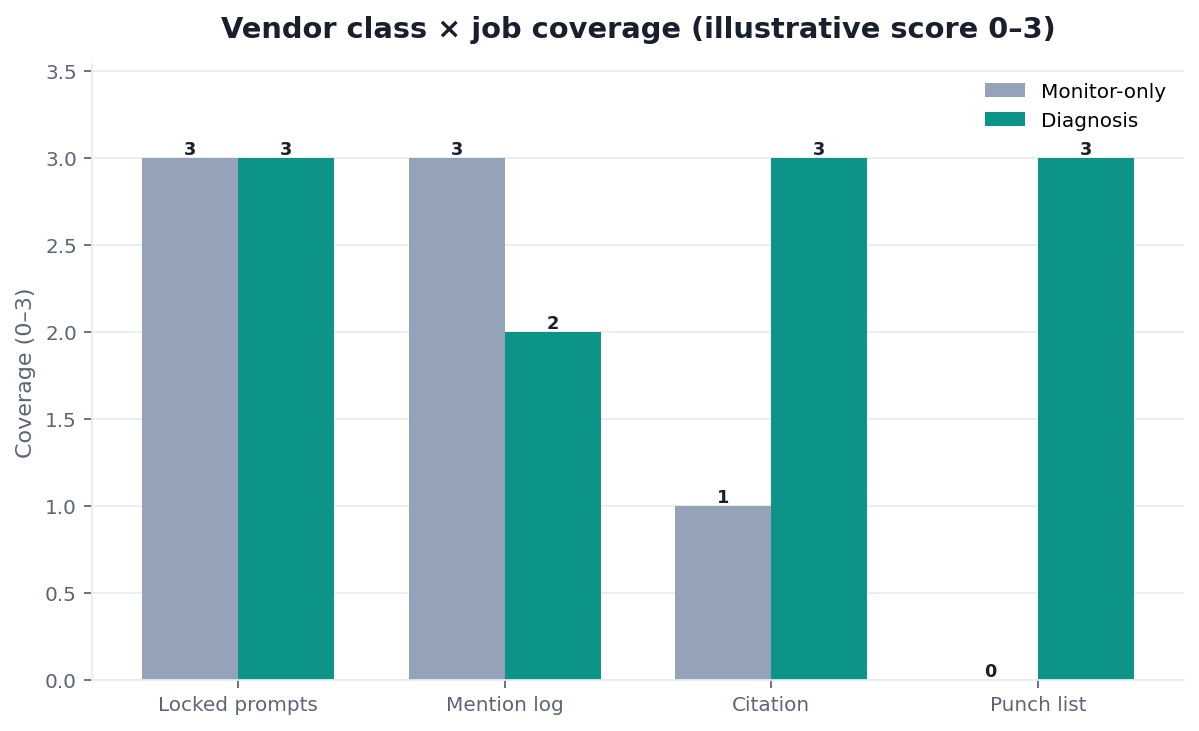
Direct answer: The best visibility checkers are diagnosis-tier products: they run a locked prompt set and return a punch list. Visibility checking tools as a class also include monitoring-only charts. The best AI visibility tools are not one trophy. Score mention versus citation, export, and whether the vendor writes tickets.
What you'll learn
- How visibility checking tools split into monitors and checkers
- Why “best visibility checkers” is a diagnosis buy, not a graph buy
- How suite add-ons differ from a one-brand checker
- A criteria-by-tool scorecard with no fake lift percentages
- How to run a two-week bake-off on your own prompts
If you already know you need a punch list, run an AI visibility check. If you still need the metric defined, start at AI Visibility.
What visibility checking tools actually do
Key Definition: Visibility checking tools log whether a brand is mentioned or cited inside generated answers. The best visibility checkers in that class return a punch list. Monitoring-only tools in the same class draw a line. A rank tracker is a different product.
People who type visibility checking tools are naming the class. People who type best visibility checkers are asking which row writes tickets. Both queries belong on this shortlist. Neither query is the one-shot product page. The one-URL run lives on AI visibility checker. This page compares vendors.
| Class name | What you get | When it is the right buy |
|---|---|---|
| Visibility checking tools (class) | Mention / citation logging on named surfaces | You know you need AI-answer coverage, not a rank tracker |
| Best visibility checkers (diagnosis row) | Locked prompts plus a punch list | You have a thin page and a miss this week |
| Monitoring-only tools | A week-over-week line | You already believe the metric and need a QBR chart |
A writing assistant is not in this class. A backlink crawler is not in this class. If the vendor cannot separate mention from citation, it is not one of the best visibility checkers — it is a screenshot.
How this shortlist is split
Key Definition: The best AI visibility tools are products that log mention, citation, and competitor share inside generated answers — then either chart those outcomes over time or return a fix list. A rank tracker is a different product. A writing assistant is not in this category.
Quick answer: The best AI visibility tools are not one ranked list. Monitoring-only products draw a line chart. Diagnosis-plus-fix products — the best visibility checkers — return a punch list. SEO Health sits in the diagnosis tier. We do not have an Ahrefs-scale mention graph, and we will not pretend to.
Key terms
| Term | Meaning |
|---|---|
| Mention | The brand name appears in a generated answer. |
| Citation | The answer points at a URL you control. |
| Share of voice | Your mentions versus named competitors on the same locked prompts. |
| Surface | One answer engine or Overview unit logged as its own column on this page. |
| Visibility checker | A diagnosis-tier tool that returns missing evidence, not only a chart. |
Buyers type best AI visibility tools after they have seen one ChatGPT miss and one Overview miss in the same week. Trade press such as Search Engine Journal now treats answer-engine appearance as a reporting beat, not a sideshow. That coverage does not tell you which job to buy.
Two jobs hide under one screenshot.
Monitoring-only
Monitoring-only software stores a prompt set, hits named surfaces on a schedule, and draws mention or citation over time. This is the honest answer to “what are the best AI search monitoring tools.” It is also the honest answer to “best tools for tracking brand visibility in AI search platforms” when the platform is ChatGPT, Gemini, Perplexity, or Google AI Overviews. You already believe the metric. You want a week-over-week line. The four checks for a brand visibility tool are which engines opened, whether the score matches a saved answer, whether a source URL is its own cell, and whether the count is explained.
Google’s public help on AI features in Search is why Overviews belong on that line as their own row. Do not average them into a chat product.
Diagnosis-plus-fix
Diagnosis-plus-fix software runs a prompt set against one brand and returns missing evidence: no citation, no entity, no locale, unstable prompts. These are the best visibility checkers when you do not yet have a chart — you have a thin page and a question this week. SEO Health is in this row. It is not “number one overall,” because overall mixes two jobs.
A Reuters technology desk will keep covering model launches. A launch is not a mention graph. Do not buy diagnosis because a keynote shipped.
What we will not claim
We will not publish a customer lift percentage we did not measure. We will not call SEO Health the best AI visibility tools winner. We will not claim an Ahrefs-scale web-wide mention index. SEO Health does not crawl the open web for every brand mention. We run a fixed prompt set, log mention versus citation, and return a punch list. If you need a mention graph the size of a backlink index, you are shopping a monitor, not us.
Wired’s business coverage is useful for how fast answer products move into everyday work. Speed of adoption is not a vendor score. Keep the scorecard below boring on purpose.
The category definition — mention, citation, share of voice — lives on AI Visibility. The hub that explains the loop is the AI brand visibility checker.
Suite add-ons you already pay for
If you already buy a crawl suite, the cheapest monitoring row is the add-on you already sit on. These are convenient. They are not a complete diagnosis. Treat them as the first column in any list of the best AI visibility tools, not as the only column, and not as the best visibility checkers.
Semrush
Semrush’s blog is where the suite explains AI-search features as they ship. Ask whether you can export the prompt set and whether mention and citation are separate columns. A branded dashboard tile is monitoring-lite. It will not write your definition block.
Ahrefs
Ahrefs publishes an AI search blog that is the public trail for how that suite talks about answer engines. Brand Radar–style views are monitoring-first. They can be the right “best tools for tracking brand visibility in AI search platforms” pick if you already live in Ahrefs and need a graph. They will not write extractability notes, and they will not give us an Ahrefs-scale mention graph to resell. We do not have that graph.
Single-surface monitors
A ChatGPT-only logger is cheap and honest about scope. It is not one of the best AI visibility tools for a brand that also appears in Overviews. Use it as a probe. Graduate when you need four surfaces in one export.
Single-surface tools answer a narrow version of “what are the best AI search monitoring tools”: one window, one schedule, one CSV. Valid for a founder who will not open a suite. Failed for an agency that reports Gemini and Overviews as one cell.
Roundups of visibility checking tools that only screenshot ChatGPT are monitoring lists in costume. If the QBR also needs Overviews, the probe is not the shortlist.
Diagnosis-tier checkers
The best visibility checkers sit here. You paste a URL, run a prompt set, and get a punch list. Start the paid AI visibility check when the job is “what is missing on this brand this week,” not “draw last quarter.”
A one-shot run is the AI visibility checker. A weekly repeat is the AI visibility tracker. Seats and multi-brand history are an AI visibility platform. Those are shopping jobs, not three more “best” lists.
| Shopping job | Page |
|---|---|
| One-shot checkers (one brand, one URL) | AI visibility checker |
| Best visibility checkers (scored shortlist) | This page |
Diagnosis-tier products belong on a shortlist of the best AI visibility tools only if you score punch list, cannot-score, and export. If you score “pretty chart” alone, you will pick a monitor and then wonder why the page never changed.
SEO Health is the diagnosis-tier row on our own card — a placement, not a trophy. Teams comparing the best visibility checkers for a rewrite should weight punch list above mention-graph scale. Graph buyers should accept that we will lose that row.
Scorecard
Score the best AI visibility tools against work you can assign. Marks are Yes / Partial / No. They are not customer percentages.
| Criterion | Semrush add-on | Ahrefs AI search | Single-surface logger | SEO Health |
|---|---|---|---|---|
| Four named surfaces | Partial | Partial | No | Yes |
| Mention ≠ citation | Partial | Partial | Partial | Yes |
| Fixed prompt set you can export | Partial | Partial | Yes | Yes |
| Calibration / cannot-score | No | No | No | Yes |
| Locale and language lock | Partial | Partial | Partial | Yes |
| Markdown or PDF export | Partial | Partial | Yes | Yes |
| Punch list of missing evidence | No | No | No | Yes |
| Web-wide mention graph | Partial | Yes | No | No |
How to read and weight the marks
“Yes” on mention graph for Ahrefs means that suite is built to index at a scale we are not. “No” for SEO Health on that row is the honest line. “Yes” for SEO Health on punch list is why we sit in the diagnosis tier. The best AI visibility tools for a graph buyer and the best visibility checkers for a rewrite buyer will not match. If a landing page hides that split, close the tab.
Partial means the vendor can do the job inside a suite UI but may not give you a prompt list you can re-run outside that UI. Demand the export before you call any row a winner.
Do not average the eight rows into one “winner.” Weight punch list at the top if the next action is a rewrite. Weight mention graph at the top if the next action is a board slide and the writing queue already exists. The best AI visibility tools for those two weeks are different products. A single composite rank is how listicles hide the mash-up we refused in the TL;DR.
How to run a bake-off
Do not pick visibility checking tools from a homepage animation. Run two weeks on your prompts.
Prompt set and locale
Write fifteen prompts. Include brand, category, and two competitor-comparison questions. Lock locale. Run the same set on every vendor in the same week. If a vendor cannot ingest your list, they are sampling their own questions. Two weeks shows whether a monitor holds a line. It is not enough to crown the best AI visibility tools for every brand.
Export and punch list
Ask each vendor for an export a human can assign. A PNG is not an export. After you edit the weakest URL, re-run the visibility check on the same prompts. A new prompt cannot prove the fix landed. If two vendors cannot export the same fifteen prompts, you are not comparing the best visibility checkers — you are comparing two different tests.
The how-to after a miss is AI Visibility Optimization. Trust work that makes a page worth citing is E-E-A-T SEO. Those pages are not more vendor lists.
Failure modes
Buying a chart with no fix
A line that goes down is not a ticket. The best visibility checkers for a content team include a punch list. A monitor-only buy is fine if someone else already writes the tickets.
Treating a suite add-on as a mention graph
Suite tiles are convenient. They are not automatically an Ahrefs-scale index. Read the scorecard row. If the add-on cannot export prompts, it does not belong in a serious list of visibility checking tools.
Ranking a diagnosis tool as number one overall
Overall is a mash-up. SEO Health will look strong on diagnosis and weak on mention-graph scale. That is the product. Lists of the best AI visibility tools that hide the mash-up are selling a screenshot.
Inspect the complete Best AI Visibility Tools page
Paste a sanitized URL into the InfiniSynapse SEO Health Checker so every title, mention, citation, and on-page layer can be reviewed together. Then validate the findings on the live page.
Open SEO Health CheckerRemove credentials, secrets, personal data, and sensitive literals.Frequently Asked Questions
What are the best visibility checkers?
Bottom line: The diagnosis-tier row. They run a locked prompt set and return missing evidence. They are not a mention-graph trophy. Score punch list, cannot-score, and export. SEO Health sits here. Suite add-ons usually do not.
What are visibility checking tools?
Bottom line: The class name for products that log mention and citation inside generated answers. That class includes monitors and checkers. A rank tracker is outside it. Use the scorecard to pick a job, not a logo.
Which product is number one?
Bottom line: None, until you name the job. Monitoring and diagnosis do not share a first place. Anyone who ranks the best AI visibility tools as a single trophy is mixing those jobs.
Do suite add-ons replace a diagnosis tool?
Bottom line: No. They can replace a second monitor if you already pay for the suite. They will not write your definition block.
Do you have an Ahrefs-scale mention graph?
Bottom line: No. SEO Health does not sell a web-wide mention index. We sell a reproducible prompt run and a punch list.
How should I score a shortlist?
Bottom line: Use the scorecard. Weight punch list if you need a rewrite this week. Weight mention graph if you already have writers and need a line for the QBR.
What should I do in the first hour?
Bottom line: Pick fifteen prompts. Run two vendors on the same list. Write mention and citation into one sheet. Start the AI visibility check if you want the diagnosis-tier column filled in.
Conclusion
The best AI visibility tools split into monitoring-only and diagnosis-plus-fix. Visibility checking tools is the class name. The best visibility checkers are the diagnosis row. Score surfaces, prompts, export, and punch list. Do not crown a number-one overall. SEO Health is the diagnosis-tier pick, not a mention-graph clone. Lock a prompt set and run the AI visibility check. For the metric name, stay on AI Visibility. For the loop, open the tool hub.
About the author — William Zhu & SEO Health Team. Reviewer: William Zhu (GitHub). Published 2026-08-16. Updated 2026-09-17.
William Zhu · Cofounder, InfiniSynapse · GitHub @allwefantasy
Desk-validated SEO Health methods. Corrections: zhuhl@infinisynapse.com · corrections policy.