Brand Visibility Tool: Mentions, Not Rank
A brand visibility tool logs whether AI names you, in what tone, and which rivals share the answer. It is not a rank tracker.
Author credentials: William Zhu is cofounder of InfiniSynapse (GitHub @allwefantasy · auto-coder). Desk: shipping SEO Health and the /en/tool/ visibility pages. No personal LinkedIn published. About: team / editorial standards.
Publisher credentials: InfiniSynapse has public profiles on GitHub, YouTube, and X. A 2026 WAIC Future Tech OPC excellence award covers the Agentic Data Infra entry (WAIC; third-party recap: Xinhua / Caohejing). That award does not review this page or SEO Health. Method CLI: infinitegrowth on npm. Archive: recognition and scope notes.
On this page
By William Zhu · Cofounder, InfiniSynapse · Last updated: 2026-09-27 · Last verified: 2026-09-27 · Methods below come from SEO Health page audits, sitemap samples, and GSC export math — not from a claimed Google score.
Author credentials: William Zhu is cofounder of InfiniSynapse. Public engineering profile: GitHub @allwefantasy (InfiniSQL, auto-coder, retrieval systems) and GitHub @InfiniSynapse. Desk work: shipping the SEO Health checker and the 76
/en/tool/visibility pages on this site. Accountability: engineering lead for InfiniSQL / platform claims on Editorial standards. No personal LinkedIn is published; GitHub and that profile are the canonicalsameAssignals. Qualification frame: open-source systems work plus first-party desk logs — not a personal certification badge or award plaque.
Trust / About: Editorial standards · About / team · Corrections · Publishing principles · Data privacy and security · NIST Privacy Framework
COI / interest disclosure: InfiniSynapse publishes this guide and ships SEO Health as a credit-based AI Brand Visibility Tool, not a web-wide mention crawl. First-party desk counts are labeled. Product CTAs are commercial.
Third-party frames (not endorsements): Stanford HAI AI Index 2025 · Gartner Peer Insights — Analytics & BI · AMA branding · Nielsen · Kantar · IPA. Corrections: zhuhl@infinisynapse.com.
TL;DR
Direct answer: A brand visibility tool logs whether AI names you, in what tone, and which rivals share the answer. It is not a rank tracker and not a recall survey. An AI Brand Visibility Tool is that log on a locked prompt set. Share of voice here is prompt-level, not traffic share.
What you'll learn
- A 45-word definition you can quote
- Mention versus sentiment versus competitor co-occurrence
- Why survey recall and generated-text logs are different studies
- How to tag tone without inventing a brand-health score
- What SEO Health will not claim
If you have a name and a miss, run a paid AI visibility check. Do not wait for a rank report to invent an answer-engine number.
What a brand visibility tool measures
Key Definition: A brand visibility tool records whether AI names you, in what tone, and which rivals share the answer. On this page that log is an AI Brand Visibility Tool: mention, tone, and competitor co-occurrence on a locked prompt set. It is not a Google ranking and not an ad-recall study. Share of voice is your name versus named rivals on the same prompts.
Quick answer: A brand visibility tool records whether AI names you, in what tone, and which rivals share the answer. It is not a rank tracker and not a recall survey. Share of voice here is prompt-level, not traffic share.
Key terms
| Term | Meaning |
|---|---|
| Mention | The brand name appears in a generated answer. |
| Citation | The answer points at a URL you control. |
| Sentiment | A tone tag on generated text: positive, negative, mixed, or descriptive — with a quote. |
| Co-occurrence | The other brand names that share the same answer. |
| Share of voice | Your mentions versus named competitors on the same locked prompts. |
| Surface | One answer engine or Overview unit logged as its own column on this page. |
People type AI Brand Visibility Tool when the object is the name. They want to know: were we named, kindly or not, next to whom. Wikipedia’s brand article is the right vocabulary for the object — a distinguishing name, not a SERP position. The metric definition still applies. This page narrows the prompt set to brand-first questions.
The pillar hub is the category. This page is the brand-name cut of an AI Brand Visibility Tool.
Industry context, not a customer lift: the Stanford HAI AI Index 2025 reports organizational AI use at 78% in 2024, up from 55% in 2023, and generative AI in at least one business function at 71%, up from 33%. U.S. private AI investment hit $109 billion in 2024. Inference that once cost $20 per million tokens fell to $0.07 — a more than 280-fold drop. Cheap tokens multiply name-drops. They do not turn a list into brand equity. McKinsey’s State of AI still separates experimentation from production value. Gartner Peer Insights — Analytics & BI is a third-party review surface; it is not an AI Brand Visibility Tool score.
Desk sample: one name, three prompt classes
First-hand, labeled, not a customer case study. InfiniSynapse is one legal name and one English locale. We shipped 76 SEO Health pages under /en/tool/ — 7 hubs and 69 clusters. That is enough to run an AI Brand Visibility Tool on brand-first prompts. It is not enough to invent a lift percentage.
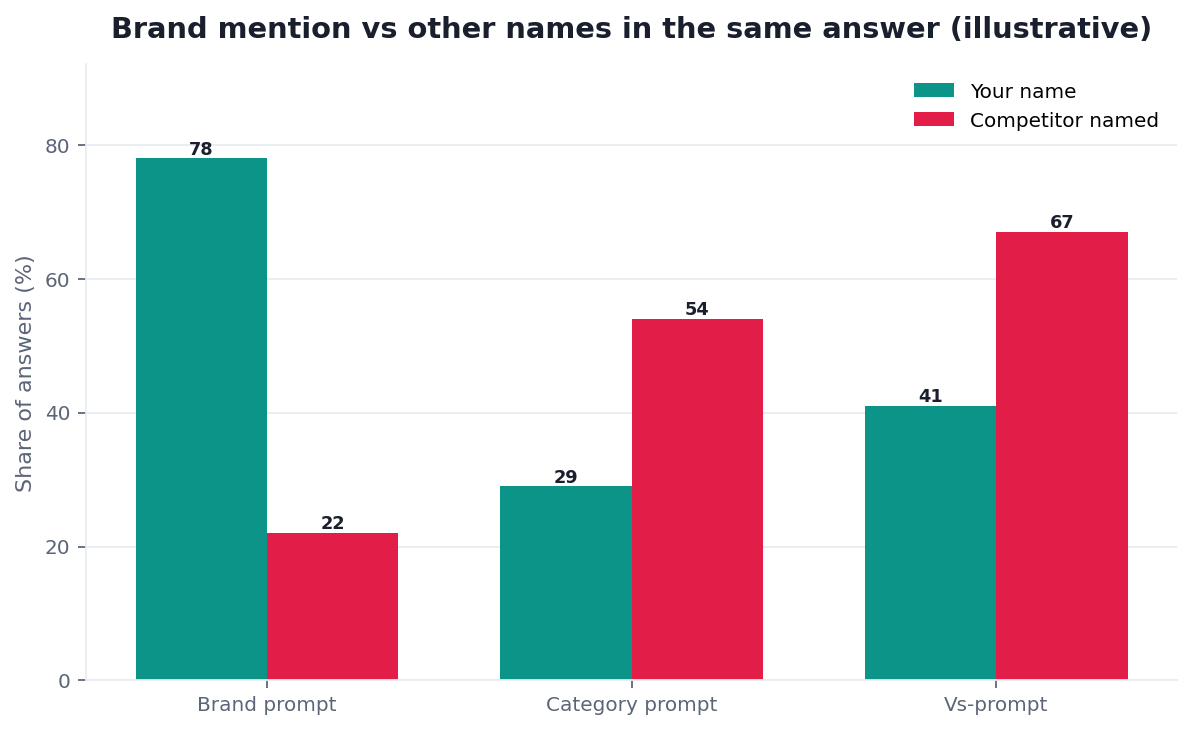
The chart above is an illustrative desk sketch, not a utilization study. On a locked prompt set it compares “your name” versus “competitor named” in the same answer: brand prompt 78% / 22%, category prompt 29% / 54%, vs-prompt 41% / 67%. Brand-first questions name you. Category and comparison questions name rivals more often. We do not publish a fake customer win from those bars.
| Prompt class | Your name (illustrative) | Competitor named (illustrative) | Sample log row |
|---|---|---|---|
| Brand prompt | 78% | 22% | Mention yes · tone descriptive · other names: 1 |
| Category prompt | 29% | 54% | Mention no/yes · tone mixed · other names: 2 |
| Vs-prompt | 41% | 67% | Mention yes · tone descriptive · other names: 1–2 |
Mention is not a rank
A mention is the string in the sentence. Rank is a retrieval position. A page can sit in the top three and stay unnamed in chat. The inverse is also true. An AI Brand Visibility Tool that writes a position into the mention cell has already mixed two machines.
Citation is still a separate column: a URL the answer points at. A name-drop with a rival’s link is not a win. Log both cells. An AI Brand Visibility Tool that hides the citation column will call every name-drop a victory.
Sentiment is tone in generated text
Sentiment here is a tone tag on a paragraph a model wrote: positive, negative, mixed, or descriptive. It is not a Net Promoter score. It is not a focus group. The American Marketing Association branding topic is how marketers talk about brand as a management object. Keep that work. Do not paste a chat adjective onto an awareness slide and call it equity.
An AI Brand Visibility Tool should let you refuse a tone tag when the sentence is merely a list. “X, Y, and Z” is co-occurrence, not praise.
Co-occurrence is who shares the paragraph
Competitor co-occurrence is the other names in the same answer. It is the useful comparison when you cannot see clicks. If the model names you beside two rivals, write the two names. Do not convert that into a fake “we own 33% of the category” slide. We do not publish invented share percentages from a single paragraph.
An AI Brand Visibility Tool that cannot list the other names is only a mention switch.
Take one comparison prompt the same morning: “best warehouse analytics for a mid-market team.” Suppose ChatGPT names you beside two rivals in a neutral list, Gemini praises a rival and skips you, and an Overview cites a publisher roundup that never uses your name. Write three rows: mention yes/no, tone tag, other names. That is the log. Do not average it into a brand-health score. We do not publish a fake lift from this pattern. We publish the habit.
How this differs from search-scene logging
Search-scene logging asks whether an Overview or ChatGPT search named or cited you on a query-shaped prompt. That cut is an AI search visibility tool job. Brand-name logging asks what the answer does with the name itself. An AI Brand Visibility Tool stays on the name.
Keep both in one week if you can. Do not stand up a second dashboard that cannot show a URL. The AI Brand Visibility Tool still needs a durable page if you care about citation, not only the string.
A one-shot on one URL is the checker. Continuous weeks are the tracker. Multi-brand seats are the platform. This page stays on mention, tone, and who shares the paragraph.
If the miss is a missing mention, split search ranking from answer-engine lift on GEO vs SEO. If the miss is “why would anyone cite us,” start on E-E-A-T SEO.
Brand visibility and brand awareness
Brand visibility is exposure in this answer: the name appeared, or it did not. Brand awareness is recall: a person remembers the name later. A brand visibility tool reads generated text. A survey asks people. Those are different studies.
Share of voice without a survey
Wikipedia’s share of voice page is the advertising-era definition: your spend or your mentions versus the category. In generated answers, share of voice is narrower: your mentions versus named competitors on the same locked prompts. It is not sitewide traffic share. It is not an Ahrefs-scale web graph. An AI Brand Visibility Tool should print the prompt list next to any share number, or the number is a slide.
Named competitors on the same prompts
Pick the rivals the model actually names, not the rivals on your pitch deck. Run the same prompts. Count who appears. An AI Brand Visibility Tool that lets you type a competitor list and then never checks whether the model used those names is scoring a wishlist.
Why survey recall is a different study
Nielsen’s homepage and Kantar’s homepage are the public faces of audience and brand-tracking research. Those studies ask people. This metric reads generated text. The IPA site is where effectiveness work lives for campaigns. None of those three is a substitute for a prompt log. Do not put an AI Brand Visibility Tool readout on a recall slide.
If a vendor shows a “brand health” doughnut with no prompt list, treat it as marketing.
Which answer engines to log
A brand visibility tool row names the surface you opened. Fill only the cells you actually ran: ChatGPT, Gemini, Perplexity, Copilot, and Google AI Overviews. A blank cell means that surface was not opened. This page does not query those five engines for you.
A one-time check versus a weekly log
A one-time check is the baseline on the locked prompts. A weekly log repeats those prompts, so a mention change is visible. The one-shot URL pass is the checker. Continuous weeks are the tracker. When you want tone and the other names written into a punch list, run the paid visibility check. Keep mention, tone, and other names in separate columns.
How to log a brand week
Treat the week as a table, not a screenshot. An AI Brand Visibility Tool week is those four columns, not a doughnut. The loop below is the same four steps in the HowTo on this page.
- Lock a brand-first prompt set. Write ten prompts: bare name, category, and one comparison. Do not change them between runs.
- Run named surfaces. Record the engines you opened — ChatGPT, Gemini, Perplexity, Copilot, Google AI Overviews — and leave a blank when you did not open that surface.
- Log mention, tone, and other names. A name-drop is a mention. Tag tone with a quote. Write the other brand names in the same answer.
- Fix the weakest extractable block. Add a short definition, a named entity, or a dated fact, then re-run.
Brand, category, and comparison prompts
Write ten to thirty prompts. Include the bare name, a category question, and one “X vs Y” comparison. Lock locale. A US English name prompt is not a 简体 query. Re-use the set.
An AI Brand Visibility Tool that changes the question every week will manufacture a mood. Add a row if you add a prompt. Do not overwrite last week.
Tone tags you can defend
Use four tags: positive, negative, mixed, descriptive. Write a five-word quote in the cell so a skeptic can see why. If two reviewers disagree, mark mixed or descriptive. Do not average tone into a 7.4. An AI Brand Visibility Tool that emits a 7.4 with no quote has already left the method. Keep the quote even when the vendor UI prefers a heart icon.
After you edit the weakest URL — usually the extractable definition — re-run the same prompt pass. A new prompt cannot prove the fix landed.
When brand logging is enough
One name, one locale
Brand logging is enough when the question is “are we named, and next to whom,” you have one locale, and you can lock ten prompts this morning. It is enough before a rewrite of the about page. It is enough when a founder heard a rival in ChatGPT and wants the cell, not a speech. It is also enough when the about page and the docs site disagree on the product name: run an AI Brand Visibility Tool on the URL the model can actually fetch, then fix the string the answers keep missing.
An AI Brand Visibility Tool is not enough when you need last quarter across twelve brands, or when the miss was an Overview on a how-to query and nobody logged the search scene.
When to add search-scene rows
Add Overview and ChatGPT search rows when the embarrassing miss was query-shaped. Keep mention and tone. Add citation. Do not replace the AI Brand Visibility Tool table with a rank export.
The how-to after a miss is AI visibility optimization.
Four checks before you buy
Judge a brand visibility tool on four checks. Do not rank vendors from a homepage.
| Check | Pass when |
|---|---|
| Which engines | The run lists the surfaces it opened |
| Saved answer | The score matches an answer you can read |
| Source URL | A cited URL is its own cell when the answer shows one |
| The count | The summary says how mentions were counted |
SEO Health is the diagnosis row: a locked prompt set plus mention, tone, and co-occurrence. It is not a crawl of the open web. The scored shortlist stays on best AI visibility tools.
Honest tool landscape
Monitoring-only products chart mention over time. Diagnosis-plus-fix products return a punch list: no citation, thin entity, unstable prompts. SEO Health sits in the diagnosis row. We do not have an Ahrefs-scale mention graph. An AI Brand Visibility Tool in our shop is a locked prompt set plus mention, tone, and co-occurrence cells — not a crawl of the open web.
A scored shortlist lives in best AI visibility tools. Use it after you know you are buying name logging, not a rank tracker.
If you only need one name this week, start the paid visibility check and keep mention, tone, and other names in separate columns.
Failure modes
Rank treated as mention
Position is not a name. An AI Brand Visibility Tool that fills mention from a SERP export has failed the category.
One adjective treated as brand health
“Trusted” in one sentence is a quote, not equity. Tag the sentence. Do not roll it into a fake index. An AI Brand Visibility Tool that turns one adjective into a health score is selling a mood.
Ahrefs-scale graphs you will not get
We will not sell a web-wide mention crawl. If you need that graph, you are shopping a monitor, not a one-brand AI Brand Visibility Tool.
Inspect the complete Brand Visibility Tool
Paste a sanitized URL into the InfiniSynapse SEO Health Checker so every title, mention, citation, and on-page layer can be reviewed together. Then validate the findings on the live page.
Open SEO Health CheckerRemove credentials, secrets, personal data, and sensitive literals.Frequently Asked Questions
What is a brand visibility tool?
Bottom line: A brand visibility tool logs whether AI names you, in what tone, and which rivals share the answer. It is not a rank tracker. On this page that is an AI Brand Visibility Tool on a locked prompt set.
Is this a ranking tool?
Bottom line: No. An AI Brand Visibility Tool reads generated mentions, tone, and who else is named. Rank is a different machine.
How is sentiment scored?
Bottom line: With a small tag set and a quote, not a 100-point official score. If the sentence is a list, use descriptive. An AI Brand Visibility Tool that cannot show the quote next to the tag is not scoring sentiment. It is decorating a doughnut.
What is competitor co-occurrence?
Bottom line: The other brand names in the same answer. Write the names. Do not invent a category-share percentage.
What should I do in the first hour?
Bottom line: Pick ten brand-first prompts. Run the surfaces you can name. Write mention, tone, and other names. Open the paid check when you want tone and competitor names written into the punch list.
Is share of voice the same as traffic share?
Bottom line: No. Here it is your mentions versus named rivals on the same prompts. It is not sessions.
Conclusion
An AI Brand Visibility Tool logs mention, tone, and competitor co-occurrence. It is not rank and not a survey. Lock the prompts. Keep the other names. Refuse a doughnut with no method. Start with the name that missed and run the AI visibility check. For the category loop, open the AI brand visibility checker.
Tone without a quote is a guess. Write the sentence the model used. If the sentence is a list of five vendors, tag it descriptive and move on. If the sentence says you failed a security review you never had, that is a Trust ticket, not a sentiment score. Keep competitor names in a third column so a category prompt and a brand-first prompt can share one log. The AI Brand Visibility Tool job ends when those three columns exist and an owner can edit the weakest URL.
A brand-first prompt set should stay under thirty items. Include the exact name, a misspelling you already see in support tickets, and one comparison that names a rival. Lock locale. Re-run after the about page or the product URL changes, not after a footer tweak. If the tone tag flips and the quote did not, the tagger drifted. Fix the quote first. The doughnut can wait. A second reviewer should be able to open the same ten prompts and mark the same cells. If they cannot, the AI Brand Visibility Tool log is still a transcript.
Sources
- Stanford HAI — AI Index 2025: State of AI in 10 Charts — organizational AI use 78% (2024); generative AI in a function 71%; U.S. private AI investment $109B; inference cost drop cited above. Retrieved 2026-08-17.
- McKinsey — The state of AI · Gartner Peer Insights — Analytics & BI — third-party frames, not a mention metric.
- AMA — Branding · Wikipedia — Brand · Wikipedia — Share of voice · Nielsen · Kantar · IPA.
- InfiniSynapse desk — 76
/en/tool/pages, one brand, one locale; illustrative brand / category / vs-prompt chart on this page. Not a customer lift study.
About the author — William Zhu, cofounder of InfiniSynapse. Public work: InfiniSQL, auto-coder, retrieval systems (GitHub @allwefantasy). Reviewer: InfiniSynapse Data Team. Published 2026-08-16. Updated 2026-09-27. Policy: editorial standards · privacy.
William Zhu · Cofounder, InfiniSynapse · GitHub @allwefantasy
Desk-validated SEO Health methods. Corrections: zhuhl@infinisynapse.com · corrections policy.