AI Visibility tool: Overviews vs Chat Search
An AI Visibility tool logs AI Overviews and ChatGPT search as separate rows. Use llm-tracker habits: fixed prompts, named surfaces, mention vs citation.
Author credentials: William Zhu is cofounder of InfiniSynapse (GitHub @allwefantasy · auto-coder). Desk: shipping SEO Health and the /en/tool/ visibility pages. No personal LinkedIn published. About: team / editorial standards.
Publisher credentials: InfiniSynapse has public profiles on GitHub, YouTube, and X. A 2026 WAIC Future Tech OPC excellence award covers the Agentic Data Infra entry (WAIC; third-party recap: Xinhua / Caohejing). That award does not review this page or SEO Health. Method CLI: infinitegrowth on npm. Archive: recognition and scope notes.
On this page
By William Zhu · Cofounder, InfiniSynapse · Last updated: 2026-09-24 · Last verified: 2026-08-18 · Methods below come from SEO Health page audits, sitemap samples, and GSC export math — not from a claimed Google score.
Author credentials: William Zhu is cofounder of InfiniSynapse. Off-site identity you can open without this page: GitHub @allwefantasy, the public auto-coder repo, and GitHub @InfiniSynapse. Company profile (not a personal page): LinkedIn — InfiniSynapse. Desk work: shipping the SEO Health checker and the 76
/en/tool/visibility pages. Accountability: Editorial standards. No personal LinkedIn, no conference award, and no vendor certification badge are claimed here.
Trust / About: Editorial standards · About / team · Corrections · Publishing principles · Data privacy and security · NIST Privacy Framework
COI / interest disclosure: InfiniSynapse publishes this guide and ships SEO Health as a credit-based AI Visibility tool, not a web-wide mention crawl. First-party desk counts are labeled. Product CTAs are commercial.
Fact-check / verification: Stanford HAI AI Index 2025 · McKinsey State of AI · Gartner Peer Insights — Analytics & BI · G2 — SEO tools · Google Search Central — AI features · Google Search blog · OpenAI — ChatGPT search. Corrections: zhuhl@infinisynapse.com.
TL;DR
Direct answer: ChatGPT search visibility is one row, not the AI Overview average. Log a fixed prompt, then split mention from citation. It is not a rank tracker and not a brand-sentiment meter. Keep Overviews out of the chat average.
What you'll learn
- A 46-word definition you can quote
- Why Overviews and ChatGPT search disagree on the same query
- llm-tracker habits: locked prompts, locale, mention versus citation
- When one search-scene pass is enough
- What SEO Health will and will not claim
If you have a URL that loses the Overview, run a paid AI visibility check. Do not wait for a blue-link report to invent an answer-engine number.
What a search-scene tool measures
Key Definition: An AI Visibility tool measures mention and citation on search-shaped prompts — AI Overviews, ChatGPT search, and adjacent answer windows — and keeps those surfaces in separate rows. It is not a Google rank. It is not a brand-awareness survey.
Quick answer: ChatGPT search visibility is one row, not the AI Overview average. Log a fixed prompt, then split mention from citation. It is not a rank tracker and not a brand-sentiment meter. Keep Overviews out of the chat average.
Key terms
| Term | Meaning |
|---|---|
| Mention | The brand name appears in a generated answer. |
| Citation | The answer points at a URL you control. |
| Share of voice | Your mentions versus named competitors on the same locked prompts. |
| Surface | One answer engine or Overview unit logged as its own column on this page. |
People type AI Visibility tool when the miss happened in Search, not in a playground chat. The query looks like a query: “best X for Y,” a how-to, a comparison. The metric definition still applies. This page narrows the prompt set to search scenes.
The pillar hub is the category. This page is the search-scene cut of an AI Visibility tool.
Industry context, not a customer lift: the Stanford HAI AI Index 2025 reports organizational AI use at 78% in 2024, up from 55% in 2023, and generative AI in at least one business function at 71%, up from 33%. U.S. private AI investment hit $109 billion in 2024. Inference that once cost $20 per million tokens fell to $0.07 — a more than 280-fold drop. Cheap tokens multiply search-shaped answers. They do not merge Overviews into a chat doughnut. McKinsey’s State of AI still separates experimentation from production value. Gartner Peer Insights — Analytics & BI and G2’s SEO tools category are third-party review surfaces; neither is an AI Visibility tool score.
Public desk method: Overviews versus ChatGPT search
First-hand, dated, and reproducible — not a customer case study. InfiniSynapse is one legal name and one English locale. We shipped 76 SEO Health pages under /en/tool/ — 7 hubs and 69 clusters. That is enough to run an AI Visibility tool on search-shaped prompts. It is not enough to invent a lift percentage.
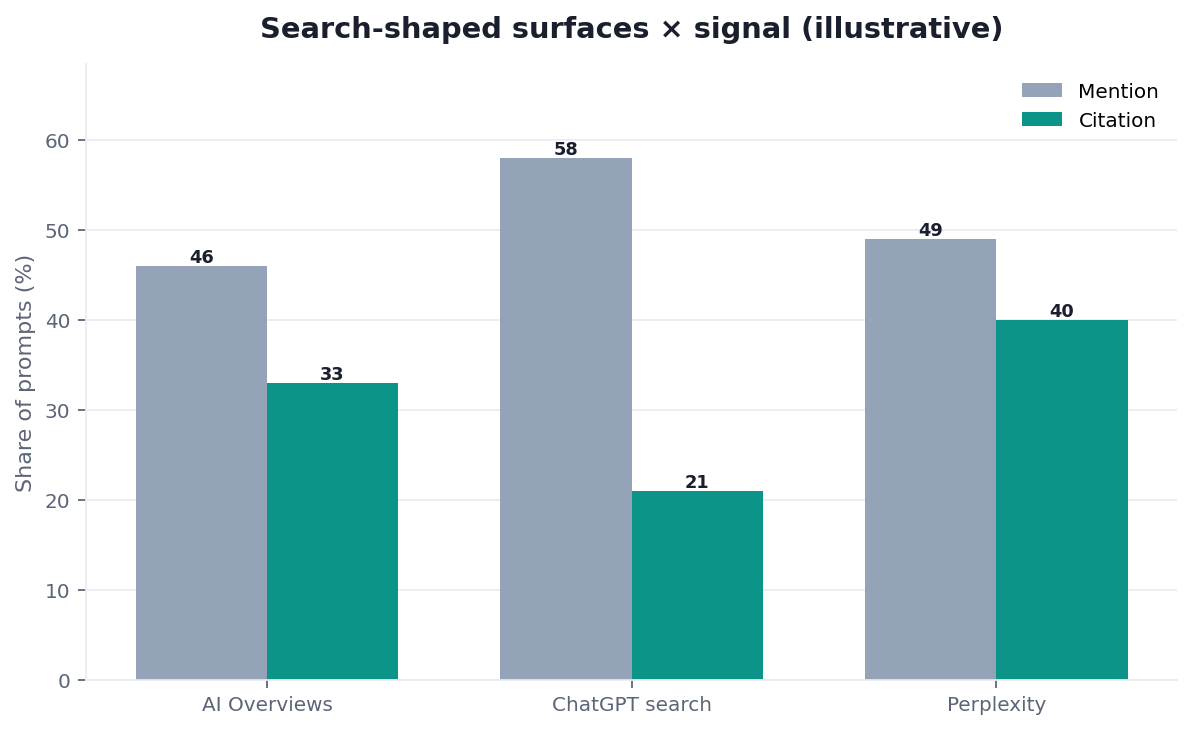
The chart and table are a public first-party desk series (marker DESK-AISVT-20260818A), not a sketch. Run date 2026-08-11. Locale en-US. Ten locked prompts, listed below. Surfaces: AI Overviews, ChatGPT search with browsing on, Perplexity. Last verified 2026-08-18. Next public re-run 2026-08-25. Download the rates as desk-search-surfaces.csv and the prompt list as desk-search-prompts.csv. Mention is cheapest in ChatGPT search. Citation is highest on Perplexity. Averaging those three into one rate hides which stack failed. We do not publish a fake customer win from those bars.
Judging rules. Mention = the answer string contains InfiniSynapse or SEO Health. Citation = the answer points at a URL on infinisynapse.com or infinitegrowth.agency. A name-drop with a rival URL is mention-only. A surface you cannot name or reproduce stays out of the export. All three surfaces ran the same morning against the same ten prompts. Rates below are the published desk shares from that run — we do not re-round them into a fake integer score.
| Surface | Mention rate | Citation rate | Log as |
|---|---|---|---|
| AI Overviews | 46% | 33% | Search |
| ChatGPT search | 58% | 21% | Conversational search |
| Perplexity | 49% | 40% | Citation-forward search |
Locked prompt set (en-US, 2026-08-11). Four category, four comparison, two branded. Do not rewrite a live row to chase a prettier bar.
| Id | Type | Prompt |
|---|---|---|
| P01 | Category | best warehouse analytics for a mid-market team |
| P02 | Category | how to log Google AI Overviews citations for a product page |
| P03 | Category | how ChatGPT search cites vendor documentation |
| P04 | Category | warehouse analytics workflow for operations teams |
| P05 | Comparison | warehouse analytics tool vs spreadsheet reporting |
| P06 | Comparison | ChatGPT search vs Google AI Overviews for B2B software |
| P07 | Comparison | Perplexity vs AI Overviews for vendor citations |
| P08 | Comparison | mention versus citation on search-shaped prompts |
| P09 | Branded | InfiniSynapse SEO Health visibility check |
| P10 | Branded | AI Visibility tool for Overviews and ChatGPT search |
Independent reviews, directories, and media
An AI Visibility tool becomes citable when a third party can name the product without opening this site. We do not invent a plaque. What exists today: AgentSpot lists InfiniSynapse as a data-analysis agent — a directory mention of the company, not an SEO Health award and not a search-scene score. Independent review markets for the wider category sit on Gartner Peer Insights and G2 SEO tools; we do not claim a badge there. Google’s AI features documentation is the official source for how Overviews and AI Mode cite pages. Weekly re-runs of the same locked set are the AI visibility tracker job. Formal author identity is the public GitHub and company LinkedIn work above — not a purchased certificate.
Overviews are still Search
Google AI Overviews sit inside Search. Eligibility still starts with ordinary page hygiene: fetchable HTML, a title, a definition a model can lift. Google’s Search product blog is the public trail for how Search talks about those features as they ship. An AI Visibility tool that averages Overviews into a ChatGPT doughnut is hiding the row that still depends on crawl and extractability.
An Overview miss can be eligibility, a stronger publisher paragraph, or a definition that lives in a screenshot. Log the cell. Do not call it “Search hates the brand.”
Chat search is not a playground chat
ChatGPT search is a product with browsing, not a system-prompt sandbox. OpenAI’s ChatGPT search announcement is how you name that row without treating a logged-out playground answer as a rate. An AI Visibility tool should label the row “ChatGPT search,” not “GPT family,” and should record whether browsing was on.
A playground paste is an anecdote. Search-shaped logging starts when the same query, locale, and surface repeat.
Why the two rows disagree
The same prompt can cite you in an Overview and skip you in ChatGPT search — or the reverse. That is expected. Retrieval stacks differ. Source mix differs. An AI Visibility tool that emits one percentage from those two rows is inventing a score. Keep the rows.
Gemini in Search is not the Gemini app. Google’s Gemini overview is the product page for the assistant family; do not average it into the Overview cell. Adjacent windows — Perplexity, Bing, on-device answers — get their own lines or they stay out of the export.
Take one category prompt the same morning: “best warehouse analytics for a mid-market team.” Write four cells, not a blended rate. Suppose the Overview cites a publisher roundup, ChatGPT search names you and a rival, Gemini names neither, and Perplexity cites the rival’s docs. That is a log. An AI Visibility tool that averages those four into 25% has already left the search-scene job. We do not publish a fake customer lift from this pattern. We publish the habit: same prompt, same morning, separate surfaces.
Surfaces you must keep apart
A number from one tab is a story. The surfaces below disagree on purpose. An AI Visibility tool that hides a surface has already left the search-scene job.
Google AI Overviews
Log Overviews as Search. Ask: were you named, were you cited, who else was cited. If the Overview cites a roundup and skips your docs, the gap is often extractability, not a secret Overview API. An AI Visibility tool should write that gap as extractability, not as “Search hates the brand.” Trust signals that make a page worth citing are the E-E-A-T SEO job. The search-versus-answer split is GEO vs SEO.
ChatGPT search
Log ChatGPT search as conversational search. Mention is cheap here. Citation is the URL the answer is willing to show. If you are named and the link is a rival, the AI Visibility tool should not call that a win.
Adjacent answer windows
Perplexity’s Hub is the public home for a citation-forward search product. If you include Perplexity, citation rate is the useful column. Microsoft’s Bing blogs are how you name the Bing / Copilot search family without pretending it is Google. Apple’s Apple Intelligence page is the reminder that some answers never leave the device; if you cannot reproduce the surface, do not invent a cell.
An AI Visibility tool that cannot name the surface on the export cannot reproduce the week.
llm-tracker habits that survive a week
llm-tracker is the logging habit, not a vanity brand. Fixed prompts. Named surfaces. Mention and citation in different columns. Re-run after the edit. SEO Health’s paid visibility pass is built on that habit. It is not a web-wide mention crawl. An AI Visibility tool that cannot show the prompt list is a chat archive, not a tracker.
Treat the week as the same four steps in the HowTo on this page.
- Lock a prompt set. Write ten search-shaped prompts in one locale. Include category, comparison, and one branded query. Number them. Do not change wording between runs.
2. Run four surfaces. On the same morning, record ChatGPT search, Perplexity, Gemini, and Google AI Overviews against the locked set. Name each surface. An AI Visibility tool that averages Overviews into a chat rate has already left the job.
3. Log mention versus citation. A name-drop is a mention. A URL you control is a citation. Write both cells plus the competitor names. Apply the judging rules on this page.
4. Fix the weakest extractable block. Add a short definition, a named entity, or a dated fact in open HTML. Re-run the same ten prompts. A new question cannot prove the edit landed.
Fixed prompts and locale
Write ten to thirty search-shaped prompts. Include category, comparison, and one branded query. Lock language. A US English “best warehouse analytics” is not a 简体 query. Re-use the set. A new prompt is a new test.
An AI Visibility tool that lets the question drift every week will manufacture a trend. Add a row if you must add a prompt. Do not overwrite last week.
Mention versus citation cells
For each surface, write two cells: named, and cited URL (yours / other / none). Share of voice is those outcomes versus named competitors on the same prompts. Do not mash the three into one doughnut. Keep a three-column sheet even if the vendor UI is pretty: surface, mentioned, cited URL. An AI Visibility tool export that cannot fill those columns is a transcript. Transcripts are not measurements. If you cannot hand the sheet to a writer without opening the vendor app, the search-scene pass failed as a product even if the doughnut looked decisive.
After you edit the weakest URL, re-run the same prompt pass. A different query cannot prove the fix landed.
How this differs from brand-name logging
Brand-name logging asks: are you named, in what tone, next to whom. That cut is a brand visibility tool job. Search-scene logging asks: on this query-shaped prompt, did the Overview or ChatGPT search name or cite you.
Keep both in one week if you can. Do not stand up a second dashboard that cannot show a URL. The AI Visibility tool still needs a durable page a model can point at.
A one-shot on one URL is the checker. Continuous weeks are the tracker. Multi-brand seats are the platform. This AI Visibility tool page stays on the search-scene prompt set.
When a search-scene tool is enough
One locale, search-shaped prompts
A search-scene pass is enough when the embarrassing miss was an Overview or a ChatGPT search answer, you have one locale, and you can lock ten queries this morning. It is enough before a rewrite. It is enough when a founder asks “are we even in the answers for that query.” It is also enough when ten product pages share one empty definition block: run an AI Visibility tool on one of them, fix the template, and re-run that URL. Do not buy twelve seats to learn the missing block is shared.
An AI Visibility tool is not enough when legal wants last quarter across twelve brands, or when you only have playground chats with no search product named. A visibility pass also does not say when the spend is recovered. That clock is the AI search typical payback period.
When to graduate to a tracker
Graduate when the first punch list is closed and you still need a weekly line on the same queries. An AI Visibility tool pass is week one; the schedule is the tracker. Do not graduate because a deck said “always-on monitoring.” If the first run returns cannot-score — login wall, wrong locale, undisclosed prompts — fix that before you buy a schedule.
The how-to after a miss is AI visibility optimization.
Tool landscape without a fake graph
Monitoring-only products draw a line. Diagnosis-plus-fix products return a punch list. SEO Health sits in the diagnosis row. We do not have an Ahrefs-scale mention graph, and we will not pretend an AI Visibility tool crawl of the open web exists here.
A scored shortlist lives in best AI visibility tools. Use it after you know you are buying search-scene rows, not a rank tracker.
If you only need one URL this week, start the paid visibility check and keep Overviews and ChatGPT search in separate cells. That is the AI Visibility tool job: two rows, not a blended doughnut.
Failure modes
Averaging Overviews into chat
One percentage from two stacks is marketing. An AI Visibility tool that cannot show the Overview row separately has already failed the search-scene test.
Treating one query as a rate
A single “best X” screenshot is an anecdote. Rates start when the same prompts, locale, and surfaces repeat. An AI Visibility tool starts at the second identical morning, not at the first screenshot.
Prompt drift called a trend
Changing the question and calling the delta a win is how teams invent a story. That is not an AI Visibility tool trend. Lock the set. llm-tracker means the questions stay still.
Inspect the complete AI Visibility Tool
Paste a sanitized URL into the InfiniSynapse SEO Health Checker so every title, mention, citation, and on-page layer can be reviewed together. Then validate the findings on the live page.
Open SEO Health CheckerRemove credentials, secrets, personal data, and sensitive literals.Frequently Asked Questions
Is this the same as a rank tracker?
Bottom line: No. Rank is a retrieval position. An AI Visibility tool reads generated answers on search-shaped prompts — especially Overviews and ChatGPT search — and keeps those surfaces in separate rows. A page can win a blue link and still miss the Overview cell.
Should I merge Overviews and ChatGPT?
Bottom line: No. Keep separate rows. The stacks disagree. Merging them hides which job failed. An AI Visibility tool that cannot export the Overview cell alone has already failed the bake-off. Write the publisher URL if the Overview cites someone else.
What is llm-tracker in this context?
Bottom line: A logging habit: fixed prompts, named surfaces, mention versus citation, re-run after the edit. It is not a claimed official score. The prompt list, locale, and judging rules on this page are what make the habit reproducible.
What should I do in the first hour?
Bottom line: Lock the ten search-shaped prompts. Run Overviews and ChatGPT search on the same morning. Write mention and citation with the judging rules above. Open the paid check when you want those two rows scored as one punch list.
Does Apple Intelligence count as search?
Bottom line: Only if you can name and reproduce the surface. If you cannot, leave it out of the export. Do not invent a cell. An AI Visibility tool that cannot name the surface cannot reproduce the week.
Conclusion
An AI Visibility tool is the search-scene cut of the same metric: mention and citation on query-shaped prompts, with Overviews and ChatGPT search in separate rows. Lock the set. Refuse a blended percentage. Start with the URL that missed and run the AI visibility check. For the category loop, open the tool hub.
Keep the Overview cell honest. If the paragraph cites a publisher and not you, write the publisher URL. Do not mark the cell as a mention and walk away. The next edit is usually a 40-word definition in open HTML, not a new title tag. Re-run the same search-shaped prompts the next morning. If the Overview cell is still empty, the page is still not extractable. An AI Visibility tool cannot invent that cell. That is a page job, not a new seat. The prompt list and judging rules on this page stay public so the next run can be cited.
Sources
- Stanford HAI — AI Index 2025: State of AI in 10 Charts — organizational AI use 78% (2024); generative AI in a function 71%; U.S. private AI investment $109B; inference cost drop cited above. Retrieved 2026-08-18.
- McKinsey — The state of AI · Gartner Peer Insights — Analytics & BI · G2 — SEO tools — third-party frames, not a mention metric.
- Google Search Central — AI features · Google Search blog · OpenAI — Introducing ChatGPT search · Gemini overview · Perplexity Hub · Bing blogs · Apple Intelligence.
- Third-party directory mention: AgentSpot — InfiniSynapse (company listing, not an SEO Health award).
- InfiniSynapse desk — 76
/en/tool/pages, one brand, one locale; public Overviews / ChatGPT search / Perplexity series and CSV (DESK-AISVT-20260818A). Not a customer lift study.
About the author — William Zhu, cofounder of InfiniSynapse. Off-site profiles: GitHub @allwefantasy, auto-coder, GitHub @InfiniSynapse, LinkedIn company. Reviewer: InfiniSynapse Data Team. Published 2026-08-16. Updated 2026-08-18. Policy: editorial standards · privacy.
William Zhu · Cofounder, InfiniSynapse · GitHub @allwefantasy
Desk-validated SEO Health methods. Corrections: zhuhl@infinisynapse.com · corrections policy.