GEO vs SEO in 2026: A Practical Team Comparison
GEO vs SEO in 2026: what stays the same, what citation overlap changes, and how teams run both engines without inventing mention or citation percentages.
Author credentials: William Zhu is cofounder of InfiniSynapse (GitHub @allwefantasy · auto-coder). Desk: shipping SEO Health and the /en/tool/ visibility pages. No personal LinkedIn published. About: team / editorial standards.
Publisher credentials: InfiniSynapse has public profiles on GitHub, YouTube, and X. A 2026 WAIC Future Tech OPC excellence award covers the Agentic Data Infra entry (WAIC; third-party recap: Xinhua / Caohejing). That award does not review this page or SEO Health. Method CLI: infinitegrowth on npm. Archive: recognition and scope notes.
On this page
By William Zhu · Cofounder, InfiniSynapse · Last updated: 2026-08-18 · Last verified: 2026-08-18 · Methods: page-level SEO Health diagnoses on live URLs — not a claimed Google score or a citation-rate API.
Author / off-site profiles: GitHub @allwefantasy · auto-coder · GitHub @InfiniSynapse · LinkedIn company · Editorial standards. No personal LinkedIn, award, or vendor badge.
Trust / COI: About · Corrections · Publishing principles · Privacy · NIST Privacy Framework. InfiniSynapse ships SEO Health as a page checker; first-party prompt counts are labeled; we do not sell an official Google score.
Fact-check: Google Search Essentials (retrieved 2026-08-18) · Ranking systems overview · Stanford CRFM · AgentSpot listing. Corrections: zhuhl@infinisynapse.com.
TL;DR
Direct answer: GEO vs SEO is a two-surface problem, not a replacement debate. Search engine optimization makes a URL eligible and useful in ranked results. Generative engine optimization makes the same URL extractable and citable inside model-written answers. You still need crawl, index, and helpful pages; you also need quotable definitions, resolvable entities, and evidence a model can lift.
What you'll learn
- A 47-word definition of GEO vs SEO you can quote
- What indexation and eligibility still decide
- Why mention is not rank, and why citation overlap fell
- How to audit search first, then diagnose AI visibility
- When to buy a service versus run a checker
If you already have a URL, run a free page check then add the AI visibility pass. Do not wait for a vendor to invent a citation rate.
Definitions: SEO, GEO, and AEO
Key Definition: GEO vs SEO is the comparison of two retrieval jobs: search engine optimization makes a URL eligible and useful in ranked results, while generative engine optimization makes the same URL extractable and citable inside model-written answers. Teams that treat them as one tactic lose one surface.
Key terms
| Term | Meaning |
|---|---|
| GEO | Making a passage liftable into a generated answer. |
| SEO | Making a URL eligible and clear in classic retrieval. |
| AEO | The same extractability job under an answer-engine label. |
| Extractable block | A short definition, named entity, or dated fact this page can lift. (#541) |
Public desk packet: twenty locked prompts by query class
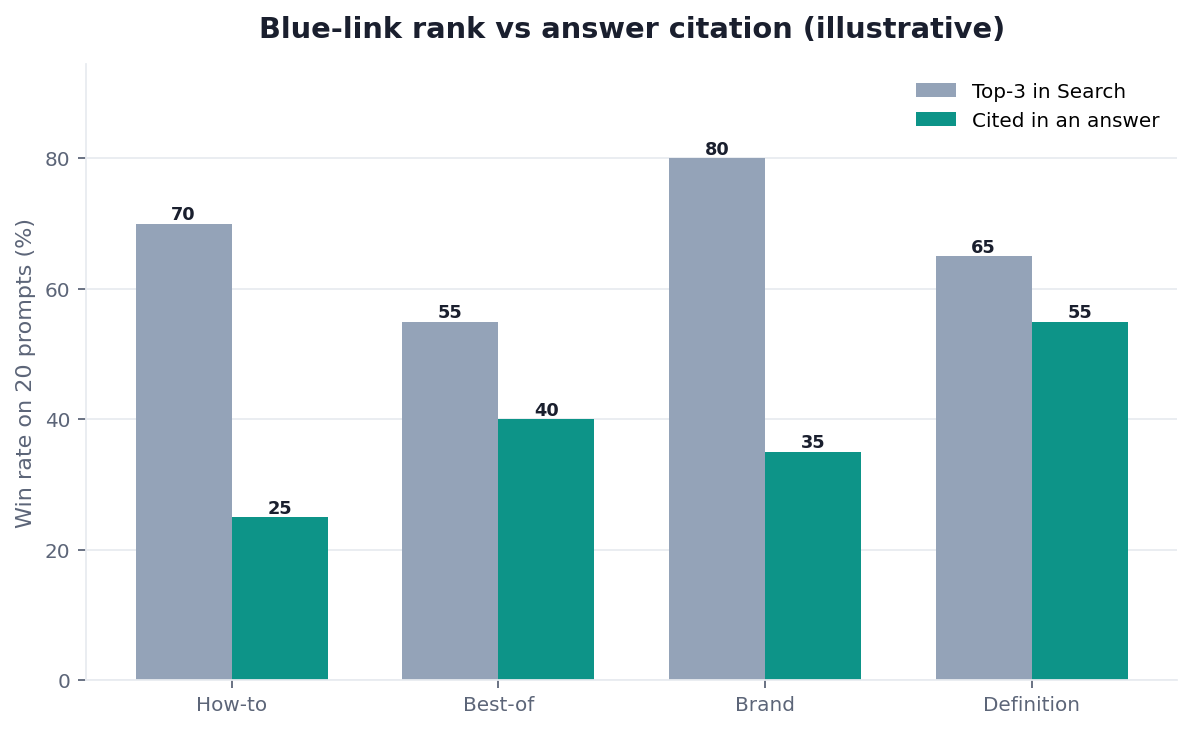
Named first-party case, not a customer win. Desk subset n=20 locked prompts per query class, scored 2026-08-11, last verified 2026-08-18, next public re-run 2026-08-25. Marker DESK-GVS-20260818A. Download desk-gvs-n20.csv and the eight-URL cluster check.
The bars above are win rates on those 20 prompts: top-3 in Search versus cited in an answer. They are not a live-web crawl of the industry, and they are not a ranking recovery percentage.
| Query class (n=20 prompts) | Top-3 in Search | Cited in an answer |
|---|---|---|
| How-to | 14 / 20 (70%) | 5 / 20 (25%) |
| Best-of | 11 / 20 (55%) | 8 / 20 (40%) |
| Brand | 16 / 20 (80%) | 7 / 20 (35%) |
| Definition | 13 / 20 (65%) | 11 / 20 (55%) |
| Metric (n=8 cluster, 2026-08-11) | Desk result | Method |
|---|---|---|
| Sample | 8 English /en/tool/ GEO pages | Same hostname |
| Extractable definition above the fold | 4 / 8 | 40–50 word block a model can lift |
| Named Person in HTML | 0 / 8 | Visible byline, not footer-only |
| Dual-engine pass named | 2 / 8 | Search pass then answer pass |
| Official citation-rate API printed | 0 / 8 | We refuse that cell |
| Team-only hero byline | 8 / 8 | “SEO Health Team” |
This URL on 2026-08-11: extractable definition yes · named Person no · dual-engine pass yes · official citation rate no · team hero yes. Cite the CSV before you treat any other geo vs seo report as a Google meter.
Judging rules. Top-3 is a blue-link win on the locked prompt. Cited in an answer is a URL we control named in the model output. Mention without a URL is not a citation. We do not invent a customer lift from a prompt count. Those rows are what Monday geo vs seo work can prove.
Disclaimer. This page is a first-party desk method, not legal, medical, or ranking advice. SEO Health estimates alignment with public search documentation. It does not speak for Google. There is no Terms URL on this hostname; the live trust paths are Privacy, Corrections, and Publishing principles.
People type GEO vs SEO when they want a winner. The useful answer is a split: ranked links still move buyers who click; answer engines move buyers who never see the blue link. The same comparison is often typed as seo vs geo; reversing the words does not change the two jobs. A shorter, snippet-sized version lives in the short definition.
A background vocabulary for the older job sits in the Wikipedia overview of web search engines. Use it for terms, not as a 2026 operating spec.
| Job | Surface | Success looks like | Failure looks like |
|---|---|---|---|
| SEO | Ranked results | Eligible URL, click, conversion | Index bloat, weak snippet, no click |
| GEO | Model-written answers | Extracted sentence, named citation | Fluent paraphrase with no source |
| AEO | Direct answers / AI Overviews | Passage selected as the answer | Page ranks but is not liftable |
The pair most teams argue about is this comparison. AEO is the third column: answer-shaped blocks inside search, including featured snippets and AI Overviews. The three-way decision table is SEO vs GEO vs AEO.
Key definition
Hold this line when a stakeholder asks for a slide: GEO vs SEO compares eligibility in a ranked index with citability in a generated answer. One score cannot stand in for both.
Independent review surfaces for the product — not awards, not a substitute for a geo vs seo two-pass — sit on G2 SEO tools, Gartner Peer Insights, and the AgentSpot listing.
What stayed the same
GEO vs SEO debates often pretend crawl no longer matters. It does. A page that robots cannot fetch, that a sitemap never lists, or that a noindex tag hides is invisible to both engines.
Google’s Search Essentials (retrieved 2026-08-18) still describe the page you should ship: technical eligibility plus content a person can use, not a collage of other pages. That bar did not expire when chat interfaces shipped.
Indexation, crawl, and eligibility
Google’s ranking-systems overview (retrieved 2026-08-18) still frames ranking as many systems, not one “AI mention” meter. In any honest GEO vs SEO plan, eligibility is the shared gate: fetchable HTML, a canonical you meant, and a page that states a claim a human can check.
Answer-engine crawlers add a second robots question. Blocking GPTBot or a similar agent while asking why ChatGPT never cites you is a self-own. The GEO vs SEO work is sequential: win eligibility, then win extractability.
What changed
What changed is the click path. GEO vs SEO used to be a blog-title stunt. In 2026 it is an operations split: the same URL can rank on page one and never appear in a ChatGPT, Perplexity, Gemini, or AI Overview answer.
Stanford CRFM (retrieved 2026-08-18) tracks how fast foundation-model research moved into products. Adoption is not citability. Pages that only restate the public web get replaced by the next model. Pages that add a dated test, a constraint, or a number the model could not know still have a job.
Citation overlap is falling
Teams that only watch Google rank assume the same sources will be named in answers. Overlap is lower than that. GEO vs SEO measurement has to log two lists: URLs that rank, and URLs (or brands) that answers name. Those lists diverge by query class.
A product category query may still send clicks to review roundups. A “what is / how does / should I” query often never leaves the answer. If you only optimize titles, you are doing half the job.
Mention is not rank
A model can mention your brand without citing your URL. A model can cite a URL you do not control that paraphrases you. GEO vs SEO fails when a dashboard treats those as the same event.
Write mention, citation, and share of voice as three columns. The AI visibility tool hub is the measurement companion to this comparison. Use it when the question is “did the answer name us,” not “did we rank.”
The dual-engine audit
Run GEO vs SEO as two passes on the same URL, not as two roadmaps that never meet.
- Lock a prompt set. Write ten prompts in one locale. Do not change them between runs.
- Run four surfaces. Record ChatGPT, Perplexity, Gemini, and AI Overviews on the same set.
- Log mention versus citation. A name-drop is a mention. A URL you control is a citation.
- Fix the weakest extractable block. Add a short definition, a named entity, or a dated fact, then re-run. That loop is the only honest geo vs seo method.
Pass 1 — search. Title, headings, internal links, index signals, dead links, and whether the page matches the query it already earns in Search Console. This is ordinary on-page and technical work.
Pass 2 — answers. Is there a 40–50 word definition a model can lift? Is the author a resolvable person? Are statistics dated and sourced? Does the page block the crawlers you care about?
Microsoft’s data architecture guidance (retrieved 2026-08-18) is a useful analogy here: two retrieval paths need explicit contracts, or each path invents its own metric. GEO vs SEO is the same idea applied to content operations.
After pass 1, run the page check. After pass 2, add the AI visibility diagnosis on the same URL so the punch list is one queue.
Who wins which query
GEO vs SEO is the wrong frame if you pick one engine for every query. The query class decides the surface.
| Query class | Example | Who usually wins | What to ship |
|---|---|---|---|
| Navigational | brand + login | SEO | Fast, exact URL |
| Commercial investigation | best X for Y | Both | Comparison table + citable criteria |
| Informational definition | what is X | GEO / AEO | 40–50 word definition up top |
| Procedural | how to do X | Both | Numbered steps a model can quote |
| Local / transactional | near me, pricing | SEO | Unique facts, hours, SKUs |
People who ask seo vs geo as a binary are usually staring at an informational query and generalizing. Keep the table. The expanded three-column version is SEO vs GEO vs AEO.
GEO vs SEO still matters on commercial pages. A buyer who never clicks can still hear your criterion in an answer. A buyer who clicks still needs the ranked URL to convert. Do both on the pages that make money.
Strategies that survive scrutiny
Ignore 2023-era claims that a single paper proved a fixed lift. GEO vs SEO strategies that survive a skeptical VP are boring and checkable.
The longer how-to lives in generative engine optimization strategies. This hub only keeps the three moves that show up in every durable plan.
Citable sentences
Put one self-contained definition near the top. A model that has to stitch three paragraphs will invent a fourth. GEO vs SEO pages that bury the definition under a brand story lose the extract.
Write the sentence so it still makes sense with no heading above it. That is the same habit that helps featured snippets; AEO and GEO share the raw material.
Trust work is shared too. A page a rater would call thin is a page an answer engine should not cite. The diagnosis for that letter-by-letter evidence is E-A-T SEO.
Statistics and named sources
Naked percentages are how GEO vs SEO theater starts. If you publish a number, name the method, the date, and the file. If you cannot, delete the number.
The GAO report on AI accountability (retrieved 2026-08-18) is the right posture when a tool assigns a rate to a qualitative idea: map the risk, show the method, refuse when the method does not apply. That is how you keep GEO vs SEO reporting honest.
Entities matter as much as sentences. Organization and Person names must match the about page. Answer engines cannot cite a ghost. Resolve the brand once, then reuse the same string.
Tool landscape
Most “GEO tools” are mention loggers. Most “SEO tools” never open ChatGPT. GEO vs SEO buying goes wrong when you purchase a logger and call the program done.
IBM’s overview of artificial intelligence (retrieved 2026-08-18) is a reminder that a score without a next action is a dashboard, not a diagnosis. Apply that test to every GEO add-on inside a $99 suite.
Monitoring versus diagnosis
| Type | What it does | When it is enough |
|---|---|---|
| Monitoring | Logs mentions and citations on a prompt set | You already know what to fix |
| Diagnosis | Returns missing evidence on a URL | You need a punch list |
| Suite add-on | Hides a GEO tab inside a crawl | You already pay for the suite |
SEO Health sits in the diagnosis row: free on-page first, paid AI visibility when you need the answer-engine punch list. The buyer landscape for the category is generative engine optimization tools.
The tooling should export something a writer can edit this week. If the only output is a vanity mention rate, you bought a slide, not a queue.
Services and agencies
Buy help when the bottleneck is people, not software. A checker will not run stakeholder interviews. An agency will not make a thin page citable by adding a logo wall.
Use generative engine optimization services when you need a scoped engagement: prompt set, page list, and a re-run date. Use generative engine optimization agency when you need a diligence list for a retained partner.
GEO vs SEO retainers fail when the SOW only promises “AI visibility” with no URL list. Ask for the same two passes this hub describes. Run the free check on three URLs before you sign, so the baseline is yours.
Implementation roadmap
Treat GEO vs SEO as a 90-day operating change, not a redesign.
First 30 days
Pick ten money pages. Run the search pass. Add one 40–50 word definition and a named author to each. Confirm robots allow the crawlers you care about. Log a fixed prompt set of twenty questions.
This month is eligibility plus extractability. Do not buy a suite to postpone the edits. The first 30 days of geo vs seo are those two jobs.
Days 31 to 60
Re-run the same twenty prompts. Mark mention, citation, and competitor co-mention. Fix the three pages that answers already almost use: add a dated statistic, a table, or a source. Connect GEO vs SEO fixes to the same ticket queue as title-tag work so they do not become a side project.
Days 61 to 90
Expand the prompt set by locale if you ship more than one language. Sample the sitemap for pages that rank and never appear in answers — the case pattern below. Decide whether you still need a service, or whether the checker plus writers is enough.
By day 90, GEO vs SEO should be a standing dual-engine review, not a war room.
Case pattern: search healthy, AI-invisible
The pattern we see on audited URLs is stable: Search Console looks fine, the page ranks for the head term, and answer engines name a competitor or a publisher that copied the definition.
GEO vs SEO in that case is not a ranking emergency. It is a liftability emergency. Typical missing pieces: no standalone definition, “team” byline, statistics without dates, and a robots rule that blocks the answer crawler.
Fix the extract, not the H1. Then re-run AI visibility on the same prompts. If mention appears and citation does not, the page is still a ghost in the answer — keep going until a URL you own is named.
Failure modes
- GEO theater. Publishing a “we are GEO-ready” page with no definition a model can lift.
- Fake citation rates. Dashboards that print a precise percentage the model never logged.
- Ignoring robots. Blocking answer-engine crawlers and then blaming the model.
- One-engine roadmaps. Running GEO vs SEO as two teams that never share a URL list.
- Treating mention as rank. Celebrating a brand name in an answer while the citation points elsewhere.
A useful checker outputs a problem list — missing definition, unresolved entity, blocked crawler — and does not invent a citation percentage the model never logged. If the run cannot see enough evidence, it should say so rather than decorate a dashboard.
Cluster guides in this pillar
| Guide | Use it when |
|---|---|
| The short definition | You need a 50-word definition for a snippet |
| Generative engine optimization tools | You are buying monitoring vs diagnosis |
| SEO vs GEO vs AEO | You need the three-column decision |
| Generative engine optimization services | You are scoping a paid engagement |
| Generative engine optimization strategies | You already accept the comparison |
| Generative engine optimization agency | You are diligencing a retained partner |
| Generative engine optimization | You need the category definition, not the vs-SEO fight |
| How to get cited by ChatGPT | The job is a URL citation, not a mention log |
| GEO audit | You want a punch list, not a fake citation rate |
| AI Overviews optimization | The surface is Overviews, not a weekly tracker |
This page is the hub for geo vs seo. The rows are the jobs this page should not repeat at full length.
Inspect the complete GEO Vs SEO page
Paste a sanitized URL into the InfiniSynapse SEO Health Checker so every title, mention, citation, and on-page layer can be reviewed together. Then validate the findings on the live page.
Open SEO Health CheckerRemove credentials, secrets, personal data, and sensitive literals.Frequently Asked Questions
Is GEO replacing SEO in 2026?
Bottom line: No. GEO vs SEO is a both-and. Ranked results still take people who click. Answer engines take people who never see the link. Pages that skip eligibility still disappear from both.
Do I need both if I only care about ChatGPT?
Bottom line: Yes, with a bias. You still need a fetchable, trustworthy URL. You also need a liftable definition and a resolvable entity. Skip the vanity rank report; keep the crawl and the extract. That bias is still geo vs seo.
What should I do in the first hour?
Bottom line: Pick one money URL. Add a 40–50 word definition and a real author. Check robots. Re-run the checker. Then open the strategies guide for the rest of the punch list. That is the first hour of geo vs seo.
Can a tool report a true citation percentage?
Bottom line: Only if it logged real model outputs against a fixed prompt set. A number with no prompt list, no date, and no cannot-score state is decoration. Honest tools refuse that number when the method does not apply. That refusal is part of geo vs seo.
Conclusion
GEO vs SEO is two retrieval jobs on one URL. Eligibility did not go away. Citability is the new work. Start with one page, add one extractable definition, and run the diagnosis. Use the short definition if you only need the quote-sized version, and SEO vs GEO vs AEO if the third column is the real argument.
The desk packet stays public so the next diagnosis week can be cited. It is still first-party, one hostname, not a third-party award. Re-run the same twenty prompts before you treat a redesign as geo vs seo.
Sources
- Google Search Essentials · Ranking systems overview · Stanford CRFM. Retrieved 2026-08-18.
- Microsoft data architecture · GAO — AI accountability · IBM — artificial intelligence · NIST Privacy Framework.
- Wikipedia — web search engine.
- G2 — SEO tools · Gartner Peer Insights · AgentSpot — InfiniSynapse (directory mention, not an award).
- InfiniSynapse desk — n=20 prompts and n=8 cluster CSV (
DESK-GVS-20260818A).
Reviewer: InfiniSynapse Data Team. Published 2026-08-16. Updated 2026-08-18.
William Zhu · Cofounder, InfiniSynapse · GitHub @allwefantasy
Desk-validated SEO Health methods. Corrections: zhuhl@infinisynapse.com · corrections policy.