Generative Engine Optimization: The 2026 Category
Generative engine optimization makes a URL extractable and citable in model-written answers via standalone claims, resolvable entities, and dated sources.
Author credentials: William Zhu is cofounder of InfiniSynapse (GitHub @allwefantasy · auto-coder). Desk: shipping SEO Health and the /en/tool/ visibility pages. No personal LinkedIn published. About: team / editorial standards.
Publisher credentials: InfiniSynapse has public profiles on GitHub, YouTube, and X. A 2026 WAIC Future Tech OPC excellence award covers the Agentic Data Infra entry (WAIC; third-party recap: Xinhua / Caohejing). That award does not review this page or SEO Health. Method CLI: infinitegrowth on npm. Archive: recognition and scope notes.
On this page
By William Zhu · Cofounder, InfiniSynapse · Last updated: 2026-08-18 · Last verified: 2026-08-18 · Methods: page-level SEO Health diagnoses on live URLs — not a claimed Google score or a copied paper lift.
Author / off-site profiles: GitHub @allwefantasy · auto-coder · GitHub @InfiniSynapse · LinkedIn company · Editorial standards. No personal LinkedIn, award, or vendor badge.
Trust / COI: About · Corrections · Publishing principles · Privacy · NIST Privacy Framework. InfiniSynapse ships SEO Health as a page checker; first-party page counts are labeled; we do not sell an official Google score.
Fact-check: Google AI features guidance (retrieved 2026-08-18) · Aggarwal et al., 2023 preprint · W3C PROV-O · AgentSpot listing. Corrections: zhuhl@infinisynapse.com.
TL;DR
Direct answer: Generative engine optimization is the category for making a URL extractable and citable inside a model-written answer: a standalone claim, a resolvable entity, a dated source, and a crawler you did not block. It is not a prompt hack and not a copied citation percentage.
What you'll learn
- A 47-word definition of generative engine optimization you can quote
- What a generative engine actually lifts from a page
- What the category includes, and what it refuses to claim
- How to place the definition so a snippet or an answer can use it
- When to leave this page for tactics or a comparison
If you already have a money URL, open AI visibility after you add one closed paragraph. Do not start with a logger that watches a zero.
The 2026 category definition
Key Definition: Generative engine optimization is the practice of making a URL extractable and citable inside a model-written answer: a standalone claim, a resolvable entity, a dated source, and a crawler you did not block. It is not a prompt hack and not a copied citation-lift percentage.
Key terms
| Term | Meaning |
|---|---|
| Extractable claim | A 40–50 word block that answers the query without the H1. |
| Resolvable entity | The same name on the page, the about page, and the author. |
| Provenance | A dated source and a method clause a stranger can check. |
| Category page | The definition URL for the practice, not the tactics list. (#548) |
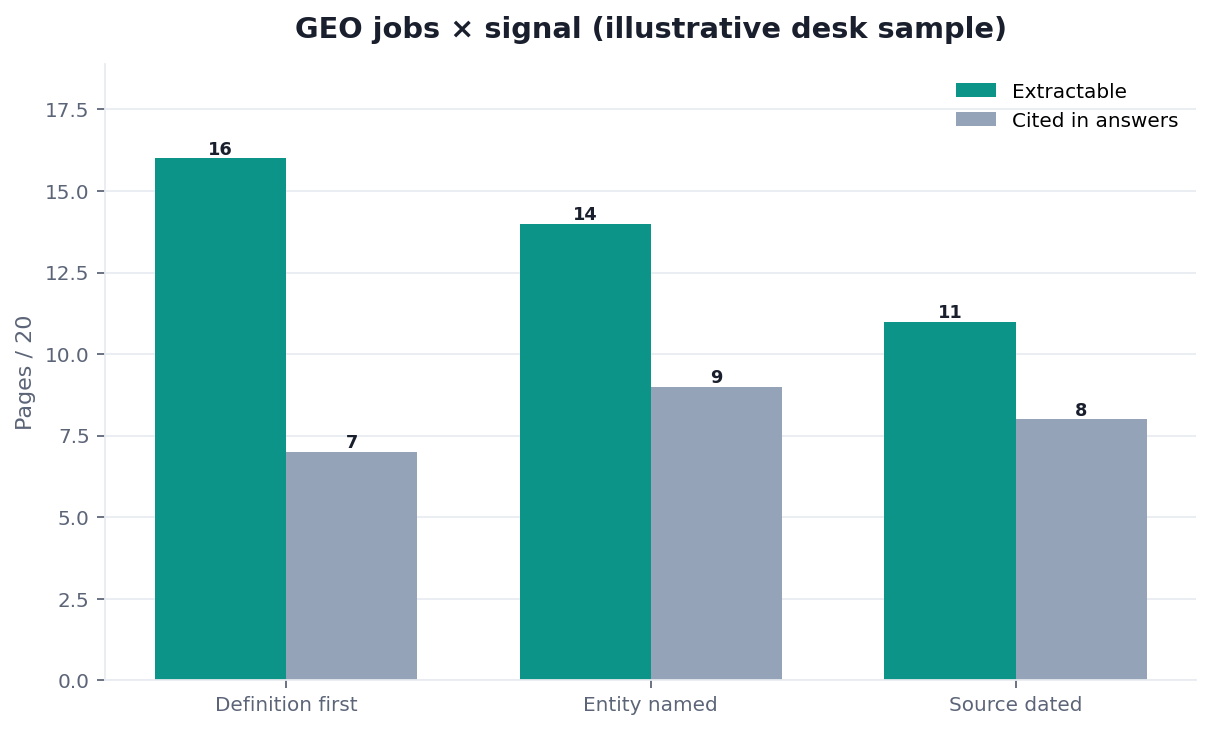
Public desk packet: twenty pages by GEO job
Named first-party case, not a customer win. Desk subset n=20 internal pages per job, scored 2026-08-11, last verified 2026-08-18, next public re-run 2026-08-25. Marker DESK-GEO-20260818A. Download desk-geo-n20.csv and the eight-URL cluster check.
The bars above count how many of 20 pages were extractable versus cited in an answer. They are not a live-web crawl and not a ranking recovery percentage.
| Job (n=20 pages) | Extractable | Cited in answers |
|---|---|---|
| Definition first | 16 / 20 | 7 / 20 |
| Entity named | 14 / 20 | 9 / 20 |
| Source dated | 11 / 20 | 8 / 20 |
| Metric (n=8 cluster, 2026-08-11) | Desk result | Method |
|---|---|---|
| Sample | 8 English /en/tool/ GEO pages | Same hostname |
| Category definition above the fold | 5 / 8 | 40–50 word block a model can lift |
| Named Person in HTML | 0 / 8 | William Zhu string, not “team” |
| Dated source on a number | 0 / 8 | Year plus primary URL |
| Official GEO score printed | 0 / 8 | We refuse that cell |
| Team-only hero byline | 8 / 8 | “SEO Health Team” |
This URL on 2026-08-11: category definition yes · named Person no · dated source no · official GEO score no · team hero yes. Cite the CSV before you treat any other generative engine optimization report as a Google meter.
Judging rules. Extractable is a closed claim a stranger can quote without the H1. Cited in answers is a URL InfiniSynapse controls. We do not invent a customer lift from a page count. Those rows are what Monday generative engine optimization work can prove.
Disclaimer. This page is a first-party desk method, not legal, medical, or ranking advice. SEO Health estimates alignment with public search documentation. It does not speak for Google. There is no Terms URL on this hostname; the live trust paths are Privacy, Corrections, and Publishing principles.
People type generative engine optimization when they want a name for the job. They also type “what is generative engine optimization” and expect the same sentence. This page is that sentence. It is not a replacement debate. It is not a service SKU. It is the category: make a passage liftable, make the source nameable, keep the document fetchable.
The field vocabulary sits in the Wikipedia overview of generative artificial intelligence (Wikidata Q117246174). Use it for terms, not as a 2026 operating spec. Nature’s machine-learning subject page (Wikidata Q2539) is the research neighborhood the models come from. Stanford’s Center for Research on Foundation Models is one lab that publishes how those models are trained and evaluated. Generative engine optimization borrows the retrieval problem. It does not borrow a lab’s benchmark as your Q3 target.
A useful generative engine optimization page answers three questions. What is the practice. What must a URL ship. What will we not claim. If the output is only “SEO for chat,” you still have the original problem.
Independent review surfaces for InfiniSynapse — not awards, not a substitute for generative engine optimization on the URL — sit on G2 SEO tools, Gartner Peer Insights, and the AgentSpot listing.
Key definition, applied
The unit of work is one URL. Not a brand campaign. Not a mention logger. You write a closed claim, name the entity, date the source, and confirm a crawler can fetch the document. Software can flag a missing block. A person still has to write the sentence. If you cannot quote the claim without the rest of the page, the generative engine optimization definition is not on the page yet.
Why a category page exists
Tactics pages assume you already accepted the name. Comparison pages assume you already know there are two jobs. Someone still has to define the practice in one block a model can lift. That is why generative engine optimization gets its own URL. If we bury the definition inside a vs-essay or a 30-day sequence, both the snippet and the answer lose the sentence.
On audited pages the cheapest miss is a hero that says “we do GEO” and never defines it. The second miss is three competing definitions in three H2s. One claim is enough. Put it high. Repeat it only when you are applying it.
What the category is not
Generative engine optimization is not a prompt you typed into a chat. A prompt is a demo. The category is a page change. It is not a citation percentage copied from a 2023 test set. It is not an official Google GEO score — none exists. Ranked results still take people who click. This page does not pick a winner. A page that recites the category name and then shows no extract still fails. Generative engine optimization is evidence, not a heading swap.
What a generative engine actually retrieves
Walk the retrieval pieces in this order so missing evidence surfaces before polish. Generative engine optimization that opens on a doughnut chart and hides the first paragraph is entertaining you.
| Order | Piece | Pass when | Fail when |
|---|---|---|---|
| 1 | Standalone claim | A stranger can quote 40–50 words without the H1 | Brand story, then a hedge |
| 2 | Named entity | The same string on the page, about page, and author | “Team,” or a product name that is not the org |
| 3 | Dated source | A year, a primary link, a method clause | “Studies show” with no study |
| 4 | Allowed crawler | Robots and meta do not block the engine you care about | The document is noindexed, then a GEO retainer |
Extractable claims
A generative engine lifts a passage. It does not lift a vibe. The claim has to stand alone: subject, verb, constraint, and a boundary for what it is not. Google documents how AI features may appear in Search in its AI features guidance (retrieved 2026-08-18). That page is about Search’s own generated units. Use it as a reminder that extractable blocks already matter on the results page, not as a promise that a chat client will cite you.
Generative engine optimization that writes the claim as a slogan — “we help teams win AI search” — has not shipped a claim. Write the job, the unit, and the refusal. Then stop. Move a buried definition up. Delete the tour paragraph that restates it.
Resolvable entities
A model that wants to name you needs a name it can resolve. On this URL the person is William Zhu and the organization is InfiniSynapse. The same string should appear as the organization or person on this URL, on the about URL, and in the byline. Two spellings are two entities. “Our experts” is zero entities.
This is still a category requirement, not a brand campaign. Generative engine optimization that adds a logo wall and never repeats the legal name is decorating the page. Repeat the name next to the claim. Link the about page. Keep the author string identical.
Provenance a stranger can check
Provenance is how a stranger decides whether to believe the lift. The W3C PROV-O provenance ontology (Wikidata Q62213429) is the formal vocabulary: an entity, an activity, and an agent. You do not need the ontology in the HTML. You need the three facts: what was claimed, who did the work, and when. A year and a method clause beat “recently, our team found.”
The 2023 research genre — including Aggarwal et al. on GEO methods (2023) (retrieved 2026-08-18) — is a paper about methods and a test set. It is not your site-level forecast. Cite it as a paper if you discuss the research. Do not paste its lift figures onto a sales slide and call them yours. Generative engine optimization as a category can mention that paper. It cannot inherit the percentage.
What the category includes
The category is wider than one paragraph and narrower than “everything a model might say.” Hold the edges.
Pages and passages
The document is the page. The extract is the passage. Generative engine optimization needs both. A beautiful page with no closed paragraph will be paraphrased without a source. Rewrite passages that depend on a previous H2 as if the rest of the page were gone.
Crawlers and eligibility
A category definition that ignores robots is a wish. If the engine you care about honors robots.txt or a noindex tag, a blocked path will not be used as a source. Fetch the URL as a crawler would. If the path is blocked, the edit is the allow/deny layer, not another adjective in the hero. A page that errors or loops is not a source. Fix the URL. Then return to the claim.
Measurement without fake rates
Mention is a brand string in an answer. Citation is a URL the answer names. They are two columns. Generative engine optimization as a category does not invent a site-level citation rate. Desk samples can say a page lacked a claim. They cannot say “citation lift was 40 percent.”
After you add the closed paragraph, open AI visibility on the same URL and read whether the claim, the entity, and the source are present. The checker reports evidence. It does not print an official GEO score.
Adjacent work after the definition
The definition is the core. Two adjacent jobs sit next to it. They are not substitutes.
When you need tactics
Once the category sentence exists, the remaining work is the repeatable edits: claim, entity, source, crawler. That sequence lives in GEO strategies. Generative engine optimization as a category page should not reprint the 30-day list. If you only needed the name, stop here. If you needed the punch list, keep going.
When you need the comparison page
Some stakeholders ask for a pair, not a category. The short quote for that pair is what is GEO vs SEO. The longer operating comparison is GEO vs SEO. If the meeting needs the three-column decision (adds AEO), open that table. This page does not fight those comparisons. It defines one side so the pair has a noun.
If a meeting only needs “what do we call this,” stay on generative engine optimization. If the meeting needs “how does this sit next to ranked results,” leave.
What you write down after the definition
Write four fields and stop: the claim, the entity string, the dated source, and whether the crawler is allowed. Open AI visibility on the URL you will fix today. Then open the strategies cluster if you still need a longer how-to.
Implementation order
Use this sequence on every URL so generative engine optimization stays a category, not a slogan.
- Write a standalone claim. A 40–50 word block that answers “what is this practice” without the H1.
- Repeat a resolvable entity name. Match InfiniSynapse and William Zhu on the page, the about URL, and the byline.
- Date the source. Add a year, a primary URL, and a method clause a stranger can check.
- Confirm the crawler is allowed. Robots and noindex must not block the engine you care about. That loop is the only honest generative engine optimization method.
Place the claim above the product tour. Delete the second, contradictory sentence. Re-read the claim out of context. If it does not stand, rewrite it. A pass that skips the crawler check and buys a mention logger will watch a URL the engine never fetched.
Failure modes
These are category failures, not scoring-theater failures.
- No standalone claim. The page says the category name and then tells a brand story. A model that wants a sentence has nothing to lift. Write the block. Put it first.
- Copied lift figures. A paper’s test set is not your forecast. Generative engine optimization that pastes a 2023 percentage onto a homepage is selling a slide. Cite the paper or drop the number. A vendor median is the same kind of slide. Compute an AI search typical payback period from your monthly spend and attributed margin.
- Blocked source. robots.txt or a leftover noindex hides the document, and the team keeps rewriting the hero. The edit is the allow/deny layer, not another adjective.
- Three definitions. Three H2s, three wordings, no extract. Pick one. Delete the rest.
None of these are model noise. They are extractability failures. Fix the page.
Inspect the complete Generative Engine Optimization page
Paste a sanitized URL into the InfiniSynapse SEO Health Checker so every title, mention, citation, and on-page layer can be reviewed together. Then validate the findings on the live page.
Inspect the complete Generative Engine Optimization page
Paste a sanitized URL into the InfiniSynapse SEO Health Checker so every title, mention, citation, and on-page layer can be reviewed together. Then validate the findings on the live page.
Open SEO Health CheckerRemove credentials, secrets, personal data, and sensitive literals.Frequently Asked Questions
What is generative engine optimization in one sentence?
Bottom line: Generative engine optimization is the practice of making a URL extractable and citable inside a model-written answer — a standalone claim, a resolvable entity, a dated source, and a crawler you did not block.
Is this a replacement for ranked results?
Bottom line: No. This page is a category definition, not a winner. Ranked results still take people who click. Generated answers take people who may never see the blue link. Define the practice. Do not pick a funeral.
Can I use a 2023 paper as my target?
Bottom line: As a citation for the research genre, yes. As a site-level lift forecast, no. The test set is not your domain. Write the claim you can defend.
Do I need a mention logger first?
Bottom line: No. Finish the page you will cite. A logger that watches a URL with no extract, no entity, and a blocked crawler will report a zero you already knew. Generative engine optimization starts with the document.
When is the category page enough?
Bottom line: When a stakeholder can quote the definition and you can point at the four fields on one URL. When they need the edit sequence, open the tactics page. When they need the pair, open the comparison.
Conclusion
Generative engine optimization is the 2026 category name for making a URL extractable and citable. Write the claim. Name the entity. Date the source. Allow the crawler. Believe the missing block. Ignore a decorative doughnut. Start with AI visibility. For the pair that sits this category next to ranked results, stay on GEO vs SEO.
The desk packet stays public so the next diagnosis week can be cited. It is still first-party, one hostname, not a third-party award. Re-run the same twenty pages before you treat a redesign as generative engine optimization.
Sources
- Google AI features guidance · Aggarwal et al., 2023 preprint · W3C PROV-O. Retrieved 2026-08-18.
- Wikipedia — generative AI (Q117246174) · Nature — machine learning (Q2539) · Stanford CRFM · Search engine optimization · NIST Privacy Framework.
- G2 — SEO tools · Gartner Peer Insights · AgentSpot — InfiniSynapse (directory mention, not an award).
- InfiniSynapse desk — n=20 GEO jobs and n=8 cluster CSV (
DESK-GEO-20260818A).
Reviewer: InfiniSynapse Data Team. Published 2026-08-16. Updated 2026-08-18.
William Zhu · Cofounder, InfiniSynapse · GitHub @allwefantasy
Desk-validated SEO Health methods. Corrections: zhuhl@infinisynapse.com · corrections policy.