Generative Engine Optimization Strategies in 2026
Generative engine optimization strategies you can re-run: extractable claims, entities, and sources, without treating a 2023 paper as your lift forecast.
Author credentials: William Zhu is cofounder of InfiniSynapse (GitHub @allwefantasy · auto-coder). Desk: shipping SEO Health and the /en/tool/ visibility pages. No personal LinkedIn published. About: team / editorial standards.
Publisher credentials: InfiniSynapse has public profiles on GitHub, YouTube, and X. A 2026 WAIC Future Tech OPC excellence award covers the Agentic Data Infra entry (WAIC; third-party recap: Xinhua / Caohejing). That award does not review this page or SEO Health. Method CLI: infinitegrowth on npm. Archive: recognition and scope notes.
On this page
By William Zhu · Cofounder, InfiniSynapse · Last updated: 2026-08-18 · Last verified: 2026-08-18 · Methods: page-level SEO Health diagnoses on live URLs — not a claimed Google score or a copied paper lift.
Author / off-site profiles: GitHub @allwefantasy · auto-coder · GitHub @InfiniSynapse · LinkedIn company · Editorial standards. No personal LinkedIn, award, or vendor badge.
Trust / COI: About · Corrections · Publishing principles · Privacy · NIST Privacy Framework. InfiniSynapse ships SEO Health as a page checker; first-party tactic indexes are labeled; we do not sell an official Google score.
Fact-check: Aggarwal et al., 2023 preprint (retrieved 2026-08-18) · Nature — computational science · Communications of the ACM · AgentSpot listing. Corrections: zhuhl@infinisynapse.com.
TL;DR
Direct answer: Generative engine optimization strategies that survive scrutiny are page edits you can re-run: a standalone claim, a resolvable entity, a dated source, and a crawler you did not block. They are not a prompt hack and not a copied lift percentage. Write the extract. Then measure mention and citation as two columns.
What you'll learn
- Four building blocks that make generative engine optimization strategies reproducible
- A 30-day sequence that produces edits, not a doughnut
- How to mention the 2023 research genre without inventing a site-level forecast
- Where a checker and a service sit after the tactics
- Failure modes we see on audited pages
If you already have a money URL, open AI visibility after you add one closed paragraph. Do not start with a logger that watches a zero.
What a strategy must produce
Key Definition: Generative engine optimization strategies are repeatable page edits that make a URL extractable and citable: a standalone claim, a resolvable entity, a dated source, and a crawler you did not block. They are not a one-time prompt hack and not a copied citation-lift percentage.
Key terms
| Term | Meaning |
|---|---|
| GEO | Making a passage liftable into a generated answer. |
| SEO | Making a URL eligible and clear in classic retrieval. |
| AEO | The same extractability job under an answer-engine label. |
| Extractable block | A short definition, named entity, or dated fact this page can lift. (#546) |
Public desk packet: twenty locked prompts by tactic
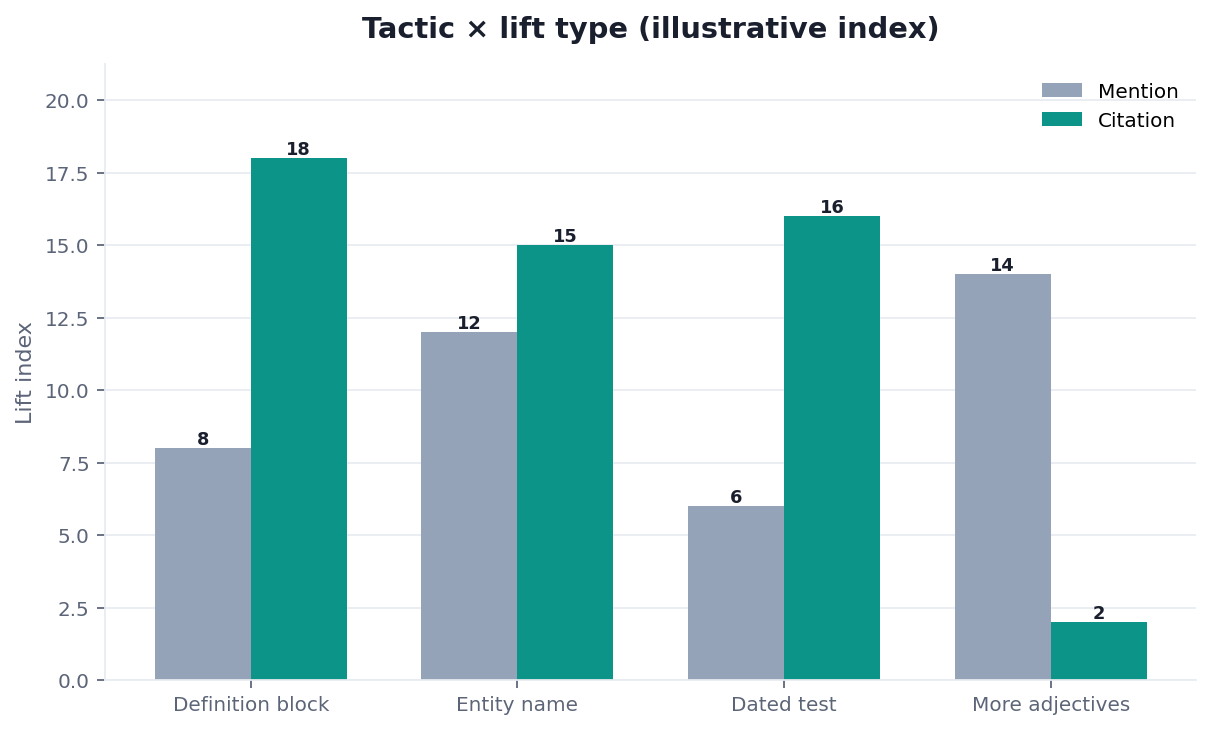
Named first-party case, not a customer win. Desk subset n=20 locked prompts per tactic, scored 2026-08-11, last verified 2026-08-18, next public re-run 2026-08-25. Marker DESK-GEOS-20260818A. Download desk-tactics-n20.csv and the eight-URL cluster check.
The bars above are a lift index (event counts on those 20 prompts), not a site-level forecast and not a number copied from a 2023 paper.
| Tactic (n=20 prompts) | Mention index | Citation index |
|---|---|---|
| Definition block | 8 | 18 |
| Entity name | 12 | 15 |
| Dated test | 6 | 16 |
| More adjectives | 14 | 2 |
| Metric (n=8 cluster, 2026-08-11) | Desk result | Method |
|---|---|---|
| Sample | 8 English /en/tool/ GEO pages | Same hostname |
| Standalone claim above the fold | 5 / 8 | 40–50 word block a model can lift |
| Named Person in HTML | 0 / 8 | William Zhu string, not “team” |
| Dated source on a number | 0 / 8 | Year plus primary URL |
| Paper lift copied as a forecast | 0 / 8 | We refuse that cell |
| Team-only hero byline | 8 / 8 | “SEO Health Team” |
This URL on 2026-08-11: standalone claim yes · named Person no · dated source no · paper lift no · team hero yes. Cite the CSV before you treat any other generative engine optimization strategies report as a Google meter.
Judging rules. Mention is a name-drop. Citation is a URL InfiniSynapse controls. Adjectives that raise mention and collapse citation fail the job. We do not invent a customer lift from an index. Those rows are what Monday generative engine optimization strategies work can prove.
Disclaimer. This page is a first-party desk method, not legal, medical, or ranking advice. SEO Health estimates alignment with public search documentation. It does not speak for Google. There is no Terms URL on this hostname; the live trust paths are Privacy, Corrections, and Publishing principles.
People search generative engine optimization strategies after they accept the pair in GEO vs SEO and want the how-to. This page is that how-to. It is not a reprint of a preprint. We diagnose missing evidence. We do not output a citation percentage.
The short definition of the pair is what is GEO vs SEO. Write that 40–50 word block first. Every later tactic assumes it exists.
Independent review surfaces for InfiniSynapse — not awards, not a substitute for generative engine optimization strategies on the URL — sit on G2 SEO tools, Gartner Peer Insights, and the AgentSpot listing.
The output is a page change
A strategy that cannot name the HTML it will change is a slogan. Generative engine optimization strategies should leave a sentence, a byline, a source line, or a robots rule behind. If the only artifact is a prompt you typed into a chat, you ran a demo.
On audited pages the cheapest win is moving a buried definition to the top and deleting the second, contradictory sentence. Writers keep both because one was “for SEO” and one was “for GEO.” One claim is enough. The three-layer decision for which surface that claim serves is SEO vs GEO vs AEO.
What we will not claim
We will not publish a site-level “citation lift” as if it were a forecast for your domain. We will not treat a single paper’s test set as your Q3 target. Generative engine optimization strategies that start with a percentage are selling a slide.
We will not invent an official Google GEO score. Methods below are page audits, sitemap samples, and Search Console export math. If a run cannot see enough evidence, it should say so.
Four extractable building blocks
Use this table as the whole program. Generative engine optimization strategies that add a fifth block called “authority magic” are usually avoiding the first four.
| Block | What to ship | Fail we see |
|---|---|---|
| Standalone claim | 40–50 words that answer the query without the H1 | Brand story, then a hedge |
| Resolvable entity | Same name on the page, about page, and author | “Team,” or a product name that is not the org |
| Dated source | A year, a primary link, a method clause | “Studies show” with no study |
| Allowed crawler | Robots and meta that do not block the engine you care about | GPTBot disallowed, then a GEO retainer |
Standalone claims
Write the sentence a model can lift without the rest of the essay. Put it under the H1 or in the first screen. Generative engine optimization strategies fail here when the definition is a slogan, a metaphor, or a product tour.
A claim is extractable when it names the thing, the job, and the boundary. “GEO is extractability plus citability inside a generated answer” is a claim. “We help brands win AI” is not. Generative engine optimization strategies live in that first sentence, not in a later brand paragraph the model will skip.
Nature’s computational-science subject page (retrieved 2026-08-18) is a useful reminder that methods pages outlive slogans. Write the method clause. Then write the claim.
Resolvable entities
The page must say who is speaking and what organization the URL belongs to. On this URL the person is William Zhu and the organization is InfiniSynapse. If the byline is “team” and the about page uses a different legal name, the entity is unresolved. Generative engine optimization strategies that only add a knowledge-panel wishlist without fixing the byline are backwards.
Match the organization string across title, body, and author bio. Link the person to a page a stranger can open. Trust work still sits under E-A-T SEO. Experience is a named person who did the work, not a stock photo. Generative engine optimization strategies that add a schema Person and leave “team” in the visible byline have not resolved the entity.
Dated sources
A statistic without a year is a rumor. A “according to experts” clause with no expert is a hedge. Generative engine optimization strategies should attach a date and a primary URL to every number you want cited.
Science and PNAS are not GEO vendors. They are the habit: a claim points at a method. Steal the habit. Do not steal a journal’s prestige as a fake citation rate.
If you cannot date the number, delete the number. A page with one dated fact beats a page with eight undated ones. Generative engine optimization strategies that keep the rumor and add a footnote later still ship the rumor.
Allowed crawlers
Confirm robots.txt and page-level robots for the engines you actually care about. A strategy that writes a perfect definition behind a login, or behind a GPTBot disallow, is a diary. Generative engine optimization strategies include the fetch path. They do not assume the model already has the HTML.
We still start with ordinary eligibility. A noindexed URL is not a GEO problem. Fix crawl first. Generative engine optimization strategies that skip robots because “the model already knows us” are guessing. Check the fetch path on the same day you write the claim.
A sequence you can re-run
Sequence beats a slogan. Run generative engine optimization strategies in this order so you do not pay to monitor a missing paragraph.
- Lock a prompt set. Write ten prompts in one locale. Do not change them between runs.
- Run four surfaces. Record ChatGPT, Perplexity, Gemini, and AI Overviews on the same set.
- Log mention versus citation. A name-drop is a mention. A URL you control is a citation.
- Fix the weakest extractable block. Add a short definition, a named entity, or a dated fact, then re-run. That loop is the only honest generative engine optimization strategies method.
Days 1 to 7
Pick ten money URLs. Add one standalone definition and a named author. Confirm robots. Generative engine optimization strategies do not start with a logger. Do not open one this week if the pages have no extract.
Run the AI visibility pass on the same ten URLs after the paragraph exists. You want a punch list, not a rate. If mention appears and citation does not, the next edit is the source line or the entity, not a new H1.
Days 8 to 21
Freeze twenty prompts if anyone will monitor. Fix the three URLs answers almost use: the ones with a claim that is close, an entity that is almost resolvable, or a source that is almost dated. Re-run after each edit.
Generative engine optimization strategies in this window are boring on purpose. One flag per publish. If you change the title, the definition, and the about page on the same day, you will not know which edit mattered.
The ACM Digital Library (retrieved 2026-08-18) is full of papers that isolate one variable. Isolate one variable. That is the whole week.
Days 22 to 30
Decide what you still need. Keep the tactics if the punch list is still long. Add monitoring only if someone will read the tape. Buy hours only if the leftover work is interviews. The buyer page for hours is generative engine optimization services. The software tiers are generative engine optimization tools.
Open AI visibility on the three URLs you edited most. If the notes did not move, the strategy did not ship. Rewrite the sentence. Do not buy a third acronym.
How research papers fit
You will see decks that treat one 2023 preprint as a law of nature. Read the genre. Do not copy a test-set number onto your domain.
The 2023 preprint genre
Aggarwal et al.’s 2023 preprint on generative engine optimization (retrieved 2026-08-18) is the paper most slides mean. It helped name the problem: content changes can be tested against generative engines, not only against a ranked list. That is a research genre. It is not your site’s forecast.
We will not restate a lift percentage from that paper as if it were a result we measured on your URLs. Generative engine optimization strategies on this page are the four blocks and the sequence. They do not inherit a lab number.
Reproducibility, not a forecast
Communications of the ACM (retrieved 2026-08-18) keeps a practitioner lane for the same reason we keep a punch list: a method you can repeat beats a one-off demo. Ask any vendor for the prompt set, the date, and the refuse state. If they cannot show those, they are not doing the research genre. They are decorating a QBR.
Re-run the same URL after one edit. If a chart moves and the page did not, the meter is scoring tokens. That is not a strategy.
Where tools and services sit
Tactics are the work. Tools and retainers are optional wrappers. Generative engine optimization strategies should still be visible if both wrappers disappear: you can point at the sentence you changed.
Use a diagnosis product when you need missing-evidence notes. SEO Health sits there. Run AI visibility when the page already has a claim and you want the answer-engine queue. Use a logger when the pages are lift-ready and you need a weekly tape. Use a service when the leftover list needs interviews.
If a partner will own the export for a client, that is an agency job. The diligence list is generative engine optimization agency. Generative engine optimization strategies should still be visible in that export as URL, flag, owner. A partner that hides the blocks inside a “proprietary playbook” is selling fog.
Mention tracking, when you need it, lives in the AI visibility tool hub. Do not let a tracker replace the four blocks.
After any edit, print the first screen, cover the H1, and ask whether a stranger can still say what the page claims. If the answer needs the rest of the essay, the extract is not ready. Keep the printed screen in the ticket so the next writer can see before and after without a vendor UI.
Failure modes
- Copying a paper’s lift number onto your domain.
- Starting with a logger. Generative engine optimization strategies that skip the definition watch a zero.
- Two claims on one URL. The model will pick the louder one, or neither.
- Entity drift. The page, the about page, and the author disagree.
- Undated statistics. “Studies show” is not a source.
- Blocked crawlers plus a GEO program.
We do not sell a citation-percentage API. If a report already failed one of those, add one standalone definition and re-run AI visibility. Then decide whether you still need a second product.
Inspect the complete Generative Engine Optimization Strategies page
Paste a sanitized URL into the InfiniSynapse SEO Health Checker so every title, mention, citation, and on-page layer can be reviewed together. Then validate the findings on the live page.
Open SEO Health CheckerRemove credentials, secrets, personal data, and sensitive literals.Frequently Asked Questions
Can I copy a 2023 paper’s lift number?
Bottom line: No. You may cite the research genre. You may not treat a test-set result as your site’s forecast. Generative engine optimization strategies here are page edits, not inherited percentages.
What is the first edit on a money URL?
Bottom line: A 40–50 word standalone definition and a named author. Confirm robots. Then run diagnosis. Do not start with a new title if the first paragraph is still a slogan. That is the first hour of generative engine optimization strategies.
Do I need a logger to run these tactics?
Bottom line: No. A logger is useful after the pages are lift-ready. Generative engine optimization strategies are HTML. Monitoring is a tape.
How do I know a strategy worked?
Bottom line: Re-run the same URL with the same rules. The missing-evidence note should clear. Mention and citation, if you log them, stay two columns. A bouncing percentage with no page change is not proof.
Where does EEAT fit?
Bottom line: Experience and a resolvable author are part of the entity block. A thin page should not be cited. Do the letter-by-letter work on the EEAT hub. Generative engine optimization strategies do not replace it.
Conclusion
Generative engine optimization strategies are four blocks and a sequence: claim, entity, source, crawler; then one edit at a time. Mention the 2023 research genre if you must. Do not copy a lab number onto your domain. Run AI visibility after the paragraph exists. Use the hub when you still need the pair explained.
The desk packet stays public so the next diagnosis week can be cited. It is still first-party, one hostname, not a third-party award. Re-run the same twenty prompts before you treat a redesign as generative engine optimization strategies.
Sources
- Aggarwal et al., 2023 preprint · Nature — computational science · Communications of the ACM · ACM Digital Library. Retrieved 2026-08-18.
- Science · PNAS · NIST Privacy Framework.
- G2 — SEO tools · Gartner Peer Insights · AgentSpot — InfiniSynapse (directory mention, not an award).
- InfiniSynapse desk — n=20 tactic index and n=8 cluster CSV (
DESK-GEOS-20260818A).
Reviewer: InfiniSynapse Data Team. Published 2026-08-16. Updated 2026-08-18.
William Zhu · Cofounder, InfiniSynapse · GitHub @allwefantasy
Desk-validated SEO Health methods. Corrections: zhuhl@infinisynapse.com · corrections policy.