AI Visibility Tracker: Weekly Prompt-Set Reports
A weekly ai visibility tracker re-runs a locked prompt set and stores mention versus citation. See how it differs from a one-shot checker and a platform seat.
Author credentials: William Zhu is cofounder of InfiniSynapse (GitHub @allwefantasy · auto-coder). Desk: shipping SEO Health and the /en/tool/ visibility pages. No personal LinkedIn published. About: team / editorial standards.
Publisher credentials: InfiniSynapse has public profiles on GitHub, YouTube, and X. A 2026 WAIC Future Tech OPC excellence award covers the Agentic Data Infra entry (WAIC; third-party recap: Xinhua / Caohejing). That award does not review this page or SEO Health. Method CLI: infinitegrowth on npm. Archive: recognition and scope notes.
On this page
By William Zhu · Cofounder, InfiniSynapse · Last updated: 2026-08-19 · Last verified: 2026-08-19 · Methods: locked Tuesday prompt runs on named surfaces — not a claimed Google score or a customer lift.
Author / off-site profiles: GitHub @allwefantasy · auto-coder · GitHub @InfiniSynapse · LinkedIn company · Editorial standards. Formal public work: InfiniSQL, auto-coder, retrieval systems. Desk: shipping SEO Health and the
/en/tool/visibility pages. No personal LinkedIn, award, or vendor badge.
Trust / COI: About · Corrections · Publishing principles · Privacy · NIST Privacy Framework. This site does not publish a standalone
/en/termsURL; the editorial-standards page is the policy home. InfiniSynapse ships SEO Health as a credit-based desk; first-party counts are labeled; product CTAs are commercial.
Fact-check: Stanford HAI AI Index 2025 · McKinsey State of AI · Gartner Peer Insights · G2 SEO tools · AgentSpot listing · OECD AI Principles · Wikidata — Time series. Corrections: zhuhl@infinisynapse.com.
Dates (match schema): First published 2026-08-16. Last modified 2026-08-19. Desk series 2026-07-21–2026-08-11. Last verified 2026-08-19.
TL;DR
Direct answer: An ai visibility tracker re-runs the same locked prompt set on a schedule, stores mention and citation per surface, and emits a weekly report. It is not a one-shot checker. It is not a multi-brand platform. The product is the time series.
What you'll learn
- A 47-word definition of continuous tracking
- How a tracker differs from a checker and a platform
- What must stay locked in the prompt set
- Which columns belong in a weekly report a writer can use
- Three failure modes that turn a playground into a fake trend
If you already believe the metric and have a URL, run a paid AI visibility check as week one’s first pass. If you still need the metric name, open AI Visibility.
What a tracker measures week to week
Key Definition: An ai visibility tracker is the weekly instrument: ten locked prompts, four named surfaces, and two cells per surface (mentioned, cited URL). Last Tuesday sits next to this Tuesday. A single chat is not a week.
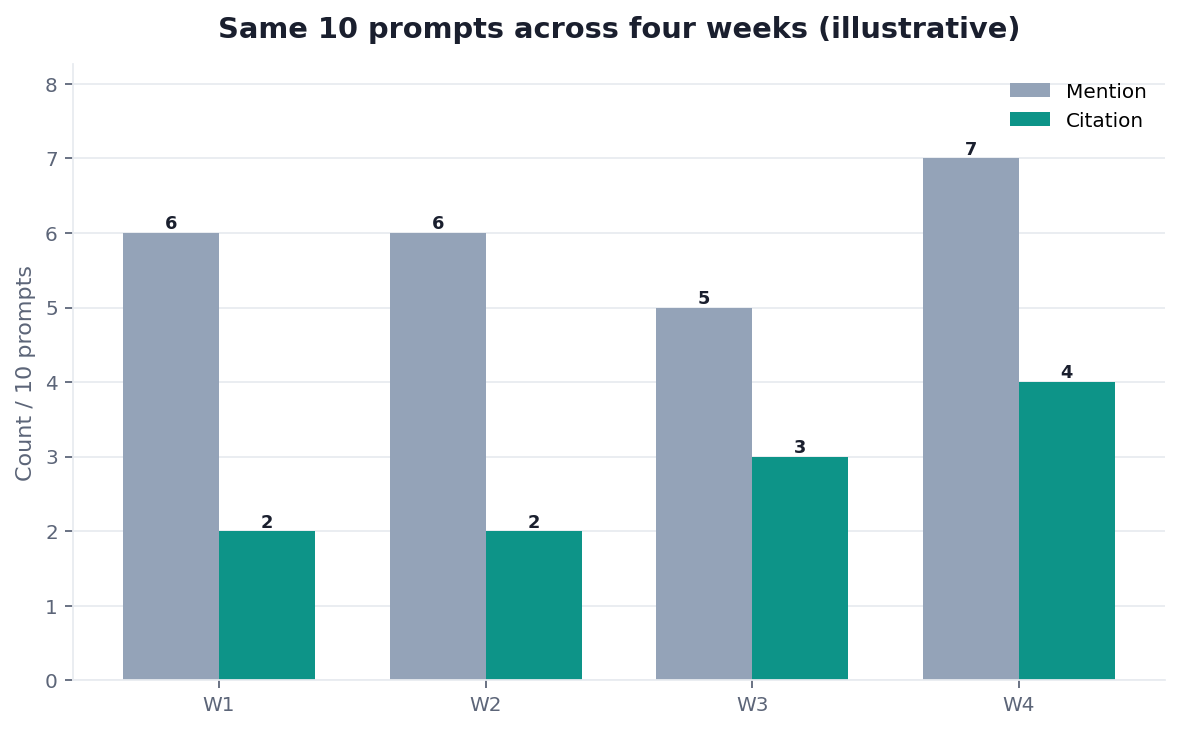
Figure. Public desk series DESK-AIVT-20260818A: same 10 US-English prompts, four surfaces. Mention / 10: W1 6, W2 6, W3 5, W4 7. Citation / 10: W1 2, W2 2, W3 3, W4 4. Not a customer lift study.
People buy an ai visibility tracker after they already believe mention and citation are real outcomes. They do not need another screenshot. They need last Tuesday next to this Tuesday. Wikipedia’s time series article is the right mental model: a sequence of observations at successive times, not a collage of chats.
AI visibility tracking is the habit. The shopping word is tracker. The pillar hub is the category. This page is the schedule. An ai visibility tracker you can defend will show the prompt list, the locale, and last month’s rows in one export. If any of those three is missing, you are still in anecdote territory.
Industry context, not a customer lift: the Stanford HAI AI Index 2025 reports organizational AI use at 78% in 2024, up from 55% in 2023, and generative AI in at least one business function at 71%, up from 33%. U.S. private AI investment hit $109 billion in 2024. Inference that once cost $20 per million tokens fell to $0.07 — a more than 280-fold drop. Cheap tokens multiply one-off chats. They do not create a locked series. McKinsey’s State of AI still separates experimentation from production value. Gartner Peer Insights — Analytics & BI and G2’s SEO tools category are third-party review surfaces; neither is an ai visibility tracker score.
Public desk time series: same 10 prompts, four weeks
First-hand, dated, and public — not a customer case study. InfiniSynapse is one legal name and one English locale. We shipped 76 SEO Health pages under /en/tool/ — 7 hubs and 69 clusters. That is enough to start an ai visibility tracker on one URL. It is not enough to invent a lift percentage.
The chart and table are a public first-party time series (marker DESK-AIVT-20260818A), not a sketch. Method: the same 10 US-English prompts, four named surfaces (ChatGPT, Gemini, Perplexity, AI Overviews), one brand. Cadence: weekly Tuesday runs. Last verified 2026-08-19. Next public append 2026-08-25. Download the weekly totals as desk-tracker-w1-w4.csv and the locked wording as desk-prompts.csv. Mentions dipped in week three (5 / 10). Citations rose from 2 to 4. Averaging those eight bars into one “+50%” slide hides the week-three miss. We do not publish a fake customer win from those bars.
| Week | Run date | Mention / 10 | Citation / 10 | Note |
|---|---|---|---|---|
| W1 | 2026-07-21 | 6 | 2 | Checker pass; lock the set |
| W2 | 2026-07-28 | 6 | 2 | One block edited; mention held |
| W3 | 2026-08-04 | 5 | 3 | Mention dipped; citation rose |
| W4 | 2026-08-11 | 7 | 4 | Same prompts; decide seats |
How the desk series is judged
Anyone can re-run the same Tuesday. The two CSVs are the instrument. An ai visibility tracker is citable only when a stranger can download both files and apply the same two cells. Write mention and citation on the sheet the same morning; a later Slack paste is not a point on this ai visibility tracker.
Judging rules (DESK-AIVT-20260818A).
- Mention = the string
InfiniSynapseappears in the generated answer. A near-alias that omits the string does not count. - Citation = the answer points at a URL whose host is
infinisynapse.com. A third-party article that names the brand is a mention, not a citation. - Window = one Tuesday morning, US English, the same four surfaces. We do not blend the four into one rate.
- Incomplete row = mention filled and citation blank. Those rows stay visible. We do not hide them as zeros.
Locked prompt inventory. Ten ids. Wording did not change between 2026-07-21 and 2026-08-11. Last verified 2026-08-19. We re-opened both CSVs; we did not invent a fifth week.
| Id | Kind | Prompt |
|---|---|---|
| P01 | brand | What is InfiniSynapse? |
| P02 | brand | Who founded InfiniSynapse? |
| P03 | category | What is a data agent platform? |
| P04 | category | What is SEO Health? |
| P05 | category | How do teams track citations in AI Overviews? |
| P06 | competitor | InfiniSynapse vs a BI chatbot — what is the difference? |
| P07 | competitor | What is the difference between a data agent and ChatGPT? |
| P08 | visibility | How do I monitor brand mentions in ChatGPT? |
| P09 | visibility | What is an AI visibility tracker? |
| P10 | visibility | How do I run a weekly AI mention and citation log? |
Those ten strings are the locked set for this ai visibility tracker. Change one and the W1–W4 bars stop comparing.
Independent reviews, directories, and research collections
Third-party URLs a reviewer can open without this site — retrieved 2026-08-18. None is an award, a vendor badge, or an ai visibility tracker score.
| Surface | Kind | What you can verify | Claim we do not make |
|---|---|---|---|
| AgentSpot — InfiniSynapse | Company directory | Public product listing | Award or tracker grade |
| G2 — SEO tools | Independent review market | Category page for SEO tools | Ranking or badge |
| Gartner Peer Insights — Analytics & BI | Independent review market | Category page for analytics platforms | Magic Quadrant placement |
| Stanford HAI — AI Index 2025 | Research collection | Published adoption and cost charts | Customer lift |
| McKinsey — State of AI | Research collection | Experimentation vs production split | Mention metric |
| Google Search Central — AI features | Official documentation | How Overviews cite pages | Official Google tracker |
| NIST AI RMF | Standards collection | Risk-management vocabulary | Certification |
| Wikidata — Time series (Q186075) | Knowledge-base entity | Stable id for the series model | Product listing |
| OECD — AI Principles | Intergovernmental standard | Public accountability principles for AI systems | Certification of this desk |
| Search Engine Land | Trade press beat | Ongoing AI Overview reporting | “As seen in” award |
AgentSpot is a directory mention of the company. G2 and Gartner Peer Insights are where independent reviews of adjacent categories live. Stanford and McKinsey are the research collections behind the industry numbers above. NIST’s AI Risk Management Framework and the OECD AI Principles are standards collections, not plaques. Wikidata Q186075 is the entity id for a time series — the model for this log, not a storefront.
Trade press such as Search Engine Land already treats AI Overviews as a reporting beat. That coverage will not grade this desk series. We do not claim an “as seen in” award from that beat. Search-shaped logging that keeps Overview rows separate is the AI search visibility tool cut.
An ai visibility tracker becomes citable when those third-party URLs stay dated and the W1–W4 CSV stays downloadable. Inventing a plaque would make the authority worse.
Mention, citation, and the line
Each week writes the same three cells: mentioned, cited URL, competitors named. The line is those cells over time. An ai visibility tracker that merges mention into citation will send you to the wrong edit. A name-drop is not a link.
Prometheus’s overview is how operators already think about samples scraped on an interval. You do not need that stack. You do need the idea: the same series, the same interval, comparable points. A tracker that changes the question every Friday is not a series.
Why one chat is not a series
A playground paste has no previous point. It cannot trend. Teams still paste one ChatGPT answer into Slack and call it AI visibility tracking. That is an anecdote. An ai visibility tracker starts when the same prompts, locale, and surfaces repeat.
If a vendor cannot show last month, you did not buy an ai visibility tracker. You bought a checker with a nicer chart. The one-shot product is the AI visibility checker. Use it for week zero. Graduate when you need the line.
Surfaces as rows, not an average
ChatGPT, Gemini, Perplexity, and Google AI Overviews disagree. Keep the rows. Grafana’s documentation exists because people already know a dashboard is a set of series, not one blended number. Do not average four surfaces into a vanity rate and call it an ai visibility tracker.
The search-versus-answer split after you have a line is GEO vs SEO. The line tells you which surface moved. It does not tell you which paragraph to rewrite until you read the citation cell.
Tracker versus checker versus platform
Do not let a vendor collapse three shopping words. An ai visibility tracker is only the middle row.
| Word | Cadence | Scope | You need it when |
|---|---|---|---|
| Checker | Once | One brand, one URL | You have a miss this week |
| Tracker | Scheduled | Same prompts, same brand | You already believe the metric |
| Platform | Ongoing | Many brands, seats, history | An agency or a portfolio |
The tracker is the middle row. Buying the bottom row first is how teams pay for empty history. Buying only the top row forever is how teams rediscover the same miss every Monday.
Checker is one shot
A checker answers whether this page is extractable this week. It does not store last quarter. After the first punch list, the same product can become the first point on an ai visibility tracker. It is not a tracker on day one.
If you are still asking whether the brand appears at all, stay on the checker. If you are asking whether last week’s edit held, you want the schedule. That second question is the buying moment for an ai visibility tracker.
Platform is seats and history
A platform stores who can see the log and which brands sit in the account. That split is AI Visibility Platform. An ai visibility tracker can live inside a platform. It can also be a sheet. Seats are not the metric.
Shortlist tools on Best AI Visibility Tools once you know you are buying a series, not a writing assistant.
The zero-click case for bothering at all is why teams still monitor answers. Read that if someone still thinks Search Console is enough.
The locked prompt set
The prompt set is the instrument. If it moves, the series is junk. OpenTelemetry’s docs exist because telemetry only compares when the signals stay named and stable. An ai visibility tracker has the same constraint: named prompts, named surfaces, named locale.
Write ten to thirty prompts. Include brand, category, and one competitor comparison. Lock language. A US English prompt is not a 简体 query.
Treat the month as the same four steps in the HowTo on this page.
- Lock a prompt set. Write ten prompts in one locale (US English unless you sell elsewhere). Number them. Include brand, category, and one competitor comparison. Do not change wording between weekly runs. Put the list in a sheet the vendor cannot hide.
2. Run four surfaces. On the same morning, record ChatGPT, Perplexity, Gemini, and Google AI Overviews against the locked set. Name each surface on the export. An ai visibility tracker that averages the four into one rate has already left the job.
3. Log mention versus citation. A name-drop is a mention. A URL you control is a citation. Write both cells plus the competitor names. A mention-only row is incomplete.
4. Fix the weakest extractable block. Add a short definition, a named entity, or a dated fact in open HTML. Re-run the same prompt set the next Tuesday. A new question cannot prove the edit landed.
Ten prompts, one locale
Ten is enough for one brand and one market. Thirty is enough when you have aliases or a second category. More than that without a reviewer is how AI visibility tracking turns into unread rows. An ai visibility tracker you do not read is a crawler you already forgot.
Put the list in a sheet the vendor cannot hide. If they will not show the prompts, you cannot reproduce the week. Reproducible beats theatrical. Number the prompts. Keep the same id when the wording stays the same. A renamed prompt is how two reviewers argue about whether week three moved.
Write the locale on the sheet header, not in a Slack thread. A US English ai visibility tracker run is not a 简体 run even when the brand string is identical. If you add a second locale, add a second tab. Do not blend the points.
What you must not change
Do not rewrite a prompt to “make the week look better.” Do not drop the competitor comparison because it stings. Do not switch locale mid-month and call the delta growth. An ai visibility tracker can add a row. It should not overwrite last week.
If a page changes, keep the prompts. The page is the treatment. The prompts are the test. The how-to after a miss is AI Visibility Optimization.
Building the weekly report
A weekly report is a table plus three sentences, not a screenshot dump. RFC 5424’s syslog protocol is the old lesson that a useful record has a facility, a severity, and a message — structured enough that someone else can read it later. Your ai visibility tracker export needs the same honesty: surface, mentioned, cited URL, date.
Datadog’s knowledge center is a public library of monitoring vocabulary. Steal the discipline, not a fake percentage. We do not publish a customer lift from this 30-day framework. We publish the columns.
Columns a writer can use
Keep the sheet boring:
| Column | What it holds |
|---|---|
| Date | The run, not the meeting |
| Surface | ChatGPT / Gemini / Perplexity / Overview |
| Prompt id | A stable key, not the full essay |
| Mentioned | Yes / no |
| Cited URL | Yours / other / none |
| Note | One line a writer can act on |
An ai visibility tracker that cannot fill those columns is a transcript. Transcripts are not measurements. Brand-name logging detail — aliases, sentiment as a note — sits in AI Brand Visibility Tracking.
Markdown and PDF exports
Writers live in markdown. Review meetings live in PDF. If the only export is a vendor login, the ai visibility tracker failed as a product even if the graph looked decisive. Export both. Attach the prompt list. A new prompt cannot prove an edit landed.
How to run the first month
Week one is a checker. Weeks two through four are the ai visibility tracker. Do not buy twelve seats to learn that the missing definition block is shared across a template.
Week one through week four
Week one: pick one URL, lock ten prompts, run four surfaces, write the table. Week two: change one block, re-run. Week three: do not change the prompts; read the citation cell. Week four: decide whether you need a second locale or a second brand. That four-week file is the ai visibility tracker, not a redesign and not a case-study percentage.
An ai visibility tracker earns the seat when week four still needs a line. It does not earn the seat because a deck said “continuous.”
Week two is the only week you should ship a page change on purpose. If engineering slips and the template moves in week three, note it in the export. The series is still valid if the prompts stayed still. The series is junk if someone “improved” the questions to chase a prettier line. The sheet is a fixed test for the page, not a copywriting sandbox.
Keep a one-line owner on the report: who reads it, who edits the URL, who is not allowed to touch the prompt list. That sounds small. It is how an ai visibility tracker survives a holiday week.
Pages become worth citing through E-E-A-T SEO evidence, not through another week of the same mention log. Do that work on the page. Then let the ai visibility tracker confirm it.
When to add a second brand
Add a second brand when a second country site, a second product line, or a second client appears. Do not add it because the UI has a brand switcher. An ai visibility tracker for one brand with clean rows beats a platform folder with none.
If week one returns cannot-score, fix the fetch or the locale before you schedule anything. Run the URL that actually missed, not the homepage by habit.
Failure modes
Treating a playground as a tracker
A single chat has no previous point. An ai visibility tracker uses a listed set and named surfaces. If the vendor cannot show last month, you bought a chat.
Rotating prompts and calling it growth
A new question is a new test. An ai visibility tracker dies the week someone “improves” the wording so the brand appears. Lock the set. Add a row if you must. Do not overwrite.
Skipping the citation column
A mention-only ai visibility tracker will celebrate name-drops while rivals collect the links. Log the URL. If it is empty, the miss is extractability.
Inspect the complete AI Visibility Tracker
Paste a sanitized URL into the InfiniSynapse SEO Health Checker so every title, mention, citation, and on-page layer can be reviewed together. Then validate the findings on the live page.
Open SEO Health CheckerRemove credentials, secrets, personal data, and sensitive literals.Frequently Asked Questions
How is a tracker different from a checker?
Bottom line: Cadence and memory. A checker is one punch list on one URL. An ai visibility tracker keeps last week’s mention and citation on the sheet so Tuesday can be compared to Tuesday. On this desk, W3 mention was 5 / 10 and W4 was 7 / 10 — that delta only exists because the ten prompts stayed locked. If last month is missing, the product is still a checker.
How many prompts should I lock?
Bottom line: Ten for one brand and one locale. This ai visibility tracker ships ten ids in desk-prompts.csv. Add rows for aliases or a second category. Do not add unread prompts to look busy. Thirty is enough when you have aliases; more than that without a named reviewer turns the log into a crawler nobody reads.
Can I change the set mid-month?
Bottom line: Add a row. Do not rewrite a live prompt. A changed question cannot compare to last week. The page is the treatment; the prompts are the test. An ai visibility tracker can grow the sheet; it cannot rewrite history. If you add a locale, add a second tab instead of blending the points.
What belongs in the weekly report?
Bottom line: Date, surface, prompt id, mention, cited URL, and one note a writer can act on. Attach both CSVs from this ai visibility tracker. A doughnut without those columns is a screenshot. Export markdown for writers and PDF for the review meeting.
What should I do in the first hour?
Bottom line: Lock ten prompts in one locale. Run four surfaces. Write mention and citation into the table. This desk’s week one was 6 mentions and 2 citations on those ten prompts. That first pass is week one of the ai visibility tracker, not a separate product.
Conclusion
Buy the schedule only after week one is a clean table: one URL, ten locked prompts, four surfaces, two cells. Then run the paid AI visibility check and keep the same ids. For the category loop, open the tool hub. Use an ai visibility tracker when the object is last Tuesday’s cells, not a doughnut. It earns a seat when week four still needs that line. The W1–W4 rows stay public and dated so this ai visibility tracker can be cited; they are first-party desk counts, not a third-party award.
Sources
- Stanford HAI — AI Index 2025: State of AI in 10 Charts — organizational AI use 78% (2024); generative AI in a function 71%; U.S. private AI investment $109B; inference cost drop cited above. Retrieved 2026-08-18.
- McKinsey — The state of AI · Gartner Peer Insights — Analytics & BI · G2 — SEO tools — third-party review markets, not a mention metric.
- Google Search Central — AI features · NIST AI RMF · OECD AI Principles · Wikidata — Time series (Q186075) · Wikipedia — Time series · Search Engine Land (category beat, not an “as seen in” award).
- Method docs: Prometheus overview · Grafana docs · OpenTelemetry docs · RFC 5424 · Datadog knowledge center.
- Third-party directory mention: AgentSpot — InfiniSynapse (company listing, not an SEO Health award).
- InfiniSynapse desk — 76
/en/tool/pages, one brand, one locale; public W1–W4 mention/citation series, weekly CSV, and prompt list on this page (DESK-AIVT-20260818A). Not a customer lift study.
About the author — William Zhu, cofounder of InfiniSynapse. Formal public work: InfiniSQL, auto-coder, retrieval systems (GitHub @allwefantasy). Reviewer: InfiniSynapse Data Team. Published 2026-08-16. Updated 2026-08-19. Policy: editorial standards · privacy.
William Zhu · Cofounder, InfiniSynapse · GitHub @allwefantasy
Desk-validated SEO Health methods. Corrections: zhuhl@infinisynapse.com · corrections policy.