AI Brand Visibility Tracking: Prompt Sets and Logs
Build a locked prompt set for ai brand visibility tracking, log mention versus citation, and export a markdown or PDF table writers will actually use.
Author credentials: William Zhu is cofounder of InfiniSynapse (GitHub @allwefantasy · auto-coder). Desk: shipping SEO Health and the /en/tool/ visibility pages. No personal LinkedIn published. About: team / editorial standards.
Publisher credentials: InfiniSynapse has public profiles on GitHub, YouTube, and X. A 2026 WAIC Future Tech OPC excellence award covers the Agentic Data Infra entry (WAIC; third-party recap: Xinhua / Caohejing). That award does not review this page or SEO Health. Method CLI: infinitegrowth on npm. Archive: recognition and scope notes.
On this page
By William Zhu · Cofounder, InfiniSynapse · Last updated: 2026-09-24 · Last verified: 2026-08-18 · Methods: SEO Health page audits, sitemap samples, GSC export math — not a claimed Google score.
Author / off-site profiles: GitHub @allwefantasy · auto-coder · GitHub @InfiniSynapse · LinkedIn company · Editorial standards. No personal LinkedIn, award, or vendor badge.
Trust / COI: About · Corrections · Privacy · NIST Privacy Framework. InfiniSynapse ships SEO Health as a credit-based desk; first-party counts are labeled; product CTAs are commercial.
Fact-check: Stanford HAI AI Index 2025 · McKinsey State of AI · Gartner Peer Insights · G2 SEO tools · AgentSpot listing · Wikipedia — Share of voice. Corrections: zhuhl@infinisynapse.com.
TL;DR
Direct answer: AI brand tracking is a locked prompt set plus a sheet. Log whether the brand is named and whether a URL you control is cited. Export markdown for writers and PDF for the weekly review. It is not a feeling from one chat.
What you'll learn
- A 48-word definition of the brand log
- How to build category, brand, and comparison prompts
- How to keep mention and citation in separate cells
- Which export a writer will actually open
- Three failure modes that scramble aliases and kill the series
If you already have the brand and a URL, run a paid AI visibility check as the first pass. If you still need the metric name, open AI Visibility.
What AI brand tracking logs
Key Definition: ai brand visibility tracking logs two cells per surface on a frozen prompt set: named, and cited. The export is a markdown or PDF table a writer can use. It does not replace a survey or an ad-recall study.
Key terms
| Term | Meaning |
|---|---|
| Mention | The brand name appears in a generated answer. |
| Citation | The answer points at a URL you control. |
| Share of voice | Your mentions versus named competitors on the same locked prompts. |
| Surface | One answer engine or Overview unit logged as its own column on this page. |
People start ai brand visibility tracking when the object is the name: are you named, in what tone, next to whom. It is still generated text. Wikipedia’s marketing mix article is the old reminder that brand is one variable among others; this log only reads the name inside an answer.
The pillar hub is the category. This page is the ai brand visibility tracking sheet — the name-first cut of the same metric family, not a second science.
Industry context, not a customer lift: the Stanford HAI AI Index 2025 reports organizational AI use at 78% in 2024, up from 55% in 2023, and generative AI in at least one business function at 71%, up from 33%. U.S. private AI investment hit $109 billion in 2024. Inference that once cost $20 per million tokens fell to $0.07 — a more than 280-fold drop. Cheap tokens multiply one-off chats. They do not replace a locked alias list. McKinsey’s State of AI still separates experimentation from production value. Gartner Peer Insights and G2 SEO tools are third-party review surfaces; neither is an ai brand visibility tracking score.
Public desk method: locale, alias, two cells
First-hand, dated, reproducible — not a customer case study. One legal name, two locales, one alias list. We shipped 76 SEO Health pages under /en/tool/. That is enough to run ai brand visibility tracking on the name that missed. It is not enough to invent a lift percentage.
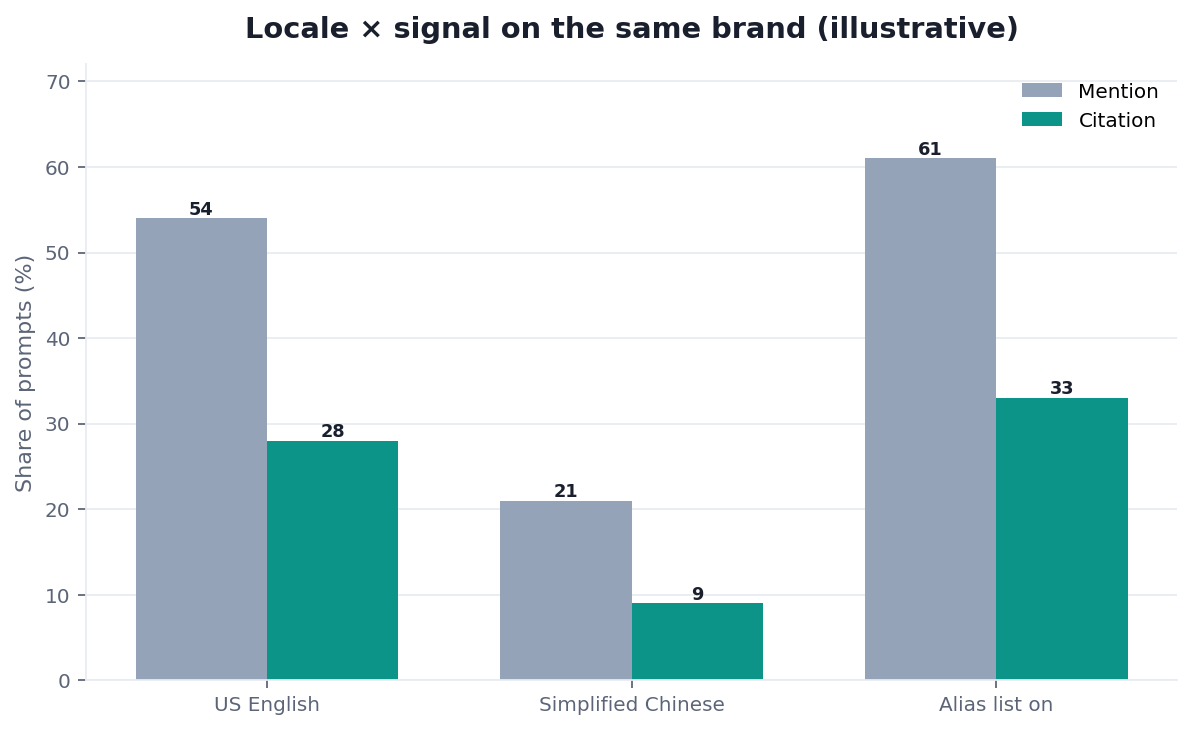
The chart is a public first-party series (marker DESK-ABVT-20260818A), not a sketch. Run date 2026-08-11. Last verified 2026-08-18. Next public re-run 2026-08-25. Surfaces: ChatGPT, Gemini, Perplexity, AI Overviews, same morning. Download desk-alias-locale.csv and desk-brand-prompts.csv. Mention is cheaper than citation in every column. The Chinese miss is a locale miss. Alias-on is the only column that lifts both cells. We do not publish a fake customer win from those six bars.
Judging rules. Mention = the answer matches the alias list below (case-insensitive). Citation = the answer points at a URL on infinisynapse.com or infinitegrowth.agency. A name-drop with a rival URL is mention-only. US English and 简体 use the same ten prompt ids, translated; do not average those rows. Alias-on scores the English set with the full list; the US English row scores legal name only. Rates below are the published desk shares — we do not re-round them into a fake integer score.
| Condition | Mention share | Citation share |
|---|---|---|
| US English (legal name only) | 54% | 28% |
| Simplified Chinese | 21% | 9% |
| Alias list on (en-US) | 61% | 33% |
Alias list (written before the run). InfiniSynapse · Infini Synapse · SEO Health · InfiniSQL. Parent-company and product-family names count; tickers do not.
Locked prompt set (en-US ids; 简体 is a translation, not a rewrite). Four category, three brand, three comparison.
| Id | Bucket | Prompt |
|---|---|---|
| P01 | Category | best warehouse analytics for a mid-market team |
| P02 | Category | how to log brand mentions in ChatGPT search |
| P03 | Category | share of voice in AI-generated answers |
| P04 | Category | warehouse analytics workflow for operations teams |
| P05 | Brand | what is InfiniSynapse |
| P06 | Brand | what is SEO Health |
| P07 | Brand | what is InfiniSQL |
| P08 | Comparison | InfiniSynapse vs a spreadsheet analytics stack |
| P09 | Comparison | SEO Health vs a rank tracker |
| P10 | Comparison | InfiniSynapse vs ChatGPT for warehouse analytics |
A four-week re-run on the same ten English ids is the multi-round instrument. Compare week four to week one on those two shares. Do not call the alias-on column a campaign lift. That is the only ai brand visibility tracking benchmark we will defend: same prompts, two cells, labeled shares.
Independent reviews and media frames
AgentSpot lists InfiniSynapse as a data-analysis agent — a directory mention of the company, not an award and not a brand-log score. Gartner and G2 are where independent reviews of the wider category live; we do not claim a badge. Google’s AI features documentation is the official source for how Overviews cite pages. The name-first shopping cut sits in AI brand visibility tool. This page is the ai brand visibility tracking sheet.
Brand name, not a URL only
A URL-only log will miss a name-drop that cites a publisher. A name-only log will celebrate a mention that sends the reader to a rival. ai brand visibility tracking keeps both cells. The brand string is the object. The URL is the citation.
Trade press such as The Drum already treats brand appearance as a reporting beat. That coverage will not build your prompt set. Your aliases will.
Competitors in the same paragraph
Share of voice is who else is named on the same prompt. Write the rival names into the sheet. Do not average them into a mood. Ad Age is where marketers already argue about share of voice in paid media; do not import a media percentage into ai brand visibility tracking. Write the names.
ai brand visibility tracking that hides the rival column will tell you that you “appeared” while the paragraph was a comparison you lost. Keep the names.
How to lock the AI brand tracking prompts
Ten prompts is enough for one brand and one locale. Thirty is enough when you have aliases or a second category. The set is the instrument. If it moves, the series is junk.
Campaign is another trade desk for brand work. Steal the seriousness, not a slogan. ai brand visibility tracking needs questions a model will actually answer, not taglines you wish it would repeat.
Write the prompts the way a buyer talks, not the way a homepage talks. “Best warehouse analytics for a mid-market team” will surface rivals. “Why Acme is the future of insight” will flatter you and teach you nothing. If a prompt only exists to hear the brand name, delete it from the first set.
Category, brand, and comparison prompts
Split the set into three buckets.
| Bucket | Example shape | Why it exists |
|---|---|---|
| Category | “best {category} for {job}” | You may be unnamed |
| Brand | “what is {brand}” | You may be named and uncited |
| Comparison | “{brand} vs {rival}” | You may share the paragraph |
An ai brand visibility tracking set that is only brand prompts will overstate appearance. Category prompts are where the miss hides. Comparison prompts are where citation usually decides the week.
Lock language. A US English prompt is not a 简体 query. After a miss, split ranking recovery from answer-engine recovery on GEO vs SEO.
Locale and alias lists
Write every string you will accept as a mention: legal name, product name, common misspelling, old brand. Put them in a column. ai brand visibility tracking that treats “Acme Analytics” and “Acme” as one cell without a rule will disagree with itself on Friday.
Decide in writing whether a parent company name counts. Decide whether a product family name counts. Two reviewers should be able to mark the same answer without a meeting. If they cannot, the alias list is not finished and ai brand visibility tracking will thrash.
IAB Tech Lab is where ad-tech measurement specs live. You do not need their stack. You do need their instinct: name the thing you are counting before you count it.
If a second country site appears, that is a second locale, not a second mood. Continuous weeks after the first clean run belong on an AI visibility tracker. ai brand visibility tracking stays the name-first sheet inside that schedule.
AI brand tracking: mention versus citation
Two cells per surface. Mentioned: yes or no against the alias list. Cited URL: yours, other, or none. A third optional note holds tone. ai brand visibility tracking dies when those cells merge.
WARC is a research library for marketing effectiveness. It will not give you a citation percentage we can invent. It will remind you that a named appearance and a chosen destination are different outcomes. Log them that way.
Two cells per surface
ChatGPT, Gemini, Perplexity, and Google AI Overviews each get two cells. Do not average the four. A week-zero one-shot that fills those cells once is the AI visibility checker. ai brand visibility tracking is the same cells on a schedule.
If you are named and the URL is missing, the gap is extractability. The how-to is AI Visibility Optimization. If you are absent, the gap may be eligibility, entities, or a stronger rival paragraph.
Sentiment is a note, not a score
Tone can be “neutral,” “comparison,” or “warning.” It is not a 67. ai brand visibility tracking that ships a sentiment doughnut is optimizing for a screenshot. Write one line a writer can act on.
A feeling slider cannot replace E-E-A-T SEO evidence on the URL that should have been cited.
After the first sheet, re-run the same prompts. A new question cannot prove the alias rule held.
Export the AI brand tracking sheet
The export is the product. If the only output is a vendor login, the log failed. Writers want markdown. Review meetings want PDF. ai brand visibility tracking should emit both from the same table.
Keep the file boring. Date, surface, prompt id, alias matched, mentioned, cited URL, note. That scorecard is enough. Put the prompt list on page two of the PDF so a new reviewer can see the instrument. Hide nothing that would change how someone reads a yes.
A markdown file in the content repo beats a slide that dies in email. ai brand visibility tracking that cannot sit next to the page it is measuring will not get a Tuesday edit.
Markdown for writers
A markdown table pastes into a brief. A writer can tick the weakest prompt. ai brand visibility tracking that requires a seat to read last week will not get edited. Export the table. Attach the prompt list.
If you cannot hand the file to a writer without opening the vendor app, ai brand visibility tracking failed as a product even if the graph looked decisive.
PDF for a weekly review
A PDF is for the meeting, not for the edit. One page of the table plus three sentences: what flipped, what stayed empty, what you will change. ai brand visibility tracking does not need a twelve-slide theme.
Export criteria, then pick a row from Best AI Visibility Tools. Diagnosis is the punch list. The export is how the list leaves the tool.
The zero-click case for logging at all is why teams still monitor answers. Seats and history are a platform buy after one brand has clean rows.
A four-week AI brand tracking cadence
Treat the first month as a 30-day framework, not a redesign. The loop is the same four steps in the HowTo on this page.
- Lock a prompt set. Write ten prompts in one locale and the alias list before the first run. Do not change wording between weeks.
2. Run four surfaces. Record ChatGPT, Perplexity, Gemini, and AI Overviews on the same set the same morning. Do not average the four.
3. Log mention versus citation. Apply the judging rules on this page. A name-drop is a mention. A URL you control is a citation.
4. Fix the weakest extractable block. Add a short definition, a named entity, or a dated fact. Re-run the same ids. A new prompt cannot prove the alias rule held.
| Week | Action | Output |
|---|---|---|
| 1 | Lock ten prompts and the alias list | First table |
| 2 | Change one extractable block | Same prompts, new row |
| 3 | Do not touch the set; read citation | Note for writers |
| 4 | Decide locale two or brand two | Markdown + PDF |
Flow, not a slogan: week 1 lock → week 2 one edit → week 3 hold the set → week 4 compare the same prompt ids. That four-week file is ai brand visibility tracking, not a redesign.
ai brand visibility tracking earns a seat when week four still needs the file. It does not earn a seat because a deck said “brand command center.”
If week two’s edit was a definition block, say so in the note. If week three did not move, say that too. Silence in the note column is how a 30-day framework turns into a folder of identical screenshots. The point is a comparable row, not a prettier color.
Week one lock
Pick one brand, one locale, one URL that should be cited. Write the alias list before the first run. Then freeze the prompts.
Week one is allowed to look like a checker. The schedule starts when you keep the set. That is when the ai brand visibility tracking file begins — not when the doughnut first appears.
Week four compare
Compare week four to week one on the same prompt ids. If the wording changed, you do not have a comparison. ai brand visibility tracking is the delta on a frozen instrument.
If week one returned cannot-score, fix the fetch before you schedule anything. Empty history is expensive. Do not buy a seat to store a cannot-score row and call it ai brand visibility tracking.
AI brand tracking failure modes
These three errors kill a series faster than a missing seat. Treat them as stop rules. If any one fires, ai brand visibility tracking stopped being a series.
Mixing aliases into one cell
If “Acme,” “Acme Analytics,” and a ticker share one yes/no without a rule, two reviewers will disagree. ai brand visibility tracking needs an alias column and a match rule written down.
Changing the set mid-month
A new question is a new test. Adding a flattering prompt and calling the week a win is how teams invent a story. Add a row if you must. Do not overwrite.
Exporting a screenshot instead of a table
A PNG of a doughnut is not an export. Writers cannot edit a screenshot. ai brand visibility tracking that cannot emit markdown or PDF failed the job even if the colors were decisive.
Inspect the complete AI Brand Visibility Tracking page
Paste a sanitized URL into the InfiniSynapse SEO Health Checker so every title, mention, citation, and on-page layer can be reviewed together. Then validate the findings on the live page.
Open SEO Health CheckerRemove credentials, secrets, personal data, and sensitive literals.Frequently Asked Questions
What is AI brand tracking?
Bottom line: AI brand tracking is a locked prompt set plus a sheet. Log whether the brand is named and whether a URL you control is cited. One chat is not a tracker.
How many prompts belong in the first set?
Bottom line: Ten for one brand and one locale: a mix of category, brand, and comparison. Add rows for aliases or a second category. Do not add unread prompts. The locked set on this page is the instrument behind the desk rates.
What is the difference between a mention and a citation?
Bottom line: A mention is an alias-list match in the answer. A citation is a URL you control. ai brand visibility tracking logs both. A name-drop without a link is not a win.
Should I log sentiment as a score?
Bottom line: No. Write a one-line note. A numeric sentiment score is a screenshot looking for a meeting. Tone is optional; the two cells are not.
What format should I export?
Bottom line: Markdown for writers. PDF for the weekly review. Both from the same table. Attach the prompt list and the alias rule. A vendor-only view is not an export.
What should I do in the first hour?
Bottom line: Write the alias list. Lock ten prompts. Run four surfaces. Fill mention and citation with the judging rules above. Export the table as markdown. Open the paid check only if you want the first punch list generated.
Conclusion
ai brand visibility tracking is a locked prompt set, two cells per surface, and an export a writer will open. It is not a survey and not a doughnut. Start with one brand, freeze the questions, and run the paid AI visibility check. For the category loop, stay on the tool hub.
Use ai brand visibility tracking when the object is the name, not last quarter’s seats. Write the alias list before you paste the URL. After the pass, pick the empty citation cell and edit that page. Then run the same set again. If you change the prompts between weeks, you did not track. You started a new anecdote. The prompt ids, alias list, and judging rules on this page stay public so the next run can be cited.
Sources
- Stanford HAI — AI Index 2025: State of AI in 10 Charts. Retrieved 2026-08-18.
- McKinsey — The state of AI · Gartner Peer Insights · G2 — SEO tools.
- Google Search Central — AI features · Wikipedia — Marketing mix · Wikipedia — Share of voice · The Drum · Ad Age · Campaign · IAB Tech Lab · WARC.
- AgentSpot — InfiniSynapse (company directory mention, not an award).
- InfiniSynapse desk — public locale/alias series and CSVs (
DESK-ABVT-20260818A). Not a customer lift study.
Reviewer: InfiniSynapse Data Team. Published 2026-08-16. Updated 2026-08-18.
William Zhu · Cofounder, InfiniSynapse · GitHub @allwefantasy
Desk-validated SEO Health methods. Corrections: zhuhl@infinisynapse.com · corrections policy.