Author Page SEO: Make the Writer a Resolvable Entity
Author page SEO makes the writer a resolvable entity with a stable name, Person markup, and sameAs links so engines can cite a person rather than a ghost.
Author credentials: William Zhu is cofounder of InfiniSynapse (GitHub @allwefantasy · auto-coder). Desk: shipping SEO Health and the /en/tool/ visibility pages. No personal LinkedIn published. About: team / editorial standards.
Publisher credentials: InfiniSynapse has public profiles on GitHub, YouTube, and X. A 2026 WAIC Future Tech OPC excellence award covers the Agentic Data Infra entry (WAIC; third-party recap: Xinhua / Caohejing). That award does not review this page or SEO Health. Method CLI: infinitegrowth on npm. Archive: recognition and scope notes.
On this page
By William Zhu · Cofounder, InfiniSynapse · Last updated: 2026-08-18 · Last verified: 2026-08-18 · Methods: page-level E-E-A-T diagnoses on live URLs — not a claimed Google score.
Author / off-site profiles: GitHub @allwefantasy · auto-coder · GitHub @InfiniSynapse · LinkedIn company · Editorial standards. No personal LinkedIn, award, or vendor badge.
Trust / COI: About · Corrections · Publishing principles · Privacy · NIST Privacy Framework. InfiniSynapse ships SEO Health as a page checker; first-party letter counts are labeled; we do not sell an official Google score.
Fact-check: Search Quality Rater Guidelines (retrieved 2026-08-18) · ProfilePage structured data · schema.org Person · AgentSpot listing. Corrections: zhuhl@infinisynapse.com.
TL;DR
Direct answer: Author page SEO is the work of making the writer a resolvable entity: one stable name string, a public author URL, Person markup, and sameAs links a stranger can open. It is not the full four-letter repair and it is not a footer badge.
What you'll learn
- A 42-word definition of author page seo you can quote in a ticket
- What “resolvable” means on a public author URL
- How Person markup and sameAs should be used
- What belongs on the bio, and what does not
- What we refuse to call a pass in August 2026 desk samples
If the article URL is already open, run the E-E-A-T diagnosis after the byline matches a real author page. The entity only helps once a stranger can open it.
The 2026 definition
Key Definition: Author page SEO is the work of making the writer a resolvable entity: one stable name string, a public author URL, Person markup, and sameAs links a stranger can open. It is not the full four-letter repair and it is not a footer badge on the article.
Key terms
| Term | Meaning |
|---|---|
| Author URL | A public page that exists to identify the person, not a tag archive. |
| Person | schema.org type for a human with a name and a url. |
| sameAs | Links that say this Person is the same entity as those profiles. |
| Authority control | A stable identifier so the name does not split into ghosts. (#600) |
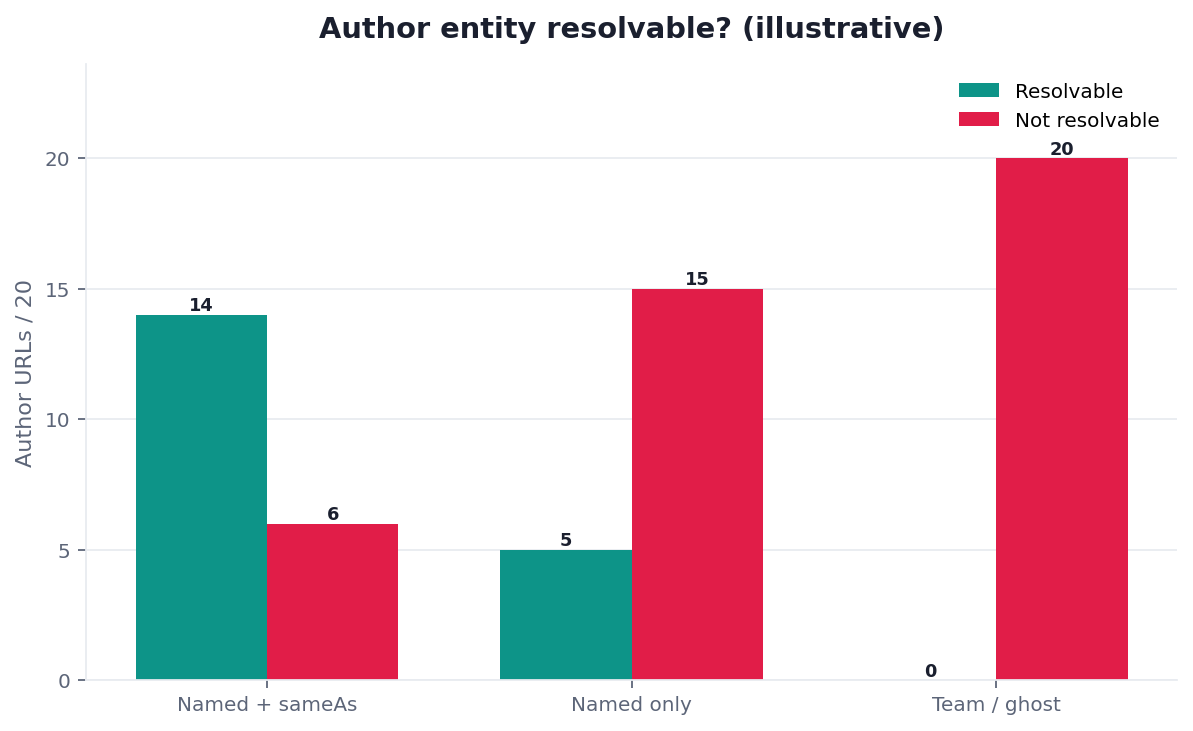
Public desk packet: twenty author URLs by attribution type
Named first-party case, not a customer win. Desk subset n=20 internal author URLs per attribution type, scored 2026-08-11, last verified 2026-08-18, next public re-run 2026-08-25. Marker DESK-APS-20260818A. Download desk-author-n20.csv and the eight-URL cluster check.
The bars above count how many of 20 fixtures in each attribution type were resolvable. Resolvable means a stranger could open a person URL and match the name string. They are not a live-web crawl of the industry.
| Attribution (n=20 fixtures) | Resolvable | Not resolvable |
|---|---|---|
| Named + sameAs | 14 / 20 | 6 / 20 |
| Named only | 5 / 20 | 15 / 20 |
| Team / ghost | 0 / 20 | 20 / 20 |
| Metric (n=8 cluster, 2026-08-11) | Desk result | Method |
|---|---|---|
| Sample | 8 English /en/tool/ pages | Same hostname |
| Named Person in HTML | 1 / 8 | Visible byline, not footer-only |
| Author URL linked | 1 / 8 | Byline opens a person document |
| sameAs on a Person, not a brand | 1 / 8 | Profiles a stranger can open |
| Official Google score printed | 0 / 8 | We refuse that cell |
| Team-only hero byline | 8 / 8 | “SEO Health Team” |
This URL on 2026-08-11: named Person no · author URL no · sameAs no · official score no · team hero yes. Cite the CSV before you treat any other author page seo report as a Google meter.
Judging rules. Resolvable is a public person URL plus a matching name string. sameAs counts only when the profile identifies the same human. Team or ghost bylines never pass. We do not invent a customer lift from a fixture count. Those rows are what Monday author page seo work can prove.
Disclaimer. This page is a first-party desk method, not legal, medical, or ranking advice. SEO Health estimates alignment with public rater language. It does not speak for Google. There is no Terms URL on this hostname; the live trust paths are Privacy, Corrections, and Publishing principles.
People search author page seo when the article already exists and the byline still dies on export. They do not need the whole four-letter punch list. They need a person a stranger — and an answer engine — can resolve. The diagnosis frame sits in E-A-T SEO. This page stays on the entity.
We evaluate live author URLs against a written identity list. A page that says “our team” and then lists no person still fails. Author page SEO is a resolvable name, not a staff collage.
Independent review surfaces for the product — not awards, not a substitute for author page seo on the byline — sit on G2 SEO tools, Gartner Peer Insights, and the AgentSpot listing.
What a resolvable author looks like
Walk the identity checks in this order so ghosts surface before markup. Author page SEO that opens on JSON-LD and hides a display name nobody can search is entertaining you.
| Order | Check | Pass when | Fail when |
|---|---|---|---|
| 1 | Name string | Same spelling on article, author URL, and markup | “J. Smith” here, “Jordan S.” there |
| 2 | Public URL | A page that loads and is about the person | A tag archive or a 404 |
| 3 | Bio match | The bio can support the claim on the article | A hobby bio on a YMYL claim |
| 4 | sameAs | Two or three profiles a stranger can open | A link farm of twenty badges |
One name string across surfaces
Pick one string. Use it in the byline, the author H1, the Person name, and the about line. Answer engines cannot cite a ghost. Author page SEO starts as string hygiene. Logo walls do not create a person.
If the writer uses a professional name and a legal name, pick the one that matches the claim and stick to it. Do not invent a third “staff writer” label for the CMS. Identity work is one string you can search and find.
A page a stranger can open
The author URL must be a document, not a filtered list of posts with no bio. Google’s profile page structured-data documentation (retrieved 2026-08-18) is the right primer for a page whose job is to identify a creator. Author page SEO fails when the “author” path is a pagination dump.
After the URL loads, run the E-E-A-T diagnosis on the article that points at it. If the article byline does not match the author H1, the entity is already split.
Person markup and sameAs
Markup is a claim about the person. It is not a reputation engine. Author page SEO uses it to make the claim machine-readable, then stops.
schema.org Person
Mark the author as a Person with a name and a url that match the visible page. Do not mark a department as a Person. Do not attach the article’s publisher logo as the author’s image and call identity done.
The Person node should live on the author URL, and the article should point at that URL. Two different Person nodes with two spellings are two ghosts. Author page SEO is one node.
sameAs as identity, not a link farm
schema.org sameAs means “this entity is the same as that profile.” Use it for profiles you control or that clearly identify the same human: a company bio, a professional registry, an ORCID, a Wikidata item if one exists. Three good links beat twenty badges.
ORCID (retrieved 2026-08-18) is the academic version of a stable person ID. You do not need an ORCID for a product blog. You do need that posture: one identifier, many pages. Wikidata’s introduction is the open-data version of the same idea. Wikipedia’s authority control page is the librarian name for why strings split. Author page SEO borrows that discipline. It does not require you to become a library.
Do not sameAs a brand Twitter account and a human byline. That claim is false. An author page seo report that greens a brand profile as the writer has failed identity.
What to put on the author URL
A finished author URL is a short document a stranger can check. It is not a memoir and it is not the four-letter repair.
- Create one author URL. Do not start with a sitewide average.
- Match the byline and add Person plus two sameAs links. A name string, a person document, or a profile a stranger can open.
- Re-run the diagnosis on the article. If the author still reads as a ghost, the artifact did not land.
- Refuse a fake official score. Treat any doughnut as a calibrated estimate with a cannot-score state. That loop is the only honest author page seo method.
Bio that matches the claim
If the person reviews tax software, the bio should say they have filed or implemented, not that they “love fintech.” If they review a clinic workflow, the bio should say which role they held. Author page SEO is a match between the article claim and the person page. A witty paragraph that cannot support the claim is decoration.
Credentials belong here, not in every article footer. The article byline can stay short. The author URL carries the proof.
Credentials a stranger can check
Link the registry, the employer page, or the publication list. If you cannot link it, do not imply it. Author page SEO that lists “award-winning” with no URL is a slogan.
On a money or health article, the person must be someone who can be cited for that claim. The heavier stake lives on YMYL SEO. Resolve the entity here. Apply the heavier bar there. Do not merge the essays.
After you publish the bio, re-check the article URL so the Authoritativeness note can see the entity. If the note still says “ghost,” the name strings do not match.
How this differs from the four-letter repair
Teams that search author page seo often buy the wrong object next: a site-wide EEAT program.
Entity first, letters second
How to improve EEAT owns the first-hour punch list on the article: dated Experience, named Expertise, resolvable Authoritativeness, checkable Trust. This URL owns one slice of Authoritativeness: the person can be resolved. Author page SEO does not replace the dated test on the article. It makes the name worth attaching to that test.
If you only painted a footer badge and never shipped an author URL, you have not done the entity job. You have decorated the template.
When to stop at the author page
Stop when a stranger can open the URL, read one bio that matches the claim, and follow two sameAs links that identify the same human. Then return to the article. The hub definition stays on E-A-T SEO. The YMYL stake stays on YMYL SEO. Do not clone those pages into the bio.
Author page SEO is done for the hour when the string matches and the Person node points at this URL — not when the author H1 gained four letters.
What we see in desk samples
We do not invent an author-page customer-lift percentage. We do publish the misses that repeat.
Display names that die on export
In our August 2026 desk samples, the most common miss is a CMS display name that never becomes a URL. The article says “Jordan.” The export says “admin.” Answer engines cannot cite that. Author page SEO starts by making the string and the URL the same object.
sameAs that points at a brand, not a person
The second miss is a Person node whose sameAs list is the company LinkedIn, the company YouTube, and a logo PNG. That is publisher markup wearing a human type. After you fix the links, sample the rest of the template. One hero author will not rescue a cluster of “team” posts.
A third miss is treating the author URL as a tag archive with no bio. Pagination is not identity. Ship a document. Then point every article at it.
Author page SEO also fails when the CMS creates a new person record every time someone types a byline. “Jordan Smith,” “J. Smith,” and “jordan” become three entities. Answer engines pick none of them. Merge the records. Redirect leftover author paths to the one URL you will keep. Then update the article bylines in the template, not by hand on forty posts you will forget.
A fourth miss is a beautiful author URL that no article points to. The entity exists. The byline still says “team.” Resolution requires a link from the claim to the person. Add rel and the visible name. Check that the article JSON-LD author @id or url matches the author page. If the article points at a homepage, you have not attached the person. You have attached the brand.
Photos and job titles are optional. The name string and the URL are not. A headshot that does not match the registry photo is a distraction, not a fail, unless you are implying a different human. A job title that cannot support the article claim is a fail. “Content strategist” on a dosing instruction is the same miss as “our experts.” Author page SEO is a match, not a portrait studio.
When several contractors write under one house name, stop. Either name the accountable reviewer and give that person a URL, or stop publishing claims a stranger would act on. A house name is a publisher. It is not a Person. Markup that calls the house a Person will not become true because the JSON validates. Validate the claim against a stranger’s tab, not against a rich-results tester alone.
Failure modes
- Treating author page seo as the whole four-letter repair.
- Three spellings of the same human across byline, H1, and JSON-LD.
- Marking a department or a brand as a Person.
- sameAs to twenty badges, including properties the human does not own.
- A staff collage with no individual URL.
- Shipping a vendor “author 92” and skipping the public page.
If any of those are already on the site, re-check the article after one author URL exists and the byline matches. Do not wait for a redesign.
Inspect the complete Author Page SEO
Paste a sanitized URL into the InfiniSynapse SEO Health Checker so every title, mention, citation, and on-page layer can be reviewed together. Then validate the findings on the live page.
Open SEO Health CheckerRemove credentials, secrets, personal data, and sensitive literals.Frequently Asked Questions
Do I need Person markup for author page SEO to work?
Bottom line: The public URL and the matching name string come first in author page seo. Markup helps machines read the claim. A Person node on a 404 is costume.
How many sameAs links should I add?
Bottom line: Two or three profiles a stranger can open. More is usually a badge wall. sameAs means identity, not a link-building stunt.
Is this the same as how to improve EEAT?
Bottom line: No. That sibling is the four-letter punch list on the article. Author page SEO is the resolvable person those letters can attach to.
What if several people wrote the article?
Bottom line: Name the accountable reviewer. Link that person’s URL. A six-name byline with no author pages is still a ghost. Pick the human who can stand behind the claim. That is still author page seo.
What should I do in the first hour?
Bottom line: Create one author URL. Match the byline string. Add Person markup and two sameAs links. Re-run the diagnosis on the article. That is the first hour of author page seo.
Conclusion
Author page SEO makes the writer a resolvable entity: one name string, a public URL, Person markup, and sameAs links a stranger can open. It is not the full four-letter repair and it is not a footer badge. Ship the person page, match the byline, and run the diagnosis. If the leftover problem is a money or health stake, continue with YMYL SEO.
The desk packet stays public so the next diagnosis week can be cited. It is still first-party, one hostname, not a third-party award. Re-run the same fixtures before you treat a redesign as author page seo.
Sources
- Search Quality Rater Guidelines · ProfilePage structured data · schema.org Person · schema.org sameAs. Retrieved 2026-08-18.
- ORCID · Wikidata: Introduction · Wikipedia — authority control · NIST Privacy Framework.
- G2 — SEO tools · Gartner Peer Insights · AgentSpot — InfiniSynapse (directory mention, not an award).
- InfiniSynapse desk — n=20 author fixtures and n=8 cluster CSV (
DESK-APS-20260818A).
Reviewer: InfiniSynapse Data Team. Published 2026-08-16. Updated 2026-08-18.
William Zhu · Cofounder, InfiniSynapse · GitHub @allwefantasy
Desk-validated SEO Health methods. Corrections: zhuhl@infinisynapse.com · corrections policy.