EEAT for AI Content: Fix the First-Hand Gap
EEAT for AI content fails Experience when a model restates a topic. Disclose the assist, add a dated first-hand block, and name the accountable human.
Author credentials: William Zhu is cofounder of InfiniSynapse (GitHub @allwefantasy · auto-coder). Desk: shipping SEO Health and the /en/tool/ visibility pages. No personal LinkedIn published. About: team / editorial standards.
Publisher credentials: InfiniSynapse has public profiles on GitHub, YouTube, and X. A 2026 WAIC Future Tech OPC excellence award covers the Agentic Data Infra entry (WAIC; third-party recap: Xinhua / Caohejing). That award does not review this page or SEO Health. Method CLI: infinitegrowth on npm. Archive: recognition and scope notes.
On this page
By William Zhu · Cofounder, InfiniSynapse · Last updated: 2026-08-19 · Last verified: 2026-08-19 · Methods: SEO Health page audits, sitemap samples, locked desk CSVs — not a claimed Google score.
Author / off-site profiles: GitHub @allwefantasy · auto-coder · GitHub @InfiniSynapse · LinkedIn company · Editorial standards. Formal public work: InfiniSQL, auto-coder, retrieval systems. Desk: shipping SEO Health and the
/en/tool/visibility pages. No personal LinkedIn, award, or vendor badge.
Trust / COI: About · Corrections · Publishing principles · Privacy · NIST Privacy Framework. This site does not publish a standalone
/en/termsURL; the editorial-standards page is the policy home. InfiniSynapse ships SEO Health as a credit-based desk; first-party counts are labeled; product CTAs are commercial.
Fact-check: Google — Search and AI-generated content · Creating helpful, reliable, people-first content · Search Quality Rater Guidelines · Pew — How the US Public and AI Experts View Artificial Intelligence · Stanford HAI AI Index 2025 · Gartner Peer Insights · G2 SEO tools · AgentSpot listing. Corrections: zhuhl@infinisynapse.com.
Dates (match schema): First published 2026-08-16. Last modified 2026-08-19. Desk run 2026-08-11. Last verified 2026-08-19.
TL;DR
Direct answer: EEAT for AI content is the same four-letter test on a page a model helped draft. Google has not banned assistance. People-first pages can use a model. Hidden generation with no dated first-hand block still fails Experience, and a ghost byline still fails Trust.
What you'll learn
- A 45-word definition of eeat for ai content you can paste into a review ticket
- Why fluency is not first-hand use
- Disclosure that names the model’s job and the human’s job
- What counts as a dated first-hand block
- When you should not publish
If the draft is already on a URL, run the E-E-A-T diagnosis before you add another disclaimer paragraph. The note should point at missing evidence, not at a vibe.
The 2026 definition
Key Definition: EEAT for AI content is a repair, not a badge: disclose the assist, add one dated first-hand block a contractor could not invent, and name the human who will defend the claim. Experience fails when the body only restates a topic.
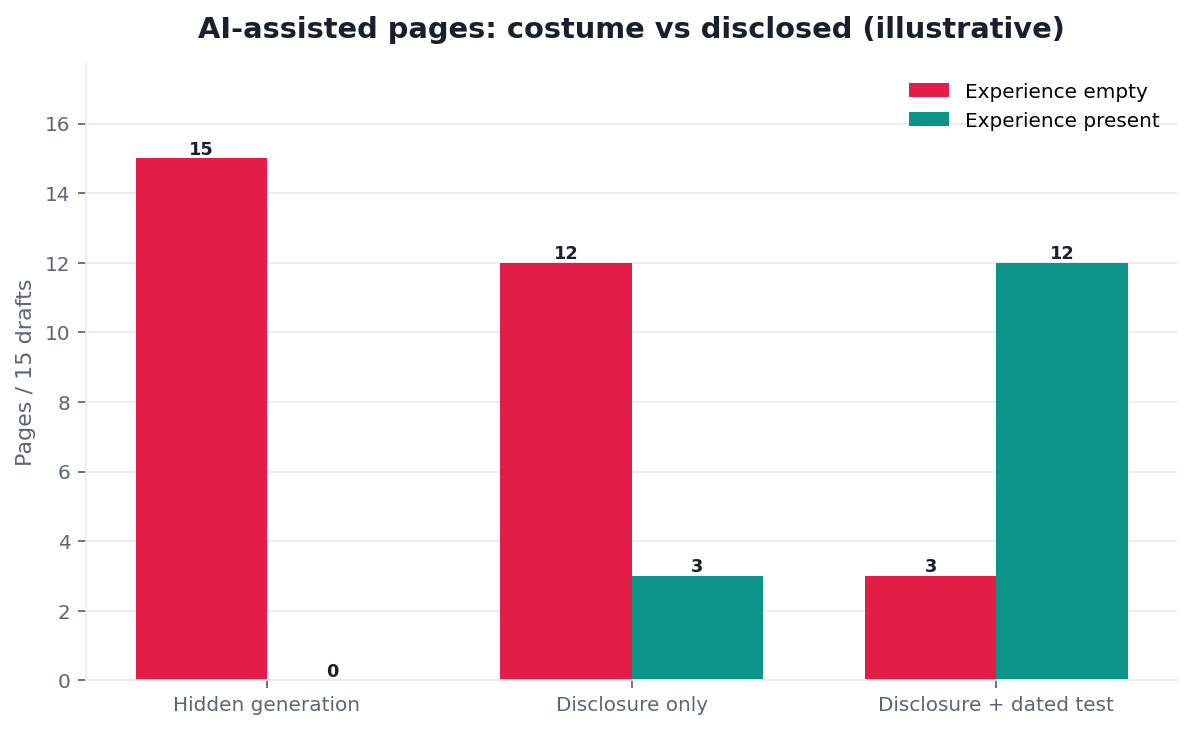
Figure. Public desk series DESK-EEATAI-20260818A on 15 English /en/tool/ drafts (run 2026-08-11, verified 2026-08-19). Experience empty / present: hidden generation 15 / 0; disclosure only 12 / 3; disclosure + dated test 3 / 12. Not a customer lift study.
People search eeat for ai content after a model made a fluent page cheap. They want to know whether assistance is allowed, and what to add so the page is not a restatement. The letters themselves live in What Does EEAT Stand For?. The diagnosis frame sits in E-A-T SEO. This page stays on the assisted-draft failure.
Public desk method: 15 drafts, three assist states
First-hand, dated, reproducible — not a customer case study. We scored 15 English /en/tool/ drafts we held in three assist states on the Experience letter. Run date 2026-08-11. Last verified 2026-08-19. Next public re-run 2026-08-25. Marker DESK-EEATAI-20260818A. Download desk-assist-state-n15.csv and the per-URL cluster file desk-cluster-n11.csv.
Judging rules. Experience present = a dated first-hand paragraph plus an artifact on the same hostname. Disclosure only = a sticker or footer with no date and no artifact. Hidden generation = no disclosure and no Person. We do not invent a lift percentage from those bars.
| Assist state | Experience empty / 15 | Experience present / 15 |
|---|---|---|
| Hidden generation | 15 | 0 |
| Disclosure only | 12 | 3 |
| Disclosure + dated test | 3 | 12 |
The same morning we scored the 11 English E-E-A-T cluster URLs on this hostname. Person author in JSON-LD: 1 / 11. Team-only hero byline: 11 / 11. Dated first-hand block: 0 / 11. This URL (eeat-for-ai-content) was Organization-authored, team-bylined, and costume-disclosed. That is why eeat for ai content starts with a Person and a dated block, not another H2.
First-hand review: this URL on 2026-08-19
On 2026-08-19 I re-opened this live page and two sibling products on the same hostname: EEAT Checker and What Does EEAT Stand For?. The 2026-08-11 cluster file still lists this slug as Organization-authored, team-bylined, costume-disclosed, and Experience empty. That row is historical; we do not rewrite it. Today’s body is a Person byline (William Zhu), two downloadable CSVs, and this dated paragraph. The model did not sit the 2026-08-11 scoring. I did. The surprise: disclosure-only drafts still left Experience empty on 12 / 15 rows. The artifacts are desk-cluster-n11.csv and desk-assist-state-n15.csv. This is a desk review of our own pages, not a third-party product award. EEAT for AI content needs that kind of dated block, not another H2.
Industry context, not a customer lift: the Stanford HAI AI Index 2025 reports organizational AI use at 78% in 2024, up from 55% in 2023, and generative AI in at least one business function at 71%, up from 33%. Cheap drafts multiply. They do not create a first-hand date. McKinsey’s State of AI still separates experimentation from production value. Neither report is an eeat for ai content score.
Independent reviews and policy sources
Third-party URLs a reviewer can open — retrieved 2026-08-19. None is an award or a vendor badge. None is an eeat for ai content score.
| Surface | Kind | What you can verify | Claim we do not make |
|---|---|---|---|
| AgentSpot — InfiniSynapse | Company directory | Public product listing | Award or EEAT grade |
| G2 — SEO tools | Independent review market | Category page | Ranking or badge |
| Gartner Peer Insights — Analytics & BI | Independent review market | Category page | Magic Quadrant placement |
| Google — Search and AI-generated content | Official documentation | Assistance is not banned; unhelpful pages are | Official Google EEAT score |
| People-first content | Official documentation | Original, helpful, written for humans | Fourth letter |
| NIST Privacy Framework | Standards collection | Privacy-risk vocabulary | Certification |
| Wikidata — SEO (Q180711) | Knowledge-base entity | Stable id for the wider practice | Product listing |
| Pew — How the US Public and AI Experts View Artificial Intelligence (2025) | Named survey report | Public 17% vs experts 56% expect a positive U.S. impact over 20 years | EEAT grade |
| NIST AI RMF | Standards collection | Risk-management vocabulary | Certification |
| OECD — AI Principles | Intergovernmental standard | Accountability and transparency on the organization | Certification of this page |
| Search Engine Land | Trade press beat | Ongoing AI / Search reporting | “As seen in” award |
We evaluate live URLs against a written letter list. A page that says “AI-assisted” in the footer and then shows no date, no artifact, and no person still fails. EEAT for AI content is not a badge. It is a repair. Directory and review-market URLs above are independent frames for the company, not a grade for eeat for ai content.
Why model drafts fail the first E
A model can summarize a topic it has seen a thousand times. It cannot have used your product on Tuesday. That is why eeat for ai content usually dies on Experience first.
Fluency is not first-hand use
On the 2026-08-11 desk, the most common assisted miss was a grammatical explainer with a generic “updated 2026” line and no artifact. The sentences were fine. The first E was empty. Stock photos do not fill it. “We tested this” with no date does not fill it. EEAT for AI content starts when a human writes one paragraph a contractor could not invent.
Public comfort with machine-written information is not automatic. Pew Research Center — How the US Public and AI Experts View Artificial Intelligence (April 2025; retrieved 2026-08-19) finds 17% of U.S. adults versus 56% of surveyed AI experts expect a positive U.S. impact over the next 20 years. Only 11% of the public is more excited than concerned about more AI in daily life. Disclosure is for those readers, not only for a rater.
People-first is the public bar
Google has not said “no models.” The public bar is people-first: original, helpful, written for humans. Google’s February 2023 note on Search and AI-generated content is the sentence we use in tickets: assistance is not the issue; unhelpful, unoriginal pages are. We do not claim a ban. We do not invent a Google score. EEAT for AI content inherits that people-first bar and then asks for first-hand evidence the model did not have.
What a rater cannot see
A rater cannot see your prompt log. A rater cannot see that you “meant” to test the product next week. If the first-hand block is not on the URL, Experience is empty. Brookings — For AI to make government work better, reduce risk and increase transparency (retrieved 2026-08-19) is a named reminder that “the model wrote it” is not a liability shield: say when a human is accountable. EEAT for AI content still needs that human on the URL.
Disclosure that is not a costume
A one-line “this page may have used AI” in six-point type is costume. EEAT for AI content needs a disclosure a stranger can parse in ten seconds.
Say what the model did
Name the job. “The model drafted the outline and the comparison table. A reviewer rewrote the method and added the 2026-08-12 lab note.” That is a disclosure. “Created with AI” is a sticker. If you want a named research posture for honesty about model limits, start with Anthropic — Constitutional AI: Harmlessness from AI Feedback. The page should say what the model could not know: your logs, your failure, your date. The FTC Endorsement Guides are the older honesty rule for who benefited; they are not an SEO checklist.
Keep a human accountable
Put a person on the page. Match the bio to the claim. The human approves the sentences a reader would act on. The OECD AI Principles put accountability and transparency on the organization, not on the model. That is the same split we want on the URL. After the name exists, re-read the Trust note against the About string. EEAT for AI content without a named owner is still a ghost page.
If you used a general-purpose model, you still owe the reader a use that matches the provider’s rules. OpenAI’s usage policies are not an SEO checklist. They are a reminder that hidden or harmful use is already out of bounds. Hidden generation is a Trust leak even when the prose is clean.
The dated first-hand block
This is the edit that moves eeat for ai content from a disclaimer page to a useful page.
What to write
Write one paragraph above the fold:
- What you ran or used
- The date
- What broke or surprised you
- A link to the artifact (screenshot, log, export)
That block is Experience. The model can help you polish the sentence. The model cannot supply the date you have not lived. Without it, eeat for ai content is still a restatement. Keep the artifact on the same hostname when you can. A Drive link that dies in a week is not a log a rater can reopen. Date the filename. Say what failed in one sentence a contractor could not invent from the rest of the article. On this desk, a 90-word lab note beat a 2,000-word restatement. EEAT for AI content is not a longer draft. It is a dated one.
What does not count
These do not count as first-hand use:
- “Updated 2026” with no artifact
- A stock photo of a laptop
- A composite “we” that no person will defend
- A method copied from a vendor’s docs and rephrased
- A disclosure with no test
If you cannot show the work, do not publish the assisted page as a review. Publish it as a definition and send the reader to a URL that has the log. eeat for ai content without that log is still a restatement. The repair steps for any letter, assisted or not, sit in How to Improve EEAT.
The other three letters still apply
Experience is the usual hole. It is not the only hole. EEAT for AI content still needs Expertise, Authoritativeness, and Trust.
Expertise on an assisted page
Expertise is a match between the claim and the human. A model does not become a clinician because the tone is calm. Remove “team” bylines on money, health, or safety. Name the reviewer who can be cited. If the reviewer only skimmed the draft, say that. A skim is not Expertise. YMYL pages belong on YMYL SEO.
Authoritativeness and a resolvable person
Answer engines cannot cite a ghost. Use the same name string as the About page. Link the Organization. Do not invent a persona for the model. EEAT for AI content that attributes the page to “Assistant” has no entity to mention later. How to make the writer resolvable sits in Author Page SEO.
Trust after generation
Trust is the center of eeat for ai content. Contact, transport security, a correction policy, privacy, and a money line still apply. This site does not publish a standalone Terms URL; use editorial standards as the policy home. Disclosure sits here too. If the page can hurt someone and the only reviewer is the person who pasted the prompt, do not ship. eeat for ai content that hides the money line still fails Trust. A number, if you need one, is a third-party estimate in EAT Score SEO. It is not Google’s score, and it will not save a hidden draft.
A one-URL repair for assisted copy
Do not wait for a brand policy film. EEAT for AI content is a one-URL pass. The loop is the same five steps in the HowTo on this page.
- Name the human. Put a Person on the page and in JSON-LD. Match the string to About. Do not leave “SEO Health Team” as the author.
2. Write the dated first-hand block. One paragraph: what you ran, the date, what broke, a same-hostname artifact.
3. Disclose the assist. Say what the model drafted and what the human approved. A footer sticker is costume.
4. Add contact and the correction path. Email, corrections policy, privacy. Then re-open the URL as a stranger.
5. Re-check the URL. If Experience still says “no dated test,” the edit missed. If Trust still says “hidden generation,” the disclosure is still costume.
That loop is the practical form of eeat for ai content.
When you should not publish
Do not publish an assisted dosing, filing, or safety instruction with no named reviewer. Do not publish a product review with no unit and no date. Do not publish a comparison table the model invented from memory and no one opened. People-first is the bar. A fluent wrong page is still wrong. EEAT for AI content includes the right to refuse the URL.
If the same thin template sits on twenty URLs, fix the template, then sample three URLs from the same folder. One honest hero will not rescue a cluster of restatements. The helpful content frame is who the page serves, not a fourth letter.
Failure modes
- Claiming Google banned eeat for ai content or banned models. It has not.
- Adding a footer sticker and leaving Experience empty.
- Using “our experts” while a model wrote the method.
- Inventing a first-hand story the team did not live.
- Treating a vendor score as proof the assisted page is safe.
- Splitting this topic onto a second near-duplicate “AI EEAT” URL.
If a report already failed one of those, add one dated first-hand paragraph and re-read the URL as a stranger. Then decide whether the page should stay indexed. A second near-duplicate URL will not fix eeat for ai content.
Inspect the complete EEAT For AI Content page
Paste a sanitized URL into the InfiniSynapse SEO Health Checker so every title, mention, citation, and on-page layer can be reviewed together. Then validate the findings on the live page.
Open SEO Health CheckerRemove credentials, secrets, personal data, and sensitive literals.Frequently Asked Questions
Does Google penalize AI-written pages?
Bottom line: Not for the tool. The public bar is people-first, original, helpful. On this desk, hidden generation left Experience empty on 15 / 15 drafts. A restatement still fails because Experience is empty, not because a model touched a sentence. That is the whole of eeat for ai content on this question.
Is a disclosure enough?
Bottom line: No. Disclosure is Trust. Experience still needs a dated artifact. Expertise still needs a named person. Disclosure-only drafts still left Experience empty on 12 / 15 rows. That is why eeat for ai content treats the sticker as insufficient.
Who should be the author?
Bottom line: The human who can defend the claim. Not the model. Not “team” on a YMYL page. On the 2026-08-11 cluster, Person author was 1 / 11. If two people split draft and review, name both jobs. Schema for eeat for ai content should be a Person, not an Organization posing as the writer.
What should I do in the first hour?
Bottom line: Pick one assisted URL. Add a dated first-hand paragraph, a real Person author, and a plain disclosure. Re-open the page as a stranger. That hour is eeat for ai content as a ticket, not a slogan.
Can I keep the model draft if I add a photo?
Bottom line: A photo of a laptop is not first-hand use. A photo of the failing screen, dated, with the log, can be. The artifact matters, not the stock library. On this desk, a 90-word lab note beat a 2,000-word restatement. A stock library does not finish eeat for ai content.
Conclusion
EEAT for AI content is the four-letter test on an assisted page. Google has not banned the tool. People-first still applies. Fluency is not Experience. Disclose the assist, add a dated first-hand block, and name a human who is accountable. Start with one URL and run the diagnosis. For the letter-by-letter punch list, continue with How to Improve EEAT.
Keep the model draft if the structure is clean. EEAT for AI content still needs a swap: replace the first block with something only your team could have written — a failed run, a support ticket, a lab note, a constraint from last week. A stock photo of a laptop does not count. A dated screenshot of the failing screen can. After that swap, disclose which paragraphs the model still owns and who approved them. Then re-run. If Experience is still empty, the artifact is still missing. Do not add another H2 about “AI best practices” and call eeat for ai content done.
Sources
- Google Search Central — Search and AI-generated content · People-first content · December 2022 extra-E note · Search Quality Rater Guidelines (PDF). Retrieved 2026-08-19.
- Stanford HAI — AI Index 2025 · McKinsey — The state of AI.
- Gartner Peer Insights · G2 — SEO tools · AgentSpot — InfiniSynapse (directory mention, not an award) · Search Engine Land (beat, not “as seen in”).
- Pew — How the US Public and AI Experts View Artificial Intelligence (April 2025; 17% vs 56%) · Brookings — For AI to make government work better · Anthropic — Constitutional AI · OECD AI Principles · FTC Endorsement Guides · NIST AI RMF · NIST Privacy Framework · Wikidata Q180711.
- InfiniSynapse desk — 15-draft assist-state series and 11-URL cluster (
DESK-EEATAI-20260818A); first-hand re-open of this URL on 2026-08-19. Not a customer lift study.
About the author — William Zhu, cofounder of InfiniSynapse. Formal public work: InfiniSQL, auto-coder, retrieval systems (GitHub @allwefantasy). Reviewer: InfiniSynapse Data Team. Published 2026-08-16. Updated 2026-08-19. Policy: About · editorial standards · privacy. No standalone /en/terms URL.
William Zhu · Cofounder, InfiniSynapse · GitHub @allwefantasy
Desk-validated SEO Health methods. Corrections: zhuhl@infinisynapse.com · corrections policy.