Helpful Content Update: People-First, Not a Fourth Letter
The helpful content update is a people-first system for who the page serves, not a fourth EEAT letter. Use it to cut unhelpful scale, then repair evidence.
Author credentials: William Zhu is cofounder of InfiniSynapse (GitHub @allwefantasy · auto-coder). Desk: shipping SEO Health and the /en/tool/ visibility pages. No personal LinkedIn published. About: team / editorial standards.
Publisher credentials: InfiniSynapse has public profiles on GitHub, YouTube, and X. A 2026 WAIC Future Tech OPC excellence award covers the Agentic Data Infra entry (WAIC; third-party recap: Xinhua / Caohejing). That award does not review this page or SEO Health. Method CLI: infinitegrowth on npm. Archive: recognition and scope notes.
On this page
By William Zhu · Cofounder, InfiniSynapse · Last updated: 2026-08-18 · Last verified: 2026-08-18 · Methods: page-level E-E-A-T diagnoses on live URLs — not a claimed Google score.
Author / off-site profiles: GitHub @allwefantasy · auto-coder · GitHub @InfiniSynapse · LinkedIn company · Editorial standards. No personal LinkedIn, award, or vendor badge.
Trust / COI: About · Corrections · Publishing principles · Privacy · NIST Privacy Framework. InfiniSynapse ships SEO Health as a page checker; first-party letter counts are labeled; we do not sell an official Google score.
Fact-check: Search Quality Rater Guidelines (retrieved 2026-08-18) · August 2022 helpful content update · Creating helpful, reliable, people-first content · AgentSpot listing. Corrections: zhuhl@infinisynapse.com.
TL;DR
Direct answer: The helpful content update is Google’s people-first system for whether a page was made for readers or for search engines. It is not a fourth EEAT letter. It asks who the page serves, what only you could write, and whether scaled outlines should be cut.
What you'll learn
- A 44-word definition of the helpful content update you can quote in a ticket
- Why this is a purpose system, not a fifth letter in the acronym
- Three people-first tests you can run on one URL
- How it sits next to EEAT evidence and assisted drafts
- What we refuse to call a pass in August 2026 desk samples
If the URL is already open, run the E-E-A-T diagnosis after you decide the page should exist. Purpose first. Evidence second.
The 2026 definition
Key Definition: The helpful content update is Google’s people-first system for whether a page was made for readers or for search engines. It is not a fourth EEAT letter. It asks who the page serves, what only you could write, and whether scaled outlines should be cut rather than decorated.
Key terms
| Term | Meaning |
|---|---|
| People-first | Written for a reader who needed the page, not for a crawler quota. |
| Unhelpful scale | Outlines mass-produced to cover queries, with nothing only you could write. |
| Core update | Broader ranking shifts; this system is the people-first slice. |
| Purpose test | Who the page serves, and whether you would still publish it offline. (#599) |
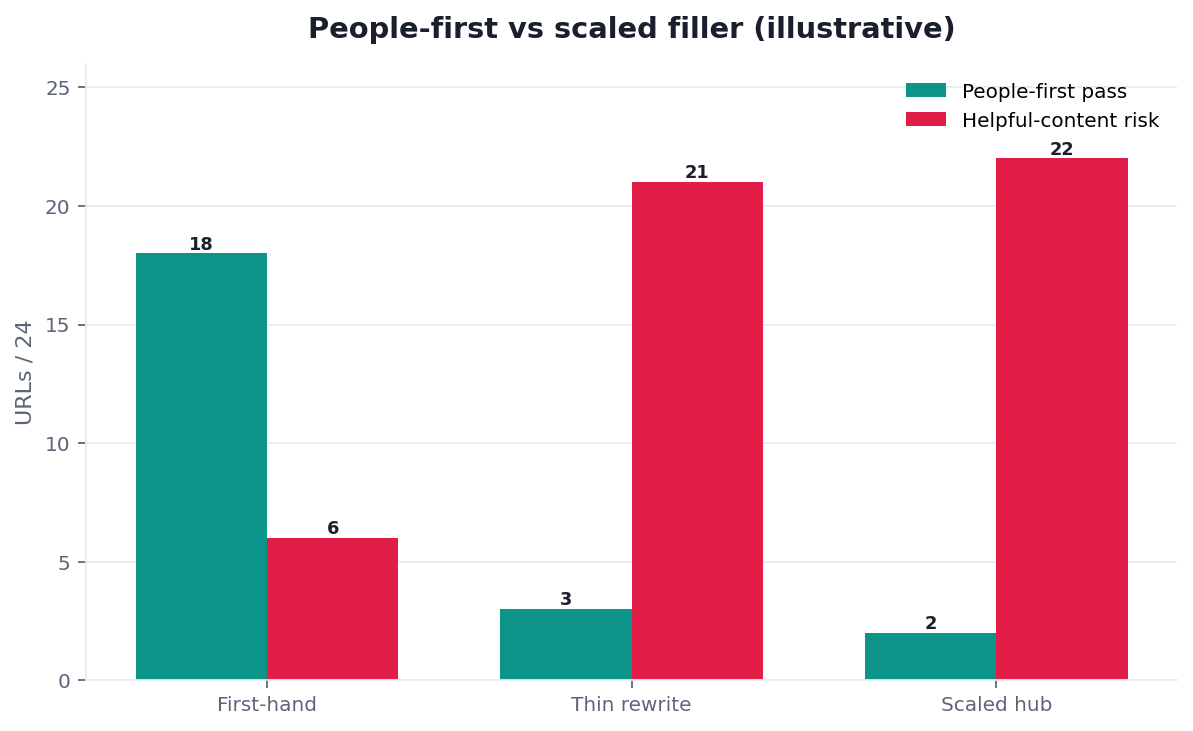
Public desk packet: twenty-four URLs by content type
Named first-party case, not a customer win. Desk subset n=24 internal URLs per content type, scored 2026-08-11, last verified 2026-08-18, next public re-run 2026-08-25. Marker DESK-HCU-20260818A. Download desk-hcu-n24.csv and the eight-URL cluster check.
The bars above count how many of 24 fixtures in each type passed a people-first test versus carried helpful-content risk. They are not a live-web crawl of the industry, and they are not a ranking recovery percentage.
| Content type (n=24 fixtures) | People-first pass | Helpful-content risk |
|---|---|---|
| First-hand | 18 / 24 | 6 / 24 |
| Thin rewrite | 3 / 24 | 21 / 24 |
| Scaled hub | 2 / 24 | 22 / 24 |
| Metric (n=8 cluster, 2026-08-11) | Desk result | Method |
|---|---|---|
| Sample | 8 English /en/tool/ pages | Same hostname |
| Reader named in first screen | 1 / 8 | Task plus audience in one sentence |
| Dated only-you paragraph | 2 / 8 | Openable log, test, or ticket |
| Treats this as a fourth letter | 0 / 8 | H glued onto E-E-A-T in the H1 |
| Official Google score printed | 0 / 8 | We refuse that cell |
| Team-only hero byline | 8 / 8 | “SEO Health Team” |
This URL on 2026-08-11: reader named yes · only-you paragraph no · fourth letter no · official score no · team hero yes. Cite the CSV before you treat any other helpful content update report as a Google meter.
Judging rules. A people-first pass is a named reader plus a paragraph a contractor could not invent. Helpful-content risk is a scaled outline, a thin rewrite, or a date bump with no artifact. We do not invent a customer lift from a fixture count. Those rows are what Monday helpful content update work can prove.
Disclaimer. This page is a first-party desk method, not legal, medical, or ranking advice. SEO Health estimates alignment with public rater language. It does not speak for Google. There is no Terms URL on this hostname; the live trust paths are Privacy, Corrections, and Publishing principles.
People search helpful content update when they want to know what changed and what to do on a URL that was written for a quota. They do not need a fourth letter glued onto E-E-A-T. The diagnosis frame for the four letters sits in E-A-T SEO. This page stays on purpose.
We evaluate live URLs against a written purpose test. A page that recites “people-first” and then exists only to cover a head term still fails. The helpful content update is a cut-or-keep decision, not a heading swap.
Independent review surfaces for the product — not awards, not a substitute for a helpful content update cut-or-keep — sit on G2 SEO tools, Gartner Peer Insights, and the AgentSpot listing.
What the update actually changed
Google announced the classifier in its August 2022 helpful content update post (retrieved 2026-08-18). Later core updates absorbed the idea into a broader people-first system; the running log is Google’s core updates page (retrieved 2026-08-18). The job for you did not become a new letter. The job became: stop publishing pages nobody needed.
A site-wide people-first classifier
The original rollout was site-wide in spirit: a pattern of unhelpful pages could weigh on the domain, not only on the one URL you decorated. That is why the helpful content update is a system, not a snippet trick. One hero rewrite will not rescue a cluster of outlines that exist to intercept queries.
Think of it as a purpose filter. Nielsen Norman Group’s helpful-content note (retrieved 2026-08-18) is the usability version of the same idea: write for the person who has the task. If you cannot name that person, the page is a quota.
Why it is not a fourth letter
Experience, Expertise, Authoritativeness, and Trust are evidence letters. The helpful content update asks a prior question: should this page exist. A page can show a named author and still be unhelpful if it was only made to rank. A page can be helpful and still need EEAT repair. Do not glue H onto the acronym.
Official sentences about what Google has and has not claimed live in EAT SEO Google. Do not clone that citation walkthrough here. This URL owns the people-first system.
Wikipedia’s Google Panda page is the historical rhyme: thin, scaled, search-first pages get a site-level penalty logic. The helpful content update is not Panda. It is the same instinct with a people-first name. Do not treat either as a public score you can buy.
People-first tests you can run
A press post does not change the next ticket. The helpful content update as a queue is three tests on one URL.
| Test | Pass when | Fail when |
|---|---|---|
| Who | You can name the reader and the task | The page exists to cover a keyword |
| Only-you | One paragraph a contractor could not invent | A restatement of the SERP |
| Cut | You would still publish it offline | You would delete it if rankings disappeared |
Who the page is for
Write the reader in one sentence. Write the task in one sentence. If you need a third sentence to justify the URL, you are covering a query. The helpful content update fails that page even if the density band is pretty.
Accessibility is part of “who.” A page a keyboard user cannot finish is not people-first. We check the obvious barriers against W3C accessibility principles (retrieved 2026-08-18). That is not a separate vanity project. It is whether the reader you named can use the page.
What only you could have written
This is the overlap with Experience, and it is still not a fourth letter. The helpful content update asks whether the body contains something a scaled outline mill would not have. A dated test, a failed attempt, a screenshot, a number you measured. If the body only restates the SERP, cut it or start over.
What you would cut if scale were the goal
If the page exists because a calendar said “ship 30,” it is a candidate for deletion. The helpful content update is kinder to a short, specific URL than to a long, generic one. Length is not help.
Poynter (retrieved 2026-08-18) is a useful reminder that newsrooms kill stories that do not serve a reader. Treat your cluster the same way. Unhelpful scale is an editorial problem before it is an EEAT problem.
After you decide the page should exist, run the E-E-A-T diagnosis so the evidence letters have somewhere to sit.
How this sits next to EEAT and AI drafts
The four letters are evidence. This system is purpose. Assisted copy is a third adjacent job.
EEAT is evidence; this is purpose
E-A-T SEO owns the letters. The helpful content update owns whether the URL should remain. Do not repair Trust on a page you should delete. Do not delete a useful page because the byline is still “team” — fix the byline.
Official language about raters and what Google has not published as a number lives on EAT SEO Google. Use that sibling when you need a citation. Use this page when you need a cut-or-keep.
Assisted copy still needs a human job
A model can draft a people-first outline and still produce an unhelpful page. Fluency is not purpose. The repair for assisted copy is EEAT for AI content: disclose the assist, add a dated first-hand block, name the accountable human. The helpful content update still asks whether that page should have been commissioned at all.
If the draft exists only because a prompt list said “cover these queries,” cut the URL. Do not add a disclaimer and call purpose done.
A one-URL people-first pass
A definition does not change the next ticket. The helpful content update in the first hour is a timed pass.
- Pick one URL. Do not start with a sitewide average.
- Cut the unhelpful block or keep one only-you paragraph. A named reader, a dated test, or a deletion.
- Re-run the diagnosis. If purpose still reads empty, the artifact did not land.
- Refuse a fake official score. Treat any doughnut as a calibrated estimate with a cannot-score state. That loop is the only honest helpful content update method.
Kill the unhelpful block
Open the page as a stranger. Would you have searched for this. Would you stay. If the first screen is a restatement of the query plus a table of synonyms, cut that block or kill the URL. The helpful content update is done with that section when a stranger can see a task, not a token.
Do not “refresh 2026” in the byline and call the page people-first. A date change that changes nothing is search-first costume.
Keep the first-hand block
If the page should exist, keep or add the one paragraph only you could write. Then re-check the URL. Purpose without evidence still fails the letters. Evidence on a page nobody needed still fails the helpful content update.
Work one URL. Clone the keep-or-cut pattern onto the next URL that shares the template. Do not announce a “people-first program” that never deletes a page.
What we see in desk samples
We do not invent a helpful-content customer-lift percentage. We do publish the misses that repeat.
Scaled outlines with no reader
In our August 2026 desk samples, the most common miss is a 2,000-word outline that could have been written about any brand in the niche. The page can say “people-first” in the hero and still have no reader. The helpful content update fails that URL. The fix is a cut, not a new H1.
Refresh dates that change nothing
The second miss is a byline bump with no new artifact. Search-first teams treat the helpful content update as a calendar. It is not. If you cannot name what a stranger gained this week, you did not update the page.
A third miss is treating the classifier as a fourth EEAT letter in the H1. That split creates a near-duplicate of the hub. Keep purpose here. Keep the letters on the hub.
The helpful content update also fails pages that exist to intercept a comparison query and then never compare anything you used. A “best X for Y” URL with no units, no dates, and no failures is search-first even when the adjectives are calm. Cut it or start from the test log. A glossary that defines twenty near-synonyms and never answers a task is the same miss in a different costume.
Site-wide patterns matter more than one decorated hero. If twenty outlines share a template and none name a reader, the purpose system is looking at the cluster. One rewritten introduction will not save the other nineteen. Walk the template. Kill the URLs that would not survive an offline test. Keep the URL that a contractor could not have invented. Then clone the keep pattern, not the outline mill.
Newsroom habits help here. Editors spike stories that do not serve a reader. Product blogs should spike posts that exist because a calendar said “ship thirty.” A short, specific note with a failed attempt beats a long, generic brief that could run under any brand name in the niche. Length is not help. A table of synonyms is not help. A 2026 refresh that changes no artifact is not help.
When you keep a URL, write the reader and the task at the top of the ticket so the next editor cannot “expand for SEO” and put the unhelpful block back. The helpful content update is a cut-or-keep discipline you repeat, not a one-time banner in the hero. If leadership wants a program name, give them a deletion log. A deletion log is people-first. A new adjective in the H1 is not.
Failure modes
- Treating the helpful content update as a fourth EEAT letter you can score.
- Decorating a quota page instead of deleting it.
- Adding “people-first” to the H1 and leaving the body as a SERP restatement.
- Bumping the date and calling the system satisfied.
- Cloning the official-docs walkthrough or the AI-draft repair onto this URL.
- Shipping a vendor “helpful 92” and skipping the who-and-why test.
If any of those are already on the page, re-check the URL after you cut the unhelpful block or kill the URL. Do not wait for a redesign.
Inspect the complete Helpful Content Update page
Paste a sanitized URL into the InfiniSynapse SEO Health Checker so every title, mention, citation, and on-page layer can be reviewed together. Then validate the findings on the live page.
Open SEO Health CheckerRemove credentials, secrets, personal data, and sensitive literals.Frequently Asked Questions
Is this a fourth EEAT letter?
Bottom line: No. The four letters are evidence. This system is purpose. Do not glue H onto the acronym.
Did the 2022 classifier stay a separate score?
Bottom line: Google folded the idea into a broader people-first system. You still run the same who / only-you / cut tests. There is no public helpful-content meter.
What if a model wrote the first draft?
Bottom line: Purpose still comes first. If the page should not exist, delete it. If it should, disclose the assist and add a dated first-hand block. Continue on EEAT for AI content.
What should I do in the first hour?
Bottom line: Name the reader and the task. Cut the unhelpful block or the URL. Keep one only-you paragraph. Then run the diagnosis. That is the first hour of the helpful content update.
How is this different from a core update?
Bottom line: Core updates are broader ranking shifts. The helpful content update is the people-first slice. Use the core-updates log for dates. Use this page for the cut-or-keep.
Conclusion
The helpful content update is a people-first system: who the page serves, what only you could write, and what you should cut. It is not a fourth EEAT letter and it is not a public score. Decide that the URL should exist, then repair evidence. Run the diagnosis after the purpose test. If the leftover problem is a model draft, continue with EEAT for AI content.
The desk packet stays public so the next diagnosis week can be cited. It is still first-party, one hostname, not a third-party award. Re-run the same fixtures before you treat a redesign as a helpful content update.
Sources
- Search Quality Rater Guidelines · August 2022 helpful content update · Creating helpful, reliable, people-first content · Core updates. Retrieved 2026-08-18.
- Nielsen Norman Group — helpful content · W3C accessibility principles · Poynter · NIST Privacy Framework.
- Wikipedia — Google Panda.
- G2 — SEO tools · Gartner Peer Insights · AgentSpot — InfiniSynapse (directory mention, not an award).
- InfiniSynapse desk — n=24 fixtures and n=8 cluster CSV (
DESK-HCU-20260818A).
Reviewer: InfiniSynapse Data Team. Published 2026-08-16. Updated 2026-08-18.
William Zhu · Cofounder, InfiniSynapse · GitHub @allwefantasy
Desk-validated SEO Health methods. Corrections: zhuhl@infinisynapse.com · corrections policy.