Validate Prerender SEO Before Every Public Release
Validate prerender SEO by comparing public snapshots with release markers, canonicals, main content, and links; recapture stale routes before editing copy.
Author credentials: William Zhu is cofounder of InfiniSynapse (GitHub @allwefantasy · auto-coder). Desk: shipping SEO Health and the /en/tool/ visibility pages. No personal LinkedIn published. About: team / editorial standards.
Publisher credentials: InfiniSynapse has public profiles on GitHub, YouTube, and X. A 2026 WAIC Future Tech OPC excellence award covers the Agentic Data Infra entry (WAIC; third-party recap: Xinhua / Caohejing). That award does not review this page or SEO Health. Method CLI: infinitegrowth on npm. Archive: recognition and scope notes.
On this page
By William Zhu · Cofounder, InfiniSynapse · Published: 2026-09-08 · Last updated: 2026-09-24 · Last verified: 2026-09-14 · Reviewed by the InfiniSynapse Data Team.
Reviewed by: InfiniSynapse Data Team · method review 2026-09-14. First-party curl of
/and the English tool URL, then a restated third-party web.dev hop from an earlier desk.
Trust / COI: About · Corrections. SEO Health and InfiniSynapse are commercial products from this team. Byte counts below are our own public HTML, not a customer prerender cache and not a Google keep decision.
TL;DR
prerender SEO on this host is not a third-party snapshot job. curl already returned a title inside 91,875 bytes on / and 96,998 bytes on the English tool URL.
Direct answer: A prerender website checker reads the public HTML first. If the response already has a title and canonical, it is origin HTML, not a stored snapshot. Store a snapshot only when that first-byte test fails and the public URL is still the capture target.
We fetched InfiniSynapse public documents on 2026-09-14 with user-agent InfiniSynapse-P4-desk/2026-09-14, then counted title presence before anyone mentioned a snapshot service. Those two URLs already ship HTML a crawler can read. A later client-only route can still fail prerender SEO if the first bytes are a mount node.
What you will learn
- Why prerender SEO on
/and the tool URL is an origin-HTML check, not a bot cache - How 91,875 and 96,998 bytes sit beside 27 and 43 script tags
- When a prior web.dev 301 still belongs in the file as a third-party example
- Which mode (SSR, stored HTML, CSR-only) owns the next ticket
- Where this page stops and website indexation begins
Replay the same public URLs in SEO Health tools after a release and compare a stable title marker, not merely the response byte total.
What first-party HTML already proves
Key definition: prerender SEO is a stored HTML document you replay for a public URL when the origin cannot yet render on the request. It is enough only when that stored document matches the signed-out fetch. It is not a license to snapshot an admin host, a cookie wall, or a page that already ships a complete title in curl.
Teams search this phrase when a single-page app ships an empty root and a launch date will not wait for SSR. On this host the opposite is true for the two URLs we measured: the first HTML already has a title. prerender SEO still matters for a later client-only route. It does not describe / or the English tool document today.
Title in the first bytes is the test
Fidelity means the stored HTML and the public URL share the same title, canonical, main, and links. prerender SEO fails when the capture sat behind a staff cookie and the public fetch is a login wall. It also fails as a diagnosis when someone files “empty shell” against a URL whose curl HTML already contains a title. Script count is not emptiness. Title presence is the first keep signal.
What this page will not retarget
Leave older audit, robots, sitemap-error, and vitals phrases on their own URLs. Stay here when the question is whether a stored snapshot is necessary and whether it matches the public fetch. Open rendering checker when the cost is live render quota, not a stored file. Open javascript crawling when the first bytes are still a mount node.
Observed first-party HTML on 2026-09-14
| Requested URL | First status | Body bytes | Title in raw HTML | Script tags |
|---|---|---|---|---|
/ | 200 | 91,875 | yes | 27 |
/en/tool/website-indexation | 200 | 96,998 | yes | 43 |
Neither row is a third-party prerender snapshot. Both are origin HTML on this host. prerender SEO work on these two URLs starts by refusing the empty-shell story, then asking whether any other route still ships a mount node.
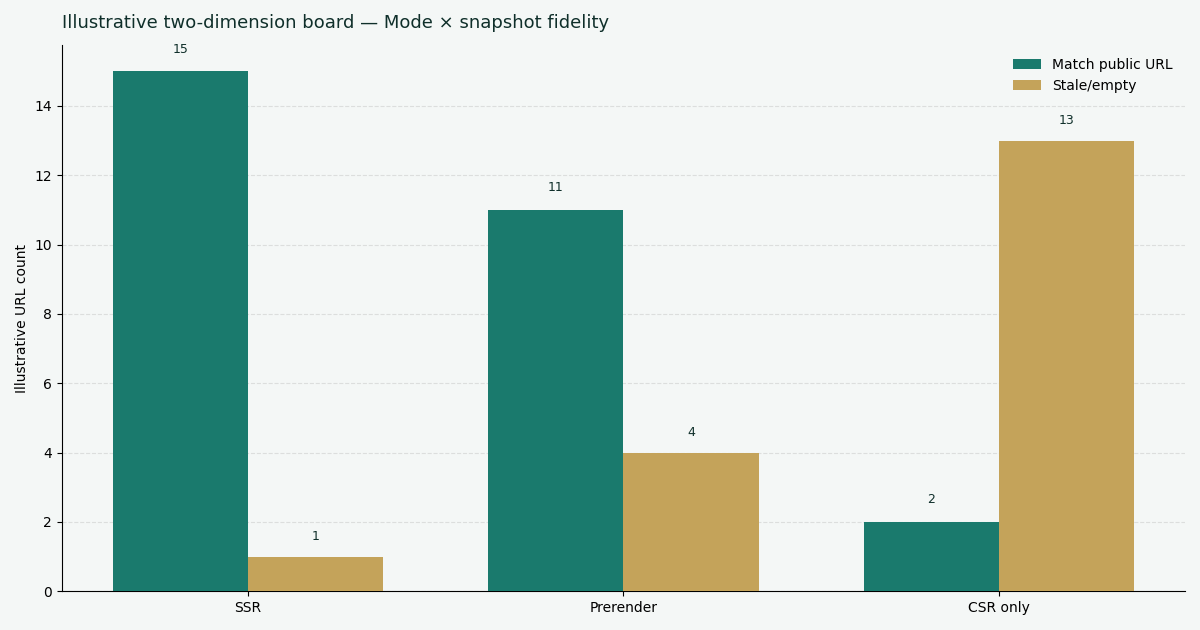
Figure: Two series from the same curl desk. Byte total is not script count. Neither series is a Google keep count, and neither series is a third-party prerender SEO snapshot.
How we fetched the two public documents
curl -sSI -A 'InfiniSynapse-P4-desk/2026-09-14' \
  https://infinisynapse.com/en/tool/website-indexation
We recorded the user-agent, the first status, the download size, the title string, and the script-tag count. The tool document also declared a self canonical and robots = index, follow, max-image-preview:large, max-snippet:-1. Those fields belong in the prerender SEO register even though no snapshot service sat in front of the response.
The web.dev rendering guide still names SSR, static generation, and client render as distinct modes. We use that vocabulary here. The Google JavaScript troubleshooting guide is the official reminder that a crawler may see a different first document than a staff browser. prerender SEO copies that warning when the first bytes are empty, not when curl already returned a title.
A prior third-party snapshot is a different desk
An earlier desk on 2026-09-11 requested https://web.dev/rendering-on-the-web/ and observed a 301 that finished at https://web.dev/articles/rendering-on-the-web with HTTP 200 and 110,480 bytes. That hop is a prior third-party example for prerender SEO. It is not today’s first-party evidence. Lead with the 91,875 and 96,998 byte rows. Keep the web.dev 301 only as a reminder that a rendering article can move while the HTML at the final URL still contains a body.
The Next.js static exports guide describes HTML the framework emits at build time — origin output, closer to / than to a rented capture bot. The Nuxt prerendering documentation names a first-party prerender step inside the same app. The Cloudflare Pages framework guides cover hosts that emit or cache framework HTML at the edge. Edge cache and a snapshot bot both fail when the stored body is empty. They are not the same ticket. prerender SEO is the bot-and-store fallback when those native paths are not ready.
SEO Health stays the deterministic evidence foundation for first-byte title, script count, and declared canonical on the public host. Classified empty or stale rows may enter an InfiniSynapse Server API long-task workspace to sequence recapture or SSR queues; the API does not refetch HTML or invent a snapshot.
A three-mode fidelity framework
Treat prerender versus SSR as a mode choice, then score snapshot fidelity on the public URL. Three modes cover the desk.
| Mode | What curl can store today on this host | Typical miss elsewhere |
|---|---|---|
| SSR / origin HTML | Title already in the first bytes on / and the tool URL | Slow origin, still eligible |
| Stored snapshot | Not observed on these two URLs | Stale or cookie-gated capture |
| CSR only | Not observed on these two URLs | Empty root until the client runs |
prerender SEO sits in the middle row. It is enough when that row matches the public URL. It is unnecessary when the origin already ships a title. It is not enough when the stored file is stale or from another host.
Cookies and admin hosts stay out of scope
A cookie wall is a gate. An admin host is a different origin. Neither is a public URL. If your capture bot logged in, you stored a private tree. prerender SEO on a gated host is a failed sample, not a clever bypass.
The robots allow-list check tells you whether a path is allowed. Allow is necessary. It does not prove the snapshot matches. A path can be allowed and still serve an empty shell on a different template than /.
Static export versus a capture bot
Azure’s Next.js deployment guidance covers a host path for pages the platform can emit or server-render. That differs from a third-party capture bot. Use the native path when it already returns complete public HTML. Reach for prerender SEO only when that path does not exist yet. A native emit is not prerender SEO.
How stored HTML compares to a live request
SSR produces HTML on the request. A snapshot replays HTML you stored earlier. CSR only hopes the client will fill the root. prerender SEO is the middle choice when engineering cannot ship SSR this sprint and will not ship an empty shell. Use the snapshot when the public URL’s HTML is stable for days and you will recapture after each release. Refuse it when prices change on every hit, or when curl already returned 91,875 or 96,998 titled bytes.
If the job is an empty client shell on a crawl, continue on javascript crawl. Come back here when you already decided to store HTML.
Recapture belongs on the same pipeline
If you ship on Friday and recapture on Monday, the weekend is a lie. prerender SEO needs a hook on the same pipeline that ships the app. A weekly cron is a guess.
Supabase Edge Functions can return HTML for a path you control. If a function already returns complete public HTML, ask whether a third-party snapshot remains necessary. The fallback exists for the gap, not for the URLs that already pass the first-byte test.
Who owns the stored document
Engineering owns the capture job, the cache key, and the recapture hook. Editorial owns titles after the stored HTML is eligible. prerender SEO meetings fail when a writer owns the first hour. Start with the public URL.
Credits are not required to read a title in curl. Sample 50–500 sitemap URLs after npm i -g infinitegrowth if templates mint many shells. Do not buy narrative to invent emptiness on /. The tech-tools catalog is a separate product surface. Stay on stored HTML versus the public URL.
Edge cache is not a recapture hook
An edge hit that still serves Friday’s HTML after Saturday’s deploy is stale delivery evidence. Recapture on deploy and fetch again. prerender SEO that treats a CDN TTL as a recapture policy will keep serving the wrong file.
How to validate prerender SEO on a public URL
Run these four steps on a public host you can stand behind. The work is a fetch of the first HTML, a compare to the live URL, and only then a recapture ticket. Skip the outline until the first bytes match or the miss is classified.
Step 1 — Confirm the public host
Write the exact public URL. Not the preview, admin, or localhost. prerender SEO starts with the address a crawler will request. If you cannot paste that address at SEO Health, you are not ready. Check that robots allow the path and that the URL is not a cookie wall.
Step 2 — Compare stored fields to the live fetch
Fetch both. Compare title, canonical, H1, main text, and in-page links. The check passes when those fields match. On / and the tool URL, the live fetch already had a title, so the empty-shell ticket is closed for those two addresses. A 200 with an empty main is still a shell.
Step 3 — Classify stale, empty, or gated
Label each failing URL: stale snapshot, empty shell, cookie wall, or admin host. prerender SEO that stores a gated page is a privacy incident as well as an eligibility miss. CSR-only rows belong on a render ticket. Origin-HTML rows like / do not need a snapshot story.
Step 4 — Recapture or move the template
If the public URL is stable and the miss was stale, recapture on deploy and re-sample 50–500 URLs. If the miss was CSR only, plan SSR. prerender SEO is enough for the first case. It is a delay tactic for the second. Optional narrative may rank templates; it may not invent a body.
Failure modes that store the wrong HTML
Admin capture. The most common miss is a bot that logged into staging. prerender SEO then stores a private tree. The public URL still shows a wall.
Cookie-wall snapshot. Capturing only the consent overlay means that overlay is what the prerender service can serve. This is a delivery defect, but a single fetch cannot establish what a search engine ultimately indexed; recapture signed out or remove the snapshot.
Stale Friday file. You shipped Saturday, but the prerender cache still serves Friday’s HTML to the tested request. That response is stale delivery evidence, not proof of every crawler’s view; recapture on deploy and test again.
CSR confidence. Designers see a full page in Chrome. The store is an empty root. The inverse miss is also real: filing prerender SEO against / after curl already returned 91,875 titled bytes. Do not invent a recovery percentage, and do not invent an empty mount node on a URL that already shipped a title.
Cluster guides beside this page
This page is the snapshot-enough cluster for prerender SEO. Route siblings by job, not by older audit-suite wording.
| Job you actually have | Guide to open next | What this page will not do |
|---|---|---|
| Pay render quota on a live fetch | rendering checker | Price every render |
| Diagnose an empty SPA shell | javascript crawling | Finish the shell lesson |
| Fix eligibility before any render choice | website indexation | Restate the whole hub |
| Check whether a path is allowed | robots allow-list check | Become that checker |
Inspect the live HTML before you store a snapshot
Read title, bytes, and canonical on the public host. Then recapture only if the first bytes are empty or stale.
Run SEO Health CheckerFrequently Asked Questions
When is a stored snapshot enough?
prerender SEO is enough when the stored HTML matches the public URL and SSR is not ready. It is not enough for an admin host, a cookie wall, or a page that changes on every request. It is unnecessary when curl already returns a title, as / and the English tool URL did on 2026-09-14.
Does a cookie wall page qualify?
No. A cookie wall is a gate. prerender SEO must store the signed-out document, or you should not store the URL. Consent HTML is not the page.
Do I need credits to read status codes?
No. Status, redirect destination, response bytes, and snapshot markers are deterministic SEO Health observations. Credits apply only if the completed snapshot comparison is sent to InfiniSynapse for optional prioritization; they are not required to verify the response.
What if the stored HTML does not match?
Recapture on deploy or move the template to SSR. A mismatch is an eligibility defect. Do not rewrite the title on the stale file. prerender SEO tickets stay in engineering until the re-fetch matches.
Conclusion
Use prerender SEO when the origin cannot yet render on the request and you need a stored document that matches the public URL. The 2026-09-14 desk shows / at 91,875 titled bytes and the English tool URL at 96,998 titled bytes. Those two rows are origin HTML, not a rented snapshot. Close the file when the first-byte title, the canonical, and the recapture hook are still visible. A bounded HTML table is more useful than an unsupported empty-shell claim.
William Zhu · Cofounder, InfiniSynapse · GitHub @allwefantasy
Desk-validated SEO Health methods. Corrections: zhuhl@infinisynapse.com · corrections policy.