What Is Claude Code: Start, Then Audit
By William Zhu (independent public engineering profile: GitHub @allwefantasy; no personal LinkedIn) & the InfiniSynapse Data Team · Published: 2026-08-22 · Last updated: 2026-08-28 · Last verified: 2026-08-28 · Next review: 2026-11-28 · About · Editorial standards · Privacy · Publishing terms · Corrections
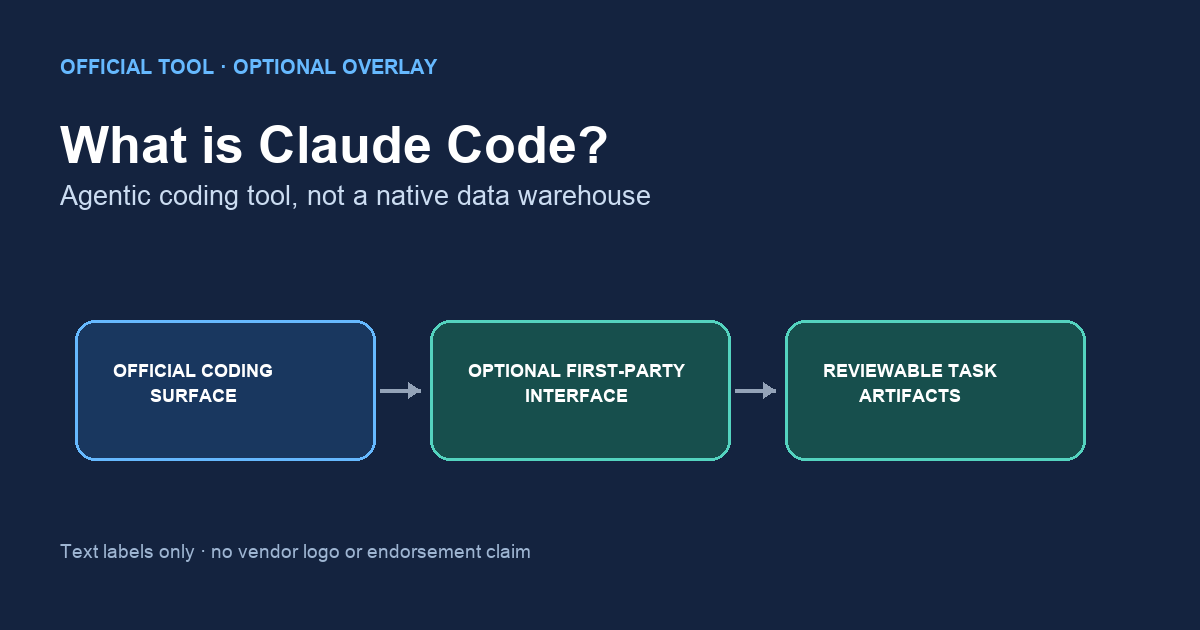
Table of Contents
- TL;DR
- What is Claude Code for analysis
- A caller-and-analyst framework
- How this differs from a chat copilot
- Tool landscape around Claude Code
- Implementation steps that prove the definition
- Desk sample: definition vs paste (InfiniSynapse desk log)
- Selection scorecard
- Failure modes that rewrite the definition
- Frequently Asked Questions
- Conclusion
TL;DR
We evaluate these patterns at the InfiniSynapse desk on sanitized composites; first-party figures on this page are desk log CC-WHATIS-20260822, not customer uplifts and not a third-party bake-off.
Direct answer: The answer to what is claude code is: Anthropic defines Claude Code as an agentic coding tool that runs in terminals and offers IDE integrations. It is not natively a data agent or warehouse. The optional agent_infini, instructions, and /tasks overlay are InfiniSynapse components.
Download evidence: desk log · aggregate CSV · verify script. These files record this desk run as a first-party sanitized composite.
What you'll learn:
- Why the useful definition is “caller,” not “analyst”
- How the definition changes once the Skill can start
task new - Where identity lives—console key, never a frontend
- Desk log
CC-WHATIS-20260822, of a definition that collapsed into paste - Failure modes that rewrite the object into a SQL plugin
Anthropic’s Claude Code overview defines the product, while how Claude Code works explains its agentic loop. IDE integrations document additional surfaces. None describes or endorses the InfiniSynapse overlay. Retrieved 2026-08-28.
What is Claude Code for analysis
Key Definition: For what is claude code, the official object is an agentic coding tool. For this first-party workflow only, it can be separately configured to call an authorized interface and produce reviewable task artifacts.
Claude Code security supports permission claims; settings and MCP support configuration claims. They do not make first-party commands native.
Author qualifications and accountability
William Zhu is an InfiniSynapse cofounder. His public GitHub profile, InfiniSynapse organization, auto-coder, byzer-llm, and BYZER-RETRIEVAL verify public project activity. They do not verify education, Claude certification, an Anthropic relationship, or independent evaluation. 2026 WAIC Future Tech OPC Excellence Award (homepage; not a review). 2026-07-29 attestation.
Official identity comes first. For this first-party workflow, agent_infini, instructions, db ls, rag enable, and /tasks require separate configuration and authorization. Claude Code, Cursor, Codex, and Gemini do not naturally share one setup.
PATH notes are not wrong. They are the wrong object for this pillar. The editor is good at local repos. It is not automatically good at your replica. Used well, it lists sources, enables retrieval, starts a task, and stops typing SQL.
ACM Artifact Review and Badging and the FAIR principles paper support artifact and metadata disclosure. Neither evaluated this page or InfiniSynapse.
If you already live in Cursor, continue in cursor data analysis. The contract both editors call is the agent infini CLI. For the analysis method that starts a goal instead of a SELECT, see goal-first Claude coding for analysis. The shared-task version of that job is claude code analysis.
An agentic coding tool, not a warehouse
Claude Code is not “the place data lives.” Connecting a replica is a data-platform job. The IDE does not become a second warehouse. It does not compile a metric mart. It does not write definitions back into production. Moving the warehouse into the editor is a capability nobody shipped.
The call is the analysis job
The useful half of what is claude code is the call. Claude Code states the outcome. The data agent plans, profiles, joins, and writes files. You read the SQL in /tasks because that is the audit, not because you wanted a plugin. AI for data analysis already drew this split between copilots and agents. The editor sits on the copilot-shaped side until the call happens.
A caller-and-analyst framework
| Piece | Owner | What “good” looks like |
|---|---|---|
| Claude Code | You | States a standing goal in the repo you already use |
| Data agent | Shared task | Plans, runs, writes Markdown, charts, extracts |
| First-party interface | InfiniSynapse | Separately configured and versioned |
| Credential | Named owner | Scoped per person, device, and environment |
| Proof | Web trail | One id a teammate can open |
If what is claude code collapses those rows into “the model looked at a paste,” you have a local session rather than this first-party task overlay.
Claude Code states the goal
Ask for the weekly pack. Do not ask for the join. Natural language to SQL is a sibling problem; this page is not a prompt cookbook for SELECT. When what is claude code means “type the business question,” you are closer to chat with your data than to autocomplete—except the trigger is the IDE.
The data agent keeps the trail
A durable run should leave files, reviewed SQL, a plan, status, and hashes. None of those artifacts should contain credential values.
How this differs from a chat copilot
A chat copilot waits for the next paste. The useful answer to what is claude code waits for the task to finish. You return to the repo. You reopen /tasks the way an SRE reopens a ticket. Self-service analytics still matters for people who will never open the IDE. Both groups should land on the same artifacts if they asked the same goal.
Name process states such as queued, running, ready, and failed; preserve errors rather than showing only a streaming paragraph.
Long task versus next paste
Paste is short. Analysis is long. Profiling a replica, joining two grains, drawing a board, and writing a memo is not a completion. If what is claude code still means “wait for the bubble,” you bought a noisy plugin. Start the job. Let the data agent work. Read the files later.
Tool landscape around Claude Code
| Client | Role after the definition | Failure |
|---|---|---|
| Claude Code | Terminal and IDE surfaces | Treats stdout as the record |
| Cursor | Separate client | Copies unreviewed instructions |
| Codex / Gemini | Separate clients | Reuses another client’s secret |
| Web Chat | Same goal, no IDE | Fine; not a lesser analysis |
A durable analysis run still needs a plan, SQL, and files a reviewer can open. Hosting choices do not change that test. The educational path still uses a shared web trail so the timeline is visible to someone who does not have your laptop. A board the task writes is a file in that folder, not a tile catalog you pre-build in the editor.
MCP for data analysis covers a protocol host. This definition stays on CLI plus Skill. Either way, what is claude code does not include minting keys in a browser.
Each client needs a separate review of configuration, instructions, permissions, and credentials. Codex data analysis and Gemini CLI data analysis describe related first-party patterns, not native compatibility.
If the reader will never install an editor, do not force the definition through a laptop. Web Chat starts the same goal. what is claude code remains “an optional client.” The task is not optional.
Implementation steps that prove the definition
- Record Claude Code context. Capture version, model, surface, permissions, config, hooks, and MCP. Expected result: Native controls are explicit.
- Version the first-party overlay. Follow authorized internal instructions and record CLI and instruction hashes; no public install command is asserted. Expected result: The optional overlay is identifiable.
- Issue a scoped credential. Assign it per person, device, and environment without publishing the value. Expected result: It can be revoked independently.
- Preserve runs and hashes. Record task IDs, status, timestamps, errors, SQL, artifacts, baseline, failures, and wall-clock definition. Expected result: Evidence can be compared.
- Run reviewer protocol. Have a reviewer reopen artifacts and disclose conflicts of interest. Expected result: Review does not require the originating surface.
Those six steps are the whole proof. You can complete the educational diagnosis at step 1. The clicks prove it.
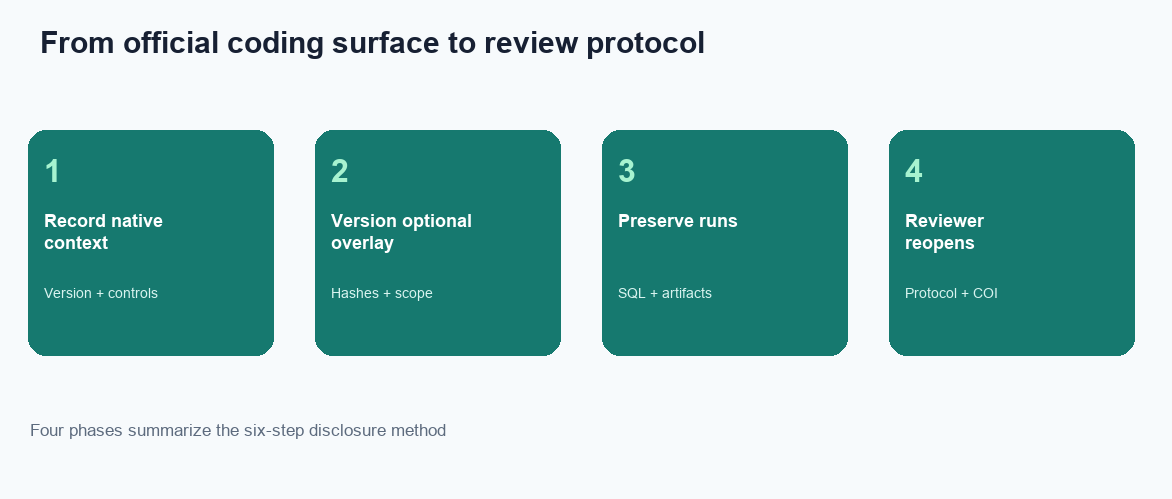
Figure. Educational four-step sequence the desk uses to tell a paste session from a caller definition. Expected result after step 6: the CLI id and the /tasks row match, and a teammate without the IDE can download the memo, charts, and CSV. Not a product screenshot or a customer SLA.
Create the key before you ask
Keys are created at app.infinisynapse.com/tasks. Never in frontend code. If the working definition of what is claude code includes a VITE_ token, revoke it. The API key for a data agent page is the issue path.
One goal, one task id
The definition is true when CLI stdout and the console row share an id. IDE vs web data analysis is that split in longer form. If the ids differ, your answer to what is claude code just created two stories.
Desk sample: definition vs paste (InfiniSynapse desk log)
This first-party sanitized demo addresses what is claude code only within the optional overlay. Run ID: CC-WHATIS-20260822. Date: 2026-08-22 (Saturday). Download the desk log and aggregate CSV.
A desk wiki answered what is claude code with “our SQL writer.” Engineers pasted table dumps into the editor. There was no task id. A review asked for the join. The only evidence was a collapsed chat.
| Retrieval state | SQL | Memo | Chart | CSV |
|---|---|---|---|---|
| IDE paste only | 0 | 0 | 0 | 0 |
| Shared task (matched id) | 1 | 1 | 2 | 1 |
The desk rewrite separated Anthropic’s coding tool from the optional first-party task overlay. Twenty-five minutes later, the sanitized run held a memo, two charts, and a CSV. Cite only artifact counts and defined wall clock from CC-WHATIS-20260822.
The next week the same goal ran with the knowledge base bound. “Active store” did not get re-invented in the prompt. That compounding is qualitative.
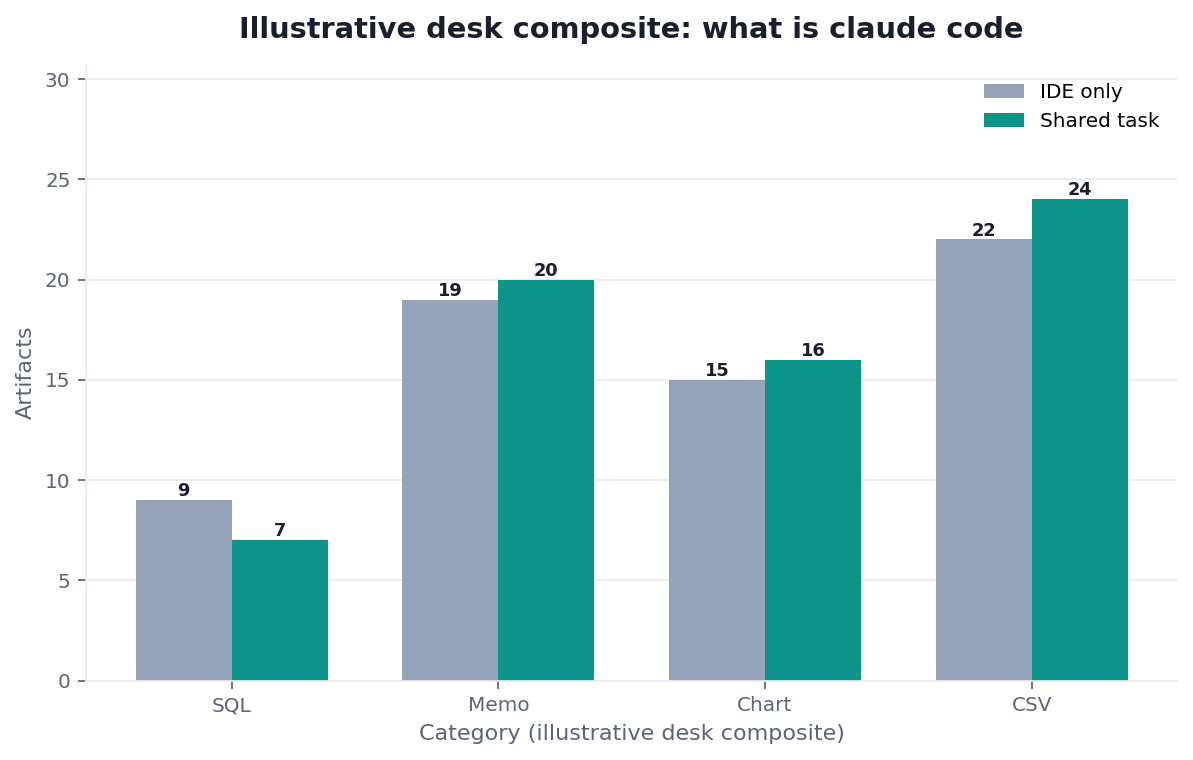
Figure. InfiniSynapse desk log CC-WHATIS-20260822: paste-only week left 0 / 0 / 0 / 0 shared artifacts; the matched id left 1 / 1 / 2 / 1. Published context: the independent sources linked in the body. Not a customer experiment, SLA, or official benchmark.
Evidence boundaries and external validation status
CC-WHATIS-20260822, its Markdown file, and aggregate CSV are first-party sanitized composite/demo evidence—not customer, raw, benchmark, third-party, or Anthropic evaluation data. No independent third party or media outlet had reproduced or assessed the InfiniSynapse overlay as of 2026-08-28.
Replication should disclose Claude Code version, model, surface, permissions, config, hooks, and MCP; first-party CLI and instruction hash; separate credential scope without its value; source authorization and snapshot; goal and SQL constraints; task IDs, status, timestamps, errors, SQL and artifact hashes; paste-only baseline; all failures; review protocol; wall-clock definition; and conflicts of interest.
| Evidence class | What you can cite | What you cannot claim |
|---|---|---|
| Desk log on this page | Wiki rewrite, shared id, finance audit, artifact counts 0/0/0/0 → 1/1/2/1, ~25 min wall-clock, run ID, downloadable log | Customer uplift %, official EEAT score, named-logo case |
| Markdown and aggregate CSV | Two observations, method, counts, reviewer flag | Raw, customer, source, or third-party data |
| Anthropic documentation | Native coding-agent surfaces and controls | Native InfiniSynapse overlay or endorsement |
| ACM and FAIR guidance | Artifact and metadata disclosure | Independent validation of this workflow |
How to cite this page
Page: Zhu, W., & InfiniSynapse Data Team. (2026). What Is Claude Code: start, then audit. InfiniSynapse
Run: InfiniSynapse Data Team. (2026). Desk log CC-WHATIS-20260822 (sanitized composite)
Neither form is an audit. Cite only the artifact counts. No independent reproduction exists. Send contradictions to zhuhl@infinisynapse.com.
Selection scorecard
| Criterion | Weak definition | Strong definition |
|---|---|---|
| Object | Chat that ate a CSV | Official coding tool plus optional task overlay |
| Trigger | “Write the SELECT” | “Run this standing goal” |
| Identity | Shared or browser secret | Separate scoped credentials; server-side web session |
| Evidence | Transcript | Task steps and downloads |
| Clients | Assumed compatibility | Separately reviewed configurations |
If a vendor pitch answers what is claude code with a feature tour and no /tasks id, score it as a copilot. If it shows the id but wants the key in application code, stop.
Failure modes that rewrite the definition
These three failures rewrite what is claude code into a plugin. A frontend token that starts tasks is the same class of secret exposure the OWASP Top 10 for LLM Applications flags; keep the console key instead.
Treating Claude Code as NLP2SQL
If every prompt is a SELECT, you have rewritten what is claude code into a plugin. Ask for the pack. Read the SQL in the workspace. Exploratory data analysis still happens inside the task. The editor is not the exploration surface.
Keys in the frontend
A definition that ships INFINI_API_KEY to the browser is a leak. what is claude code does not include a public token. Revoke. Re-issue in the console. Search VITE_ and NEXT_PUBLIC_.
No shared id
Two surfaces, two stories. If the IDE summary and the console row disagree, what is claude code failed in production even if the paragraph sounded confident.
Before you publish the definition internally, check four things: the key is not in git, sources are authorized only, a teammate can open the last task without the IDE, and the artifacts are files. That inspection is the diagnosis.
W3C PROV-O and OpenTelemetry traces support provenance and invocation records. NIST SSDF, NIST AI RMF, NCSC secure AI guidance, OWASP GenAI/LLM Top 10, and GitHub secret scanning support controls. None tested this demo.
Start one analysis goal from Claude Code, then audit it
Create a key in the task console, start one standing goal from the IDE, and confirm the same id opens with SQL and files in /tasks. This check uses only sources you authorize.
Commercial association: You do not need the workspace to complete the educational diagnosis on this page.
Open InfiniSynapseSourcing and accountability. William Zhu’s public profile verifies project activity, not this workflow. Anthropic defines Claude Code; independent guidance supports limited artifact and control claims. None evaluated InfiniSynapse. 2026 WAIC Future Tech OPC Excellence Award (homepage; not a review). COI: InfiniSynapse sells the optional overlay evaluated here.
Frequently Asked Questions
What is Claude Code if I only write application code?
Bottom line: Claude Code remains an agentic coding tool for terminal and IDE surfaces. The InfiniSynapse task overlay is optional and separately configured.
Does the definition require the web app?
Bottom line: The educational definition of what is claude code for analysis requires a shared trail. The web workspace is that trail. The IDE start is optional. The audit is not. If nobody can open the id, you still have a chat.
Where does the API key live?
Bottom line: Use a separately scoped, revocable credential per person, device, and environment. Web login uses a server-side session and never exposes a service secret to browser code.
Can Cursor be the same object?
Bottom line: No automatic equivalence exists. Each client needs separate instructions, config, permissions, adaptation, and credential review.
Does Anthropic’s documentation define Claude Code as a data warehouse?
Bottom line: No. Anthropic’s Claude Code docs describe an agentic coding tool. They do not make the editor a warehouse, and they do not run the desk table on this page.
Is a pasted CSV chat third-party proof of the definition?
Bottom line: No. A paste session is a local story. what is claude code for analysis treats proof as a matched task id and files a reviewer can download.
Conclusion
The accurate answer to what is claude code starts with Anthropic’s agentic coding tool. For this first-party workflow, what is claude code remains separate from the optional interface, scoped credentials, authorized sources, and reviewable artifacts.
Teams asking what is claude code should distinguish official capabilities from configured overlays before evaluating any data workflow.
Independent replication of what is claude code overlays requires disclosed versions, permissions, inputs, failures, hashes, review protocol, and conflicts of interest.