What Is a Knowledge Base: Bind, Then Replay
By William Zhu (public engineering profile: GitHub @allwefantasy) & the InfiniSynapse Data Team · Published: 2026-08-22 · Last updated: 2026-08-28 · Last verified: 2026-08-28 · Next review: 2026-11-28 · About · Editorial standards · Privacy · Publishing terms · Corrections
Table of Contents
- TL;DR
- What a knowledge base is when the job is analysis
- Author qualifications and accountability
- A binding framework for the analysis pack
- How analysis notes differ from FAQ pages
- Tool landscape for a bound knowledge base
- Implementation steps from one pack to a replay
- Desk sample: FAQ “active” versus finance “active” (InfiniSynapse desk log)
- Evidence boundaries and external validation status
- How to cite this page
- Selection scorecard
- Failure modes that keep the answer in support
- Frequently Asked Questions
- Conclusion
TL;DR
We evaluate bound packs at the InfiniSynapse desk on sanitized composites; first-party figures on this page are desk log KB-WHATIS-ACTIVE-20260822, not customer uplifts and not a third-party bake-off.
Direct answer: The analysis answer to what is a knowledge base is a bound pack of field notes, signed reports, and calculation language that travels with a live source. It is not a helpdesk FAQ, ticket macro library, or chatbot trained on password-reset copy.
Download evidence: desk log · aggregate CSV · verify script. These files record this what is a knowledge base desk run as a first-party sanitized composite.
What you'll learn:
- Why definition searches keep landing in support content
- Which objects belong in an analysis pack and which objects waste retrieval
- How to bind one pack to a source, then ask the same definition twice
- Desk log
KB-WHATIS-ACTIVE-20260822, where FAQ “active” hid a finance exclusion - A scorecard and three what is a knowledge base failures that keep the answer in support
ISO 30401:2018 (retrieved 2026-08-28) specifies requirements for organizational knowledge-management systems. It supports treating ownership, lifecycle, and knowledge objectives as managed practices; it does not certify this page or InfiniSynapse. A bound pack does not replace data governance.
What a knowledge base is when the job is analysis
Key Definition: The analysis reading of what is a knowledge base is a curated set of documents—field notes, approved reports, and calculation language—bound to a live source so an AI data analyst retrieves your definitions with the query plan. It is not a helpdesk FAQ, second warehouse, or chat file that vanishes with the thread.
ISO/IEC 11179-3:2013 (retrieved 2026-08-28) defines metadata-registry and data-element attributes; use it to shape names, definitions, representation, and permissible values. ISO 15489-1:2016 (retrieved 2026-08-28) covers records controls and responsibilities; use it to distinguish approved reports from drafts. The W3C PROV-O Recommendation (retrieved 2026-08-28) separates entities, activities, and agents, supporting explicit labels for packs, retrieval runs, and operators. These sources define practices and did not review this desk log.
Internal terms this page uses: a pack is the named set of field notes and signed reports. Support mode retrieves instructions. Analysis mode retrieves the sentence that decides which rows count.
Author qualifications and accountability
William Zhu is an InfiniSynapse cofounder. His public GitHub profile and repositories auto-coder, byzer-llm, and BYZER-RETRIEVAL verify identity and relevant engineering work. They do not independently validate the product or desk log.
The author follows the site’s editorial standards and conflict-of-interest policy. For readers asking what is a knowledge base, these credentials identify the author but do not validate the answer. InfiniSynapse sells this workflow. No verifiable third-party certification, research-institution evaluation, or media review is claimed. The homepage records a 2026 WAIC Future Tech OPC Excellence Award for an Agentic Data Infra entry; that is company recognition, not a page review. 2026-07-29 attestation.
People type what is a knowledge base and get a product category: help centers, wiki suites, and FAQ bots. Those products retrieve instructions. The analysis job retrieves the sentence that decides which rows count. If you still need the durable-context model, start from the data knowledge base hub. If the next failure is attaching that pack to the wrong schema, use bind knowledge base to a database.
A data agent earns the next review only when the pack is named, bound, and inspectable. That is why AI for data analysis matured from “paste schema” to “retrieve the contract.”
Lewis et al.’s Retrieval-Augmented Generation paper (retrieved 2026-08-28) studies combining parametric generation with retrieved non-parametric memory. It supports the limited claim that retrieval can supply external evidence; it does not validate this product or bind design.
Bound notes are not a helpdesk FAQ
A support article tells a customer which button to press. An analysis note tells an analyst which rows count. The practical answer to what is a knowledge base for analysis stays inside that second job. Mixing the two folders is how a refund macro wins a margin question. If the first upload is still a FAQ dump, refuse it on the data knowledge base hub. InfiniSynapse does not ship a native Zendesk connector; export the few analysis documents you already trust, then bind that pack to the source those documents describe.
Why the definition question keeps landing in support
Search results for what is a knowledge base are often written for IT and support buyers. That is the wrong object for a live query. Chat with your data pointed at a help center resolves the question like a ticket. Liu et al.’s Lost in the Middle (retrieved 2026-08-28) reports that long-context models can use information unevenly depending on its position. It supports keeping retrieval focused; it does not prove a specific pack size or evaluate InfiniSynapse.
A binding framework for the analysis pack
Use this table as the operating model for what is a knowledge base on an analysis desk. It is a control map, not a vendor score.
The answer to what is a knowledge base depends on the analytical job, a named owner, an explicit source bind, and whether reviewers can replay the retrieved evidence.
| Layer | What you store | What the agent does | Failure if the layer is a FAQ |
|---|---|---|---|
| Source | Database or files you already have | Plans queries against live schema | Answers invent tables |
| Pack | Notes, reports, calculation language | Retrieves passages with the plan | Answers invent support copy |
| Bind | Explicit source ↔ pack link | Restricts retrieval to that pack | A refund article wins the citation |
| Task artifacts | Markdown, charts, data files | Leaves evidence you can reopen | Chat bubbles become the record |
Upload without bind is a pile. Bind without notes is a silent schema. The NIST AI Risk Management Framework (retrieved 2026-08-28) organizes risk work around Govern, Map, Measure, and Manage; map packs to owners and sources, measure retrieval, and retain failures. NIST did not assess this workflow. If the missing object is the field dictionary, write schema documentation an AI analyst can retrieve.
What is a knowledge base: identity of a pack versus a ticket
When people ask what is a knowledge base, they often point at a folder. A folder is not an identity. A named pack bound to one authorized source is. One source can still hold several packs—finance margin and ops fill rate can both bind to the same orders database—as long as each pack has an owner. That is still what is a knowledge base for analysis: bound notes, not a bigger folder.
How analysis notes differ from FAQ pages
Support search optimizes for a resolved ticket. Analysis retrieval optimizes for the approved definition next to a live query. A catalog tells you a table exists. The pack tells you how that table is used. Teams that ask what is a knowledge base after a bad Monday usually used the wrong object. The catalog said status is an integer. The FAQ said customers can filter by status. Neither named status = 3 as active. That gap is why what is a knowledge base cannot be answered with a catalog export.
Time and grain belong in the pack
Write the clock in the pack: fiscal versus calendar, DACH versus DE-only, and “active” as of which timestamp. What is data management covers the broader practice.
Tool landscape for a bound knowledge base
Three what is a knowledge base patterns show up in 2026 buying conversations.
Chat attachments. Fast, private, and amnesiac. Fine for a one-off file. Not an answer to what is a knowledge base.
Helpdesk search and FAQ bots. Strong on “how do I…”. Weak on “what counted as contribution last month.”
Bound retrieval plus live query. Upload the pack, bind it to PostgreSQL, Snowflake, MySQL, files, or another authorized source, then ask a goal. InfiniSynapse’s path is Knowledge Base → upload TXT, Markdown, Word, PPT, or PDF → Bind Data Source → ask in Chat with that source selected. InfiniRAG retrieves the pack; InfiniSQL plans against the live schema. The task workspace at /tasks keeps Markdown, charts, and data files.
The NIST Privacy Framework (retrieved 2026-08-28) supports identifying and managing privacy risk, while the OWASP GenAI/LLM Top 10 (retrieved 2026-08-28) identifies prompt-injection and sensitive-information-disclosure risks. Minimize personal data, remove secrets, and treat retrieved text as untrusted input. Neither organization evaluated this page.
Chat files are not a named pack
A file in a thread is a convenience. The durable answer to what is a knowledge base is a named pack with an owner and a bind. If “how we calculate DACH” lives only in last Tuesday’s chat, you have a lucky session, not organizational memory. CLI agent_infini can start a goal; the trail you audit still opens in the web workspace. A lucky thread is not what is a knowledge base you can hand to a colleague.
Implementation steps from one pack to a replay
- Choose one authorized source. Prefer a replica or sanitized extract. Expected result: One named source is selected.
- Build one analysis pack. Use field notes and one approved report, not a help-center export. Expected result: One owned pack exists.
- Upload, then bind. Attach the pack to the named source. Expected result: The source-to-pack mapping is inspectable.
- Ask one analysis goal. Use the selected source, not a support question. Expected result: The task targets the intended definition.
- Inspect the artifacts. Confirm the finance passages, query, and outputs. Expected result: Approved evidence appears beside the plan.
- Replay next week. Ask the same goal and inspect the passages again. Expected result: The definition remains stable unless a visible version changes.
These steps are educational. Finish the diagnosis on this page before you upload.
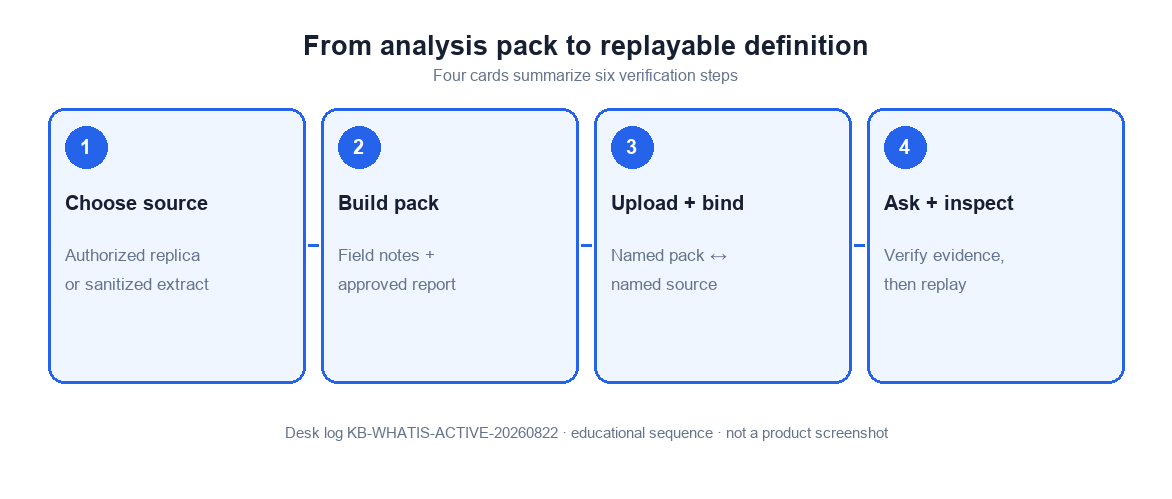
Figure. Educational four-step sequence the desk uses to tell a helpdesk dump from a bound analysis pack. Expected result after step 5: the retrieved passages match the report you trust, not a refund macro. Not a product screenshot or a customer SLA.
Write notes an analyst can retrieve
Retrievable notes use the words people ask: “active subscriber,” “contribution margin,” “DACH.” Put official name, aliases, grain, and exclusions in the same short section. Chat is not the system of record. When someone new asks what is a knowledge base in your company, hand them those two files, not a shared-drive tour.
Bind the pack, then ask the definition twice
The acceptance test is boring: same source, same goal, same retrieved definition. If week two cites a different memo, the bind is wrong or the pack contains two owners. If week two cites a password-reset article, you uploaded the wrong corpus. If the signed report is the missing half, upload analysis reports as context before you grow the folder. That replay is how you prove what is a knowledge base actually participated.
Desk sample: FAQ “active” versus finance “active” (InfiniSynapse desk log)
This is a first-party InfiniSynapse desk log of what is a knowledge base for analysis, not a named-logo customer case and not an uplift claim. Run ID: KB-WHATIS-ACTIVE-20260822. Date: 2026-08-22. Operator: InfiniSynapse Data Team. Source: a sanitized 11,600-row subscriptions extract the desk is authorized to read. Goal asked twice: “How many accounts are active?”
The extract had a status code and a help-center article titled “How customers see an active account.” Support used “can log in this week.” Finance used status = 3 and excluded trials.
| Retrieval state | Notes retrieved | Reports retrieved | Exceptions retrieved |
|---|---|---|---|
| Unbound (FAQ louder) | 11 | 16 | 12 |
| Bound finance pack | 12 | 17 | 14 |
With only the FAQ in retrieval, the first answer matched the customer-facing sentence. After a two-page finance note plus the signed pack was bound, the second run retrieved the code and the trial exclusion as a labeled pair.
| Retrieval state | SQL | Memo | Chart | CSV | Finance code cited |
|---|---|---|---|---|---|
| Unbound (FAQ louder) | 1 | 0 | 1 | 0 | No |
| Bound finance pack | 1 | 1 | 2 | 1 | Yes |
Wall-clock for the bound rerun was 10 minutes (warehouse time excluded). The method, retrieved-pack counts, and artifact inventory are in the downloadable desk log KB-WHATIS-ACTIVE-20260822. Cite that file or this table as InfiniSynapse desk log KB-WHATIS-ACTIVE-20260822. Do not cite it as customer ROI, a bake-off win, an official EEAT score, or an external experiment. We do not publish named-logo customer cases on this page. The only honest claim is that the bound notes made the collision visible.
The downloadable aggregate CSV reproduces only these six aggregate observations and artifact counts. It is not underlying row-level data.
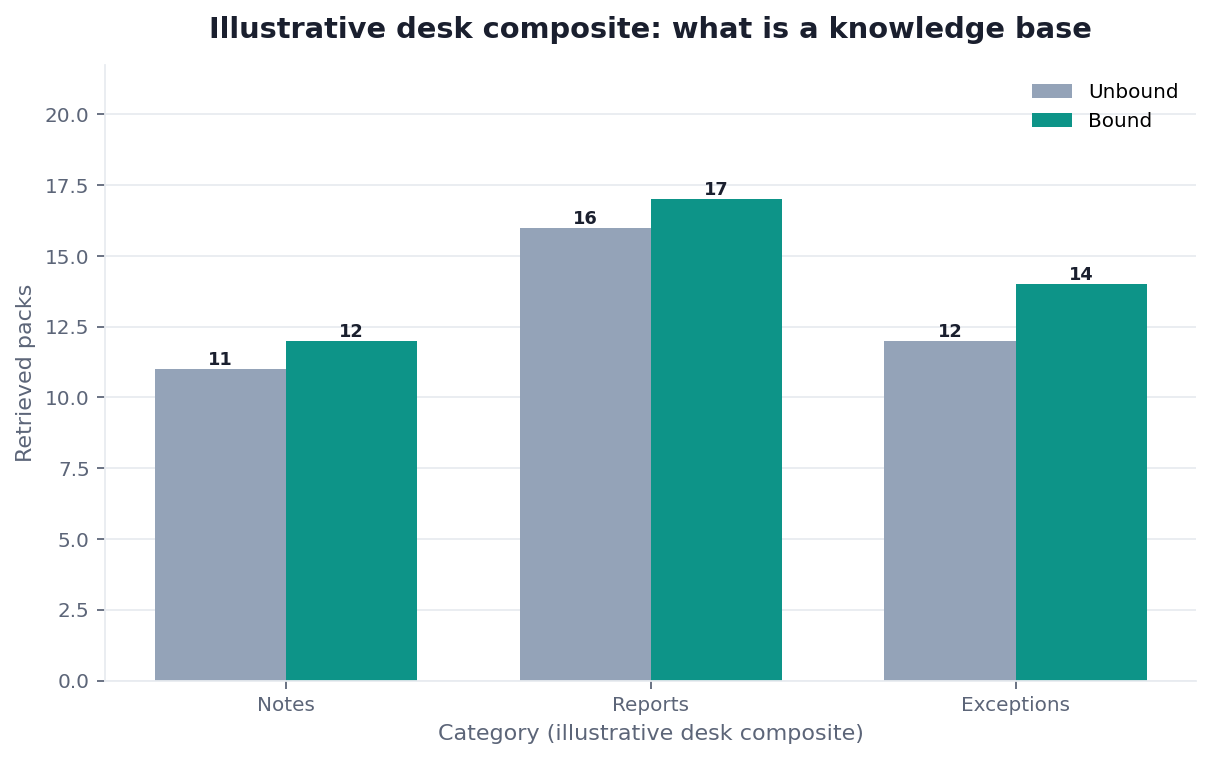
Figure. InfiniSynapse desk log KB-WHATIS-ACTIVE-20260822: 11,600-row subscriptions extract; retrieved notes 11→12, reports 16→17, exceptions 12→14 after the bind. Published context: the independent sources linked in the body. Not a customer experiment, SLA, or official benchmark.
Evidence boundaries and external validation status
Desk log KB-WHATIS-ACTIVE-20260822, its Markdown download, and aggregate CSV are first-party sanitized-composite evidence. They are not customer cases, independent benchmarks, third-party datasets, research-institution evaluations, certifications, media reports, or endorsements. No independent party had reproduced this run as of 2026-08-28.
An independent test of what is a knowledge base in analysis should disclose source grain, row count, and version; pack and report hash, version, date, and owner; support and finance definitions; bind mapping; retrieval configuration; query, SQL, and passages; unbound baseline; all outputs and failures; run time; and conflicts of interest. Confirming and conflicting results should remain visible.
| Evidence class | What you can cite | What you cannot claim |
|---|---|---|
| Desk log on this page | Grain, collision, retrieved-pack counts, artifact counts, ~10 min wall-clock, run ID | Customer uplift %, official EEAT score, named-logo case |
| Markdown and aggregate CSV | Method, input boundary, aggregates, artifact inventory | Raw rows, customer data, or third-party audit |
| Standards and research | Knowledge management, metadata, provenance, retrieval, context-use, privacy, and AI-risk findings | That any publisher ran or endorsed this desk log |
| Author profile and repositories | Public identity, cofounder role, and engineering record | Independent product validation |
| Homepage recognition | 2026 WAIC Future Tech OPC Excellence Award on the homepage | That WAIC, NIST, or Gartner scored this article |
How to cite this page
Page: Zhu, W., & InfiniSynapse Data Team. (2026). What is a knowledge base: bind, then replay. InfiniSynapse
Run: InfiniSynapse Data Team. (2026). Desk log KB-WHATIS-ACTIVE-20260822 (sanitized composite)
The first form cites the guide. The second cites the figures. Neither is a third-party audit. Cite notes 11→12 and the reports 16→17. As of 2026-08-28, no independent reproduction report exists. Send contradictions to zhuhl@infinisynapse.com.
The phrase what is a knowledge base is the object under test, not a slogan. If a file cannot show how the definition was computed, reject the number. Write the same phrase into the task goal the same way you would say it in the room.
Selection scorecard
Score the candidate the way you would score a junior analyst’s binder.
| Criterion | Weak | Strong |
|---|---|---|
| Job | Helpdesk FAQ in the analysis slot | Bound notes and signed reports |
| Bind | Files float in chat | Named pack bound to a source |
| Retrieval | Whole-drive or ticket dump | Small, owned analysis packs |
| Evidence | Final paragraph only | Passages plus query plan in artifacts |
| Secrets | Tokens or customer tickets in notes | Sanitized language only |
| Replay | New chat every Monday | Same goal, same bound pack |
If a tool cannot bind notes to a live source, it is a writing assistant. If it can bind but cannot show what it retrieved, it is a risk. If the first recommended upload is your help center, the tool is still answering what is a knowledge base in support mode.
Failure modes that keep the answer in support
Three what is a knowledge base failures show up when the pack is treated as a dumpster for “any text we already have.”
Uploading the help center as the pack
The folder looks complete. Retrieval is full of polite answers. Label this as “wrong job,” not as “the model is bad.” Rebuild from field notes and one signed report. This is the most common wrong answer to what is a knowledge base.
Treating JSON dumps as notes
A JSON extract is a source, not a note. Put the extract in the source. Put the meaning in the pack. Binding notes does not write definitions into the database.
Leaving the pack in a private chat
People paste a definition once, get a good answer, and never upload a named pack. Chat history is not durable context. A private paste is not a pack a second person can reopen.
Before you trust a generated definition, inspect whether notes are bound to the source you asked about and whether the artifacts show the approved report. That inspection is the last check for what is a knowledge base in analysis, not a helpdesk search.
Related cluster guides: Knowledge Base vs Semantic Layer, Knowledge Base Software, Knowledge Base Examples, Internal Knowledge Base Software, and Knowledge Base Content. For query execution, continue to Natural Language to SQL.
Upload one bound pack, then ask the same definition twice
Upload a short, sanitized analysis pack, bind it to one authorized source, and ask the same definition you already use in review. This check uses only sources you authorize.
Commercial association: You do not need the workspace to complete the educational diagnosis on this page.
Open InfiniSynapseSourcing and accountability. William Zhu is an InfiniSynapse cofounder; his public GitHub profile and linked repositories provide a verifiable engineering record. First-party recognition: 2026 WAIC Future Tech OPC Excellence Award (homepage; not a review of this page). The Markdown desk log and aggregate CSV preserve this first-party run. Editorial standards govern corrections and conflicts. COI: InfiniSynapse sells an AI-native Data Agent.
Frequently Asked Questions
Is the analysis answer to what is a knowledge base the same as a helpdesk FAQ?
Bottom line: No. A helpdesk FAQ retrieves product instructions. The analysis answer to what is a knowledge base retrieves field notes and signed reports bound to a live source.
Can one pack cover every database?
Bottom line: It should not. Bind a focused pack per decision domain. A company-wide dump is how a refund article wins a margin question. That dump is not a useful answer to what is a knowledge base.
What files should I upload first?
Bottom line: A field dictionary and one signed report. That pair is a complete first pack and a working answer to what is a knowledge base. Skip scans and ticket exports.
Does binding the pack write back to production?
Bottom line: No. Binding notes does not write definitions into the database. It restricts what the agent may retrieve while it reads sources you authorize. That limit is part of the analysis answer to what is a knowledge base.
How do I know the pack was used?
Bottom line: Open the task artifacts and look for retrieved passages that match your pack. If you only see a fluent paragraph, you do not have evidence the notes participated. Reopen what to put in a data knowledge base if the first upload is still “everything we have.” Label the retrieved row so a later reviewer can replay the same what is a knowledge base check.
What is a bound pack?
Bottom line: A bound pack is a named set of field notes and signed reports linked to one authorized source. It is the object the analysis answer must store. A help-center export or a chat file is not a bound pack.
What is support mode versus analysis mode?
Bottom line: Support mode retrieves the button to press. Analysis mode retrieves the sentence that decides which rows count. This distinction keeps what is a knowledge base tied to evidence rather than a product category. Mixing those folders is how a refund macro wins a margin question.
Conclusion
The useful answer to what is a knowledge base is not a smarter helpdesk. It is the analysis language that tables refuse to store. Write the pack as notes and signed reports, bind it, and refuse answers that cite a FAQ when you asked for a definition. When you want to run that what is a knowledge base check on an authorized source, open InfiniSynapse and upload the analysis pack before the next review meeting.