Analysis Reports as Context: Bind, Then Replay
By William Zhu (public engineering profile: GitHub @allwefantasy) & the InfiniSynapse Data Team · Published: 2026-08-22 · Last updated: 2026-08-28 · Last verified: 2026-08-28 · Next review: 2026-11-28 · About · Editorial standards · Privacy · Publishing terms · Corrections
Table of Contents
- TL;DR
- Why signed reports are priors
- Author qualifications and accountability
- A prior framework for approved packs
- How a prior differs from a second analysis
- Tool landscape for report-backed retrieval
- Implementation steps for the first signed prior
- Desk sample: last month's pack versus a fresh guess (InfiniSynapse desk log)
- Evidence boundaries and external validation status
- How to cite this page
- Selection scorecard
- Failure modes that turn a prior into a rewrite
- Frequently Asked Questions
- Conclusion
TL;DR
We evaluate signed priors at the InfiniSynapse desk on sanitized composites; first-party figures on this page are desk log KB-REPORT-JUNE-20260822, not customer uplifts and not a third-party bake-off.
Direct answer: Treat analysis reports as context when you bind a signed pack to a live source so the next question reuses last quarter’s accepted language. The report is a prior, not a second analysis and not a script the agent should copy as if the world had not changed.
Download evidence: desk log · aggregate CSV · verify script. These files record this analysis reports as context desk run as a first-party composite.
What you'll learn:
- Why report-backed retrieval fails when you upload drafts, decks with no text, or every slide you ever sent
- How a signed prior differs from asking the agent to “redo the board pack”
- How to upload one approved report, bind it, then ask a new goal against live rows
- Desk log
KB-REPORT-JUNE-20260822, where last month’s exclusion survived a fresh count - A scorecard and three failure modes that turn analysis reports as context into a rewrite
Industry context stays independent of desk claims. ISO 15489-1:2016 (retrieved 2026-08-28) defines concepts and principles for creating, capturing, and managing records, including records controls and assigned responsibilities. Applied here, retain an approved report with owner, date, version, and integrity controls rather than uploading an unlabeled draft. ISO did not review this workflow. Using analysis reports as context does not replace AI for data analysis.
Why signed reports are priors
Key Definition: Using analysis reports as context means binding an approved, dated pack—board memo, monthly close, exception list—to the live source it describes so retrieval can cite the prior while a professional AI data analyst plans against current rows. It is not a second warehouse, a copy-paste of last quarter’s numbers, or a request to regenerate the same deck.
ISO 23081-1:2017 (retrieved 2026-08-28) covers principles governing metadata for records, their processes, systems, and responsible organizations. A signed prior therefore needs metadata that identifies the report hash, version, date, owner, approval state, and source relationship. The W3C PROV-O Recommendation (retrieved 2026-08-28) provides a vocabulary for entities, activities, and agents; those concepts support labeling the report, retrieval run, and operator separately. Neither standards body evaluated InfiniSynapse.
Internal terms this page uses: a prior is a signed, dated pack. A script is last month’s deck treated as something to reprint. A new goal counts this period’s rows under last period’s rule.
Author qualifications and accountability
William Zhu is an InfiniSynapse cofounder. His public GitHub profile identifies that role and links engineering work. Public repositories include auto-coder, byzer-llm, and BYZER-RETRIEVAL. These links verify identity and relevant open-source experience; they do not independently validate this experiment.
The author is accountable to the site’s editorial standards, including corrections and conflict-of-interest disclosures. InfiniSynapse sells the workflow described here, so product descriptions and desk results are first-party claims unless an external source is explicitly cited. The homepage records a 2026 WAIC Future Tech OPC Excellence Award for an Agentic Data Infra entry; that is company recognition, not a page review. 2026-07-29 attestation.
A signed report already lost an argument. That is why it is valuable. Finance already decided marketplace fees sit above contribution. The board already accepted DACH as Germany plus Austria for that pack. If you ignore analysis reports as context, the next fluent paragraph re-opens both fights and calls the result insight.
The NIST Privacy Framework (retrieved 2026-08-28) helps organizations identify and manage privacy risk. Strip personal or customer-identifying extracts before you treat analysis reports as context, and retain only the rule and evidence needed for the new goal. The UK NCSC Guidelines for Secure AI System Development (retrieved 2026-08-28) support security across design, development, deployment, and operation. Neither organization evaluated this implementation.
If you still need the pack model, start from the data knowledge base hub and refuse a FAQ dump there. If the report exists and the source link is the next risk, bind knowledge base to a database.
Self-service analytics still needs a prior. A non-analyst who asks “same as last month” without analysis reports as context will get a confident new story.
Priors are dated on purpose
A signed pack has a date. That date is part of the meaning. When you use analysis reports as context, retrieval should be able to say “last month excluded test accounts.” It should not silently treat 2025 exclusions as 2026 law. Write the date into the filename and into the first paragraph. A prior without a date becomes folklore.
Do not ask the agent to reproduce last month’s number as if the rows had not moved. Analysis reports as context supply the rule. The live source supplies the count. If those two disagree, the task artifacts should show both.
Drafts are not priors
Drafts lose arguments later. If you upload every version, retrieval will cite the louder file. Treat analysis reports as context only after someone signed, approved, or otherwise accepted the pack. A “v7_final_FINAL” deck is a risk, not a prior. Keep drafts out of the bound pack.
InfiniSynapse does not invent a native connector to your slide tool. Export a text-based PDF or a Markdown memo you already trust, then bind that file to the source it describes.
A prior framework for approved packs
Use this table as the operating model. It is a control map, not a vendor score.
Analysis reports as context require one authoritative version. Analysis reports as context also need an explicit owner. Analysis reports as context preserve the accepted rule, not old rows. Analysis reports as context must expose retrieval provenance. Analysis reports as context become defensible through replay. Analysis reports as context fail when drafts and signed records share one retrieval scope.
| Layer | What you store | What the agent does | Failure if the report is treated as a script |
|---|---|---|---|
| Source | Live database or files | Plans against current rows | Answers invent tables |
| Analysis reports as context | Signed, dated packs | Retrieves the accepted rule | Answers invent a new memo |
| Bind | Source ↔ report link | Restricts retrieval to that prior | A draft deck wins |
| Task artifacts | Markdown, charts, data files | Shows rule plus new count | Chat bubbles become the record |
The U.S. National Archives’ records management policy and guidance (retrieved 2026-08-28) emphasizes systematic records controls and accountability. For this workflow, define which signed report is authoritative, who approved it, how long it remains in scope, and how superseded versions are handled. NARA did not assess this desk log.
The NIST AI Risk Management Framework (retrieved 2026-08-28) supports mapping, measuring, managing, and governing AI risk. Applied here, map the report to its source and owner, measure whether the correct passage retrieves, manage failed replays, and retain governance records. NIST did not evaluate InfiniSynapse.
Analysis reports as context: what belongs in the first prior
Put one signed monthly pack and the one-page exception list into the first prior. Prefer searchable text. A scanned slide with no text layer looks official and retrieves nothing. Then the model writes a fresh memo and you think the prior participated.
One report per decision domain beats a year of every deck. “Finance close, June” and “ops fill rate, June” can both bind to the same orders database. Mixing them in one dump makes retrieval noisy.
Leave working files, speaker notes, and email threads out. Those files teach the agent how the argument sounded, not what was accepted.
How a prior differs from a second analysis
A second analysis answers a new question. A prior constrains the language of that answer. When you treat analysis reports as context, you are not asking the agent to reprint last month. You are asking it to keep last month’s exclusions while it counts this month’s rows.
Data visualization still happens after the prior is bound. Charts without the accepted rule are decoration. A dashboard that cannot cite the signed pack will drift the first week a new hire asks “what is margin.”
Do not treat analysis reports as context as a replacement for live query. The report is stale by construction. The bind keeps the rule. The source keeps the facts. If you only retrieve the PDF and never query, you have a summarizer. If you only query and never retrieve the PDF, you have a guess.
Why “redo the pack” is the wrong ask
“Redo last month’s board pack” sounds efficient. It treats the prior as a script. The agent will copy structure, invent transitions, and quietly drop the exception that made the original pack true. Ask a goal instead: “contribution margin this month, using the signed June exclusions.” Then open the artifacts and check that the June sentence was retrieved.
The OWASP GenAI/LLM Top 10 (retrieved 2026-08-28) highlights prompt injection and sensitive-information disclosure. Treat report content as untrusted input: screen embedded instructions, remove secrets, and prevent retrieved text from overriding query controls. OWASP did not review this implementation.
Tool landscape for report-backed retrieval
Three patterns show up in 2026 buying conversations.
Chat attachments of last month’s PDF. Fast, private, and amnesiac. Fine for a one-off. Not organizational context.
Slide copilots. Strong at rewriting bullets. Weak at binding the accepted rule to a live source you did not migrate.
Bound report plus live query. Upload the signed file, bind it to PostgreSQL, Snowflake, MySQL, files, or another authorized source, then ask a goal. InfiniSynapse’s path is Knowledge Base → upload TXT, Markdown, Word, PPT, or PDF → Bind Data Source → ask in Chat with that source selected. InfiniRAG retrieves the prior; InfiniSQL plans against the live schema.
InfiniSynapse does not write the new count back into the old PDF and does not ship a prebuilt metric warehouse. The task workspace keeps Markdown, charts, and data files so you can defend the rule and the new number as a pair.
File types that actually retrieve
Text-based PDFs, Word, and Markdown retrieve. Image-only scans do not. If you cannot copy a sentence out of last month’s pack, do not treat that file as analysis reports as context. Rebuild a one-page Markdown prior from the signed numbers and the exclusion list. That one page is a better prior than a fifty-slide scan.
PowerPoint is acceptable when the text extracts. Speaker notes that contradict the signed slide should stay out.
Implementation steps for the first signed prior
- Pick one authorized source. Prefer a replica or sanitized extract. Expected result: One named source is selected.
- Choose one signed report. Refuse the draft folder and record the hash, version, date, and owner. Expected result: One approved prior is selected.
- Upload, then bind. Bind the report to the named source as a separate action. Expected result: The source-to-report mapping is inspectable.
- Ask one new goal. Ask with the source selected, not to redo the deck. Expected result: Current rows are analyzed under the prior rule.
- Inspect the artifacts. Confirm the signed passage and current-row count. Expected result: The retrieved footnote and new count have distinct provenance.
- Replay next week. Ask a related goal and inspect the exclusion again. Expected result: The same exclusion retrieves unless a visible version changed.
These steps are educational. Finish the diagnosis on this page before you upload.
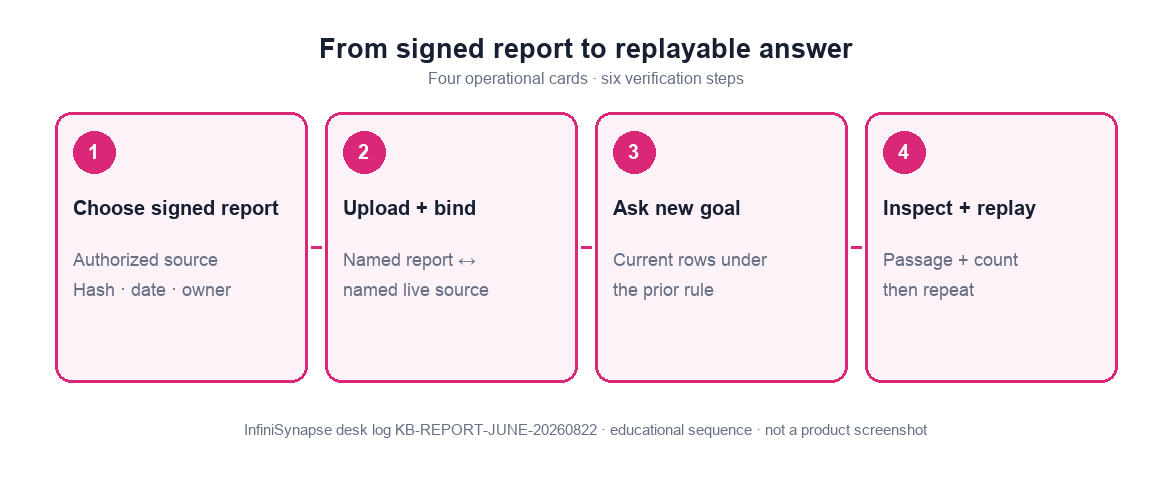
Figure. Educational four-step sequence the desk uses to tell a slide rewrite from a bound prior. Expected result after step 5: the retrieved footnote is the signed rule, and the count used current rows. Not a product screenshot or a customer SLA.
Write a one-page exception list
Signed packs bury exceptions in footnotes. Retrieval needs them in a short list. When you use analysis reports as context, pair the PDF with a Markdown page: date, owner, exclusions, aliases. The agent can find “exclude test accounts” faster on that page than on slide 37.
If two signed packs disagree, keep both and label the date. Do not average them in chat.
Bind the prior, then ask a new goal
The acceptance test is boring: same source, new month, same retrieved exclusion. If week two cites a draft, you uploaded the wrong file. If week two reprints last month’s number, you asked the wrong goal. Analysis reports as context should constrain language, not freeze the count.
Desk sample: last month's pack versus a fresh guess (InfiniSynapse desk log)
This is a first-party InfiniSynapse desk log of analysis reports as context, not a named-logo customer case and not an uplift claim. Run ID: KB-REPORT-JUNE-20260822. Date: 2026-08-22. Operator: InfiniSynapse Data Team. Source: a sanitized 15,200-row orders extract the desk is authorized to read. Goal asked twice: “What is July contribution?”
June’s signed finance pack excluded marketplace fees from contribution.
| Retrieval state | Invoice−COGS margin | Fee-excluded contribution | July rerun uses June pack |
|---|---|---|---|
| No signed prior | 24.0 | 24.0 | 0 |
| June pack as context | 18.5 | 18.5 | 1 |
Without analysis reports as context, the first July answer used invoice minus COGS (24.0) and looked decisive. After the June pack was bound, the second run retrieved the fee footnote and reported 18.5.
| Retrieval state | SQL | Memo | Chart | CSV | June footnote cited |
|---|---|---|---|---|---|
| No signed prior | 1 | 0 | 1 | 0 | No |
| June pack as context | 1 | 1 | 2 | 1 | Yes |
Wall-clock for the bound rerun was 11 minutes (warehouse time excluded). The method, 24.0 → 18.5 flip, and artifact inventory are in the downloadable desk log KB-REPORT-JUNE-20260822. Cite that file or this table as InfiniSynapse desk log KB-REPORT-JUNE-20260822. Do not cite it as customer ROI, a bake-off win, an official EEAT score, or an external standards-body experiment. We do not publish named-logo customer cases on this page. The only honest claim is that the bound pack made the fee exclusion visible.
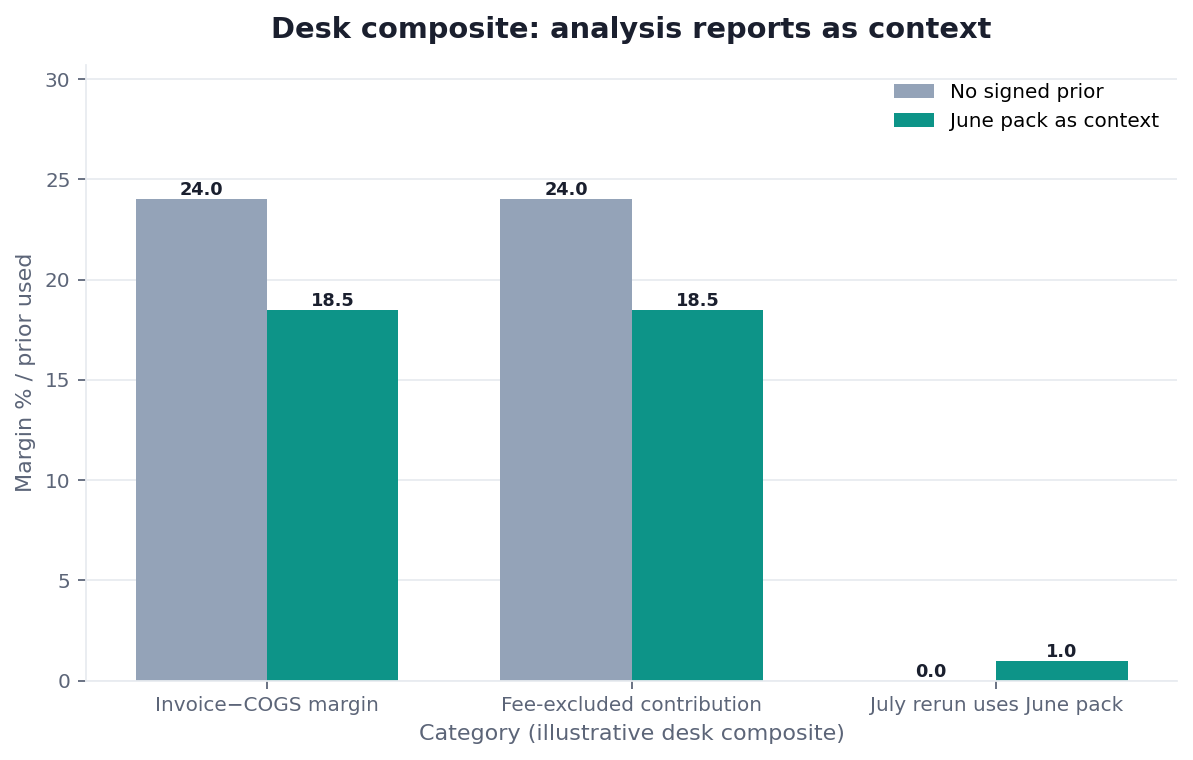
Figure. InfiniSynapse desk log KB-REPORT-JUNE-20260822: 15,200-row orders extract; June signed pack excludes marketplace fees. Published context: the independent sources linked in the body. Not a customer experiment, SLA, or official benchmark.
Evidence boundaries and external validation status
Desk log KB-REPORT-JUNE-20260822 and its downloadable file are first-party, reproducible sanitized-composite examples. They are not customer cases, independent benchmarks, third-party datasets, certifications, media evaluations, or endorsements. The download improves transparency by preserving the method, input boundary, 24.0 → 18.5 result, and artifact inventory; publication does not turn it into independent evidence.
No independent party had reproduced this desk log as of 2026-08-28. A third-party replication should disclose source grain, row count, and version; signed-report hash, version, date, and owner; exclusion rule; bind mapping; retrieval configuration; query, SQL, and retrieved passage; the no-prior baseline; all outputs and failures; run time; and commercial conflicts of interest. Both confirming and conflicting outcomes should remain visible.
| Evidence class | What you can cite | What you cannot claim |
|---|---|---|
| Desk log on this page | Grain, 24.0 → 18.5, June-pack flag 0 → 1, artifact counts, ~11 min wall-clock, run ID | Customer uplift %, official EEAT score, named-logo case |
| Downloadable desk log | Same input boundary, result, six-step method, and artifact inventory | That the file is a customer extract or a third-party audit |
| Third-party standards and guidance | Published records, provenance, privacy, AI-risk, and secure-development practices | That any publisher ran or endorsed this desk log |
| Author profile and repositories | Public identity, cofounder role, and open-source engineering record | Independent verification of product performance |
| Homepage recognition | 2026 WAIC Future Tech OPC Excellence Award as published on the homepage | That WAIC, NIST, or Gartner scored this article |
How to cite this page
Page: Zhu, W., & InfiniSynapse Data Team. (2026). Analysis reports as context: bind, then replay. InfiniSynapse
Run: InfiniSynapse Data Team. (2026). Desk log KB-REPORT-JUNE-20260822 (sanitized composite)
The first form cites the guide. The second cites the first-party figures. Neither is a third-party audit. Cite the 24.0 → 18.5 flip. As of 2026-08-28, no independent reproduction exists. Send contradictions to zhuhl@infinisynapse.com.
Selection scorecard
Score the candidate the way you would score a junior analyst’s binder of last quarter.
| Criterion | Weak | Strong |
|---|---|---|
| Prior | Drafts and scans | Signed, dated analysis reports as context |
| Job | “Redo the deck” | New goal, old rule |
| Bind | File floats in chat | Report bound to the source it describes |
| Evidence | Final paragraph only | Retrieved rule plus new count |
| Secrets | Customer extracts in the PDF | Sanitized language only |
| Replay | New upload every Monday | Same prior, new period |
If a tool cannot treat analysis reports as context bound to a live source, it is a slide rewriter.
Failure modes that turn a prior into a rewrite
Three analysis reports as context failures show up every time people treat last month’s pack as either garbage or scripture.
Uploading the scan with no text layer
The file looks like the board pack. Retrieval is empty. The model writes a new memo.
Asking the agent to reprint last month
The prior becomes a script. The count freezes. Stakeholders think July matched June because the bullets match. Ask a new goal. Keep the rule.
Treating every deck as a prior
A year of slides will retrieve the loudest title. Use analysis reports as context only for signed packs. Archive the rest.
When the next missing object is not this page, open Schema Documentation an AI Analyst Can Retrieve when Write schema documentation the agent can retrieve, Knowledge Base vs Semantic Layer when Documents retrieve; contracts compile, or What to Put in a Data Knowledge Base when A first pack is a dictionary plus one signed report.
Cluster guides under this hub: Data Knowledge Base; Bind a Knowledge Base to a Database; What Is a Knowledge Base; Knowledge Base Software; Knowledge Base Examples; Internal Knowledge Base Software; Knowledge Base Content. Related technical hops remain Self-Service Analytics, Data Visualization, and Natural Language to SQL.
Upload one signed report as the first prior
Upload one sanitized, signed report, bind it to one authorized source, and ask a new goal under last period's rule. This check uses only sources you authorize.
Commercial association: You do not need the workspace to complete the educational diagnosis on this page.
Open InfiniSynapseSourcing and accountability. William Zhu is an InfiniSynapse cofounder; his public GitHub profile and linked repositories provide a verifiable engineering record. First-party recognition: 2026 WAIC Future Tech OPC Excellence Award (homepage; not a review of this page). The downloadable desk log
KB-REPORT-JUNE-20260822preserves this first-party run. Editorial standards govern corrections and conflicts. COI: InfiniSynapse sells an AI-native Data Agent. External sources do not validate the run.
Frequently Asked Questions
Are analysis reports as context the same as a second analysis?
Bottom line: No. A second analysis answers a new question. Analysis reports as context supply the accepted rule while the live source supplies the new count. Reprinting last month is the wrong ask.
Can I upload every deck from last year?
Bottom line: You should not. Retrieval gets noisy. Use analysis reports as context for signed, dated packs. Archive drafts and scans with no text layer.
What file should I upload first?
Bottom line: One signed monthly pack plus a one-page exception list. That pair is a complete first prior. Add the next signed pack only when the decision domain changes.
Does using analysis reports as context write back to the old PDF?
Bottom line: No. Binding a report does not update the file and does not write numbers into production. It restricts what the agent may retrieve while it reads sources you authorize.
How do I know the prior was used?
Bottom line: Open the task artifacts and look for the retrieved footnote next to a new count. If you only see a fluent rewrite of last month, you do not have evidence that analysis reports as context participated. Label the footnote in the memo so a later reviewer can replay the same check.
What is a prior in this article?
Bottom line: A prior is a signed, dated pack—board memo, monthly close, or exception list—that already lost an argument. It is the object analysis reports as context must store. A draft, a scan with no text layer, or a year of every deck is not a prior.
What is a script versus a new goal?
Bottom line: A script reprints last month’s bullets and freezes the count. A new goal counts this period’s rows under last period’s rule. Analysis reports as context constrain the language; they do not freeze the number.
Conclusion
A signed report is not a second analysis. It is the prior that tables refuse to store. Treat analysis reports as context, bind the dated pack to a live source, and refuse answers that cannot show the footnote they used. When you want to run that analysis reports as context check on an authorized source, open InfiniSynapse and upload one signed report before the next review meeting.