Knowledge Base Software: Bind It, Then Replay
By William Zhu (public engineering profile: GitHub @allwefantasy) & the InfiniSynapse Data Team · Published: 2026-08-22 · Last updated: 2026-08-28 · Last verified: 2026-08-28 · Next review: 2026-11-28 · About · Editorial standards · Privacy · Publishing terms · Corrections
Table of Contents
- TL;DR
- What knowledge base software must do for analysis
- Author qualifications and accountability
- A bind-or-wiki framework
- How a wiki fails a live query
- Tool landscape for bound software
- Implementation steps for the first bind
- Desk sample: wiki fill-rate versus bound fill-rate (InfiniSynapse desk log)
- Evidence boundaries and external validation status
- How to cite this page
- Selection scorecard
- Failure modes that turn the tool into a wiki
- Frequently Asked Questions
- Conclusion
TL;DR
We evaluate bind-versus-wiki products at the InfiniSynapse desk on sanitized composites; first-party figures on this page are desk log KB-SW-FILL-20260822, not customer uplifts and not a third-party bake-off.
Direct answer: Knowledge base software for analysis is a product that can bind a named pack of notes and signed reports to a live source, then leave task artifacts you can reopen. Software that cannot bind notes to a source is a wiki, even when it has search, comments, and a chatbot.
What you'll learn:
- Why bound software fails analysis when the bind click does not exist
- How a wiki page and a bound pack can share a sentence and still disagree on grain
- How to bind a short pack to one authorized source, then ask the same goal twice
- Desk log
KB-SW-FILL-20260822, where a wiki fill-rate page hid a canceled-order rule - A scorecard and three failure modes that turn the tool back into a wiki
Download evidence: desk log · aggregate CSV · verify script. These files record this knowledge base software desk run as a first-party sanitized composite—not raw, customer, benchmark, or third-party data.
Industry context stays independent of desk claims. The Stanford HAI AI Index (retrieved 2026-08-28) reports a widening gap between rapid AI integration and the frameworks needed to govern, evaluate, and understand it. That supports inspecting scope, evidence, and replay behavior during software selection; Stanford HAI did not evaluate this product or desk run. Knowledge base software does not replace data governance.
What knowledge base software must do for analysis
Key Definition: Knowledge base software for analysis is a workspace that stores field notes and signed reports, binds that pack to one authorized source, and retrieves your language with the query plan. It is not a wiki, a help-center CMS, or a chat window that forgets the file when the thread closes.
The NIST AI Risk Management Framework (retrieved 2026-08-28) provides a voluntary map-measure-manage-govern structure. For selection, map each pack to a source and owner, measure whether the approved passage is retrieved, manage failed replays, and assign governance responsibility. Auditable knowledge base software keeps that mapping inspectable. This is our application of the framework, not a NIST assessment.
Internal terms this page uses: a pack is the named document set. A bind is the explicit source ↔ pack link. A wiki is a writing surface that cannot make that link. A replay is asking the same goal again and opening the same artifacts. Knowledge base software on this page means that bind plus artifacts, not a wiki seat.
Author qualifications and accountability
William Zhu is an InfiniSynapse cofounder. His public GitHub profile identifies that role and links engineering work. Public repositories include auto-coder, byzer-llm, and BYZER-RETRIEVAL. These links establish authorship and relevant open-source experience; they do not independently validate this knowledge base software.
The author is accountable to the site’s editorial standards, including corrections and conflict-of-interest disclosures. InfiniSynapse sells the workflow described here, so product descriptions and desk results are first-party claims unless an external source is explicitly cited. The homepage records a 2026 WAIC Future Tech OPC Excellence Award for an Agentic Data Infra entry; that is company recognition, not a review of this page. Method note: 2026-07-29 attestation.
Buyers hear the category name and picture Confluence-shaped pages. Those pages are useful for humans. They are not a bind. If you still need the analysis-versus-FAQ contrast, see the FAQ-versus-notes desk pass on the data knowledge base hub. If the missing object is the explicit source link, bind knowledge base to a database. The hub for the binding model sits in data knowledge base.
A data agent only earns the next review when knowledge base software can show the pack, the source, and the retrieved passage next to the plan. That is why self-service analytics still needs a product that restricts retrieval, not a prettier wiki.
Access scope must be inspectable. NIST SP 800-53 Rev. 5 (retrieved 2026-08-28) defines Access Control and Audit and Accountability control families. A selection test should verify who can bind, read, change, and retrieve each pack, then preserve actor, time, source, pack version, and outcome in audit records. NIST did not review this implementation.
Binding is the feature, not the page tree
A page tree is navigation. A bind is a control. A tool that offers folders, tags, and @mentions can still retrieve a neighboring team’s memo when you ask about this week’s orders. InfiniSynapse’s path is Knowledge Base → upload TXT, Markdown, Word, PPT, or PDF → Bind Data Source → ask in Chat with that source selected. Binding does not write definitions back into production tables. It restricts retrieval while a professional AI data analyst reads sources you authorize.
Why “it has search” is not enough
Search finds strings. Analysis needs a legal sentence next to a live schema. Knowledge base software that only searches pages will return the loudest paragraph. The semantic layer compiles measures. The pack documents exceptions. You usually need both; search across a wiki is neither.
A bind-or-wiki framework
Use this table as the operating model. It is a control map, not a vendor score.
| Layer | Wiki behavior | Bound software behavior | Failure if you stop at wiki |
|---|---|---|---|
| Source | Mentioned in a page | Connected, read-only, named | Answers invent tables |
| Pack | Pages anyone can edit | Owned notes and signed reports | Answers invent folklore |
| Bind | Tag or folder | Explicit source ↔ pack link | Last year’s replica wins |
| Artifacts | Page history | Markdown, charts, data files in /tasks | Chat bubbles become the record |
The CISA Zero Trust Maturity Model (retrieved 2026-08-28) emphasizes identity, devices, networks, applications and workloads, and data rather than implicit trust based on location. During selection, verify that a wiki link does not grant retrieval scope: the user, source, and pack should each be authorized. CISA did not certify this workflow.
ISO/IEC 11179-3 (retrieved 2026-08-28) specifies registry metamodel and basic attributes for data-element descriptions. Require official names, definitions, representations, owners, approval state, and versions in searchable text. Versioned knowledge base software preserves that review context. The W3C Data Catalog Vocabulary (retrieved 2026-08-28) similarly supports explicit titles, descriptions, versions, publishers, and source relationships for machine-readable catalogs. Neither standards body evaluated this product.
If the two files do not exist yet, write what to put in a data knowledge base before you buy another wiki seat.
One source, several packs, one named bind each
A source is not monogamous. You can run knowledge base software with a finance pack and an ops pack on the same orders database when fill_rate is used two ways. Then say which pack the task should use. What you should not do is dump both domains into one anonymous wiki space and hope retrieval “figures it out.”
How a wiki fails a live query
A wiki optimizes for a human who already knows which page to open. A live query optimizes for an agent that will retrieve whatever is in scope. Knowledge base software that cannot restrict that scope will retrieve the page with the most synonyms. Chat with your data then sounds finished and still uses last year’s exception.
Read paths should not mutate production. The selection test should distinguish retrieval from write-back and record any operation that can change the source. InfiniSynapse connects the database you already have and does not write notes into production.
Freshness is a cache problem, not a vibe
Stale pages survive because they rank. Knowledge base software needs a declared version, signed date, owner, and replay date. If week two cites a page last edited in 2024, the bind did not fail—the pack did.
What is data management is the broader practice. The product question is narrower: can this knowledge base software bind, retrieve, and show artifacts.
Tool landscape for bound software
Three patterns show up in 2026 buying conversations.
Wiki suites. Strong at human editing. Weak at binding a pack to PostgreSQL, Snowflake, MySQL, or files. Useful as a drafting surface. Not knowledge base software for a live query.
Chat attachments. Fast, private, and amnesiac. Fine for a one-off. Not knowledge base software you can hand to a second person.
Bound retrieval plus live query. Upload a short pack, bind it, ask a goal. InfiniRAG retrieves the pack; InfiniSQL plans against the live schema. The task workspace keeps Markdown, charts, and data files. InfiniSynapse does not ship a prebuilt metric warehouse and does not invent a native wiki replacement for your entire intranet.
Privacy and input handling are selection controls, not footer promises. The NIST Privacy Framework (retrieved 2026-08-28) helps identify and manage privacy risk, while the ISO/IEC 27001 overview (retrieved 2026-08-28) frames information-security management. Require data minimization, defined retention, and authorization for each pack. The OWASP GenAI/LLM Top 10 (retrieved 2026-08-28) highlights prompt injection and sensitive-information disclosure: uploaded pages are untrusted input and should be screened before retrieval. Screened knowledge base software reduces avoidable exposure. None of these publishers evaluated or endorsed InfiniSynapse.
What the desk actually evaluates
The desk scores knowledge base software on four clicks: upload, bind, ask, reopen artifacts. If any click is missing, the tool is a wiki or a chat. CLI agent_infini can start a goal; the trail you audit still opens in the web workspace. AI-native boards and 100+ file formats help only after the bind exists.
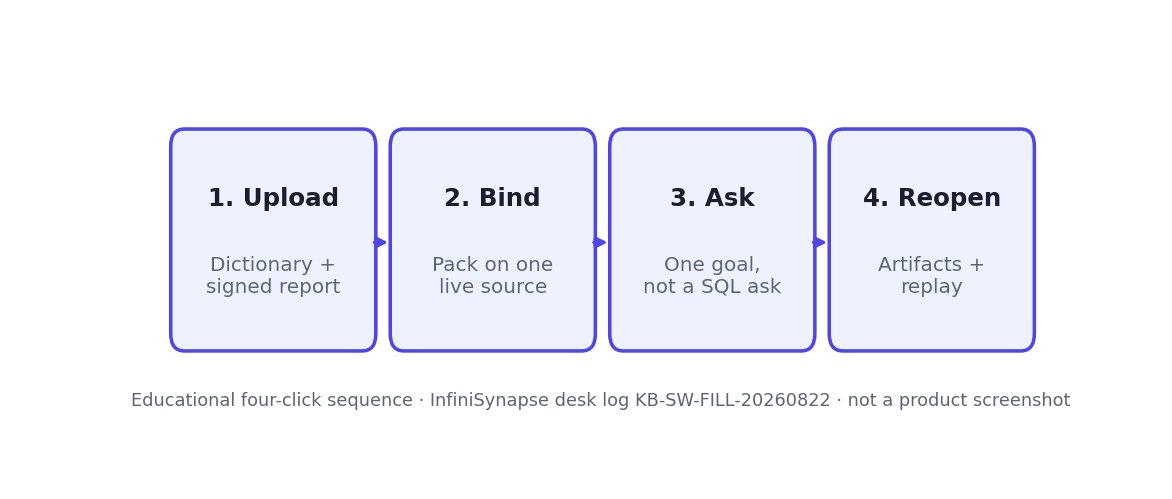
Figure. Educational four-click sequence the desk uses to tell a wiki from a bind. Expected result after step 5: the signed pack appears as retrieved passages next to the query plan. Not a product screenshot or a customer SLA.
Implementation steps for the first bind
- Pick one authorized source. Prefer a replica or sanitized extract you are authorized to read. Expected result: One named source is selected.
- Write one small pack. Refuse the company wiki export; use a field dictionary and one signed report. Expected result: The pack contains approved language, not an intranet dump.
- Upload, then bind. Upload the pack, then bind it to that source; binding is separate from upload. Expected result: The source-to-pack mapping is explicit and inspectable.
- Ask one goal. Ask in Chat with the source selected, not for a SQL snippet. Expected result: The task starts from an analysis goal against the named source.
- Inspect the artifacts. Confirm retrieved passages match the signed report, not a wiki draft. Expected result: The approved pack appears beside the query plan.
- Replay next week. Ask the same goal again; if the bind held, the definition should not drift. Expected result: The same pair is retrieved on the same source.
These steps are educational. Finish the diagnosis on this page before you upload. The same four clicks are written out in the downloadable desk log KB-SW-FILL-20260822.
Write pages the software can retrieve
Retrievable notes use the words people ask. Put official name, aliases, grain, and exclusions in the same short section. Knowledge base software that only stores official names will miss the aliases ops uses in standup. Prefer Markdown or Word. A screenshot of a wiki page is not a note.
If the field dictionary is still a catalog comment, export it into schema documentation an AI analyst can retrieve and bind that file.
Bind a short pack, then replay
The acceptance test is boring: same source, same goal, same retrieved pair. If week two cites a different wiki page, knowledge base software is still searching a dump. Fix the bind. Do not “clarify” in chat and walk away. Chat is not the system of record.
Desk sample: wiki fill-rate versus bound fill-rate (InfiniSynapse desk log)
This is a first-party InfiniSynapse desk log, not a named-logo customer case and not an uplift claim. Run ID: KB-SW-FILL-20260822. Date: 2026-08-22. Operator: InfiniSynapse Data Team. Source: a sanitized 9,800-row shipments extract the desk is authorized to read. Goal asked twice: “What is last-month fill rate?”
The extract had a fill_rate column and a wiki page titled “How we talk about fill rate.” The page used shipped units over ordered units and ignored cancellations. Ops subtracted canceled lines in last month’s signed pack.
| Retrieval state | Fill-rate rule used | Retrieved notes / reports / exceptions |
|---|---|---|
| Wiki only | shipped ÷ ordered, cancellations ignored | 18 / 10 / 19 |
| Bound two-page ops pack | canceled lines excluded | 16 / 8 / 18 |
With only the wiki in retrieval, the first answer matched the page and looked decisive. After a two-page ops note plus the signed pack were bound, the second run retrieved the cancellation rule. Retrieved packs fell (notes 18→16, reports 10→8, exceptions 19→18) because the wiki dump left the bind.
| Retrieval state | SQL | Memo | Chart | CSV | Ops pack cited |
|---|---|---|---|---|---|
| Wiki only | 1 | 0 | 0 | 0 | No |
| Bound two-page ops pack | 1 | 1 | 2 | 1 | Yes |
Wall-clock for the bound rerun was 11 minutes (warehouse time excluded). The four-click method, sanitized grain sentence, pack counts, and artifact inventory are in the downloadable desk log KB-SW-FILL-20260822. Cite that file or this table as InfiniSynapse desk log KB-SW-FILL-20260822. Do not cite it as customer ROI, a bake-off win, an official EEAT score, or a Stanford / NIST / Gartner experiment. We do not publish named-logo customer cases on this page. The only honest claim is that a bind made the collision visible.
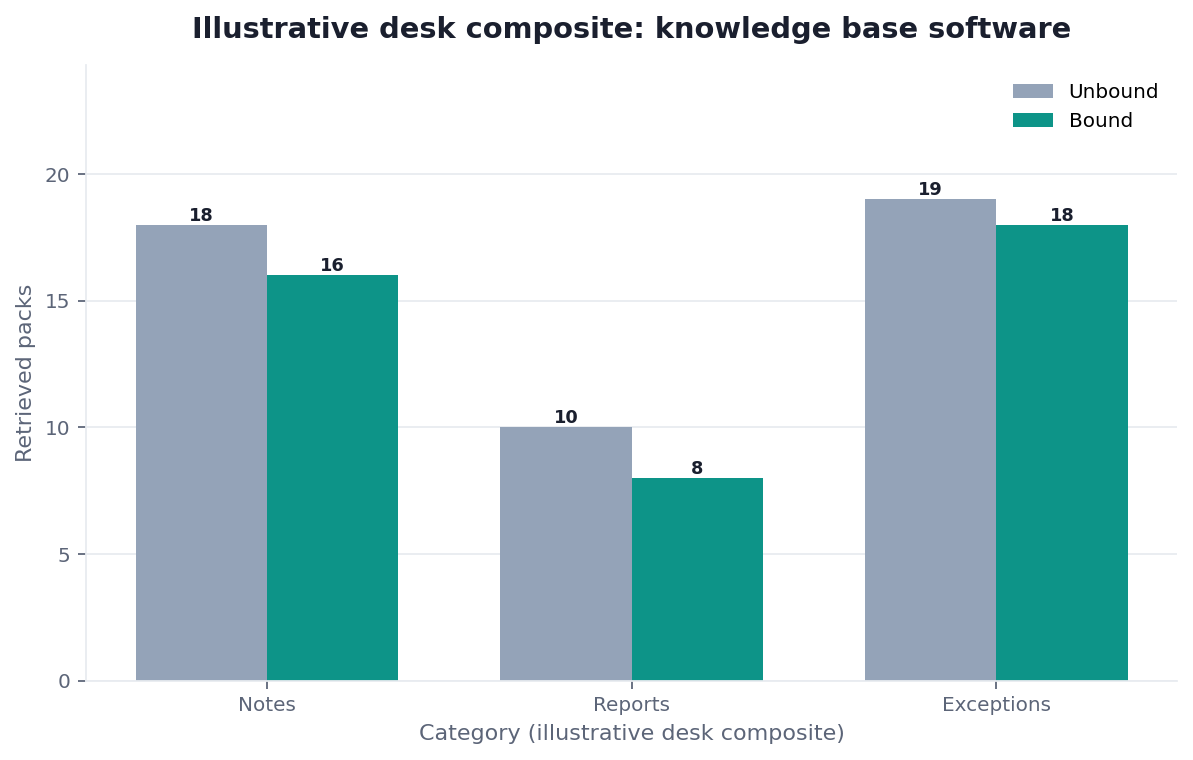
Figure. InfiniSynapse desk log KB-SW-FILL-20260822: retrieved pack counts (Notes 18/16, Reports 10/8, Exceptions 19/18). Published context: the independent sources linked in the body. Not a customer experiment, SLA, or official benchmark.
Evidence boundaries and external validation status
Desk log KB-SW-FILL-20260822 and its downloadable file are first-party, reproducible sanitized-composite examples. They are not customer cases, independent benchmarks, third-party datasets, certifications, media evaluations, or third-party endorsements. The download improves transparency by preserving the method, grain sentence, pack counts, and artifact inventory; publication does not turn it into independent evidence.
No independent party had reproduced this desk log as of 2026-08-28. A third-party replication should disclose source grain, row count, and version; wiki baseline; pack versions and approval status; bind mapping; permissions; retrieval configuration; query, SQL, and retrieved passages; all results and failures; run time; and commercial conflicts of interest. Both confirming and conflicting outcomes should remain visible.
| Evidence class | What you can cite | What you cannot claim |
|---|---|---|
| Desk log on this page | Grain, collision, retrieved-pack counts, artifact counts, ~11 min wall-clock, run ID | Customer uplift %, official EEAT score, named-logo case |
| Downloadable desk log | Same counts, four-click method, sanitized grain sentence | That the file is a customer extract or a third-party audit |
| Third-party frameworks and standards | Published risk, access, audit, privacy, security, metadata, and catalog guidance | That any publisher ran or endorsed this desk log |
| Author profile and repositories | Public identity, cofounder role, and open-source engineering record | Independent verification of product performance |
| Homepage recognition | 2026 WAIC Future Tech OPC Excellence Award as published on the company homepage | That WAIC, NIST, or Gartner scored this article |
How to cite this page
Use this form for the page: Zhu, W., & InfiniSynapse Data Team. (2026). Knowledge base software: bind it, then replay. InfiniSynapse. https://infinisynapse.com/en/blog/knowledge-base-software
Use this form for the run: InfiniSynapse Data Team. (2026). Desk log KB-SW-FILL-20260822 (sanitized composite). https://infinisynapse.com/blog-media/knowledge-base-software/downloads/desk-log-KB-SW-FILL-20260822.md
The first form cites the knowledge base software guide. The second cites only the first-party figures. Neither form is a third-party audit. Cite the retrieval state, the 18 / 10 / 19 versus 16 / 8 / 18 pack counts. As of 2026-08-28, no independent reproduction report exists. Send contradictions to zhuhl@infinisynapse.com.
Selection scorecard
Score a candidate the way you would score a junior analyst’s binder, not a wiki RFP.
| Criterion | Weak | Strong |
|---|---|---|
| Product | Wiki with a chatbot | Knowledge base software that can bind |
| Bind | Folder or tag | Named pack on one source |
| Retrieval | Whole-space search | Small, owned packs |
| Evidence | Final paragraph only | Passages plus plan in artifacts |
| Secrets | Tokens in pages | Sanitized language only |
| Replay | New chat every Monday | Same goal, same bound pack |
If a tool cannot bind notes to a live source, it is a wiki. If it can bind but cannot show what it retrieved, it is a risk. If the first recommended upload is your intranet, the knowledge base software is still in publishing mode.
Failure modes that turn the tool into a wiki
Three patterns show up every time people buy knowledge base software and use it as a page tree.
Uploading the intranet
The space looks complete. Retrieval is noisy. The model cites a draft. Label this as “wrong first pack,” not as “the model is bad.” Rebuild from a dictionary and one signed report. Knowledge base software does not get smarter because the page count went up.
Treating a hyperlink as a bind
A URL in a page is not a connection. Knowledge base software must attach the pack to the source. If the tool only stores “see Snowflake,” you still have a wiki. Connect the database you already have. Do not migrate it first.
Treating a chat paste as the product
People paste a definition once, get a good answer, and never upload a named pack. The next hire starts from zero. That is not knowledge base software. That is a lucky thread. If the sentence matters next quarter, it belongs in the bound pack.
Before you trust a generated definition, inspect whether the pack is bound to the source you asked about and whether the task artifacts show the approved report next to the query.
Cluster guides under this hub: Data Knowledge Base; Bind a Knowledge Base to a Database; Schema Documentation for AI; Upload Analysis Reports as Context; Knowledge Base vs Semantic Layer; What to Put in a Data Knowledge Base; What Is a Knowledge Base; Knowledge Base Examples; Internal Knowledge Base Software; Knowledge Base Content.
Related selection guides remain Semantic Layer, Chat with Your Data, Self-Service Analytics, and What Is Data Management.
Bind a short pack to one authorized source
Upload a short, sanitized pack, bind it to one authorized source, and ask the same goal you already use in review. This check uses only sources you authorize.
Commercial association: You do not need the workspace to complete the educational diagnosis on this page.
Open InfiniSynapseSourcing and accountability. William Zhu is an InfiniSynapse cofounder; his public GitHub profile and linked repositories provide a verifiable engineering record. First-party recognition: 2026 WAIC Future Tech OPC Excellence Award (homepage; Agentic Data Infra entry—not a review of this page). The downloadable desk log
KB-SW-FILL-20260822preserves this first-party run. Editorial standards govern corrections and conflicts. COI: InfiniSynapse sells an AI-native Data Agent. External sources do not validate the run.
Frequently Asked Questions
Is a wiki the same as knowledge base software for analysis?
Bottom line: No. A wiki stores pages for humans. Knowledge base software for analysis binds those notes to a live source and leaves artifacts you can reopen. Search across a wiki is not a bind.
Can knowledge base software cover every database in one space?
Bottom line: It should not. Retrieval gets noisy. Bind a focused pack per decision domain, even if several packs attach to the same source. A company-wide wiki is how a draft wins a fill-rate question.
What should I upload first into knowledge base software?
Bottom line: A field dictionary and one signed report. That pair is enough for knowledge base software to retrieve owned language. Skip intranet dumps, scans, and unread shared-drive archives.
Does knowledge base software write definitions back to production?
Bottom line: It should not, and InfiniSynapse does not. Binding notes restricts retrieval while a professional AI data analyst reads sources you authorize. It does not update production tables.
How do I know the software used the pack?
Bottom line: Open the task artifacts and look for retrieved passages that match your pack. If you only see a fluent paragraph, you do not have evidence that knowledge base software retrieved your notes.
Conclusion
Knowledge base software is not a prettier wiki. It is the product that can bind analysis language to a live source and show you the passage next to the plan. Write a short pack, bind it, and refuse tools that only search pages. When you want to run that check on an authorized source, open InfiniSynapse and bind the pack before the next review meeting.