AI Knowledge Base for Data Analysis (2026)
By William Zhu & the InfiniSynapse Data Team · Published: 2026-08-22 · Last updated: 2026-08-23 · Last verified: 2026-08-23 · Next review: 2026-11-23 · Editorial standards · Corrections
AI Knowledge Base for Data Analysis (2026)
Table of Contents
- TL;DR
- What an AI knowledge base is for analysis
- A retrieval framework for analysis packs
- How an analysis pack differs from support search
- Tool landscape for an analysis-bound pack
- Implementation steps for the first analysis pack
- Desk sample: FAQ answers versus analysis notes (illustrative)
- Selection scorecard
- Failure modes that keep the pack in support mode
- Frequently Asked Questions
- Conclusion
TL;DR
We evaluate these patterns at the InfiniSynapse desk on sanitized composites; sample figures on this page are illustrative, not customer uplifts.
Direct answer: An AI knowledge base for analysis is a bound pack of field notes, signed reports, and calculation language that travels with a live source. It is not a helpdesk FAQ, a ticket macro library, or a chatbot trained on “how do I reset my password.” Bind the analysis pack before you trust a generated definition.
What you'll learn:
- Why an AI knowledge base for analysis fails when you upload support articles
- Which documents belong in an analysis pack and which documents waste retrieval
- How to bind one pack to a source, then ask the same goal twice
- A desk-composite sample (illustrative) where FAQ language hid a margin collision
- A scorecard and three failure modes that keep the pack in support mode
Industry context stays independent of desk claims. Adoption of generated answers is climbing while evaluation discipline lags—the same gap you feel when a fluent paragraph uses the wrong “active customer.” An AI knowledge base does not replace data governance; it is the retrieval surface those policies need when an agent reads your warehouse.
What an AI knowledge base is for analysis
Key Definition: An AI knowledge base for analysis is a curated set of documents—field notes, approved reports, and calculation language—bound to a live source so a professional AI data analyst retrieves your definitions with the query plan. It is not a helpdesk FAQ, a second warehouse, or a chat file that vanishes with the thread.
The phrase sounds adjacent to support search because both retrieve text. The jobs are not the same. A support article tells a customer which button to press. The analysis pack tells an analyst which rows count and which exception last quarter’s signed pack already accepted.
The Stanford HAI AI Index tracks enterprise adoption climbing while evaluation of generated answers still lags, which is the same gap an unbound FAQ dump creates in analysis. IBM’s explainer on augmented analytics is useful here: automation helps, but the machine still needs a definition surface that belongs to the question you asked.
If the missing object is durable context rather than a one-off pack, continue in the data knowledge base hub. If the next failure is attaching that pack to the wrong schema, use bind knowledge base to a database.
Risk language for generated definitions should stay aligned with the NIST AI Risk Management Framework. Map the risk that fluent language looks authoritative. An AI knowledge base is a map. The bind is a control. The task artifact is the measure.
That is why AI for data analysis matured from “paste schema, get SQL” to “state a goal, retrieve the contract.” The pack is the contract you can upload. Leave the helpdesk corpus in the support product.
Field notes versus ticket macros
Ticket macros encode a path: if the customer says X, send paragraph Y. Field notes encode a decision: if the question is contribution margin, exclude marketplace fees. A pack that stores macros will retrieve polite sentences and still join the wrong table. Keep the AI knowledge base inside the decision domain you are about to ask; mixing support and finance owners is how the wrong memo wins.
Signed reports versus canned replies
A canned reply is reusable because the situation repeats. A signed report is reusable because the definition was accepted. The pack wants the second object. InfiniSynapse does not ship a native Zendesk connector; export the few analysis documents you already trust, then bind that pack to the source those documents describe.
A retrieval framework for analysis packs
Use this table as the operating model. It is a desk composite, not a vendor score.
| Layer | What you store | What the agent does | Failure if the layer is a FAQ |
|---|---|---|---|
| Source | Database or files you already have | Plans queries against live schema | Answers invent tables |
| AI knowledge base | Notes, reports, calculation language | Retrieves passages with the plan | Answers invent support copy |
| Bind | Explicit source ↔ pack link | Restricts retrieval to that pack | A refund article wins the citation |
| Task artifacts | Markdown, charts, data files | Leaves evidence you can reopen | Chat bubbles become the record |
The bind is the product of an AI knowledge base. Upload without bind is a pile. Bind without notes is a silent schema. A data agent earns trust only when both sides are present and inspectable.
Microsoft’s Azure data architecture guide is the right backdrop for this table: sources, meaning, and consumption are separate layers. An AI knowledge base sits in the meaning layer. A helpdesk sits in the consumption layer for customers. Do not collapse them because both happen to be Markdown.
What belongs in an analysis pack
Put durable analysis language in the pack: field dictionaries, status-code tables, approved KPI statements, signed monthly packs, and short notes on known dirty joins. Prefer searchable text. Write the AI knowledge base as retrieval, not as a novel: official name, aliases, grain, and exclusions in the same short section. Leave ticket transcripts, password-reset articles, and unread shared-drive archives out.
How an analysis pack differs from support search
Support search optimizes for the shortest path to a resolved ticket. Analysis retrieval optimizes for the approved definition next to a live query. Chat with your data is the second job. If you point it at a help center, it will resolve the question the way a bot resolves a ticket: confidently, politely, and on the wrong grain.
A catalog still matters. It tells you a table exists and who owns it. The pack tells you how that table is used in a decision. Those surfaces can share a company and still must not share a folder.
Why support retrieval invents the wrong grain
Help articles speak in user actions. Warehouses speak in events. An AI knowledge base must speak in measures. When retrieval returns “customers can filter by status,” the model still has to guess whether status = 3 means active. If the next missing object is the field dictionary itself, write schema documentation an AI analyst can retrieve before you add another FAQ.
Tool landscape for an analysis-bound pack
Three patterns show up in 2026 buying conversations.
Chat attachments. Fast, private, and amnesiac. Fine for a one-off file. Not an AI knowledge base.
Helpdesk search and FAQ bots. Strong when the question is “how do I…”. Weak when the question is “what counted as contribution last month.” They are not analysis products, even when they sit next to a warehouse login.
Bound retrieval plus live query. Upload an AI knowledge base, bind it to PostgreSQL, Snowflake, MySQL, files, or another authorized source, then ask a goal. InfiniSynapse’s path is Knowledge Base → upload TXT, Markdown, Word, PPT, or PDF → Bind Data Source → ask in Chat with that source selected. InfiniRAG retrieves the pack; InfiniSQL plans against the live schema. The task workspace keeps Markdown, charts, and data files so you are not stuck defending a chat bubble. The product is a professional AI data analyst, not a ChatBI window and not an NLP2SQL demo.
The OWASP Top 10 for LLM Applications is blunt about prompt injection and sensitive-data leaks. An AI knowledge base that includes secrets, ticket dumps, or customer-identifying extracts fails before it helps. Sanitize first. Bind second. Ask third.
Chat attachments are not durable context
A file in a thread is a convenience. An AI knowledge base is a named pack with an owner and a bind. If “how we calculate DACH” lives only in last Tuesday’s chat, you have a lucky session, not organizational memory. The educational path on this page still uses the web app: upload, bind, ask, then reopen the task artifacts.
Implementation steps for the first analysis pack
- Pick one source you are authorized to read. Prefer a replica or sanitized extract.
- Refuse the help-center export. Write or export a small AI knowledge base: ten field notes and one approved report beat a hundred support articles.
- Upload the pack, then bind it to that source. Binding is a separate click from upload.
- Ask one goal in Chat with the source selected—not a request for a SQL snippet, and not a support question.
- Open the task artifacts. Confirm the retrieved passages match the report you trust, not a refund macro.
- Ask the same goal again next week. If the bind held, the definition should not drift.
These steps are educational. You can execute the same sequence in the web app after you finish the diagnosis on this page.
Write notes an analyst would retrieve
Retrievable notes use the words people actually ask: “active subscriber,” “contribution margin,” “DACH.” Put the official name, aliases, grain, and exclusions in the same short section. If two teams fight over a word, keep both sentences and label the owner. Chat is not the system of record.
Bind the pack, then ask a goal twice
The acceptance test is boring: same source, same goal, same retrieved definition. If week two cites a different memo, the bind is wrong or the AI knowledge base contains two owners. Fix the notes. If week two cites a password-reset article, you uploaded the wrong corpus. The second ask is the control. Without it, a lucky first answer becomes folklore.
Desk sample: FAQ answers versus analysis notes (illustrative)
This sample is a desk composite, not a customer uplift claim.
A 12,800-row orders extract (illustrative) had a margin column and a help-center article titled “How we talk about margin with customers.” Sales used invoice minus COGS in that article. Finance subtracted marketplace fees in last month’s signed pack. With only the FAQ in retrieval, the first answer looked decisive and matched the customer-facing sentence. After an AI knowledge base of two pages of finance notes plus the signed pack was bound, the second run retrieved the fee exclusion and showed both numbers as a labeled pair.
Nothing in the database changed. The pack changed what was allowed to count as “margin.” Do not read the sample as a customer uplift.
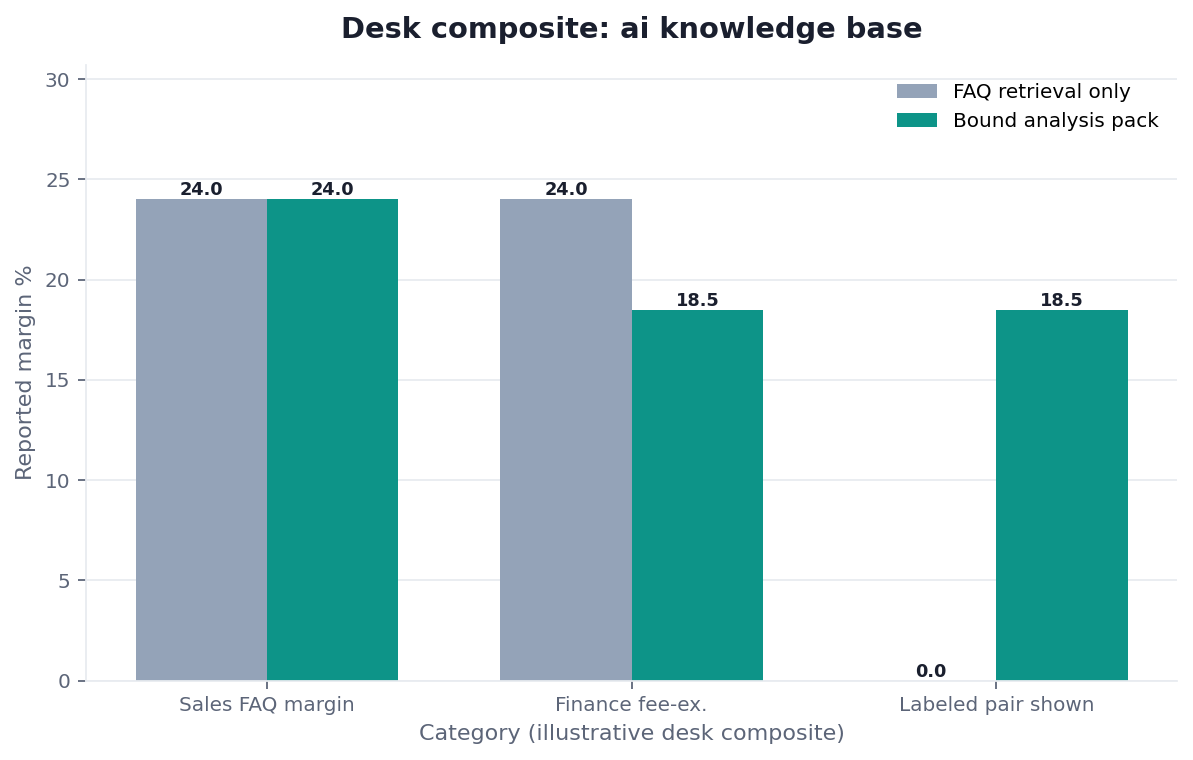
Figure. Desk composite from this page: 12,800-row orders extract; FAQ “margin” vs signed fee exclusion as a labeled pair. Published context: hai.stanford.edu; ibm.com; nist.gov. Not a customer experiment, SLA, or official benchmark.
| Evidence class | What you can cite | What you cannot claim |
|---|---|---|
| Desk composite on this page | Grain, collision, inspectable artifacts | Customer uplift %, vendor bake-off win |
| Published authority (linked above) | Frameworks and definitions from the cited sources | That those sources ran this desk sample |
Selection scorecard
Score a candidate the way you would score a junior analyst’s binder, not a support backlog.
| Criterion | Weak | Strong |
|---|---|---|
| Job | Helpdesk FAQ in the analysis slot | AI knowledge base of notes and signed reports |
| Bind | Files float in chat | Named pack bound to a source |
| Retrieval | Whole-drive or ticket dump | Small, owned analysis packs |
| Evidence | Final paragraph only | Passages plus query plan in artifacts |
| Secrets | Tokens or customer tickets in notes | Sanitized language only |
| Replay | New chat every Monday | Same goal, same bound pack |
If a tool cannot bind an AI knowledge base to a live source, it is a writing assistant. If it can bind but cannot show what it retrieved, it is a risk.
Failure modes that keep the pack in support mode
Uploading the help center dump
The folder looks complete. Retrieval is full of polite answers. The model improvises the grain. Label this as “wrong job,” not as “the model is bad.” Rebuild the AI knowledge base from field notes and one signed report you can search.
Mixing ticket macros with KPI language
A refund macro and a revenue definition can share the word “credit” and still be different objects. An AI knowledge base that stores both will retrieve the louder file. Split packs by decision domain. Bind each pack to the source it describes.
Treating a chat paste as the pack
People paste a definition once, get a good answer, and never upload an AI knowledge base. The next hire starts from zero. Chat history is not durable context.
When the next missing object is not this page, open Upload Analysis Reports as Context when Signed reports are priors, not a second analysis, Knowledge Base vs Semantic Layer when Documents retrieve; contracts compile, or What to Put in a Data Knowledge Base when A first pack is a dictionary plus one signed report.
Upload an analysis pack, not a support FAQ
Upload a short, sanitized analysis pack, bind it to one authorized source, and ask the same goal you already use in review. This check uses only sources you authorize.
Commercial association: You do not need the workspace to complete the educational diagnosis on this page.
Open InfiniSynapseHow this page is sourced. William Zhu is cofounder of InfiniSynapse (GitHub @allwefantasy); no personal LinkedIn is published. Reviewed by analytics engineering · data platform · LLM security · editor. Editorial standards · corrections · publishing principles · Company Vision. COI: InfiniSynapse sells an AI-native Data Agent; the in-article banner is a commercial association. Fact-check: Stanford HAI AI Index · McKinsey State of AI · Gartner Peer Insights — Analytics & BI · NIST AI Risk Management Framework · OWASP Top 10 for LLM Applications.
Frequently Asked Questions
Is an AI knowledge base the same as a helpdesk FAQ?
Bottom line: No. A helpdesk FAQ retrieves product instructions. An AI knowledge base retrieves analysis language—field notes, signed reports, and exceptions—bound to a live source. Using the FAQ as the pack keeps the agent in support mode.
Can one AI knowledge base cover every database?
Bottom line: It should not. Retrieval gets noisy. Bind a focused pack per decision domain, even if several packs attach to the same source. A company-wide dump is how a refund article wins a margin question.
What files should I upload first?
Bottom line: A field dictionary and one signed report. That pair is a complete first AI knowledge base. Add exception lists next. Skip scans, ticket exports, and unread shared-drive archives.
Does binding an AI knowledge base write back to production?
Bottom line: No. Binding notes does not write definitions into the database and does not update production tables. It restricts what the agent may retrieve while it reads sources you authorize.
How do I know the AI knowledge base was used?
Bottom line: Open the task artifacts and look for retrieved passages that match your pack. If you only see a fluent paragraph, you do not have evidence that the AI knowledge base participated.
Conclusion
An AI knowledge base is not a smarter helpdesk. It is the analysis language that tables refuse to store. Write the pack as notes and signed reports, bind it to a live source, and refuse answers that cite a FAQ when you asked for a definition. When you want to run that check on an authorized source, open InfiniSynapse and upload the analysis pack before the next review meeting.