
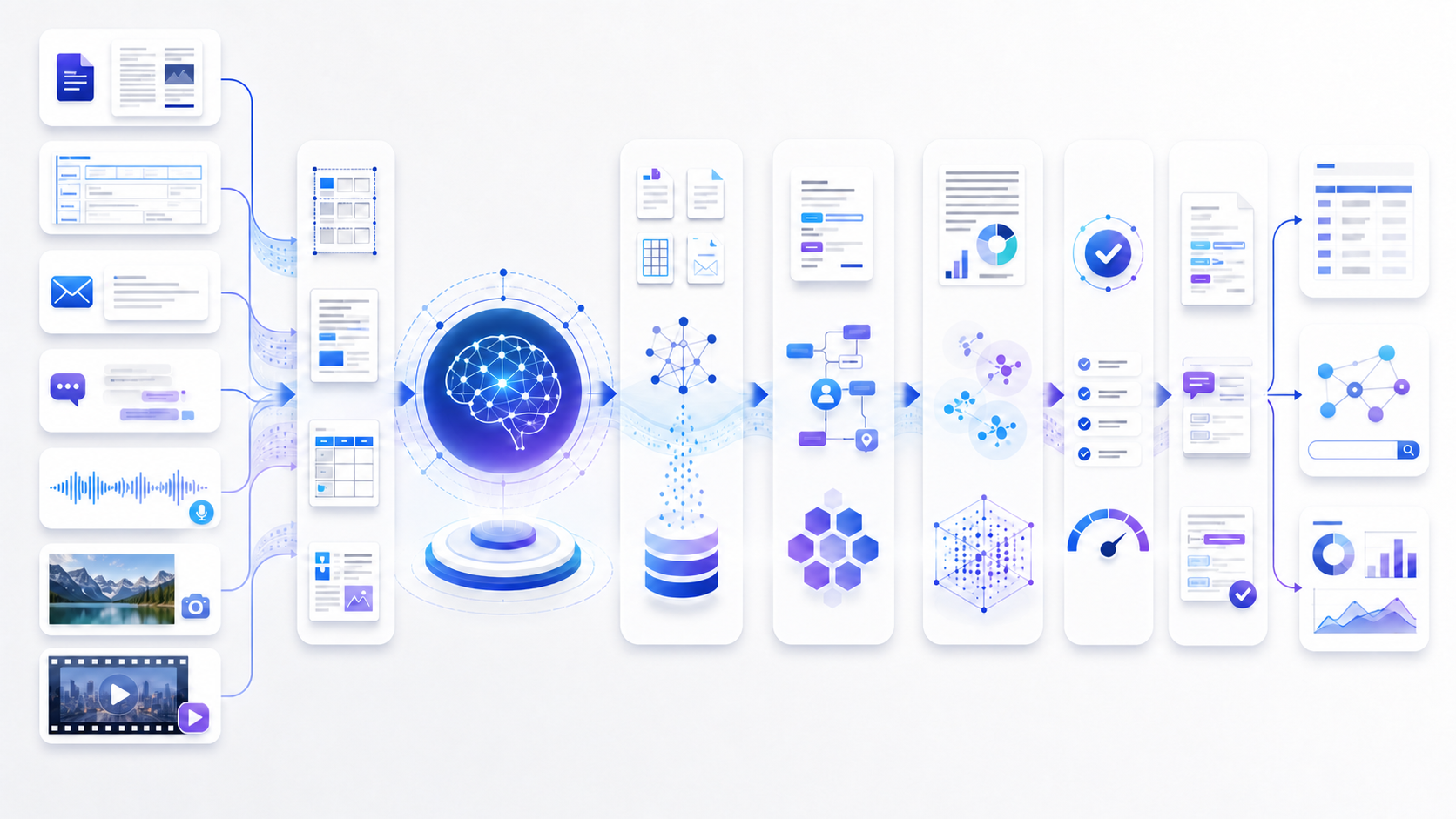
Unstructured Data Processing and Document Intelligence: The Short Answer快速回答:非结构化数据处理与文档智能是什么
Unstructured data processing converts information without a fixed tabular schema—documents, free text, images, audio, and video—into representations that people and systems can search, analyze, validate, and govern. Document intelligence is the document-focused part of that work. It combines capture, OCR when needed, layout analysis, classification, indexing, field and entity extraction, validation, and routing. Modern implementations may add language models, embeddings, vector retrieval, and human review, but these components do not remove the need for source provenance, quality measurement, access control, or workflow ownership.
非结构化数据处理,是把没有固定表格模式的信息——文档、自由文本、图像、音频和视频——转化为人员与系统能够搜索、分析、验证和治理的表示形式。文档智能是其中面向文档的部分,通常组合采集、必要时的OCR、版面分析、分类、索引、字段与实体提取、验证和路由。现代实现还可能加入大语言模型、嵌入、向量检索与人工复核,但这些组件不能替代来源追踪、质量衡量、访问控制和流程责任。
A production pipeline normally moves through six logical outcomes: preserve the original object and its identity; recover text, layout, timing, or visual structure; classify the item and split compound files; extract facts and enrich metadata; index lexical and semantic representations; then deliver a governed result to search, analytics, automation, or an AI application. Each stage should retain links back to the source and emit confidence, version, and processing metadata so an operator can explain where an answer came from.
生产管道通常形成六类结果:保留原始对象及其身份;恢复文本、版面、时间轴或视觉结构;对内容分类并拆分复合文件;提取事实并丰富元数据;建立关键词与语义索引;最后把受治理的结果交给搜索、分析、自动化或AI应用。每个阶段都应保留回到原始来源的链接,并输出置信度、版本和处理元数据,使运维人员能够解释答案从何而来。
The best design is not the one with the most models. It is the smallest observable workflow that meets a defined business decision, document population, accuracy threshold, review policy, latency objective, and compliance boundary. Begin with a representative sample, score fields and classes separately, send uncertain or high-risk cases to people, and measure downstream corrections. Scale only after the team can reproduce outputs and control cost, access, retention, and change.
最佳设计并不是模型最多的设计,而是能够满足明确业务决策、文档范围、准确率阈值、复核政策、时延目标与合规边界的最小可观测流程。应从具有代表性的样本开始,分别评分类别与字段,把低置信度或高风险案例交给人员处理,并衡量下游纠错。只有当团队能够复现结果并控制成本、访问、保留和变化时,才扩大规模。
1. What Is Unstructured Data?1. 什么是非结构化数据?
Unstructured data is information that does not conform to a predefined relational schema at the point of use. A contract has clauses, a scan has regions, a photograph has objects, a recording has speakers and time, and an email has prose; none naturally arrives as a dependable row with agreed columns. The word unstructured does not mean the content has no structure. It means the useful structure is implicit, variable, nested, visual, linguistic, temporal, or dependent on context and therefore must be discovered or represented before conventional querying works well.
非结构化数据是指在使用时不符合预定义关系模式的信息。合同包含条款,扫描件包含区域,照片包含对象,录音包含说话人和时间,电子邮件包含自然语言;这些内容都不会天然成为列定义一致、可依赖的一行数据。“非结构化”并不表示内容毫无结构,而是有效结构通常隐含、可变、嵌套、视觉化、语言化、时间化或依赖上下文,必须先被发现或表示,传统查询才能有效工作。
Structured data has explicit fields, types, constraints, and relationships, such as an order table with customer_id, amount, currency, and created_at. Semi-structured data has machine-readable organization but flexible records, such as JSON, XML, event logs, or an email envelope with headers around a free-text body. Unstructured content usually lives as a binary object or text stream, accompanied by metadata that may be sparse or inconsistent. Boundaries are practical rather than absolute: a PDF can contain structured form fields, semi-structured bookmarks, unstructured prose, scanned images, and tables on the same page.
结构化数据具有明确字段、类型、约束与关系,例如包含customer_id、amount、currency和created_at的订单表。半结构化数据具有机器可读的组织方式,但记录灵活,例如JSON、XML、事件日志,或在自由文本正文之外带有邮件头的电子邮件。非结构化内容通常以二进制对象或文本流存在,只附带稀疏或不一致的元数据。边界并非绝对:一个PDF可以同时包含结构化表单字段、半结构化书签、非结构化段落、扫描图像和表格。
Common textual types include reports, policies, contracts, tickets, messages, reviews, transcripts, web pages, slide notes, and source-code comments. Visual types include scans, photographs, diagrams, charts, engineering drawings, and video frames. Audio and video add sequence, timing, speakers, scenes, and nonverbal cues. Compound formats—PDF portfolios, email threads with attachments, office files with embedded media—require container parsing before content analysis. A useful inventory records file type, origin, owner, language, sensitivity, retention class, version, size, quality, and expected analytical use.
常见文本类型包括报告、政策、合同、工单、消息、评论、转录、网页、幻灯片备注与代码注释。视觉类型包括扫描件、照片、图示、图表、工程图和视频帧。音频与视频还包含顺序、时间、说话人、场景和非语言线索。PDF组合包、带附件的邮件线程、嵌入媒体的办公文件等复合格式,需要先解析容器再分析内容。有效盘点应记录文件类型、来源、所有者、语言、敏感度、保留类别、版本、大小、质量和预期分析用途。
Choose the representation from the question, not the file extension. Invoice payment automation needs supplier, amount, tax, date, line items, and validation evidence. Contract discovery needs clauses, parties, obligations, dates, governing law, and page citations. Semantic search needs meaning-preserving chunks and metadata. Video safety review may need sampled frames, speech transcripts, detected events, and timestamps. Treating every object as plain text discards layout and modality; preserving every byte without extracted structure leaves the information operationally dark.
表示方式应由问题决定,而不是由扩展名决定。发票付款自动化需要供应商、金额、税额、日期、明细行和验证证据;合同发现需要条款、主体、义务、日期、适用法律和页码引用;语义搜索需要保留含义的分块与元数据;视频安全审查可能需要抽样帧、语音转录、事件和时间戳。把所有对象都当作纯文本会丢失版面和模态信息,只保存每个字节而不提取结构,则会让信息继续处于不可用状态。
| Data class | Typical organization | Examples | Useful processing |
|---|---|---|---|
| Structured | Fixed schema and typed fields | Transactions, inventory, measurements | Validation, SQL, aggregation |
| Semi-structured | Flexible records with tags or keys | JSON, XML, logs, email headers | Parsing, schema inference, normalization |
| Unstructured | Meaning implicit in content and context | Documents, text, images, speech, video | OCR, layout, NLP, vision, speech, embeddings |
| 数据类别 | 典型组织方式 | 示例 | 常用处理 |
|---|---|---|---|
| 结构化 | 固定模式与类型字段 | 交易、库存、测量值 | 校验、SQL、聚合 |
| 半结构化 | 带标签或键的灵活记录 | JSON、XML、日志、邮件头 | 解析、模式推断、规范化 |
| 非结构化 | 含义隐含在内容与上下文中 | 文档、文本、图像、语音、视频 | OCR、版面、NLP、视觉、语音、嵌入 |
2. Why Is Unstructured Data Important?2. 为什么非结构化数据很重要?
Organizations frequently describe most enterprise information as unstructured, with public estimates commonly ranging from roughly eighty to ninety percent. Those percentages should be treated as directional, not as a measurement of a particular estate: definitions differ, duplicated files inflate counts, and storage bytes do not equal business value. The reliable conclusion is simpler. Important evidence about customers, products, operations, obligations, and risk often sits outside relational tables, and teams cannot manage or analyze it well until they know what exists and how it should be interpreted.
公开资料常把企业大多数信息描述为非结构化数据,常见估计约为80%至90%。这些数字只能作为方向性判断,而不能当作某个企业数据资产的实测值,因为定义不同、重复文件会抬高数量,存储字节也不等于业务价值。更可靠的结论是:有关客户、产品、运营、义务和风险的重要证据往往不在关系表中;只有知道内容是什么、应如何解释,团队才能有效管理和分析。
For operations, processing can replace rekeying and manual routing with evidence-backed extraction and exception handling. Finance teams can capture invoice fields while retaining the source page; claims teams can classify submissions and identify missing material; legal teams can find clauses and compare obligations; support teams can summarize themes across tickets and calls. The value is not merely faster transcription. It comes from connecting content to a decision, preserving context, and making the result available to authorized workflows with measurable quality.
对运营团队而言,处理流程可用有证据支持的提取与异常处置替代重复录入和人工路由。财务团队可提取发票字段并保留来源页;理赔团队可分类材料并识别缺失内容;法务团队可查找条款、比较义务;客服团队可汇总工单和通话中的主题。价值并不只是更快转录,而在于把内容连接到决策、保留上下文,并以可衡量的质量把结果交给获得授权的流程。
For analytics and AI, the same material provides language, visual, and behavioral evidence that structured measures omit. Reviews expose product friction, calls reveal intent and objections, incident narratives explain numeric anomalies, images show physical condition, and policies define the rules behind a decision. Retrieval-augmented generation also depends on prepared content: parsing, chunking, metadata, access filters, and citations determine whether retrieval returns relevant and permitted evidence. A language model cannot repair a missing page, a broken table, an incorrect speaker boundary, or a document that should never have been indexed.
对分析和AI而言,这些材料提供结构化指标遗漏的语言、视觉与行为证据。评论揭示产品摩擦,通话反映意图和异议,事故叙述解释数值异常,图像展示物理状况,政策则定义决策背后的规则。检索增强生成同样依赖准备良好的内容:解析、分块、元数据、访问过滤与引用决定检索能否返回相关且获准使用的证据。语言模型无法修复缺页、破损表格、错误说话人边界或本不应进入索引的文档。
Compliance makes the topic more urgent, not less. Unstructured stores may contain personal data, credentials, health information, contracts, legal holds, trade secrets, and regulated communications. Without discovery and classification, retention, deletion, access review, and incident response become guesswork. Processing must therefore support minimization and control as well as insight: collect only necessary material, label sensitivity, limit derived copies, propagate permissions, record lineage, and prove deletion across originals, caches, indexes, embeddings, prompts, and exports.
合规要求会提高紧迫性,而不是降低它。非结构化存储可能包含个人信息、凭证、健康信息、合同、诉讼保留材料、商业秘密和受监管通信。如果缺少发现与分类,保留、删除、访问复核和事件响应只能依靠猜测。因此处理流程既要支持洞察,也要支持最小化与控制:只收集必要材料,标注敏感度,限制派生副本,传递权限,记录血缘,并能证明原件、缓存、索引、嵌入、提示和导出结果中的删除。
Planned child guides: unstructured data management
规划中的子文章: 非结构化数据管理
3. Core Challenges of Unstructured Data3. 非结构化数据的核心挑战
Format diversity is the visible challenge. A pipeline may receive born-digital PDFs, camera images, spreadsheets exported as PDF, password-protected archives, email containers, corrupted office files, multiple languages, handwriting, diagrams, low-resolution faxes, and hours of audio. MIME labels and extensions can be wrong. Pages may be rotated, duplicated, missing, or assembled from several document types. Robust intake identifies the real format, checks malware and encryption, computes a stable object identity, preserves the original, extracts container metadata, and routes each item to an appropriate parser instead of forcing every file through one model.
格式多样性是最明显的挑战。管道可能接收原生数字PDF、相机图像、导出为PDF的表格、受密码保护的压缩包、邮件容器、损坏的办公文件、多语言、手写内容、图示、低分辨率传真和数小时音频。MIME标签与扩展名可能错误,页面也可能旋转、重复、缺失或由多种文档类型拼接。稳健的接入会识别真实格式、检查恶意内容与加密、计算稳定对象身份、保留原件、提取容器元数据,并把内容路由到合适解析器,而不是强迫所有文件经过同一个模型。
Semantic variability is harder. The same amount can appear as Total, Amount Due, Balance, or a table subtotal; a contract obligation can span several clauses; a negative statement can reverse the meaning of a sentence; a speaker may correct an earlier claim. Extraction schemas must define the business concept, evidence span, normalization rule, allowed values, and ambiguity policy. Otherwise a system can be technically accurate at reading characters yet wrong about the fact the workflow needs. Evaluation samples must include rare layouts, languages, amendments, poor scans, and adversarial edge cases—not only clean examples.
语义差异更难处理。同一金额可能显示为Total、Amount Due、Balance或表格小计;合同义务可能跨越多个条款;否定句会反转句意;说话人也可能纠正前面的陈述。提取模式必须定义业务概念、证据范围、规范化规则、允许值和歧义政策,否则系统即使字符识别正确,也可能误解流程真正需要的事实。评估样本必须包含罕见版式、语言、修订版本、低质量扫描和对抗性边界案例,而不能只使用整洁样本。
Storage and computation have different cost shapes. Native objects may be cheap to retain but expensive to repeatedly parse. OCR, speech recognition, vision models, embeddings, and large-model inference can dominate processing cost; derived images, page crops, chunks, vectors, and caches multiply storage. Teams need idempotent processing, content hashes, versioned artifacts, tiered storage, deduplication, and change-aware reprocessing. Rebuilding everything after a parser upgrade is rarely economical, but mixing outputs from incompatible versions without lineage creates silent inconsistency.
存储与计算具有不同成本曲线。保留原生对象可能便宜,但反复解析很昂贵;OCR、语音识别、视觉模型、嵌入和大模型推理可能主导处理成本,派生图像、页面裁剪、分块、向量和缓存也会成倍增加存储。团队需要幂等处理、内容哈希、版本化产物、分层存储、去重和感知变化的重处理。解析器升级后重建一切通常不经济,但如果没有血缘就混用不兼容版本的结果,又会造成无声的不一致。
Search, privacy, and operations interact. A document may be easy to retrieve but forbidden for the requester; a redacted preview may still have an unredacted embedding; a deleted object may survive in a cache; an extraction service may succeed while the downstream index silently rejects records. Observability must span the complete chain with correlation IDs, stage timing, retry reason, confidence distributions, queue depth, cost, review outcomes, and delivery status. Security must apply to raw and derived data. Reliability must include backpressure, poison-item quarantine, replay, cancellation, and a tested recovery path.
搜索、隐私与运维彼此影响。某文档可能很容易检索,却不允许当前请求者查看;已脱敏预览可能仍对应未脱敏的嵌入;已删除对象可能残留在缓存;提取服务可能成功,但下游索引却静默拒绝记录。可观测性必须覆盖完整链路,包括关联ID、阶段耗时、重试原因、置信度分布、队列深度、成本、复核结果和交付状态。安全控制必须同时覆盖原始与派生数据;可靠性还应包含背压、问题项隔离、重放、取消和经过测试的恢复路径。
4. End-to-End Document Processing Workflow4. 文档处理全流程
A dependable workflow begins with acquisition and registration. Receive content through an approved connector, upload, mailbox, scanner, or event; verify authorization and permitted purpose; capture source metadata; calculate a checksum; detect format, encryption, malware, and corruption; then assign a stable document and processing-run identifier. Store the original immutably or according to policy before transformation. This first record is the root of provenance: every page, field, chunk, embedding, decision, and export should be traceable to it and to the exact processor version that created it.
可靠流程始于采集与登记。通过获准的连接器、上传、邮箱、扫描仪或事件接收内容;验证授权与允许目的;捕获来源元数据;计算校验和;检测格式、加密、恶意内容与损坏;随后分配稳定的文档ID与处理运行ID。在转换前,应依据政策不可变地保留原件。首条记录是来源追踪的根:每一页、字段、分块、嵌入、决策和导出都应能追溯到它,以及创建结果的确切处理器版本。
Next, prepare and understand the document. Container parsing extracts pages and attachments. Image preprocessing may deskew, rotate, denoise, crop, and assess readability. Born-digital text should generally be extracted directly; OCR is reserved for image content or used as a controlled fallback. Layout analysis reconstructs blocks, reading order, headings, tables, lists, selection marks, and coordinates. Classification determines document type and a splitter separates compound packets. The correct route can then invoke a specialized extractor rather than applying a costly general model to every page.
下一步是准备并理解文档。容器解析提取页面与附件;图像预处理可进行纠偏、旋转、去噪、裁剪和可读性评估。原生数字文本通常应直接提取,OCR主要用于图像内容或作为受控回退。版面分析重建区块、阅读顺序、标题、表格、列表、选择标记和坐标。分类器判断文档类型,拆分器分离复合材料包;随后正确路由调用专用提取器,而不是让每一页都经过昂贵的通用模型。
Extraction produces candidate facts, not automatically accepted truth. Normalize dates, currency, addresses, identifiers, units, and names while retaining the raw value and evidence location. Validate required fields, type and range, arithmetic, cross-field consistency, reference data, duplicates, and business rules. Combine model confidence with deterministic checks and document risk to decide whether a result can pass automatically, needs sampling, or requires human review. A corrected value becomes labeled feedback only after its provenance and review context are preserved.
提取结果是候选事实,并不自动等于已接受事实。应规范化日期、货币、地址、标识符、单位和名称,同时保留原始值与证据位置;再验证必填字段、类型与范围、算术、跨字段一致性、参考数据、重复项和业务规则。将模型置信度与确定性检查、文档风险结合,决定结果可自动通过、需要抽样还是必须人工复核。纠正值只有在保留来源与复核上下文后,才能成为可靠的标注反馈。
Finally, enrich, index, deliver, and archive. Attach owner, sensitivity, retention, language, entities, topics, permissions, and lineage. Build a lexical index for exact terms and a semantic index for conceptual retrieval when justified; keep chunk-to-page mappings. Send validated fields to an authorized system of record or analysis store through an idempotent contract. Record delivery acknowledgement and reconcile failures. Archive or delete originals and derivatives according to policy. The workflow is complete only when the downstream consumer can use the result and an operator can explain, reproduce, correct, and remove it.
最后进行丰富、索引、交付和归档。附加所有者、敏感度、保留期限、语言、实体、主题、权限和血缘;在有依据时为精确词构建关键词索引,为概念检索构建语义索引,并保留分块到页码的映射。通过幂等契约把验证后的字段发送到获准的记录系统或分析存储,记录交付确认并核对失败。再依政策归档或删除原件与派生物。只有当下游能够使用结果,且运维人员能够解释、复现、纠正和删除时,流程才算完成。
| Stage | Primary output | Essential control |
|---|---|---|
| Acquire | Registered original and provenance | Authorization, checksum, malware and format checks |
| Understand | Text, layout, pages, classes | Quality routing and processor version |
| Extract | Fields, entities, tables, chunks | Evidence spans and normalization rules |
| Validate | Accepted result or review task | Thresholds, business rules, reviewer audit |
| Index | Lexical and semantic retrieval records | Permission filters and source mapping |
| Deliver | Acknowledged downstream transaction | Idempotency, reconciliation, retention |
| 阶段 | 主要输出 | 必要控制 |
|---|---|---|
| 采集 | 已登记原件与来源 | 授权、校验和、恶意内容与格式检查 |
| 理解 | 文本、版面、页面、类别 | 质量路由与处理器版本 |
| 提取 | 字段、实体、表格、分块 | 证据范围与规范化规则 |
| 验证 | 已接受结果或复核任务 | 阈值、业务规则、复核审计 |
| 索引 | 关键词与语义检索记录 | 权限过滤与来源映射 |
| 交付 | 获得确认的下游事务 | 幂等、核对与保留 |
Child guides: document classification document indexing
5. Document Digitization and Automation5. 文档数字化与自动化
Digitization creates a machine-usable representation of a physical or image-based document; automation uses that representation to advance a workflow. Scanning alone creates a digital picture. OCR converts visible characters into text and coordinates. Layout analysis adds reading order, regions, tables, lists, and selection marks. Intelligent document processing adds classification, extraction, validation, and routing. Robotic process automation can then enter approved results into a legacy interface or trigger repeatable actions. These layers solve different problems, and a tool should not be called intelligent merely because it scans or recognizes characters.
数字化把纸质或图像文档转为机器可用的表示,自动化则利用该表示推进流程。扫描只会生成数字图片;OCR把可见字符转成文本与坐标;版面分析补充阅读顺序、区域、表格、列表和选择标记;智能文档处理继续完成分类、提取、验证和路由;随后RPA可把已批准结果录入旧系统界面或触发重复动作。这些层解决的问题不同,不能因为工具会扫描或识别字符,就把它称为智能系统。
Capture quality establishes the ceiling. Specify resolution, color mode, compression, duplex handling, page size, focus, lighting, crop, and orientation for scanners and mobile cameras. Detect blank pages, cut-off edges, blur, glare, skew, bleed-through, and low contrast before expensive processing. Preserve the unmodified capture and record preprocessing. For born-digital files, prefer native text and object extraction because rasterizing every page can lose fonts, links, form values, logical order, and accessibility information. Run OCR selectively on image regions or as a documented fallback.
采集质量决定效果上限。应为扫描仪和手机相机制定分辨率、色彩模式、压缩、双面处理、页面尺寸、对焦、光照、裁剪与方向要求;在昂贵处理前检测空白页、边缘截断、模糊、反光、倾斜、透印和低对比度。保留未经修改的采集文件并记录预处理。对原生数字文件,应优先提取原生文本与对象,因为把每页栅格化会丢失字体、链接、表单值、逻辑顺序和无障碍信息;OCR应选择性用于图像区域或作为有记录的回退。
Automation design starts with exception economics. A straight-through rate can look impressive while the remaining cases consume disproportionate expert effort. Define which errors are tolerable, which fields block processing, which classes require mandatory review, and how queues prioritize risk and service level. Review interfaces should show the source region, extracted value, validation reason, relevant context, and safe correction controls. Avoid asking reviewers to reread whole documents when the system can focus attention, but never hide context needed to detect a plausible-looking error.
自动化设计应从异常成本开始。直通率可能看起来很高,但剩余案例可能消耗不成比例的专家时间。需要定义哪些错误可容忍、哪些字段会阻塞流程、哪些类别必须复核,以及队列如何按风险与服务等级排序。复核界面应显示来源区域、提取值、验证原因、相关上下文和安全纠正控件。系统可以聚焦注意力,避免复核人员重读整份文档,但绝不能隐藏识别貌似合理错误所需的上下文。
Measure digitization and automation separately. Capture metrics include unreadable-page rate, rescan rate, orientation errors, and time to registration. Recognition metrics include character or word error for relevant languages and field-level accuracy for the business schema. Workflow metrics include straight-through rate, review minutes, correction rate, cycle time, backlog age, downstream rejection, and cost per accepted document. A successful program reduces total handling risk and time while preserving evidence; it does not simply maximize the number of pages sent to a model.
数字化与自动化应分别衡量。采集指标包括不可读页面率、重扫率、方向错误和登记耗时;识别指标包括相关语言的字符或词错误率,以及业务模式中的字段级准确率;流程指标包括直通率、复核分钟数、纠正率、周期时间、积压时长、下游拒绝和每份已接受文档的成本。成功项目应在保留证据的同时降低总体处理风险与时间,而不是只追求发送给模型的页数。
Planned child guides: document digitization automated document processing intelligent document automation
6. Document Data Extraction Techniques6. 文档数据提取技术
Rule-based extraction uses coordinates, regular expressions, dictionaries, anchors, table rules, and deterministic parsers. It is transparent, fast, and reliable when layouts and syntax are stable. It becomes brittle when templates vary or meaning depends on context. Machine-learning extractors learn from labeled examples and can generalize across layouts, but require representative training and evaluation data. Language-model extraction can express flexible schemas and reason over dispersed text, yet it may omit, normalize incorrectly, or generate unsupported values. Mature systems combine methods and validate every important output against source evidence and business rules.
基于规则的提取使用坐标、正则表达式、词典、锚点、表格规则和确定性解析器;当版式与语法稳定时,它透明、快速且可靠,但遇到模板变化或依赖上下文的含义时会变脆弱。机器学习提取器从标注示例学习,可跨版式泛化,但需要有代表性的训练与评估数据。大语言模型提取可灵活表达模式并理解分散文本,却可能遗漏、错误规范化或生成无依据值。成熟系统会组合方法,并依据来源证据和业务规则验证重要输出。
PDF extraction must first identify what kind of PDF is present. A born-digital PDF may expose characters in a confused drawing order; a scan contains only pixels; a hybrid has a hidden OCR layer that may be stale; a form can store values separately from visible appearance; a signed or redacted file has security and legal implications. Parse text, fonts, objects, annotations, form fields, attachments, page geometry, and permissions where appropriate. Compare extracted text with visible rendering for critical cases, and never assume that copying text from a viewer proves correct reading order or complete content.
PDF提取首先要判断PDF类型。原生数字PDF可能暴露字符但绘制顺序混乱;扫描PDF只有像素;混合PDF可能带有过期的隐藏OCR层;表单值可能与视觉显示分开存储;签名或脱敏文件还涉及安全与法律影响。应按需解析文本、字体、对象、注释、表单字段、附件、页面几何与权限。关键场景要把提取文本与可见渲染对照,不能因为阅读器可以复制文本,就假设阅读顺序正确、内容完整。
Tables require structural reconstruction, not a string dump. Detect the table boundary, rows, columns, spanning cells, headers, repeated headers, footnotes, units, and continuation across pages. Preserve cell coordinates and source page. Validate arithmetic and totals when the domain permits, but do not silently change the source. For invoices and financial statements, distinguish a visual subtotal from the business total and connect values to currency and period. Evaluate table structure and cell values separately because a system can read every token yet assign it to the wrong row.
表格需要重建结构,而不是导出字符串。应检测表格边界、行、列、跨单元格、表头、重复表头、脚注、单位和跨页续表,并保留单元格坐标与来源页。领域允许时可验证算术与合计,但不能静默修改来源。对于发票和财务报表,要区分视觉小计与业务总额,并把值连接到货币和期间。表格结构与单元格值应分别评估,因为系统可能读对每个字符,却把它放到错误的行。
Define extraction quality at the field and decision level. Exact match is useful for identifiers; normalized match is better for dates and currency; token or span overlap can suit long clauses; tolerance bands can suit measurements. Report precision, recall, false accepts, false rejects, and coverage by document class. Weight fields by business consequence rather than averaging everything. A model that extracts twenty optional fields perfectly but misses bank-account changes is not acceptable. Store the raw value, normalized value, evidence, confidence, rule results, processor version, and reviewer disposition together.
提取质量应在字段与决策层定义。标识符适合精确匹配;日期与货币适合规范化匹配;长条款可使用词元或跨度重叠;测量值可使用容差区间。按文档类别报告精确率、召回率、错误接受、错误拒绝和覆盖率,并按业务后果给字段加权,而不是简单求平均。一个模型即使完美提取二十个可选字段,却漏掉银行账户变更,也不可接受。原始值、规范化值、证据、置信度、规则结果、处理器版本和复核处置应一起保存。
Planned child guides: document data extraction PDF data extraction automated data extraction Field accuracy is measured on accurate document data extraction.
7. Text Analytics and NLP7. 文本分析与NLP
Text analytics begins before modeling. Detect language and encoding; remove duplicated headers, footers, boilerplate, and OCR artifacts without deleting meaningful repetition; preserve sentence and paragraph boundaries; normalize Unicode; and decide how to handle casing, punctuation, spelling, emojis, domain abbreviations, and personally identifiable information. Tokenization and lemmatization can help traditional models, but aggressive normalization can damage legal quotations, product codes, negation, or multilingual text. Keep an immutable raw text layer and version every cleaned representation so analysts can audit preprocessing effects.
文本分析始于建模之前。应检测语言与编码;去除重复页眉页脚、样板内容和OCR噪声,同时不删除有意义的重复;保留句子与段落边界;规范化Unicode;并决定如何处理大小写、标点、拼写、表情、领域缩写和个人信息。分词与词形还原可帮助传统模型,但过度规范化会损坏法律引文、产品代码、否定关系或多语言文本。应保留不可变原始文本层,并为每个清洗表示建立版本,以便审计预处理影响。
Named entity recognition identifies spans such as people, organizations, locations, products, dates, identifiers, and domain-specific concepts. Entity linking resolves those mentions to a controlled record, which is often more useful than recognition alone. Relation extraction connects entities—for example, a supplier owes an amount under an invoice or a party must perform an obligation by a date. Extraction tools should return evidence spans and uncertainty, handle nested and overlapping entities where the domain requires them, and avoid exposing sensitive entities to unauthorized users through indexes or logs.
命名实体识别会定位人员、组织、地点、产品、日期、标识符和领域概念等文本片段;实体链接把这些提及解析到受控记录,通常比只识别名称更有用;关系提取进一步连接实体,例如某供应商在发票下对应某金额,或某合同主体必须在指定日期前履行义务。工具应返回证据范围与不确定性,在领域需要时处理嵌套和重叠实体,并避免通过索引或日志向未授权用户暴露敏感实体。
Sentiment, intent, stance, urgency, toxicity, and summarization are different tasks and need separate labels. A customer can express negative sentiment while intending to renew; an agent can quote an angry customer without sharing the stance; a neutral sentence can describe severe risk. Train and evaluate on the channel, language, product, and time period where the model will operate. Segment by speaker or author and retain conversational context. Do not turn a probabilistic score into an employment, credit, health, or disciplinary decision without appropriate review, policy, and evidence.
情感、意图、立场、紧迫性、毒性与摘要是不同任务,需要不同标签。客户可能情绪负面但仍有续约意图;客服人员可能引用愤怒客户,却不代表认同其立场;中性句子也可能描述严重风险。训练与评估应使用模型实际运行的渠道、语言、产品和时间段,并按说话人或作者分段、保留对话上下文。没有适当复核、政策和证据时,不能把概率分数直接变成人事、信贷、健康或纪律决定。
Embeddings map text into vectors so semantic similarity can complement exact-term search. Chunking determines what each vector represents and therefore strongly affects retrieval. Split by meaningful document boundaries, carry titles and local context, avoid cutting tables or clauses arbitrarily, and record offsets and page references. Evaluate retrieval with real questions using relevance at k, recall, ranking quality, permission correctness, and citation support. Hybrid retrieval often works better than a vector-only design because names, codes, dates, and exact phrases remain important.
嵌入把文本映射为向量,使语义相似度能够补充精确词搜索。分块决定每个向量代表什么,因此会强烈影响检索。应按有意义的文档边界切分,携带标题与局部上下文,避免随意截断表格或条款,并记录偏移和页码。使用真实问题评估检索,衡量前k项相关性、召回、排序质量、权限正确性和引用支持。混合检索通常优于纯向量方案,因为名称、代码、日期和精确短语仍然重要。
Child guides: text analytics tools · text analysis software · entity extraction tools
8. Topic Modeling8. 话题建模(Topic Modeling)
Topic modeling discovers recurring patterns of word or embedding usage across a collection and represents documents as mixtures or assignments of latent themes. Latent Dirichlet Allocation is the classic probabilistic approach: documents contain distributions over topics, and topics contain distributions over words. It can expose broad themes without requiring every document to be labeled, but the outputs are statistical constructs, not self-validating business categories. Analysts must interpret, name, merge, split, and test topics against the decisions the organization wants to support.
话题建模在文档集合中发现反复出现的词语或嵌入模式,并把文档表示为潜在主题的混合或分配。潜在狄利克雷分配(LDA)是经典概率方法:文档对应主题分布,主题对应词语分布。它无需为每份文档预先标注即可暴露宏观主题,但输出只是统计结构,不是天然正确的业务分类。分析人员仍需解释、命名、合并、拆分并依据业务决策测试主题。
Preparation shapes the result. Select the corpus and time window, remove boilerplate that would create artificial topics, handle multilingual material deliberately, preserve domain terms, and decide whether documents or smaller segments are the unit of analysis. For LDA, vocabulary thresholds, stop words, n-grams, topic count, priors, and random seeds affect stability. Embedding-based clustering can capture semantic similarity beyond shared vocabulary but inherits the embedding model's behavior and may form visually plausible yet operationally useless clusters.
准备工作决定结果。需要选择语料与时间窗口,去除会制造人工主题的样板内容,有意识地处理多语言材料,保留领域术语,并决定以整份文档还是较小片段作为分析单元。对于LDA,词表阈值、停用词、n-gram、主题数量、先验和随机种子都会影响稳定性。基于嵌入的聚类能捕获超越共同词汇的语义相似,但也会继承嵌入模型行为,可能形成视觉上合理、运营上无用的簇。
Evaluate topics with more than a coherence score. Review top terms and representative documents, measure stability across samples and runs, test separation from near-duplicate content, and ask domain experts whether the themes are distinct and actionable. Compare discovery output with known labels where available. Track topic prevalence over time only after verifying that changes are not caused by ingestion, vocabulary, language mix, or model updates. A dashboard should expose representative evidence and uncertainty rather than presenting an automatically generated topic name as fact.
评估话题不能只看一致性分数。应检查高权重词和代表文档,衡量不同样本与运行之间的稳定性,测试与近重复内容的区分,并让领域专家判断主题是否独特、可行动。有已知标签时,应将发现结果与标签对照。只有确认变化不是由摄取、词表、语言构成或模型更新造成后,才能追踪主题随时间的占比。仪表板应展示代表证据与不确定性,而不能把自动生成的话题名称当成事实。
Useful applications include exploratory corpus mapping, support-ticket themes, research landscapes, content recommendation candidates, emerging issue detection, and creating a labeling taxonomy for a supervised classifier. Topic modeling is a poor replacement for precise compliance classification, required routing, or individual case decisions because latent themes can drift and overlap. Use it to generate hypotheses and organize review, then convert stable, important themes into explicitly defined labels with monitored classifiers when the workflow needs repeatability.
适用场景包括探索性语料地图、客服工单主题、研究领域分布、内容推荐候选、新问题发现,以及为监督分类器建立标签体系。话题建模不适合替代精确合规分类、强制路由或单个案例决策,因为潜在主题会漂移且相互重叠。应把它用于提出假设和组织复核;当流程需要可重复性时,再把稳定且重要的主题转成定义明确、持续监控的标签和分类器。
Planned child guides: topic modeling
规划中的子文章: 话题建模
9. Conversation Intelligence and Speech Analytics9. 对话智能与语音分析
Speech analytics begins with an audio chain, not a transcript alone. Capture channel, codec, sample rate, language, consent status, participant identity rules, and timing. Voice activity detection separates speech from silence; diarization estimates who spoke when; automatic speech recognition produces words and timestamps; punctuation and inverse text normalization improve readability. Call recordings may include overlapping speakers, accents, noise, hold music, low-bandwidth audio, names, account numbers, and domain terms. Word accuracy must therefore be evaluated on representative calls and on the specific phrases that drive decisions.
语音分析始于完整音频链,而不只是转录文本。需要记录声道、编码、采样率、语言、同意状态、参与者身份规则和时间;语音活动检测区分语音与静音;说话人分离判断谁在何时发言;自动语音识别生成带时间戳的词语;标点和逆文本规范化提高可读性。通话可能包含重叠发言、口音、噪声、等待音乐、低带宽、姓名、账号和领域术语,因此必须在代表性通话与真正驱动决策的短语上评估词语准确率。
Conversation intelligence adds structure above transcription: turns, speakers, topics, questions, commitments, objections, intent, sentiment, compliance phrases, escalation signals, and summaries. Every derived event should retain a time range and supporting utterance. A summary should distinguish what a customer stated, what an agent promised, and what the system inferred. Intent taxonomies need operational definitions and an unknown class. Compliance detection needs precision and recall targets aligned with risk, plus review procedures that avoid treating a missing transcript phrase as proof that an event did not occur.
对话智能在转录之上增加结构,包括轮次、说话人、主题、问题、承诺、异议、意图、情感、合规话术、升级信号和摘要。每个派生事件都应保留时间范围与支持性话语。摘要应区分客户所说、坐席承诺和系统推断;意图标签体系需要运营定义与未知类别;合规检测需要与风险一致的精确率和召回率目标,并建立复核程序,避免把转录中未出现某句话误认为事件没有发生。
Privacy and employment concerns require careful design. Record only where permitted, announce or obtain consent as required, restrict access, encrypt recordings and transcripts, minimize retained audio, redact sensitive spans, and audit playback and export. Performance or quality monitoring should be transparent, proportionate, and reviewed for bias across language, accent, disability, channel, and call type. Models can support coaching and quality assurance, but high-impact personnel actions need appropriate policy, contestability, and human judgment rather than an opaque aggregate score.
隐私与就业影响要求谨慎设计。只在允许的情况下录音,按要求告知或取得同意,限制访问,加密录音与转录,尽量减少保留音频,脱敏敏感片段,并审计播放与导出。绩效或质量监控应透明、适度,并检查在语言、口音、残障、渠道和通话类型上的偏差。模型可以辅助辅导与质检,但高影响人事行动需要适当政策、申诉机制与人工判断,不能依赖不透明总分。
Measure the entire use case. Speech metrics can include word or entity error by segment and speaker. Diarization metrics evaluate speaker assignment. Conversation models need class-level precision, recall, calibration, and evidence quality. Workflow metrics include review time, issue discovery, coaching follow-through, false alerts, customer outcomes, and cost per analyzed minute. Test live latency separately from offline batch accuracy. If a business user cannot jump from an alert to the exact audio and transcript context, the system is difficult to trust and correct.
应衡量完整用例。语音指标可包括按片段和说话人的词或实体错误率;说话人分离指标评估角色归属;对话模型需要类别级精确率、召回率、校准和证据质量;流程指标包括复核时间、问题发现、辅导落实、误报、客户结果和每分钟分析成本。实时延迟与离线批量准确率要分别测试。如果业务人员无法从告警跳转到确切音频和转录上下文,系统就难以被信任和纠正。
Planned child guides: conversation intelligence conversation analytics software speech analytics software
10. Multimodal Embeddings10. 多模态嵌入(Multimodal Embeddings)
A multimodal embedding maps content from two or more modalities—such as text, images, audio, or video—into vectors whose geometry supports cross-modal comparison. CLIP-style contrastive training aligns images with textual descriptions so a text query can retrieve a visually related image, and related approaches align audio with language or represent video clips with captions. The vector is not a lossless copy of the source. It is a task-shaped representation that emphasizes patterns learned from training data and may ignore details essential to a particular business decision.
多模态嵌入把文本、图像、音频或视频等两种以上模态映射为向量,使其几何关系支持跨模态比较。CLIP类对比学习把图像与文本描述对齐,使文本查询能够检索视觉相关图像;类似方法也会对齐音频与语言,或用字幕表示视频片段。向量并不是来源的无损副本,而是由任务塑造的表示,会强调训练数据中学到的模式,也可能忽略某个业务决策至关重要的细节。
Preparation still matters. Images need orientation, crop, quality, and provenance; documents need page and region boundaries; audio needs time segments and speakers; video needs shot or clip selection. Attach modality, source ID, location or timestamp, permissions, model name, model version, and preprocessing version to every vector. Decide whether to embed a full page, region, caption, transcript segment, table rendering, or a fusion of representations. One universal embedding per file is convenient but often too coarse for precise retrieval and citation.
准备工作仍然重要。图像需要方向、裁剪、质量与来源;文档需要页面和区域边界;音频需要时间片段与说话人;视频需要镜头或片段选择。每个向量都应附带模态、来源ID、位置或时间戳、权限、模型名称与版本、预处理版本。还要决定嵌入整页、区域、标题、转录片段、表格渲染,还是融合表示。每个文件只生成一个通用嵌入虽然方便,却通常过于粗糙,难以支持精确检索与引用。
Multimodal retrieval can support product-image search from natural-language descriptions, finding diagrams related to an engineering issue, locating the moment in a video where an event occurs, or retrieving document pages whose layout and text jointly matter. In multimodal RAG, the retriever may return text, crops, tables, or audio segments to a model that can interpret them. The application must keep the evidence visible and permission checked. A fluent answer about an image does not prove that the correct image was retrieved or that a chart value was read accurately.
多模态检索可支持用自然语言描述搜索产品图像、查找与工程问题相关的图示、定位视频中事件发生时刻,或检索版面与文本共同重要的文档页。在多模态RAG中,检索器可把文本、裁剪图、表格或音频片段返回给能够理解它们的模型。应用必须保持证据可见并检查权限;对图像生成流畅答案,并不能证明检索到了正确图像,也不能证明图表数值读取准确。
Evaluation requires modality-specific and cross-modal test sets. Measure recall and ranking for real queries, exact-region or timestamp localization, near-duplicate behavior, robustness to poor quality, multilingual queries, and subgroup performance. Test access filters before similarity ranking and after any reranking. Monitor embedding drift when models change and plan re-indexing deliberately; vectors from different spaces are generally not interchangeable. Keep lexical, metadata, and structured filters alongside semantic similarity so identifiers, dates, product codes, and permissions remain deterministic.
评估需要模态专用与跨模态测试集。应对真实查询衡量召回和排序、精确区域或时间定位、近重复行为、低质量鲁棒性、多语言查询和分组表现。在相似度排序前以及任何重排后测试访问过滤。模型变化时监控嵌入漂移并有计划地重建索引,不同向量空间通常不能互换。语义相似度旁还应保留关键词、元数据与结构化过滤,使标识符、日期、产品代码和权限保持确定性。
Planned child guides: multimodal embeddings
规划中的子文章: 多模态嵌入
11. Unstructured Data Platform11. 非结构化数据平台
An unstructured data platform is not a single model or vector database. It is the operating layer that discovers and ingests content, preserves originals, orchestrates processors, stores derived representations, manages metadata and lineage, enforces policy, supports search and analysis, routes human review, and delivers results to applications. Some organizations assemble these capabilities from object storage, queues, parsers, model services, catalogs, search engines, vector stores, workflow tools, and observability systems. Others buy an integrated service. The architectural question is which responsibilities must be consistent and which can remain modular.
非结构化数据平台并不是单个模型或向量数据库,而是负责发现与摄取内容、保留原件、编排处理器、保存派生表示、管理元数据与血缘、执行政策、支持搜索分析、路由人工复核,并把结果交付应用的运营层。有些组织使用对象存储、队列、解析器、模型服务、目录、搜索引擎、向量库、工作流工具和可观测系统自行组合,也有组织购买集成服务。架构问题在于哪些责任必须保持一致,哪些可以模块化。
Evaluate functional coverage against a real corpus. Required formats, languages, handwriting, tables, forms, email, audio, images, and video should be tested rather than inferred from a feature list. Examine classification, split, extraction, layout, chunking, lexical and vector retrieval, permission filtering, redaction, review, export, and deletion. Ask how custom schemas are defined, how versions are deployed, whether evidence coordinates are returned, and how confidence is calibrated. A compelling demo on clean invoices says little about contracts, multilingual scans, or long recordings.
功能覆盖应使用真实语料评估。所需格式、语言、手写、表格、表单、邮件、音频、图像和视频必须实测,不能从功能清单推断。检查分类、拆分、提取、版面、分块、关键词与向量检索、权限过滤、脱敏、复核、导出和删除;询问自定义模式如何定义、版本如何部署、是否返回证据坐标、置信度如何校准。整洁发票上的精彩演示,几乎不能说明合同、多语言扫描件或长录音的表现。
Assess the operating model. The platform needs idempotent jobs, asynchronous processing, retries with bounded backoff, dead-letter handling, replay, prioritization, quotas, backpressure, regional controls, encryption, key management, private networking where needed, service identities, least privilege, and audit. It should expose stage-level latency, volume, error taxonomy, confidence, review outcomes, token or model use, storage growth, and cost. Confirm backup and recovery for metadata and configuration, and understand what happens to originals and derivatives when a customer requests deletion.
还要评估运营模式。平台需要幂等任务、异步处理、有限退避重试、死信处理、重放、优先级、配额、背压、区域控制、加密、密钥管理、必要时的私有网络、服务身份、最小权限和审计;还应公开阶段级时延、数量、错误分类、置信度、复核结果、令牌或模型使用、存储增长和成本。确认元数据与配置的备份恢复,并理解客户要求删除时,原件与派生物将如何处理。
Portability and governance deserve equal weight. Export originals, normalized content, metadata, fields, evidence coordinates, permissions, and vectors or the means to rebuild them. Avoid business logic trapped inside an opaque prompt or visual workflow with no version history. Define ownership for sources, schemas, labels, models, queues, review policies, indexes, and consuming contracts. Require model and processor change management, rollback, reproducible evaluation, and compatibility rules. Platform flexibility is valuable only if teams can operate it safely; integration convenience is valuable only if the resulting data remains explainable and removable.
可移植性与治理同样重要。平台应能导出原件、规范化内容、元数据、字段、证据坐标、权限和向量,或提供重建方法;避免把业务逻辑困在没有版本历史的不透明提示词或可视化流程中。为来源、模式、标签、模型、队列、复核政策、索引和消费契约定义所有者,并要求模型与处理器变更管理、回滚、可复现评估和兼容规则。只有团队能安全运维,平台灵活性才有价值;只有结果可解释、可删除,集成便利才有价值。
| Selection area | Questions to verify with evidence |
|---|---|
| Corpus fit | Does it handle representative formats, languages, quality, length, and layout? |
| Quality | Are class, field, table, retrieval, and workflow metrics measurable separately? |
| Governance | Do permissions, lineage, retention, legal hold, and deletion cover derivatives? |
| Operations | Can teams observe, retry, replay, prioritize, recover, and control cost? |
| Integration | Are inputs and outputs versioned, idempotent, exportable, and documented? |
| Change | Can model, schema, prompt, and index changes be evaluated and rolled back? |
| 选型维度 | 需要用证据验证的问题 |
|---|---|
| 语料适配 | 是否处理代表性格式、语言、质量、长度与版式? |
| 质量 | 是否能分别衡量类别、字段、表格、检索与流程指标? |
| 治理 | 权限、血缘、保留、诉讼保留与删除是否覆盖派生物? |
| 运维 | 团队能否观察、重试、重放、排序、恢复并控制成本? |
| 集成 | 输入输出是否版本化、幂等、可导出且有文档? |
| 变化 | 模型、模式、提示与索引变化能否评估和回滚? |
Cluster guides: unstructured data platform unstructured data analytics unstructured data discovery
12. AI Document Analysis12. AI文档分析
AI document analysis uses machine-learning and language-model capabilities to answer questions, summarize, compare, classify, or extract information from documents. It should sit on top of dependable document preparation. The system must know which pages exist, which text and tables were recovered, what the reading order is, where chunks begin and end, and which permissions apply. Sending a raw file to a model may be useful for exploration, but production work needs explicit inputs, versioned prompts or schemas, bounded outputs, evidence references, validation, and an accountable downstream action.
AI文档分析使用机器学习与大语言模型能力,对文档进行问答、摘要、比较、分类或信息提取。它应建立在可靠的文档准备之上:系统必须知道存在哪些页面、恢复了哪些文本与表格、阅读顺序如何、分块边界在哪里、适用哪些权限。把原始文件直接发送给模型可用于探索,但生产工作需要明确输入、版本化提示或模式、受约束输出、证据引用、验证以及责任清晰的下游动作。
Question answering normally uses retrieval to select relevant chunks, then asks a model to answer from those sources. Good retrieval is necessary but not sufficient. The prompt should require the model to state when evidence is missing or conflicting, cite page or section references, and avoid using inaccessible material. The application should show the cited passage and document version. Evaluate retrieval and generation separately: whether the right evidence appears in the candidate set, whether the answer is supported, whether citations point to the supporting text, and whether abstention works for unanswerable questions.
文档问答通常先检索相关分块,再要求模型依据这些来源回答。良好检索是必要条件,但不是充分条件。提示应要求模型在证据缺失或冲突时明确说明,引用页码或章节,并避免使用无权访问的材料;应用应展示引用片段与文档版本。检索与生成要分别评估:候选集合是否包含正确证据、答案是否有支持、引用是否指向支持文本,以及面对无法回答的问题能否拒答。
Summarization is a compression task with a purpose. A contract executive summary needs parties, dates, obligations, termination, liability, and exceptions; a financial report summary needs period, basis, key movements, uncertainty, and linked tables; a case-file summary needs chronology and source distinctions. Define required and prohibited content, length, audience, and evidence policy. Compare summaries with expert reference notes and score omissions, unsupported claims, contradictions, date and number accuracy, and citation quality. Never assume a fluent paragraph is complete.
摘要是带有目的的压缩任务。合同管理摘要需要主体、日期、义务、终止、责任与例外;财报摘要需要期间、口径、关键变化、不确定性和关联表格;案件材料摘要需要时间线和来源区分。应定义必须包含与禁止包含的内容、长度、读者和证据政策,并将摘要与专家参考笔记比较,评估遗漏、无依据陈述、矛盾、日期数字准确性与引用质量。不能因为段落流畅就假设它完整。
Contract and financial analysis illustrate why deterministic checks remain important. A model can propose a clause type or extract a reported value, while a parser supplies exact page geometry and rules verify arithmetic, currency, period, entity, and permitted range. High-impact findings should enter a review queue with the original evidence, not automatically change a record or trigger payment. Treat model output as a claim with provenance and confidence. Keep the model, prompt, retrieval corpus, index version, parameters, and reviewer action so a result can be reproduced during an audit.
合同与财务分析说明确定性检查为何仍然重要。模型可以提出条款类型或提取报告值,解析器提供精确页面坐标,规则再验证算术、货币、期间、主体和允许范围。高影响发现应连同原始证据进入复核队列,不能自动修改记录或触发付款。应把模型输出视为带来源和置信度的主张,并保存模型、提示、检索语料、索引版本、参数与复核动作,使结果在审计时可以复现。
Security boundaries must remain intact throughout RAG and tool use. Filter candidates by the requester's identity and purpose before content reaches a model, prevent cross-tenant caches, minimize prompt logging, protect model inputs and outputs, and restrict tools that can write or send information. Test prompt injection embedded in documents, malicious links, hidden text, conflicting instructions, and data exfiltration attempts. Document content is data, not trusted system instruction. A model that reads a document should not gain authority from words contained inside that document.
RAG与工具调用的全过程都必须保持安全边界。在内容进入模型前,按请求者身份与目的过滤候选;防止跨租户缓存;减少提示日志;保护模型输入输出;限制能够写入或发送信息的工具。测试嵌入文档的提示注入、恶意链接、隐藏文本、冲突指令和数据外泄尝试。文档内容是数据,不是可信系统指令;模型不能因为读到文档中的文字就获得额外权限。
Child guides: AI document analysis
子文章: AI文档分析
13. Best Practices13. 最佳实践
Start with one bounded decision, not an enterprise-wide promise. Choose a document class and a downstream outcome with a named owner, such as extracting five invoice fields for review or finding three contract clause types. Define the population, languages, channels, historical range, daily volume, peak rate, latency, risk, and current manual baseline. Sample across normal, rare, poor-quality, and high-consequence cases. Write acceptance criteria before selecting a model so a polished demo cannot redefine success after the fact.
从一个边界明确的决策开始,而不是承诺覆盖整个企业。选择一种文档类别和一个有明确责任人的下游结果,例如提取五个发票字段供复核,或查找三种合同条款。定义数据范围、语言、渠道、历史范围、日均量、峰值、时延、风险和当前人工基线;样本应覆盖正常、罕见、低质量和高后果案例。在选模型前写明验收标准,避免精彩演示事后重新定义成功。
Create a governed data contract for inputs and outputs. The input contract specifies source, permitted purpose, file constraints, metadata, identity, and retention. The output contract specifies schema, raw and normalized values, evidence, confidence, errors, processor version, review state, and delivery semantics. Assign owners for the document population, label definitions, processing service, review queue, security policy, downstream record, and incident response. Record changes to schemas, prompts, thresholds, models, and reference data as deployable versions with approval and rollback.
为输入输出建立受治理的数据契约。输入契约规定来源、允许目的、文件约束、元数据、身份与保留;输出契约规定模式、原始与规范化值、证据、置信度、错误、处理器版本、复核状态和交付语义。为文档范围、标签定义、处理服务、复核队列、安全政策、下游记录与事件响应分配所有者。把模式、提示、阈值、模型和参考数据变化记录为可部署版本,并具备审批与回滚。
Build a layered evaluation set. A frozen benchmark supports release comparison; a rolling set reflects recent production; challenge sets target rare layouts, languages, low-quality scans, injection, and high-risk fields. Prevent train-test leakage and near-duplicate leakage. Report by class, field, source, language, quality band, and risk, not only an average. Calibrate review thresholds using the cost of false acceptance and false rejection. After deployment, sample accepted cases, analyze reviewer corrections, and watch for changes in input mix and confidence—not just service errors.
建立分层评估集。冻结基准用于版本比较,滚动集合反映近期生产,挑战集专门覆盖罕见版式、语言、低质量扫描、注入与高风险字段。防止训练测试泄漏和近重复泄漏;按类别、字段、来源、语言、质量区间与风险报告,而不只看平均值。使用错误接受与错误拒绝的成本校准复核阈值。部署后抽样已接受案例,分析复核纠正,并监控输入构成与置信度变化,而不只是服务错误。
Design human review as part of the system. Route by uncertainty, rule failure, novelty, value, and consequence; distinguish correction, approval, escalation, and adjudication. Measure reviewer agreement and provide a path for ambiguous policy, not just model mistakes. Protect reviewers from sensitive material they do not need and log access. Feed corrections back only after quality control, because rushed or inconsistent clicks can degrade training. Use active learning to select informative examples, but preserve a representative sample so rare easy cases do not disappear from evaluation.
把人工复核设计为系统组成部分。按不确定性、规则失败、新颖性、价值和后果路由;区分纠正、批准、升级与裁决;衡量复核者一致性,并为模糊政策提供处理路径,而不只处理模型错误。避免向复核人员暴露不必要的敏感内容,并记录访问。纠正数据必须经质量控制后才能反馈训练,因为匆忙或不一致的点击会降低质量。可用主动学习选择有信息量的样本,但仍要保留代表性抽样,防止罕见但容易的案例从评估中消失。
Operate for failure and cost. Make each stage idempotent, bound retries, quarantine poison items, preserve correlation IDs, and reconcile expected versus delivered counts. Set timeouts and cancellation, prioritize urgent work, and protect downstream systems with backpressure. Track cost per source, page, minute, model, accepted document, and business outcome. Cache only where correctness and retention permit. Reprocess selectively when formats, schemas, models, or policies change. Run deletion, restoration, dependency outage, and model rollback exercises before relying on the workflow for critical decisions.
以故障和成本为前提运营。每个阶段保持幂等,限制重试,隔离问题项,保留关联ID,并核对预期与已交付数量;设置超时与取消,对紧急工作排序,用背压保护下游。按来源、页面、分钟、模型、已接受文档和业务结果追踪成本;只在正确性与保留政策允许时缓存;格式、模式、模型或政策变化时选择性重处理。在关键决策依赖流程前,演练删除、恢复、依赖中断与模型回滚。
NIST's AI Risk Management Framework provides a useful governance lens: govern responsibilities and policies, map context and impact, measure performance and risk, and manage prioritized risk over the lifecycle. It is not a substitute for sector law or organizational controls, but it reinforces continuous documentation, evaluation, and defined human roles. Apply that discipline proportionately. A low-risk search aid and an automated eligibility workflow should not share the same review and evidence threshold, even if they call the same underlying model.
NIST人工智能风险管理框架提供了有用治理视角:治理责任与政策,映射情境与影响,衡量性能与风险,并在生命周期内管理优先风险。它不能替代行业法律或组织控制,但强调持续记录、评估和明确的人类角色。应按比例应用这种纪律:低风险搜索辅助与自动资格判定流程,即使调用同一底层模型,也不应使用相同复核与证据阈值。
14. Future Trends14. 未来趋势
Generative models are expanding document workflows from fixed-field extraction toward flexible schema generation, question answering, comparison, and multimodal reasoning. The practical trend is not rules disappearing; it is orchestration becoming more selective. A classifier can route a common form to a cheap specialized parser, a novel document to a general model, a numeric result to deterministic validation, and a risky case to a person. Systems that expose evidence and uncertainty will be easier to trust than systems that return a single fluent answer from an opaque chain.
生成式模型正把文档流程从固定字段提取扩展到灵活模式生成、问答、比较与多模态推理。真正趋势并不是规则消失,而是编排更具选择性:分类器可把常见表单路由到廉价专用解析器,把新颖文档交给通用模型,把数值结果交给确定性验证,把高风险案例交给人员。能够暴露证据与不确定性的系统,会比从不透明链路返回单一流畅答案的系统更值得信任。
Vector databases and retrieval layers will continue to mature around hybrid search, metadata filtering, reranking, compression, and lifecycle management. The difficult work will shift toward corpus quality, permission-aware retrieval, citation fidelity, evaluation, and change control. Index freshness must follow source updates, legal holds, retention, and deletion. Embedding upgrades will require migration strategies rather than silent replacement. For many enterprises, the most important retrieval feature will be the ability to explain why an item was eligible and to remove every derived representation when its source is no longer permitted.
向量数据库与检索层将围绕混合搜索、元数据过滤、重排、压缩和生命周期管理继续成熟。难点会转向语料质量、感知权限的检索、引用忠实度、评估与变更控制。索引新鲜度必须跟随来源更新、诉讼保留、保留和删除;嵌入升级需要迁移策略,不能静默替换。对许多企业而言,最重要的检索能力将是解释某结果为何有资格出现,并在来源不再获准时删除全部派生表示。
Multimodal systems will increasingly connect text, page images, charts, audio, and video inside one task. This can reduce information loss caused by flattening everything to text, especially for layout, handwriting, diagrams, tone, and temporal events. It also increases evaluation and security complexity because each modality has different failure modes and privacy implications. Teams will need modality-aware evidence viewers, cross-modal benchmarks, and policies that govern not only raw media but captions, transcripts, crops, vectors, and model-generated descriptions.
多模态系统将越来越多地在同一任务中连接文本、页面图像、图表、音频与视频。这可减少把一切压平为文本造成的信息损失,尤其是版面、手写、图示、语调和时间事件方面;同时也会提高评估与安全复杂度,因为每种模态都有不同故障模式与隐私影响。团队需要感知模态的证据查看器、跨模态基准,以及同时治理原始媒体、字幕、转录、裁剪图、向量和模型生成描述的政策。
Agentic workflows may plan a sequence of retrieval, extraction, calculation, comparison, and system actions. Their value depends on constrained authority. Separate reading from writing, give tools least privilege, validate structured outputs, require approval for consequential actions, and record every source and tool result. Documents can contain adversarial instructions, so content must never override system policy. The strongest architectures will combine flexible reasoning with deterministic boundaries: typed contracts, policy checks, transaction controls, evidence, monitoring, and the ability to stop or replay a run.
代理式工作流可能规划检索、提取、计算、比较与系统操作序列,其价值取决于受约束的权限。应区分读取与写入,赋予工具最小权限,验证结构化输出,对高后果动作要求批准,并记录每个来源与工具结果。文档可能包含对抗性指令,因此内容绝不能覆盖系统政策。最强架构会把灵活推理与确定性边界结合:类型化契约、政策检查、事务控制、证据、监控,以及停止或重放运行的能力。
Finally, document intelligence will converge with broader data architecture. Extracted fields, entities, topics, and embeddings must connect to governed structured records and analytical systems, while originals remain authoritative evidence. Federated access can help authorized teams combine content-derived metadata with operational databases without migrating every source first. Durable platforms will treat this as a data-product problem: explicit ownership, semantic contracts, quality objectives, policy, observability, and fit-for-purpose choices between live access, indexing, caching, and materialization.
最后,文档智能将与更广泛的数据架构融合。提取字段、实体、主题和嵌入需要连接到受治理的结构化记录与分析系统,而原件继续作为权威证据。联邦访问可帮助获得授权的团队把内容派生元数据与业务数据库联合起来,而不必先迁移所有来源。持久平台会把它视为数据产品问题:明确所有权、语义契约、质量目标、政策、可观测性,并在实时访问、索引、缓存与物化之间按用途选择。
15. Summary and Next Steps15. 总结与下一步
Unstructured data processing turns documents, text, images, speech, and video into governed representations that can support search, analytics, automation, and AI. Document intelligence is the document-centered workflow of capture, OCR or native parsing, layout understanding, classification, splitting, extraction, validation, indexing, review, and delivery. Text analytics, topic modeling, conversation intelligence, and multimodal embeddings extend the same discipline to language, audio, images, and cross-modal retrieval. None of these technologies removes the need for provenance, permissions, quality measurement, operational ownership, and lifecycle control.
非结构化数据处理把文档、文本、图像、语音和视频转为受治理的表示,以支持搜索、分析、自动化和AI。文档智能是以文档为中心的流程,包括采集、OCR或原生解析、版面理解、分类、拆分、提取、验证、索引、复核和交付。文本分析、话题建模、对话智能与多模态嵌入把同样纪律扩展到语言、音频、图像和跨模态检索。这些技术都不能替代来源、权限、质量衡量、运营责任和生命周期控制。
A practical first step is to inventory one content population and select one decision. Build a representative benchmark; define class, field, retrieval, review, latency, security, and cost targets; then implement the smallest end-to-end path that preserves originals and evidence. Compare rules, specialized models, general models, and hybrid approaches on the same corpus. Include human review and downstream delivery in the test. The winning prototype is the one that produces accepted business results safely and repeatably, not the model with the most impressive isolated score.
实际第一步是盘点一类内容并选择一个决策。建立代表性基准;定义类别、字段、检索、复核、时延、安全与成本目标;随后实现能够保留原件和证据的最小端到端路径。在同一语料上比较规则、专用模型、通用模型与混合方式,并把人工复核和下游交付纳入测试。获胜原型应能安全、可重复地产生被业务接受的结果,而不是孤立分数最亮眼的模型。
Use the detailed companion guides as implementation references for management, discovery, platform selection, extraction, classification, indexing, digitization, automation, text tools, entity extraction, topic modeling, conversation and speech analytics, AI document analysis, and multimodal embeddings. Live child guides—including entity extraction tools, text analytics tools, text analysis software, document processing tools, and AI document analysis—are ordinary links. Remaining cluster URLs stay marked planned until those articles publish.
后续可使用配套的详细指南,深入了解管理、发现、平台选型、提取、分类、索引、数字化、自动化、文本工具、实体提取、话题建模、对话与语音分析、AI文档分析和多模态嵌入。已上线的子文章——包括实体提取工具、文本分析工具、文本分析软件选型、文档处理工具和AI文档分析——是普通链接。其余集群URL在对应文章发布前仍标为规划。
unstructured data management AI document analysis document classification topic modeling conversation intelligence text analytics tools unstructured data analytics unstructured data analysis unstructured data platform unstructured data discovery unstructured data extraction document processing software document processing tools automated document processing intelligent document automation document digitization document digitization software document classification software document indexing document indexing software document data extraction PDF data extraction automated data extraction entity extraction tools text analytics software text analysis software text analysis tools conversation analytics software speech analytics software multimodal embeddings
非结构化数据管理 AI文档分析 文档分类 话题建模 对话智能 文本分析工具 非结构化数据分析 非结构化数据分析方法 非结构化数据平台 非结构化数据发现 非结构化数据提取 文档处理软件 文档处理工具 自动化文档处理 智能文档自动化 文档数字化 文档数字化软件 文档分类软件 文档索引 文档索引软件 文档数据提取 PDF数据提取 自动化数据提取 实体提取工具 文本分析软件 文本分析软件选型 文本分析工具对比 对话分析软件 语音分析软件 多模态嵌入
For cross-source architecture, continue to the guide to federated queries and data virtualization. Federation can expose governed metadata, extracted fields, transcripts, or search results alongside structured databases when connector capabilities, permissions, latency, and source impact are understood. It does not make every binary object directly queryable, and it does not replace the processing pipeline described here. A sound design first turns content into evidence-linked representations, then chooses whether each workload should query live, use an index, cache results, or materialize a durable analytical product.
如需了解跨源架构,可继续阅读联邦查询与数据虚拟化指南。当连接器能力、权限、时延和源端影响清晰时,联邦可把受治理元数据、提取字段、转录或搜索结果与结构化数据库一起提供;但它不会让每个二进制对象都直接可查,也不能替代本文的处理管道。合理设计应先把内容转为带证据链接的表示,再决定各类负载是实时查询、使用索引、缓存结果,还是物化为持久分析产品。
InfiniSynapse supports direct database connections and authorized analysis across multiple sources without requiring a complex migration first. After an approved document, speech, or multimodal pipeline has produced governed metadata or structured outputs in connected data sources, teams can use that verified multi-source capability to analyze those outputs with related operational records. This page does not claim that InfiniSynapse itself performs OCR, document classification, speech recognition, or embedding generation; those capabilities must be selected and validated separately for the intended corpus and risk.
InfiniSynapse支持直接连接数据库,并让获得授权的团队在无需先进行复杂迁移的情况下开展多源联合分析。当获准的文档、语音或多模态管道已在连接的数据源中生成受治理元数据或结构化输出后,团队可使用该经过验证的多源能力,把这些结果与相关业务记录联合分析。本文不声称InfiniSynapse本身执行OCR、文档分类、语音识别或嵌入生成;这些能力必须针对目标语料与风险单独选择和验证。
Ready to analyze governed outputs across connected databases? Explore InfiniSynapse's verified direct-connection and authorized multi-source analysis workflow.
准备好跨已连接数据库分析受治理结果了吗?了解InfiniSynapse经过验证的直接连接与授权多源联合分析流程。
Frequently Asked Questions常见问题
It converts documents, text, images, audio, and video without a fixed tabular schema into evidence-linked representations that can be searched, analyzed, validated, governed, and delivered to authorized workflows.
它把没有固定表格模式的文档、文本、图像、音频与视频转为带证据链接的表示,使其可被搜索、分析、验证、治理并交付授权流程。
It combines capture, OCR or native parsing, layout analysis, classification, splitting, field and entity extraction, validation, indexing, human review, and workflow delivery.
它组合采集、OCR或原生解析、版面分析、分类、拆分、字段与实体提取、验证、索引、人工复核和流程交付。
No. OCR recognizes visible characters. Intelligent document processing also interprets layout, classifies documents, extracts and validates business data, handles exceptions, and routes approved results.
不同。OCR识别可见字符;智能文档处理还会理解版面、分类文档、提取并验证业务数据、处置异常和路由已批准结果。
Measure class and field precision, recall, false accepts, false rejects, coverage, evidence quality, and downstream corrections by document type, source, language, quality band, and business risk.
按文档类型、来源、语言、质量区间与业务风险,衡量类别和字段的精确率、召回率、错误接受、错误拒绝、覆盖、证据质量与下游纠正。
Use review for low-confidence, rule-failing, novel, high-value, ambiguous, or high-consequence cases, and sample automatically accepted cases to detect silent drift.
对低置信度、规则失败、新颖、高价值、有歧义或高后果案例使用复核,并抽样自动接受案例以发现无声漂移。
It aligns content from modalities such as text, images, audio, or video in a vector space for semantic comparison and cross-modal retrieval; it is not a lossless copy of the source.
它在向量空间中对齐文本、图像、音频或视频等内容,用于语义比较与跨模态检索,但不是来源的无损副本。
Federation can query governed metadata, extracted fields, transcripts, or indexed results alongside structured sources, but content must first be processed into a supported representation and protected by access controls.
联邦可以把受治理元数据、提取字段、转录或索引结果与结构化来源联合查询,但内容必须先被处理为受支持表示并受访问控制保护。
Sources and Evidence Notes资料来源与证据说明
Primary product documentation used to verify the document workflow includes Google Cloud Document AI's overview, Microsoft's Azure Document Intelligence overview, and Amazon Textract documentation. These sources distinguish text and layout recognition from classification and structured extraction. Product features, limits, prices, regions, and model versions change; verify the current official documentation during selection and implementation.
用于验证文档流程的一手产品资料包括Google Cloud Document AI概览、Microsoft Azure Document Intelligence概览和Amazon Textract文档。这些资料区分文本与版面识别、分类和结构化提取。产品功能、限制、价格、区域与模型版本会变化,选型实施时应核对当前官方文档。
The data-type discussion references IBM's explanation of unstructured, structured, and semi-structured data. The governance discussion references the NIST AI Risk Management Framework and its lifecycle functions. Public estimates about the share of unstructured enterprise data vary and are not treated here as a measured fact for any organization. Teams should inventory their own assets, duplication, sensitivity, ownership, and use rather than multiplying a generic percentage by storage volume.
数据类型讨论参考IBM对非结构化、结构化和半结构化数据的说明;治理讨论参考NIST人工智能风险管理框架及其生命周期职能。关于企业非结构化数据占比的公开估计差异较大,本文不把它视为任何组织的实测事实。团队应盘点自身资产、重复、敏感度、所有权与用途,而不是用通用百分比乘以存储容量。