
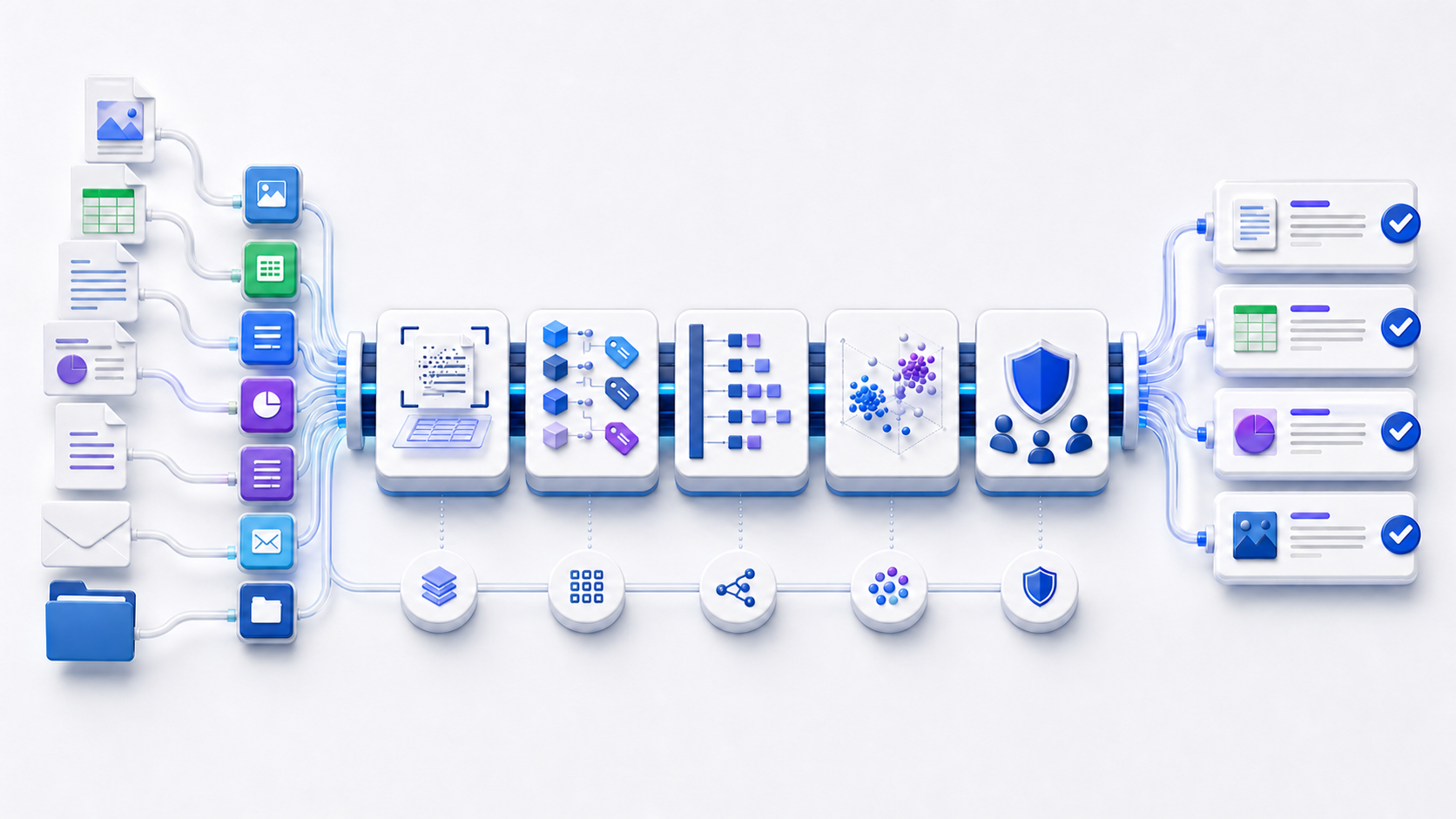
Document indexing software, in one clear answer文档索引软件的快速回答
For the full topic map and the neighboring methods that support this workflow, continue with the unstructured data processing and document intelligence guide.
如需查看完整主题结构以及支撑本流程的相邻方法,请继续阅读非结构化数据处理与文档智能指南。
Document indexing software ingests files, extracts text and metadata, creates searchable structures, enforces access rules, and returns ranked results. A credible system handles format coverage, OCR where needed, metadata normalization, incremental updates, deletion, security trimming, relevance, monitoring, and recovery—not only the first bulk import.
文档索引软件负责采集文件、提取文本与元数据、建立可检索结构、执行访问规则并返回排序结果。可靠系统不仅要完成首次批量导入,还要处理格式覆盖、必要的 OCR、元数据规范化、增量更新、删除、权限裁剪、相关性、监控与恢复。
People search for this category for different jobs: finding local files, adding enterprise search to shared repositories, creating a searchable archive, preparing a RAG knowledge base, or generating a professional back-of-book index. These are not interchangeable. This guide focuses on software that indexes a collection for digital retrieval; editorial book-indexing tools are a separate category.
用户搜索这一类别时,任务可能是查找本地文件、为共享资料库增加企业搜索、建立可检索档案、准备 RAG 知识库,或制作书籍末尾的专业主题索引。这些需求并不等价。本指南聚焦为数字检索建立文档集合索引的软件;出版物人工编制索引属于另一类工具。
The document indexing software pipeline文档索引软件的完整处理链
Treat indexing as a pipeline with evidence at every boundary. The source connector discovers a file and records its stable identity. A parser extracts native text; image-only pages go through approved OCR. Normalization converts dates, names, paths, tags, and content types into consistent fields. The indexer writes terms, fields, and—when justified—vector representations. Query-time controls filter unauthorized records before ranking and presentation.
应把索引视为每个边界都有证据的处理链。源连接器发现文件并记录稳定标识;解析器提取原生文本;纯图像页面进入获批的 OCR 流程;规范化步骤把日期、名称、路径、标签和内容类型转成一致字段;索引器写入词项、字段,并在确有需要时生成向量表示;查询阶段在排序与展示前过滤无权访问的记录。
| Layer层级 | Required output必要输出 | Failure evidence失败证据 |
|---|---|---|
| Discovery and intake发现与采集 | Stable source ID, path, owner, version, timestamps稳定源 ID、路径、所有者、版本与时间戳 | Missing, duplicated, or endlessly reprocessed files文件遗漏、重复或被无限重复处理 |
| Extraction and OCR提取与 OCR | Text, page boundaries, structure, language, extraction status文本、页边界、结构、语言和提取状态 | Blank text, gibberish, scrambled order, skipped attachments空文本、乱码、顺序错乱或附件遗漏 |
| Normalization规范化 | Consistent fields, canonical types, provenance一致字段、规范类型和来源信息 | Filters split equivalent values or merge different ones筛选器拆分同义值或错误合并不同值 |
| Index construction索引构建 | Terms, positions, fields, facets, optional vectors词项、位置、字段、分面和可选向量 | Known documents cannot be retrieved or ranked sensibly已知文档无法召回或排序不合理 |
| Access and serving访问与服务 | Permission-filtered results, snippets, audit records按权限过滤的结果、摘要和审计记录 | Unauthorized hits, stale results, misleading snippets越权结果、陈旧结果或误导性摘要 |
Apache Solr documents indexing as adding structured documents and fields to an index, including content extracted from common file formats. That field model matters: a document is not just one text blob. Title, author, path, department, dates, security labels, and body text often need different analyzers, filters, and ranking weights. See the official Apache Solr indexing and update-handler documentation.
Apache Solr 的官方说明把索引描述为向索引加入结构化文档与字段,并支持从常见文件格式提取内容。字段模型非常重要:文档不是单一文本块。标题、作者、路径、部门、日期、安全标签与正文往往需要不同的分析器、过滤器和排序权重。可参考Apache Solr 索引与更新处理器官方文档。
What to prepare before indexing documents开始建立文档索引前要准备什么
Start with a corpus inventory, not a vendor demo. Record repositories, file counts by type, approximate size, languages, scanned-page proportion, update frequency, ownership, permission source, deletion rules, and the questions users need answered. Separate facts from assumptions. “Most files are PDFs” is an assumption until sampled; “the repository reports 62% PDF by object count” is observed evidence.
先做语料盘点,而不是先看厂商演示。记录资料库、按格式统计的文件数量、近似容量、语言、扫描页比例、更新频率、所有权、权限来源、删除规则,以及用户需要回答的问题。必须区分事实与假设。“大多数文件是 PDF”在抽样前只是推断;“资料库按对象计数显示 PDF 占 62%”才是观察证据。
- Representative corpus: normal files plus difficult scans, tables, multi-column layouts, attachments, unusual encodings, large files, duplicates, and deleted items.
- Permission matrix: users or test roles that should and should not see each protected item.
- Query set: exact names, phrases, metadata filters, broad concepts, misspellings, multilingual questions, and deliberately unanswerable queries.
- Acceptance criteria: measurable coverage, freshness, security, relevance, latency, recovery, and ownership conditions.
- 代表性语料:常规文件,以及困难扫描件、表格、多栏布局、附件、特殊编码、大文件、重复项和已删除项。
- 权限矩阵:针对每个受保护对象,列出应当可见和不应可见的测试用户或角色。
- 查询集:准确名称、短语、元数据筛选、宽泛概念、拼写错误、多语言问题和故意无法回答的问题。
- 验收条件:可量化的覆盖率、时效性、安全、相关性、延迟、恢复与责任人要求。
How to compare document indexing software如何比较文档索引软件
Feature checklists are useful only when tied to your corpus and risk. Score candidates with the same test set, configuration time, and reviewer rules. Do not award a point because a brochure says “AI search”; require observable behavior and an exportable record of how the result was produced.
功能清单只有与实际语料和风险绑定时才有价值。应使用相同测试集、配置时间与复核规则给候选方案评分。不要因为宣传页写着“AI 搜索”就加分;应要求可观察的行为,以及能够导出的结果产生记录。
| Decision area决策维度 | Evidence to request需要的证据 | Warning sign警示信号 |
|---|---|---|
| Format and OCR coverage格式与 OCR 覆盖 | Pass/fail by your file type and page type按你的文件类型和页面类型给出通过/失败结果 | “Supports PDF” without scan, table, attachment, or language detail只称“支持 PDF”,却不说明扫描件、表格、附件或语言 |
| Metadata and schema元数据与模式 | Field mapping, custom types, provenance, reprocessing behavior字段映射、自定义类型、来源与重处理行为 | All content flattened into one field所有内容被压成一个字段 |
| Security trimming权限裁剪 | Negative tests with restricted users, groups, and changed permissions使用受限用户、组和权限变更进行负向测试 | Permissions applied only in the interface, not the retrieval layer权限只在界面层应用,而非检索层 |
| Freshness and lifecycle时效与生命周期 | Create, update, rename, move, revoke, and delete tests创建、更新、重命名、移动、撤权与删除测试 | Only a scheduled full recrawl只能定时全量重爬 |
| Retrieval quality检索质量 | Judged query set, explainable fields, hybrid controls人工判定的查询集、可解释字段与混合检索控制 | A polished answer without source or ranking evidence答案精美却没有来源或排序证据 |
| Operations运维 | Queue visibility, retry rules, dead-letter handling, backup and rebuild队列可见性、重试规则、失败隔离、备份与重建 | Silent skipping or no item-level status静默跳过或没有对象级状态 |
A repeatable document indexing workflow可重复执行的文档索引流程
- Define the retrieval job. Write user questions, protected collections, freshness targets, and unacceptable outcomes before selecting technology.
- Inventory and sample sources. Measure real formats, languages, sizes, versions, permissions, and hard pages. Preserve source identity and provenance.
- Design the index schema. Separate body text from title, author, dates, path, content type, department, sensitivity, and stable source ID. Decide which fields are searchable, filterable, facetable, sortable, or stored.
- Build a small permission-aware pilot. Include expected hits, expected misses, restricted items, updates, renames, and deletions. Do not start with the easiest files only.
- Tune extraction and retrieval separately. A ranking change cannot repair missing text; a better OCR model cannot correct an authorization leak. Diagnose the failing layer first.
- Run acceptance gates. Verify coverage, extraction, permissions, freshness, relevance, snippets, and operational recovery against the prewritten criteria.
- Release with monitoring. Track queue failures, lag, rejected formats, permission-sync errors, zero-result queries, stale hits, and index size. Assign owners and escalation paths.
- Revalidate after change. Parser upgrades, OCR language changes, embedding-model changes, schema edits, and permission migrations may require controlled reindexing and benchmark comparison.
- 定义检索任务。在选技术前写清用户问题、受保护集合、时效目标和不可接受结果。
- 盘点并抽样数据源。测量真实格式、语言、大小、版本、权限和困难页面,保留源标识与来源链。
- 设计索引模式。把正文与标题、作者、日期、路径、内容类型、部门、敏感级别和稳定源 ID 分开,并决定字段是否可搜索、筛选、分面、排序或存储。
- 建立小型权限感知试点。纳入预期命中、预期不命中、受限对象、更新、重命名和删除,不要只用最容易的文件。
- 分别调优提取与检索。排序调整无法补回缺失文本;更好的 OCR 也不能修复越权泄露。先定位失败层。
- 执行验收门禁。按预先写定的标准验证覆盖、提取、权限、时效、相关性、摘要和运维恢复。
- 带监控发布。跟踪队列失败、延迟、不支持格式、权限同步错误、零结果查询、陈旧命中和索引容量,并指定责任人与升级路径。
- 变更后重新验证。解析器升级、OCR 语言变化、嵌入模型更换、模式编辑和权限迁移,都可能需要受控重建索引与基准对比。
Full-text, metadata, and semantic document indexing全文、元数据与语义文档索引怎么选
Full-text indexing maps normalized terms to documents and positions. It is strong for names, exact phrases, identifiers, Boolean logic, proximity, and highlighting. Metadata indexing supports precise filters and facets such as owner, date, department, type, or matter number. Semantic indexing maps passages or documents into representations that may retrieve conceptually similar language even without exact term overlap.
全文索引把规范化词项映射到文档及其位置,适合名称、准确短语、标识符、布尔逻辑、邻近搜索和高亮。元数据索引支持所有者、日期、部门、类型或事项编号等精确筛选与分面。语义索引把段落或文档映射为语义表示,即使没有完全相同的词,也可能召回概念相近内容。
Practical default: keep exact full-text and metadata retrieval as a testable foundation, then add semantic or hybrid ranking for queries that genuinely need conceptual recall. Store the source, version, chunk boundary, and permissions with every derived representation so a result can be traced and removed.
实用默认方案:先以可测试的全文与元数据检索为基础,再为确实需要概念召回的查询增加语义或混合排序。每个派生表示都要保留来源、版本、分块边界和权限,确保结果可追溯、可删除。
Chunking is a retrieval design decision, not a cosmetic preprocessing step. Very large chunks dilute relevance; tiny chunks lose context and may separate a statement from its heading, table header, footnote, or permission boundary. Test section-aware and page-aware chunks on your judged query set. Preserve links back to the authoritative source rather than treating chunks as independent truth.
分块是检索设计决策,不是无关紧要的预处理。块过大会稀释相关性;块过小会丢失上下文,还可能把陈述与标题、表头、脚注或权限边界拆开。应在人工判定查询集上测试章节感知和页面感知的分块,并保留回到权威源文档的链接,而不是把文本块当成独立事实。
Example: indexing a mixed policy library示例:为混合格式政策库建立索引
Consider a hypothetical policy library containing born-digital DOCX files, searchable PDFs, scanned appendices, spreadsheets with control owners, and superseded versions. The goal is to answer “Which current policy defines approval for vendor access?” while preventing contractors from seeing internal-only appendices. No performance numbers are assumed.
假设一个政策库包含原生 DOCX、可搜索 PDF、扫描附件、记录控制责任人的电子表格,以及已被替代的旧版本。目标是回答“哪份当前政策规定了供应商访问审批?”同时阻止承包商看到仅限内部的附件。这里不假设任何性能数字。
A defensible design assigns every source a stable ID and version state, extracts native text before using OCR, maps policy owner and effective date into typed fields, keeps superseded documents searchable only when the user explicitly includes history, and synchronizes source permissions. The test set includes exact policy codes, natural-language questions, a query that should return only the latest version, and negative tests run as a contractor role. When a scanned appendix is missing, the team inspects extraction status—not ranking weights. When an unauthorized result appears, release stops until security trimming is corrected.
可辩护的设计会为每个来源分配稳定 ID 与版本状态,优先提取原生文本,仅在需要时使用 OCR,把政策所有者和生效日期映射为有类型的字段,只有用户明确包含历史记录时才检索旧版本,并同步源权限。测试集包括准确政策编号、自然语言问题、只应返回最新版本的查询,以及以承包商角色执行的负向测试。若扫描附件缺失,应检查提取状态,而不是调整排序权重;若出现越权结果,则必须停止发布,直到权限裁剪修复。
How to verify a document search index如何验证文档搜索索引
Verification needs both system metrics and human judgments. Coverage compares discovered, accepted, rejected, failed, indexed, and deleted objects. Extraction checks representative text against the source. Freshness measures the time from an authorized source change to the corresponding index state. Security tests attempt to retrieve restricted documents. Relevance testing uses queries with expected useful results and records whether the top results help the user complete the task.
验证既需要系统指标,也需要人工判断。覆盖检查比较已发现、已接受、被拒绝、失败、已索引和已删除对象;提取检查把代表性文本与源文件对照;时效性测量获批源变更到索引状态同步的时间;安全测试尝试召回受限文档;相关性测试使用带有预期有效结果的查询,并记录前排结果能否帮助用户完成任务。
- Search exact titles, identifiers, names, dates, and phrases visible in source files.
- Test broad concept queries, ambiguous queries, misspellings, and no-answer cases.
- Inspect snippets for correct source, surrounding context, and safe redaction.
- Create, edit, rename, move, revoke, delete, and restore test items; confirm every transition.
- Run the same protected query as an authorized role and an unauthorized role.
- Rebuild from backup or source-of-truth data in a controlled environment before claiming recoverability.
- 搜索源文件中可见的准确标题、标识符、姓名、日期与短语。
- 测试宽泛概念、歧义查询、拼写错误和无答案场景。
- 检查摘要的来源、上下文和安全脱敏是否正确。
- 创建、编辑、重命名、移动、撤权、删除和恢复测试对象,确认每个状态转换。
- 分别以有权与无权角色执行同一个受保护查询。
- 在受控环境中从备份或权威数据源重建后,才能声称具备恢复能力。
Use indexed documents in a connected analysis workflow在已连接的分析工作流中使用索引文档
Once an approved connector or knowledge-source workflow has made documents available with usable text, metadata, and permissions, teams may need to analyze those documents alongside structured data. InfiniSynapse describes support for querying across connected databases and documents through RAG-based workflows. It is not presented here as a scanner, OCR engine, records-management system, or universal replacement for a dedicated search platform.
当获批的连接器或知识源工作流已经以可用文本、元数据与权限提供文档后,团队可能需要把文档与结构化数据一起分析。InfiniSynapse 的现有说明支持通过基于 RAG 的工作流查询已连接的数据库与文档。本页不会把它描述为扫描器、OCR 引擎、档案管理系统或专用搜索平台的通用替代品。
Before opening the app, confirm the document or knowledge source is approved for processing, text extraction is usable, metadata identifies the authoritative version, and access rules are defined. Then use InfiniSynapse to explore questions across connected document and data sources with source context.
打开应用前,请确认文档或知识源获准处理、文本提取可用、元数据能够标识权威版本,并已定义访问规则。之后可使用 InfiniSynapse 在已连接的文档与数据源之间探索问题并保留来源上下文。
Open the InfiniSynapse web app打开 InfiniSynapse 网页应用For the product’s documented retrieval approach, review RAG data analysis across databases and documents. If the immediate problem is an image-only PDF rather than collection-wide indexing, use the separate searchable PDF OCR and verification guide before adding the file to an index.
如需了解产品已记录的检索方法,请阅读跨数据库与文档的 RAG 数据分析指南。如果当前问题只是纯图像 PDF,而不是整个文档集合的索引,请先使用独立的可搜索 PDF OCR 与验证指南处理文件,再将其加入索引。
Frequently asked questions about document indexing software关于文档索引软件的常见问题
No. That phrase usually means a BPO tagging desk or a DMS someone else builds. This page is how to select and verify document indexing software. The method loop is document indexing. It is not the LlamaIndex glossary for LLM indexes.
不是。该说法通常指外包打标台或别人代建的文档系统。本页是如何选型并验收文档索引软件。方法循环看 document indexing。也不是 LlamaIndex 给大模型建索引的词条。
Document indexing software ingests documents, extracts searchable text and metadata, builds one or more indexes, applies access rules, and returns ranked results so authorized users can find specific information.
文档索引软件采集文档、提取可搜索文本与元数据、构建一种或多种索引、应用访问规则并返回排序结果,使获授权用户能够找到特定信息。
It needs OCR only for image-only or scanned pages. Born-digital documents normally provide extractable text, although both extraction and OCR still require validation.
只有纯图像或扫描页面需要 OCR。原生数字文档通常可以直接提取文本,但无论直接提取还是 OCR,结果都仍需验证。
Full-text indexing maps terms to documents and supports exact words, phrases, filters, and field-aware ranking. Semantic indexing represents meaning for conceptually similar retrieval. Many systems combine both.
全文索引把词项映射到文档,支持准确词语、短语、筛选与字段感知排序;语义索引表示含义,用于召回概念相近内容。许多系统会组合两者。
Use a representative, permission-aware test corpus and measure ingestion coverage, extraction accuracy, freshness, permission correctness, retrieval relevance, operational recovery, and total ownership effort.
使用具有代表性且包含权限差异的测试语料,衡量采集覆盖、提取准确性、时效性、权限正确性、检索相关性、运维恢复与总体拥有工作量。
No blanket replacement is claimed. InfiniSynapse can analyze across connected databases and document or knowledge sources; retention, records management, OCR, legal holds, and document lifecycle controls may still require dedicated systems.
不能作出通用替代结论。InfiniSynapse 可以跨已连接的数据库、文档或知识源分析;保留、档案管理、OCR、法律保全与文档生命周期控制仍可能需要专用系统。
Authoritative sources and further reading权威来源与延伸阅读
- Apache Solr: indexing with update handlers—official field and document indexing mechanics.
- Elasticsearch: documents and indices—official explanation of JSON documents, fields, and indices.
- Microsoft Support: search indexing in Windows—first-party desktop indexing scope and modes.
- Apache Solr:使用更新处理器建立索引——字段与文档索引机制的官方说明。
- Elasticsearch:文档与索引——JSON 文档、字段和索引的官方解释。
- Microsoft 支持:Windows 中的搜索索引——桌面索引范围与模式的第一方说明。